
Updated; originally posted July 2009.
Americans are notorious for their ignorance of global issues and international news. This may be because Americans aren’t interested or it may be that our news outlets feed us fluff and focus us only on the U.S. Probably it’s a vicious cycle.
This month, for example, Time magazine’s cover story is about the political strife in Egypt… everywhere except the U.S. that is. Americans get “pop psychology” (via Global Sociology):
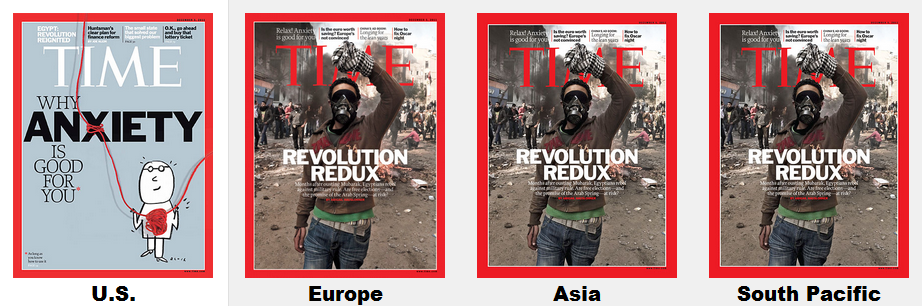
It turns out you can go to the Time website and compare covers from previous issues going back a long ways. Here are some more examples from the last couple years (I cherry picked just a bit):
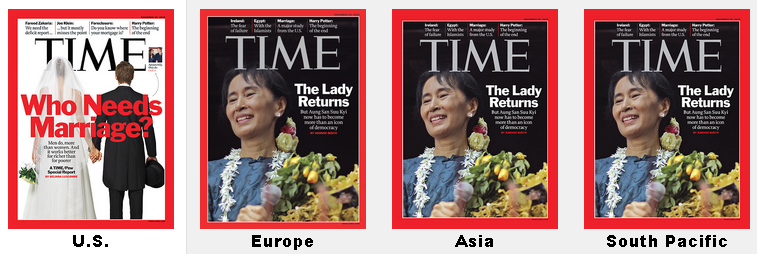
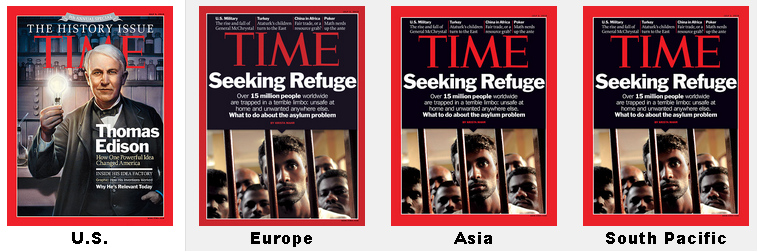


Dmitriy T.M. sent in these previous examples a while back.
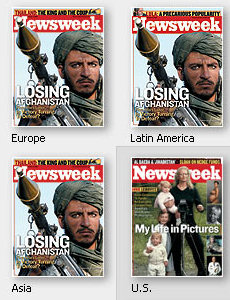
The cover story for Newsweek magazine’s September 2006 edition was “Losing Afghanistan” in Europe, Latin America, and Asia. It was “My Life in Pictures,” a story about the photographer Annie Liebovitz in the U.S. (via):
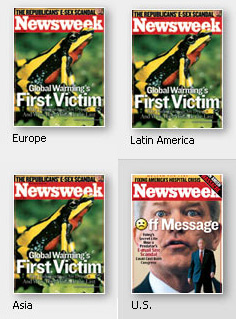
The cover story for Newsweek magazine’s October 2006 edition was “Global Warming’s First Victim” in Europe, Latin America, and Asia. It was “Off Message,” a story about Republican Congressman Mark Foley’s sexually suggestive emails and IMs to teenage boys (via):
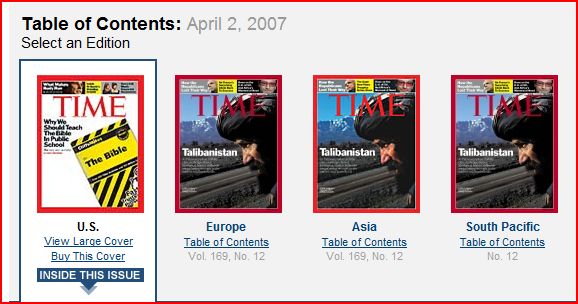
The cover story for Time magazine’s April 2007 edition was “Talibanistan” in Europe, Latin America, and Asia. It was “Why We Should Teach the Bible in Public Schools” in the U.S. (via, also see Time):
As SocProf writes:
Lisa Wade, PhD is an Associate Professor at Tulane University. She is the author of American Hookup, a book about college sexual culture; a textbook about gender; and a forthcoming introductory text: Terrible Magnificent Sociology. You can follow her on Twitter and Instagram.Talk about self-fulfilling prophecy: Americans are assumed to not be interested in international and global affairs… ergo, Time decides to replace a perfectly legitimate and newsworthy cover on a significant event in Egypt with some pop psychology item. As a result, Americans are less informed and knowledgeable on global affairs because they do not get intelligent coverage on that topic.
Comments 152
Duran — July 26, 2009
I agree with you that the choices
if those lead articles are surprising an unortunate. However we can't blame Americans' ignorance on the media, because it's just selling people hat they want to read. Also, with the advent of the information economy, lack of availability of other viewpoints is not an excuse.
George — July 26, 2009
Newsweek is just one example of this. Another good one is CNN vs. CNN international. One of the funny things about that is a lot of people in Europe think that CNN international is the same CNN we see here.
On the other hand, other countries have news programs that are almost exclusively devoted to their own domestic news. They just have an additional international news option that was harder to find in America before the internet.
Jennifer — July 26, 2009
The only one I don't agree about is the second example, the global warming vs. Mark Foley. The Foley scandal was a big deal in the US at the time, whereas the global warming piece was probably more of a feature story, the kind of thing that could be released the following week or somewhere down the road. No one outside of the US, however, would be interested in the Foley scandal.
Lance — July 26, 2009
Jennifer got there before I did: I was going to remark that unlike the other two, the Mark Foley cover isn't a fluff piece; it's just America-centric and thus sensible to put on the American edition.
Of course, when it comes to Time Magazine, y'all could probably have a field day with this list of their ten most absurd covers (really, a list of their most absurd cover stories, though the covers are so lurid that they almost stand alone).
Adam — July 26, 2009
I can confirm that the UK can also be bad for this. In the BBC's televised news at least, it's common to hear in segments on international disasters, the reporter murmuring some facts about 'local impact'-this and 'residents killed'-that, and then with great emphasis 'INCLUDING PERHAPS AS MANY AS FIVE BRITISH VICTIMS' - which always makes me feel a little ashamed.
Chris — July 26, 2009
Frankly, I'd make the same case as Jennifer and Lance for the last article--admittedly because the movements advocating the teaching of the Christian Bible in American public schools is an area of academic interest for me. Why would it make sense for Time to put that cover story about teaching the Bible in public schools in Europe or Asia, since conversations about the intersection between church and state would take very different forms there?
An alternate way to frame this issue would be as a discussion of globalizing market forces: should we consider it an unambiguous good to have U.S.-based media conglomerates presenting the same cover stories for news markets around the world? If anything, these examples strike me as having potentially too much homogenization, not too little.
(Or perhaps the "ha ha, stupid Americans" idea just seems like particularly low-hanging fruit to me.)
Lance — July 26, 2009
I think, Chris, that part of the problem may be not that Time's US cover was a bad story, but rather that the Taliban in Afghanistan might be more pressing an issue than the Bible in public schools. Then again, the mistake may be in thinking of Time as a news magazine; "Why We Should Teach the Bible in Public Schools" isn't news, it's at best analysis, and at worst a cynical way to sell magazines.
Annoyed — July 26, 2009
Newsweek is famous for this:
http://www.annainthemiddleeast.com/photos/maps_media/2259/
Whether or not we don't get the news easily because as Duran says they are just selling us what we want, or because we are only getting fluff doesn't really matter. It's a huge problem. Most people don't have the time to search the "information economy" all day to find out what is really going on. We have jobs. And because the news was not always a consumer product, people still tend to trust it, and think it is not completely biased.
Umlud — July 26, 2009
... if you say that Foley and Bible teaching are stories with more local interest in the US, then why didn't the other regional issues have stories of more local issues to their regions? Were there no regional stories going on elsewhere that wouldn't be so interesting to the US readers? Somehow, I think there might have been... Therefore, this isn't necessarily so much about there being an interesting story only in the US, but rather that TIME provided two different faces: a US-point-of-view face to the world, and a national face to US readers.
Israel_B — July 27, 2009
Garbage blog post. You missed the basic factor that news is a product and you have to market it to your target audience. All these covers are prime examples of selling down the US in times and places when it was popular to do so. As for "Americans are notorious for their ignorance of global issues and international news." allow me to remind you of the classic Wiki style editorial "Citation Needed".
Elena — July 27, 2009
@Israel_B: If content was tailored to local interests of the target audiences, then we'd have different cover editions for each WHOLE CONTINENT outside the USA instead of the same cookie-cutter magazine, wouldn't we?
Benjamin Stürmer — July 27, 2009
I think this article tries to make an important point, but the images used are badly misleading. Newsweek publishes only a single English-language international edition, so the pictures of Newsweek covers captioned "Europe," "Latin America" and "Asia" are in fact just three pictures of the same magazine. Why not show the covers of the Japanese or Korean editions of the magazine instead of just labeling the international version "Asia?"
Time Magazine does have multiple international versions, but the company's Wikipedia article indicates that both the European and Latin American editions are produced in London, which makes me suspect that they are also the same, or at least very similar.
Again, I think the point made by the article is valid, though the fact that you're going back to magazines published in 2006 and 2007 seems like either laziness or cherry picking. I live in Germany at the moment and am consistently amazed by the difference in the quality of the news between the two countries. Of course, it's worth pointing out that commerically generated German news is sensationalized infotainment just like in America. It's just that the two most widely watched news broadcasts (Die Tagesschau/Tagesthemen on ARD and Heute Journal on ZDF) are on Germany's phenomenal public television.
Okay, that got a bit rambly at the end. To sum up: post good, pictures bad, American news bad, German news good.
Hugh — July 27, 2009
Couldn't you also take this as evidence that Newsweek and Time are less concerned with the international market, that they're responsive enough to the US readership enough to publish more local issues, while the global markets are left with the big universal stories which require less individualisation, and probably a lot less research?
I'd think that they target them at such large regions points towards this too - Europe is certainly diverse enough that there are not often going to be "local" stories which are of interest to the whole continent.
Nia — July 27, 2009
Related question: I know that the US education system has a very decentralised system and that not all kids learn the same things everywhere, but, it is compulsory or at least normal to study world geography at some point? What age?
Reader — July 27, 2009
I agree that this wasn't the most persuasive post, although I think the intended point is valid.
One nitpick: Time and Newsweek are weeklies, so why are you identifying them by the month, instead of the week in which they appeared?
Annoyed — July 27, 2009
Look how easily some people accept the ideology that news is a consumer product.
Jennifer — July 27, 2009
Nia,
In my state, most students learn world geography around age 13, during their first year at high school.
Alyssa — July 27, 2009
@Nia: Each state has their own standards for what students learn and when, but they are based on National Standards (can be seen here: http://www.education-world.com/standards/national/soc_sci/geography/k_12.shtml ). World Geography is actually supposed to be taught at all grade levels, but I image you are talking about specifically identifying different countries on a map. In California that is typically done in middle school.
Tatiana von Tauber — July 31, 2009
Great piece, Lisa. I don't always agree with the opinions on this site but I'm always introduced to different views - which is why I come here.
I'm often boggled at the stupidity of media and this is such a fine example of some of the things I've personally discussed and witnessed. After living abroad in Germany for 7 years and now ending up back in America, I'm glad to see I'm not the only one who catches the major differences between the American and International mind.
One main issue is that I think Americans forget there's a whole world out there across the oceans - not necessarily one with whom we're engaged in war with. I've often been cornered with questions and comments about American ignorance and arrogance - and "fat people" (which really irks me). It was always rather embarassing, specifically being an American abroad.
The human interest, religious and sex scandal stories may be what Americans want to read, as some replies here suggest but why stop there? There doesn't seem to be as much interest for information but rather sales and ratings for media outlets. For a powerful nation, the international outlook of it isn't that much to be proud of. Sadly, of course. I'd like to give Americans more credit but I'm continually disappointed. Perhaps time will change that.
Keep up the good work here!
gsgdfgd — August 3, 2009
If you think Latin Americans are more knowledgeable about international issues than North Americans you're sadly mistaken, they just care about fútbol and nothing else.
maalikkhan — August 5, 2009
wanna repair your credit report?
is your credit score is low?
you cant get a good job or low interest loan?
We have the solution take a step and visit our website http://www.safedataxchange.com/sdx_click.php?pgid=233&aff=15
let our Credit Mentor worry about all these issue.
Amy — August 6, 2009
Interesting. I know the stereotype is that Americans are dumb and ignorant, but it's not like the rest of the world has brilliant news all the time just because a couple of American newsmagazines sometimes change their covers for the foreign market. I have to say that living in Australia has really made me miss American newspapers. Compare the New York Times or Wall Street Journal with the Sydney Morning Herald (supposedly the most respectable paper out of Sydney). It's as if the best paper in NY was the Post.
This magazine-cover thing does seem a bit weak. Probably they did the US covers first and then changed them to something else because they knew those particular things would not be relevant to a foreign audience. It's also possible that the audience for Newsweek abroad is a different demographic than the people who are likely to buy it in the US.
Kira — August 21, 2009
I think the non-American versions look far more interesting :(
Phil E. Drifter — December 5, 2009
IT'S BECAUSE THE US GOVERNMENT DOESN'T WANT IT'S CITIZENS TO KNOW WHAT'S GOING ON AROUND THE WORLD. THEY WANT THEIR CITIZENS STUPID SO THEY'RE MORE EASILY CONTROLLABLE.
Anonymous — November 26, 2011
Oh how little has changed since then http://bit.ly/tnu8Or
Anonymous — December 2, 2011
But the articles are still *in* the magazine (at least in the case of the recent Egypt story) so if you subscribe, or pick it up, you'll still get the same content as the other cover editions.
I think this is more the case of what publishers think will sell on news stands. Do they think we're more/less attracted to the international story or other news? What is their reputation for news/writing like in the US as opposed to these other regions?
Anonymous — December 2, 2011
As this doesn't seem to be a selaction made to be statistically representative, is i possible to notice a similar trend in Europe? After all, we do have something in common by way of privilege and obsession with ourselves. Also, if the marriage story was about equality, that would probably be the one good alternative.
Anonymous — December 2, 2011
On the other hand, the Nov. 14 issue put a "serious" topic (socioeconomic mobility) on the cover of the US issue while putting a pop psychology piece (on favoritism among siblings) on the non-US editions: http://www.time.com/time/magazine/0,9263,7601111114,00.html
And on Oct. 31, the US issue featured a story on the Chinese economy, while the non-US editions were about the comic book Tintin: http://www.time.com/time/magazine/0,9263,7601111031,00.html
Larrycharleswilson — December 2, 2011
My, oh my, what a surprise? Americans more interested in their navels than what's going on in other countries! Say it's not so.
Daniel — December 3, 2011
North-Americans can boast having the cleanest brains of mankind. Not talking puritanism here, I mean they have their brain washed daily with powerful stuff!"
Legolewdite — December 3, 2011
To me this is all a matter of the media misunderstanding itself. Many look to the ways a magazine might purport to represent a culture, but they ignore the manner in which the media (re)produces that culture at the same time.
Culture's similar to a song, in that whether you like it or not, you'll find yourself humming along to that crappy pop-tune if you hear it enough.
More plainly put, these editors are trying to discern what the public wants and then market to it. Meanwhile, they are determining what the public actually does consume by limiting the choices available.
In the examples we see here in this blog, the differences are telling. It seems to strongly suggest a lack of respect on the part of the editors for their American audience. The same can no doubt be said for blockbuster film-makers, authors, musicians, and even educators and cirriculums. The problem as I see it then is to what extent do people live up to societal expectations? Because we have certainly lowered the bar for ourselves, haven't we?
Dubikan — December 3, 2011
Or, it's the other way round - these are AMERICAN publications, so they put on the cover stuff that interests Americans. On the global editions, however, they can't put something that interests Americans, so they put something of general interest - something that would be relevant to somebody in Thailand no less that somebody in Peru: international news. Shabang.
To prove this false, you'll have to show that what you show here is not the same for, say, British magazines with international editions, or French ones. Know any?
Destinee Evers — December 3, 2011
Embarrassed as a result of reading this
Blix — December 3, 2011
Are these just the covers, or are the articles eliminated altogether from the U.S. versions? Either way the articles for the U.S. seem biased while the others are simply informative. I don't understand.
Lauren — December 3, 2011
This year, Time covers were identical across regions 32 times. The US only got different ones 16 times: 9 times, the covers were different but the contents were (largely) the same. 3 times, the covers were different because the rest of the world was doing a fluffy cover that the US got earlier (which often meant that the rest of the world was Fluffy while the US was Serious). Which means there were only 4 weeks when the rest of the world got a serious cover story that was not present at all in the US version. Twice, it was because the US was doing a Special Money Issue or something. And once was because the US got an Occupy Wall Street cover instead of Afghanistan. Which leaves Aug. 8 as the only time the world got a serious cover that was totally absent from the US’s fluffy version.So, basically, most of the time Time is the same. Sometimes they market the US version to be fluffier. On occasion, they market the foreign version to be fluffier (e.g., that TinTin cover). But almost always, the inside is the same across regions, which means Americans are just as “informed” by Time as the rest of the world.In conclusion, this is a ridiculous thing for people to make a big deal out of.
Anonymous — December 3, 2011
Interesting, but the assumptions that Americans are any less educated about global affairs than anyone else is ridiculous. I have been to Europe. I cannot speak for Asians or anyone else, but Europeans seem to be aware of "global affairs" about as far as they are aware of the affairs of their direct neighbors, and that other countries in Europe exist. Europeans don't know anything more about North American culture than Americans know about European culture (and in some cases, I think Americans actually have picked up slightly more). The Scandinavia and the World comic has a running joke that while America can't tell the difference between Scandinavian countries, Europeans don't even realize South America is a thing. I'll wager that yeah, the average German knows more about France than the average American. I'll also promise you, the average German knows barely more about Mexico than "it is indeed a location." The idea of "global affairs," like many topics, is very Eurocentric. And the covering of these topics hasn't made Europeans any less phobic of Middle Easterners and any topics related to Islam.
Also, we're spared yet another repetitive discussion of how China is moving up in the world (I sure hadn't heard that one over the last 2 decades!), global warming, and how violent Middle Easterners are. Oh NOES! The only non-US cover that isn't a boring repeat story on something everyone in the whole world has known for a generation, or an intentionally unpleasant picture of people of color is the second one. The rest are images that bombard Americans daily from all kinds of different newspapers and magazines. Do Americans really NEED to be reminded that brown people in turbans are scary and that China has money now? Because I'd be hard pressed to find an American over the age of 5 who hasn't realize that there's violence in the Middle East, China has money, and global warming is a thing.
Baiskeli — December 4, 2011
When overseas, I used to watch CNN International. When I came to the U.S, I was shocked at how crappy U.S CNN was.
I feel like the U.S news market infantilizes U.S consumers, assuming that they are not smart enough to parse complex subjects.
As an example, compare a U.S news based interview with a BBC or an Al-Jhazeera interview. The latter two ask tough questions, the former engage in weak puffery and softball questions.
Every so often a U.S politician goes on BBC and gets their asses handed to them because they are used to being coddled by U.S media (PBS/NPR tries, but every time they do so, they get drowned out by accusations of 'liberal bias')
Melanie E L Bush — December 4, 2011
Wonderfully useful visual.
Why not say US vs international?
Annette Jackson — December 4, 2011
Perhaps they did their research and know what sells to Americans. I happened to purchase the last edition on Anxiety. I'm almost ashamed to say that if the cover story would have been on the political strife in Egypt, I would not have purchased it. Sorry to disappoint....
cheryl — December 4, 2011
It's not merely that the american version is "limited" in scope to american culture, but the american version repeatedly consists of only dumbed-down trivia. It's total fluff. And considering the version given to everybody else is the same, and is more relevant to EVERYBODY living in a global economy, it seems odd for the publishers to make the assumption that american readers would prefer to remain ignorant.
I think this says more about the publishers than it does the readers.
Anonymous — December 4, 2011
We are dumb down. We are easier to manage that way.
@Lion_Chew_Toy — December 4, 2011
I absolutely had no idea the level of big media corporate (government???) censorship here. I also wonder whether the content inside the magazines are much different as well. When I saw this, as an American Citizen, my visceral reaction was that I was sickened to my core, almost to the point of literally vomiting!!! What has happened to my country? It is my perception since I was a boy, that the United States was an example and a beacon of freedom and hop for the rest of the world. Now, I'm not so certain. To the rest of the world... we American citizens are good people, good at heart, even if our leaders, the banks and corporations are not. SHAME! :(
Lucas Green.screen — December 5, 2011
One note, though it may be of limited relevance:
Scrolling through the cover-art gallery chronologically, you'll see that at least SOME of the *different* international covers DO appear on the american edition, but offset by one edition either forwards or backwards. Perhaps at least some of this discrepancy in American vs. International covers has something to do with publishing/editorial deadlines?
Sotojb — December 5, 2011
Well it can easily be argued that yes Americans are supposedly less informed, but lets compare the statistics here. Americans rely on a school system which is not necessarily the most brilliant and as a result causes this lapse in global knowledge and feeds into the fact that we are more interested in pop culture due to this lack of education. If you think about it as well the U.S. only has two bordering countries of which we are actually well aware of the issues pertaining to us. Now comparing this with European relations you have developed a globalized view based upon centuries of boarder control, warfare and politics. Your globalized view of this whole issue is a result of your respective country's close proximity to multiple other countries and sharing boarders with many. If you want this quantified for you think about this, the U.S. is one nation in which many states identify with belonging to the U.S. and a united currency of the Dollar, Europe however is a group of multiple countries which HAVE to rely on global politics, Europe had to generalize its currency because of the boarders it must enforce. Europeans have to be more globalized not because they're more intelligent but rather the fact you guys are somewhat of a political battleground and your populations must be involved because it does affect them. In the U.S. our politics are only concerned with who is our next president and such, while yours' are concerns with how does another country's elected officials affect out own political agenda as a nation. In a more simplified way I guess, I'm trying to say we don't have to care because we as a population don't have to worry about other nations and how they will affect our political agenda. It kinda comes with being a Super Power but what can you do. If you want to continue to argue I can say this those who do follow politics vote and as you can tell not all of us vote. We may not be a informed as many others and that is somewhat our fault but do not fail to look at the whole picture, we aren't Europe and we aren't like any other country in terms of geography (minimal boarder relations), political relations (we run the security force, we don't worry about much) and our creation into one of the biggest most powerful countries in the world. Oh and a final thing, there used to be a saying, "if America sneezes, the world catches a cold." Don't forget we do have our hands in almost everything even though we may be in a down economy; its like comparing the U.S. to a celebrity, why would you want to watch about everything you do when you can just watch other things on tv, but we do like to look in the mirror and be self centered cause even though this will make me sound bad, we do have an ego, that we have in a way earned by being a dominant political structure and our powerful military which you all forget Europe relies on for most military power in the U.N.
Wanderingi — December 7, 2011
That is why I stopped all subscriptions, and cancelled my cable service. At least, I can look for opinions from different sides of a situation, online. And, I have been watching Al Jazeera, RT, oh and John Stewart, for my news...
Bob Aho — December 10, 2011
I didn't read all the comments, so mea culpa if it has been said before, but...
Who is reading Time, Newsweek, et al, in regions beyond America? Do the authors believe the local populace is subscribing to these publications? I hypothesize that the overwhelming majority of or readers for these magazines are not the foreign nationals, but rather the expatriate and traveling population (i.e., Americans). Why would a German read Time when he/she could pick up Der Spiegel?
The hypothesis is flawed, the methodology is tenuous, and the conclusion absurd. Over analysis of the data coupled with confirmation bias, SocProf needs to redesign the experiment.
Kevin Kane — December 10, 2011
Europeans know much more about American affairs than we know about European affairs for multiple reasons. Mainly because they have to. The US still drives the world economy (at least for now).
I agree with the author that Americans are relatively ignorant both due to lack of interest and lack of exposure in the media. Remember, media bias is not usually HOW things get reported, rather WHAT is reported.
gpctman — December 12, 2011
I am a Canadian who has been travelling to the US for the winter months for the last 10 years and this issue has been so obvious to me and it seems to be getting worse. Some of my American friends have astounded me at times with their (no other word for it), ignorance of issues outside their country. I've always believed it to be the fault of the media.
I actually had one of them ask me if there are area codes in Canada.
It's sad because I have met some wonderful people in America that I am proud to call friends. Never the less some of the things they say and ask cause me to shake my head.
Archangel America — December 17, 2011
No, it isn't that Americans are more interested in these dumbed down and sanitized topics. If you examine the magazines contents they are nearly identical, the cover changes are merely highlighting one story while the international versions highlight another. Americans in general feel far removed from what the rest of the world feels is happeneing next door. This isn't a matter of failed interest, but rather the benefit of having an ocean on either side of us to insulate us from all the violence and despair... over there.
Archangel America — December 17, 2011
The average Grman knows more about France than the average American... Does this come as a surprize to anyone familiar with world geography? #1 - German and France share a common border. #2 - Germans and French routinely spend weekends in the others' country. #3 - The total land mass of both countries combined is roughly half of our largest state.
I could use the same poor argument the article posits to demonstrate how ignorant the rest of the world is of the US since they know less about Virginians than Carolinians.
I suppose this type of "article" passes as heady researched and orignal thought in the Pseudo-science of sociology.
Sarah Jessica — December 28, 2011
If they think this is what sells in US news stands, they have an interesting perception of their market.
My friend told me a nice place w W w.richsingleclub.C//o//m. He said it’s a place where successful men and women reside in the
hopes of finding love.
Joe — January 24, 2012
Americans are spoon fed information with regards to international issues. I have traveled extensively and served in the US Marines. Not only are we fed but also misled by the information distorted by the government in conjunction with the national news media to control views and create fear.
Radioactivexkid — February 6, 2012
dont blame americans blame the people behind the scenes. we dont blame third world countries for being the way they are, we blame their shitty corrupted selfish leaders. we dont blame the poor for being poor, we blame the king for eating all the bread.
fuck people that think we WANT to ignore. because we dont. at least i speak for myself, and the occupy movements growing in the US that are trying to overthrow the corruption in major corporations and congress/government.
GoBlue79 — February 26, 2012
Americans being ignorant
about international news has more to say about widespread apathy and
self-induced ignorance than it does about the media. There are tons of
places to get international news on the internet. However, I also know a
lot of Americans who are pretty well
informed about foreign current events. Moreover, as someone who has
traveled fairly extensively outside the U.S., I can tell you that
Americans are NOT the only people in the world ignorant of global
events.
Sdewitt — February 27, 2012
So interesting. I'm sure we're very unaware of this. Why do these publications seem to prolong our ignorance? MAKE us aware. Are they afraid of losing subscribers?
L.e.g.10 — March 31, 2012
The writer misses a great opportunity here. Ok so Americans don't know and don't care about the rest of the world, but some of us do and because we suffer from this "americentric" problem, can't find or don't know about truly international publications where we can get more exposure. So instead of just pointing things out, tell us where we should be looking. And as for all the waste of time arguments in the posts below, maybe instead of wasting time and space whining and word vomiting, you could have been constructive and pointed others in the right direction.
Donna Bray — June 26, 2012
Why is it that you can post this on Twitter, however, Facebook has opted only to add a "like" button to it?? Does this fact speak to anyone else??
Sigrid — June 27, 2012
That just shows our intelegence!!!!No wonder we have the government we have. I always knew we were not getting News, were getting trash!!! Heaven help us if we start thinking!!!
Rmcgrewracing — November 18, 2012
So their cover uses a gimmick to sale more copies in the US. this is no big surprise. Standard procedure around the worlds. Strip away the cover and the contents of the rag-a-zine is the same. Thanks for wasting a few minutes of my life on a non-story.
Ross Aldridge — November 29, 2012
Perhaps it's more an explanation of why people in the US are reading TIME and Newsweek less.
MKRAW25 — August 27, 2013
I have watched more cable news lately than I
have in a while, and noticed there was little-to-no "news" being
reported. My suspicions were confirmed when I heard that a scantily
clad 20 year old (whose name doesn't deserve repeating for all
the free press she's already gotten courtesy of...everyone) performed
next to some bears on MTV, and that this needed in depth analyzing by
everyone on TV, the internet, and in cafes. Apparently nothing else
happened in the world...anywhere.
According to these Time and
Newsweek covers nothing happens in the world...except stories about pop
psychology and feel good human interest stories. At least nothing happens in the world according to America. God this is revolting.
Mike P — May 2, 2015
These conspiracy theories are ridiculous. The fact that the author "cherry picked" shows that the issues are isolated and not consistent. In fact, there are covers from both magazines in direct opposite of the claims made in this article. So time, has provided "fluff" to the world just as it has provided "fluff" editions of its magazines to the us. Even then over 80% of the time all magazines contained the same content, disproving this theory. On a personal note, I think it makes sense that a culture is more interested in its own culture. And I'm no professional sociologist, but it sure seems that most cultures, if not all, are this way. To make an assumption that our culture as a whole is less concerned with other cultures than other cultures seems to be a pointless observation in my opinion. What benefits does our culture get in knowing more about another cutlure outside of just knowing?