Archive: Jul 2023

Over the course of the past year, M&M’s have been plastered all over the news, social media, and even Super Bowl commercials. In January 2022, Mars Wrigley gave the brown M&M shorter heels and replaced the green M&M’s boots with sneakers in a push toward more inclusive marketing. 

What resulted was outrage. Tucker Carlson became the face of the backlash, stating, “M&M’s will not be satisfied until every last cartoon character is deeply unappealing and totally androgynous.” Carlson was not the only one speaking out. In a Rolling Stone article titled, “Let the Green M&M Be a Nasty Little Slut,” senior writer EJ Dickson argues, “The green M&M has spent decades building her brand as a horny, sexy bitch, and for what? For her creators to give her Larry David footwear in the name of feminism?”

By September, the purple M&M had made her debut. Carlson soon reignited the war, leading to Mars’ temporary suspension of their spokescandies. On FOX News, he remarked, “The green M&M got her boots back, but apparently is now a lesbian maybe? And now there’s a plus-sized, obese purple M&M.” While all of these comments are nonsensical, they point to the pressure placed on women to conform to gender norms and accommodate men’s sexual desires.
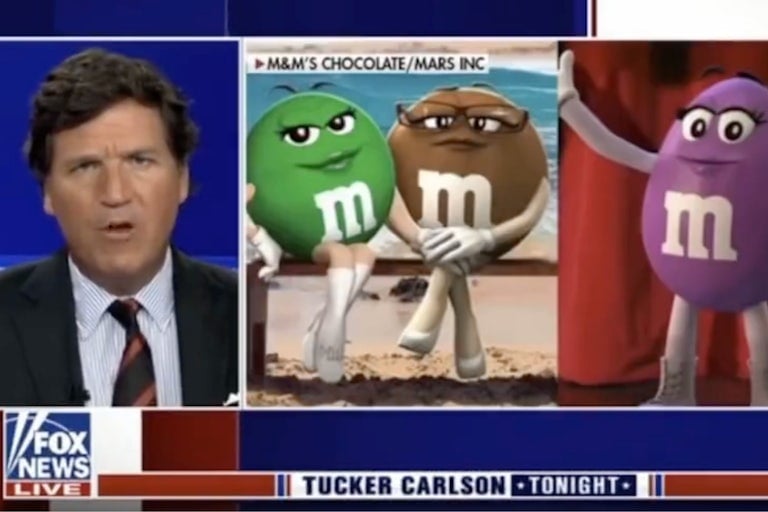
Sexualization of Women in the Media

M&M’s were not the first nor the only gendered commercial food product. In the 1940s, the Chiquita Banana, the world’s first branded fruit, made her debut. The original Miss Chiquita Banana was racialized and sexualized in order to appeal to the American market. Her femininity, specifically, was oversexualized through her flirtatious winking and eye-rolling as well as her frilly dresses and lipstick. 
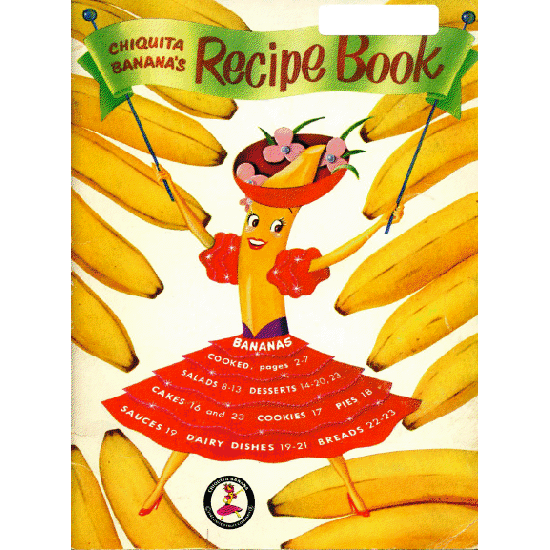
Smithsonian Magazine, Chiquita Banana’s Recipe Book, 1947
Photo courtesy of Christina Ceisel

M&M’s has long employed the same strategy by sexualizing their female spokescandies. Their hypersexualization not only appears in their dress, but the erotic nature of the commercials in which they have been featured. The green M&M has been pictured pole dancing, stripping, and fondling chocolate, among other overt sexual acts. What’s more, the male M&M’s can be seen ogling her in the background, reinforcing the pervasiveness of the male gaze, in which men actively view women as passive ‘objects’ of their sexual desires.

Emphasized Femininity

Emphasized femininity refers to a range of traditional feminine norms that encourage women to accommodate men’s sexual appetites and desire for control. It legitimizes the gender hierarchy and upholds various forms of oppression. 

As women step away from the “stereotypical cultural notions” of emphasized femininity, men must “negotiate the dilemma of incorporating women’s resistance into their masculine identity projects.” Therefore, when the female M&M’s became less conventionally attractive and “sexy,” those that subscribe to the ideals of hegemonic masculinity felt threatened. They became angry that their sexual desires were not being satisfied, even with regard to a candy mascot.

This outrage reveals that women face the prospect of being labeled “socially undesirable” when they possess masculine characteristics.

In Carlson’s words, “When you’re totally turned off, we’ve achieved equity.” In our patriarchal society, when a woman exhibits defiance or authority, men feel threatened unless they can stigmatize and feminize their behavior.

When this happens, a woman is no longer a “good girl,” but a “bitch,” “lesbian,” or “slut.” Evidently, for women to be valued by men, they need to be subservient to the male gaze.

Impact of Hypersexualization

The hypersexualization of women is incredibly harmful to young people. Adolescents’ exposure to a sexualized media environment leads them to recognize women as sex objects. When women and young girls constantly see their bodies objectified, they begin to internalize the idea that the most valuable thing about them is their body. They become acutely aware that they are seen as “sexual playthings waiting to please men’s sexual desires” and begin to feel unworthy if they do not meet society’s standards. It does not go unnoticed when children see that the very candy they eat is sexualized.

When people become outraged when a female M&M’s shoe is changed, what message does that send? Of course, a so-called “culture war” waged against M&M’s is ludicrous, but there is power behind words, and this controversy’s real-world implications must be addressed. The vicious cycle of sexualizing women, mascots or not, for profit must be brought to an end, and prominent figures need to realize that the oppression of others is not a punchline.

Jillian Nord is a sociology student at Hamilton College.
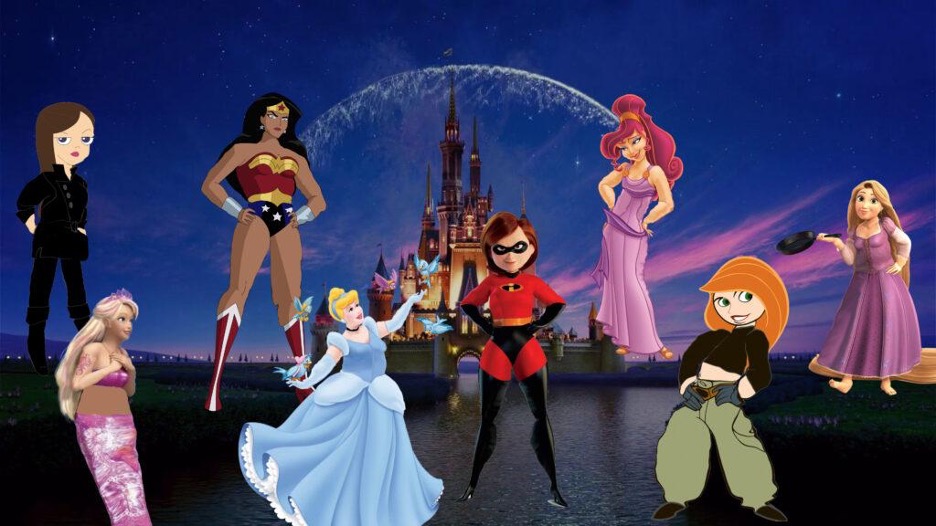
Television distorts, mocks and marginalizes fat people. Fat characters are reduced to caricatures whose stories and identities aren’t developed and don’t matter. In one study by Tzoutzou et al., all 36 compliments about appearance given to women were for thin women. Not one positive message was included for a woman of an average or overweight body type. For men, the same pattern was found: only one overweight character received a positive message. 

Collage by Victoria Lieberman

These TV shows tell the audience that external beauty only resides in thinness and excludes anyone who deviates from this definition of beauty. Viewers can internalize this thin ideal, which in turn can make it difficult for the audience to feel good about themselves, especially if their body doesn’t fit this body standard. Seeing the treatment of fat people on TV can affect how viewers think about their own bodies, especially if their body type doesn’t fit the thin ideal.

Bigger Bodies, Smaller Roles

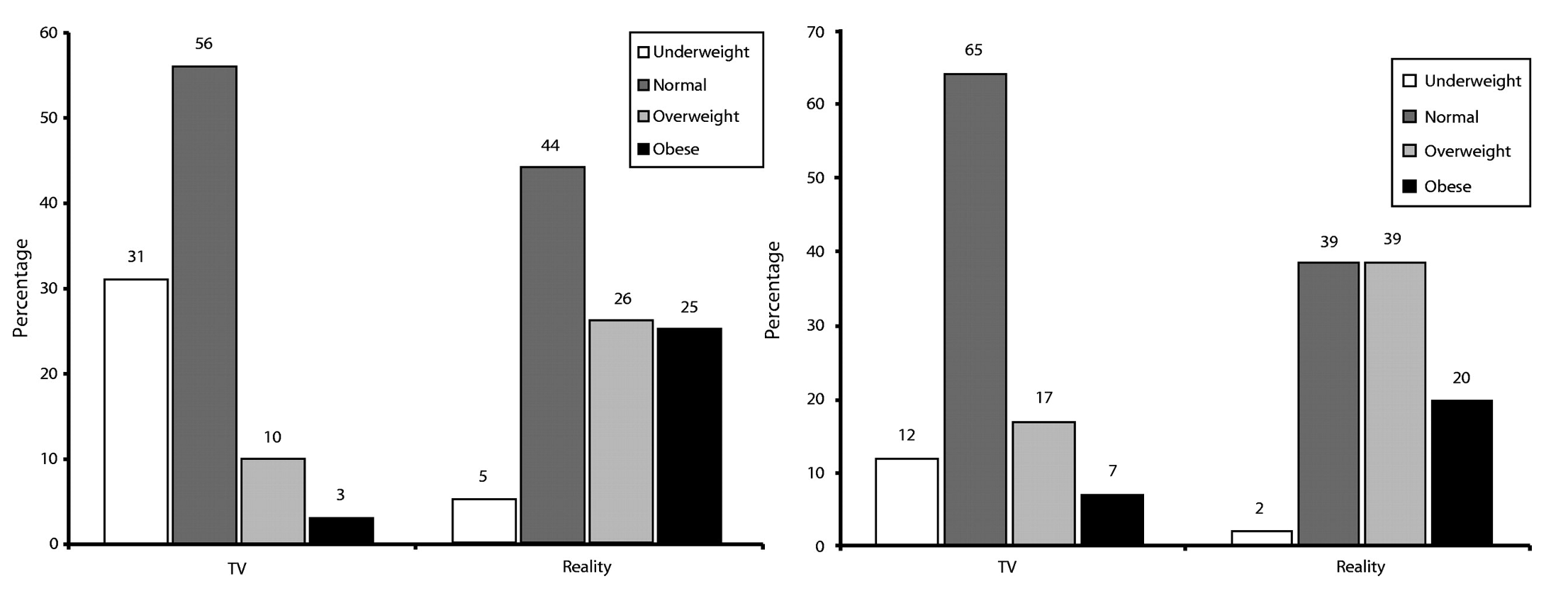
Not only is the representation of fat people overwhelmingly negative, but fat bodies are underrepresented on TV shows.

Comparison of female body types: television vs reality 1999-2000 (left)
Comparison of male body types: television vs reality 1999-2000 (right)
(Brownell et al. 2003)

This pattern of dehumanizing fat people continues when they don’t get the chance to develop their characters. They are often represented as a comedy sidekick or as villains.

In comedy, we often don’t laugh with fat women, but at them. Overweight women are about twice as likely to be the reason for a joke than thinner women. They also have smaller roles, less romantic relationships, and are in “fewer positive interactions than thin characters”.

Media often represents fat characters as villains as well. One study by Himes and Thompson “found that obesity was equated with negative traits (evil, unattractive, unfriendly, cruel) in 64% of the most popular children’s videos”. Examples of this can be seen in famous children’s movies with characters such as Ursula from The Little Mermaid or The Queen of Heartsfrom Alice In Wonderland. These villains help to draw the connecting line between fat and negative qualities Fat characters become less human than other characters who have full stories built around them. Makers of TV don’t just ignore fatness, they demonize it.

Effects on the Audience

The negative portrayal of fat people in TV shows can lead audiences to internalize negative portrayals of being overweight. This internalization can happen quickly: a study by Fouts and Burggraf found that only 30 minutes of watching TV can affect how a young woman views her body which can result in various external struggles. 

In the study by Tzoutzou et al., girls agreed that the media influenced their desire to be thin and fit the beauty standard. This can cause frequent dieting because many eating problems are due to unrealistic body standards, an image that mass media often transmits.

Not only can these misrepresentations of fat people lead to low self-esteem, but it can lead viewers to believe that they will be treated in the sexist ways that they see on TV if they don’t fit the body norm to avoid this.

All of these aspects have the potential to make a female viewer feel worse about themselves through their appearance and perceived reactions from other people rooted in fictional and distorted depictions on TV.

TV Should be Fun for Everyone

TV is a space that is meant to be enjoyed. But viewers can’t sit back and relax with TV if they feel like their body is being judged by the shows that they put on. All bodies should feel like they have a space within TV shows. All bodies deserve to be seen by a wide audience.

Tori Lieberman is a rising Sophomore at Hamilton college planning on studying Creative Writing and Sociology. You can find examples of her journalism here.

Picture this. Walking down 135th street in Harlem, you spot a park in the distance. As you walk closer, you hear a basketball bouncing and kids yelling. It’s a small, outdoor court, well-maintained with fresh paint and a sturdy chain-link fence surrounding it. The ball is constantly in motion, being passed, dribbled, and shot from all angles. As the game progresses, the excitement draws in more kids around the court. 

New York City is synonymous with basketball. From Harlem to Brooklyn, basketball has been a part of the city’s culture for decades. But why has basketball become such a staple of African American culture in cities? The answer is complex, but the roots of its popularity among minority groups stem from discriminatory practices like redlining and segregation.

A White Man’s Sport

Basketball was originally invented as a white man’s game

  – Micheal Novack, The Joy of Sports (1946)

Basketball was founded in 1891 by Dr. James Naismith, a Canadian physical education instructor seeking a way to keep his students active. By the early 1900s, it was being played in colleges and high schools across the nation. Colleges like Harvard, Yale, Cornell and Princeton began to play games against each other as early as 1901. The first professional basketball league, the National Basketball League (NBL), was founded in 1937. It was later merged with the Basketball Association of America (BAA) to form the National Basketball Association (NBA) in 1949. 

The 1950 Minneapolis Lakers basketball team, Wikimedia Commons

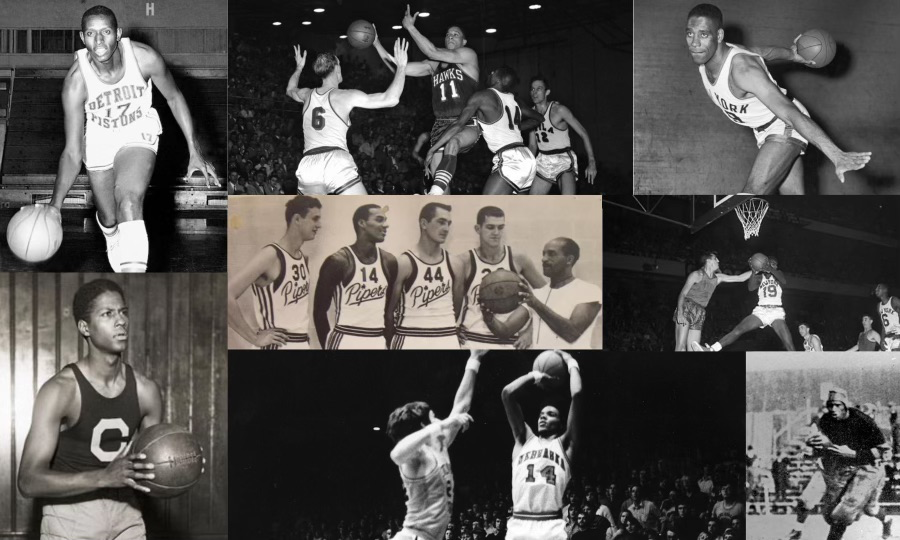
For the first 30 years, the majority of participants at the collegiate and professional level were white, as black participants were barred from playing. The first black collegiate player, George Gregory Jr, did not appear until 1928. In the 1949-1950 season Chuck Cooper, Nathaniel Clifton, and Earl Lloyd became the first black players to play professional basketball, breaking the color barrier. Basketball at this time was played mostly at community centers like YMCAs, where white owners refused membership to black people. If black people wanted to play basketball, they would need to build their own. 

NYC’s History Of Racial, Economic, and Athletic Segregation

Redlining and other forms of economic discrimination depressed resources in minority neighborhoods. Redlining is an exclusionary practice that began in 1934 with the implementation of the National Housing Act (NHA). The NHA created government programs such as the Federal Housing Association (FHA) and the HomeOwner Loan Corporation (HOLC) with the intent to improve the housing market. It intended to promote homeownership by providing mortgage insurance to lenders, which would make it easier for people to obtain loans to buy homes. While the FHA improved housing conditions for White people, this support largely excluded black people.

The HOLC wrote dozens of reports to banks which categorized areas with large populations of black residents as “risky” for investors, driving down their property values and scaring off many potential investors. The FHA then used these maps to guide its lending policies, which meant refusing federally insured housing loans for minorities. In addition to this, as more black people began moving to white neighborhoods in northern cities in efforts to escape Jim Crow segregation, white people began to create suburbs outside the city to escape the influx of black people. As more white homeowners fled to the suburbs, the remaining ones agreed to sell their homes at deeper discounts, fearful of falling prices. 

Economic inequality caused by redlining practices also created disparities in the types of sports played by the kids in poorer neighborhoods. Redlined neighborhoods have less green space and have smaller parks on average. According to an analysis by the Trust for Public Land, the average park size is 6.4 acres in poor neighborhoods, compared with 14 acres in wealthy neighborhoods in New York City. 

In addition to available parks, minority children gravitated toward basketball because of the cost of entry barriers that other sports carried. In order to play baseball at a high level, you need money to pay for equipment and travel teams. Basketball did not carry this prerequisite. David C Ogden, a professor at the University of Nebraska who studied race and sport dynamics, wrote that the most common reasons for the lack of racial diversity were the paucity of baseball facilities in Black neighborhoods, and the cost of playing select baseball. As a result:

“More than two-thirds of the 27 coaches said that African-American youth prefer to spend their time on the basketball court rather than on the diamond”

Ogden (2003)

Rise of Black YMCAs

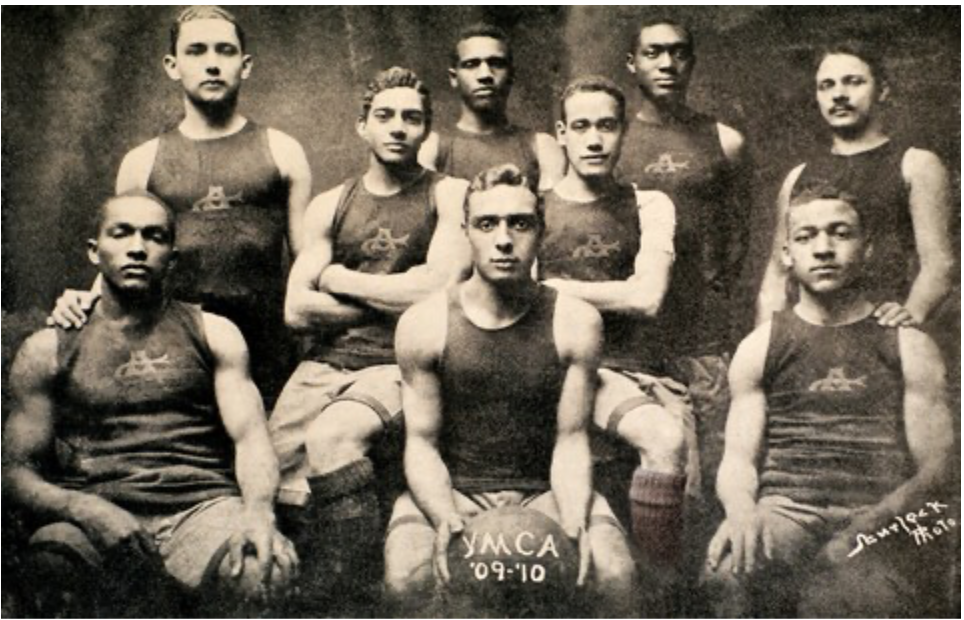
Basketball’s popularity among minority communities flourished because of the development of black YMCA’s. The Smart Set Athletic Club of Brooklyn would be the first fully independent Black basketball team in America in 1907. As more and more YMCA’s appeared in major cities, basketball spread in similar fashion. 

In the last game of the season, the 12th Streeters beat the Smart Set in Brooklyn 20:17 in front of more than 2,000 spectators and in this way directly dethroned the reigning champion.” (Domke 2011)

Edwin Bancroft Henderson, an educator working in Washington D.C., introduced the game of basketball to the Black community. Henderson learned the game during summer sessions at Harvard University, and then introduced the game to young Black men in the Wash. D.C. area. Soon the game would be played across the east coast of the United States, mainly in New York, Philadelphia and Baltimore.  

Basketball also became a means for economic upward mobility. The Harlem Globetrotters formed in 1926 and became the most renowned basketball team for black basketball players. For black basketball players, the globetrotters provided the best and only way to make a living while playing basketball. 

Basketball Today

Now, basketball is an important part of NYC culture, regardless of race. Black participation in basketball has soared in the decades after segregation, and has especially soared in NYC. Every summer, minority communities gather for basketball tournaments held in NYC parks, some that even draw national attention. Nike sponsored “NY vs NY” and Slam magazine’s Summer Classic feature the top ranked high school players and have thousands of fans watching every summer. They both have been held in Dyckman park in Manhattan for the past 5 years.

 Significant changes have occurred  in professional demographics as well. In contrast to 1950, 75 % of the NBA is black, with a bunch of black athletes playing abroad in leagues all over the world. Segregation and redlining stifled black participation in basketball in its early history, but the economic conditions it fostered helped basketball become an enduring staple of the community for generations.

Sharif Nelson ‘26 is a student at Hamilton College studying economics. 

Additional Resources:

Aaronson, D., Faber, J., Hartley, D., Mazumder, B., & Sharkey, P. (2020). The Long-Run Effects of the 1930s HOLC “Redlining” Maps on Place-Based Measures of Economic Opportunity and Socioeconomic Success. The Effects of the 1930s HOLC “Redlining” Mapshttps://doi.org/10.21033/wp-2020-33 

Bowen, F. (2023, April 7). In its early years, NBA blocked black players. The Washington Post. Retrieved April 24, 2023, from https://www.washingtonpost.com/lifestyle/kidspost/in-nbas-early-years-black-players-werent-welcome/2017/02/15/664aa92e-f1fc-11e6-b9c9-e83fce42fb61_story.html

Centopani, P. (2020, February 24). The makings of basketball mecca: Why it will always be New York. FanSided. Retrieved May 1, 2023, from https://fansided.com/2020/02/24/makings-basketball-mecca-will-always-new-york/ 

Domke, M. (2011). Into the vertical: Basketball, urbanization, and African American … Into the Vertical: Basketball, Urbanization, and African American Culture in Early- Twentieth-Century America. Retrieved March 31, 2023, from http://www.aspeers.com/sites/default/files/pdf/domke.pdf

Gay, C. (2022, January 13). The black fives: A history of the era that led to the NBA’s racial integration. Sporting News Canada. Retrieved April 24, 2023, from https://www.sportingnews.com/ca/nba/news/the-black-fives-a-history-of-the-era-that-led-to-the-nbas-racial-integration/8fennuvt00hl1odmregcrbbtj 

Gorey, J. (2022, July 25). How “White flight” segregated American cities and Suburbs. Apartment Therapy. Retrieved April 30, 2023, from https://www.apartmenttherapy.com/white-flight-2-36805862 

Hunt, M. (2022, October 11). What is the National Housing Act? Bankrate. Retrieved April 25, 2023, from https://www.bankrate.com/real-estate/the-national-housing-act/#:~:text=What%20is%20the%20National%20Housing%20Act%20(NHA)%3F,Loan%20Insurance%20Corporation%20(FSLIC).

Hu, W., & Schweber, N. (2020, July 15). New York City has 2,300 parks. but poor neighborhoods lose out. The New York Times. Retrieved April 21, 2023, from https://www.nytimes.com/2020/07/15/nyregion/nyc-parks-access-governors-island.html

Ivy league regular season champions, by Year. Coaches Database. (2023, March 5). Retrieved April 24, 2023, from https://www.coachesdatabase.com/ivy-league-regular-season-champions/

McIntosh, K., Moss, E., Nunn, R., & Shambaugh, J. (2022, March 9). Examining the black-white wealth gap. Brookings. Retrieved April 25, 2023, from https://www.brookings.edu/blog/up-front/2020/02/27/examining-the-black-white-wealth-gap/

Ogden, D. C. ., & Hilt, M. L. . (2003). Collective Identity and Basketball: An Explanation for the Decreasing Number of African Americans on America’s Baseball Diamond. Retrieved March 31, 2023, from https://www.nrpa.org/globalassets/journals/jlr/2003/volume-35/jlr-volume-35-number-2-pp-213-227.pdf

Ortigas, R., Okorom-Achuonyne, B., & Jackson, S. (n.d.). What exactly is redlining? Inequality in NYC. Retrieved March 30, 2023, from https://rayortigas.github.io/cs171-inequality-in-nyc/

Pearson, S. (2022). Basketball origins, growth and history of the game. History of The Game Of Basketball Including The NBA and the NCAA. Retrieved April 24, 2023, from https://www.thepeoplehistory.com/basketballhistory.html 

Robertson, N. M. (1995). [Review of Light in the Darkness: African Americans and the YMCA, 1852-1946., by N. Mjagkij]. Contemporary Sociology24(2), 192–193. https://doi.org/10.2307/2076853

Townsley, J., Nowlin, M., & Andres, U. M. (2022, August 18). The lasting impacts of segregation and redlining. SAVI. Retrieved March 30, 2023, from https://www.savi.org/2021/06/24/lasting-impacts-of-segregation/