
Archive: Apr 2016

Flashback Friday.

Americans tend to conflate the law and morality. We believe, that is, that we make things illegal because they’re immoral. While we might admit that there are exceptions, we tend to think that our laws generally reflect what is right and wrong, not a simple or arbitrary effort to control the population in ways that people who influence policy want.

This is why changing laws can sometimes be so hard. If it isn’t just about policy, but ethics, then changing a law means allowing something immoral to be legal.

In some other countries, people don’t think like this. They see law as simple public policy, not ethics, which leads to a different attitude toward enforcement.

In Amsterdam, for example, possession and cultivation of marijuana is a misdemeanor. Despite the city’s famous and deserved reputation for the open use of marijuana and the”coffee shops” that sell it, it’s illegal. The city, though, decided that policing it was more trouble than it was worth, so it has a policy of non-enforcement.

An even more fascinating example is their approach to street level sex work. While prostitution is legal in Amsterdam, “streetwalking” is not. Still, there will always be sex workers who can’t afford to rent a work space. These women, some of the most economically deprived, will be on the streets whether the city likes it or not.

Instead of adding to their problems by throwing them all in jails or constantly fining them, the city built a circular drive just outside of town equipped with semi-private stalls. In other words, the city decided against enforcing the law on “streetwalking” and instead spent tax money to build a location in which individuals could engage in behavior that was against the law… and they considered it a win-win.

I thought of this when Julieta R. sent in this picture, shot by her friend at the Aberdeen Pub in Edinburgh, Scotland. Sex in the bathroom, it appears, had begun to inconvenience customers. But, instead of trying to eradicate the behavior, the Pub just said: “Ok, fine, but just keep it to cubicle no. 4.”

Americans would never go for this. Because we think it’s immoral to break the law, not just illegal, we would consider this to be hypocrisy. It doesn’t matter if enforcing the law is impractical (marijuana), if doing so does more harm than good (sex work), or if it’d be easier and cheaper not to do it (cubicle no. 4), in America we believe that the person breaking the law is bad and letting them get away with it is letting a bad person go unpunished.

If we had a practical orientation toward the law, though, instead of a moral one, we might be quicker to change laws, be more willing to weigh the benefits of enforcement with its costs, be able to consider whether enforcement is ethical, feel more comfortable with just letting people break the law, and even helping them do so, if we decided that it was the “right” thing to do.

This post originally appeared in 2010.

Lisa Wade, PhD is an Associate Professor at Tulane University. She is the author of American Hookup, a book about college sexual culture; a textbook about gender; and a forthcoming introductory text: Terrible Magnificent Sociology. You can follow her on Twitter and Instagram.
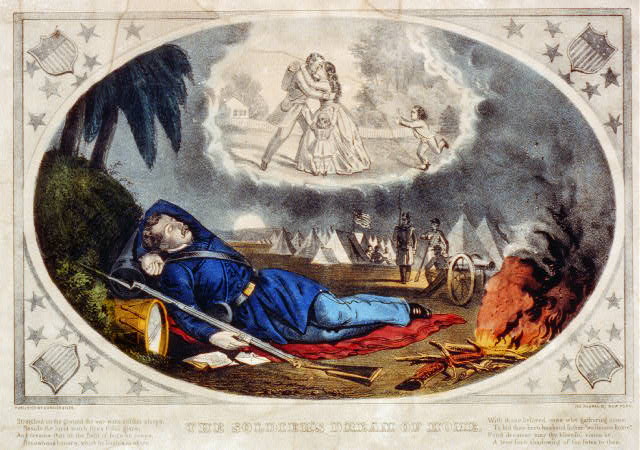
“The poor fellow died of Nostalgia,” said a war surgeon in 1861. “Deaths from this cause are very frequent in the army.”

During the Civil War, physicians believed that acute homesickness was a genuine disease and a sometimes fatal one. Symptoms included heart palpitations, fever, lesions, lack of appetite, incontinence and bowel irregularities and, ultimately, dementia. A veteran of the war described homesickness as a “vampyre-like,” sucking the life out of soldiers.

“The soldier’s dream of home” (Library of Congress):4

Writing for the New York Times, historian Susan Matt writes that “between 1861 and 1866, 5,537 Union soldiers suffered homesickness acutely enough to come to a doctor’s attention, and 74 died of it.” Some believed that homesickness was the single most deadly threat to soldiers, above and beyond the war itself.

Physicians debated how best to avert nostalgia. Some said not enough letters from home caused it; others said too many could do so. Some units prohibited music that reminded men of home or sang its praises. They wondered whether young men — barely more than boys — were most susceptible. Or whether it was grown men, like the man in the image above — accustomed to the comforts of domestic life — who would miss home the most. If homesickness was untreatable, soldiers would be granted a furlough as a last resort and a few were honorably discharged, simply unable to function away from home.

Susan Matt, who has written a book about the history of homesickness, points out that Americans don’t think of themselves as homebodies anymore. They’ve re-cast themselves as natural adventurers who seek novelty and new experiences. When Europeans arrived on the East Coast, they didn’t sit there, they went West! Today, people get the “travel bug.” We are now a nation of tourists.

And when people do express homesickness, Matt observes, writing for the Council on Contemporary Families, we see it as a different kind of pathology: weakness or immaturity. When young adults don’t want to leave home, we call it “failure to launch,” “boomerang kids,” or “the Peter Pan syndrome.” Colleges now shoo away “helicopter parents” and have “parting ceremonies” symbolizing a “cutting of the cord” between parent and child.

But the word “homesick” reminds us that it wasn’t always that way, nor was it always so easy to dismiss feelings of nostalgia and isolation. The notion that we should be ruggedly independent and eager to set out on our own is only about 90 years old. So, the homebodies out there who first heard the word “staycation” and said YES! are holding up a true American tradition.

Lisa Wade, PhD is an Associate Professor at Tulane University. She is the author of American Hookup, a book about college sexual culture; a textbook about gender; and a forthcoming introductory text: Terrible Magnificent Sociology. You can follow her on Twitter and Instagram.

Last week PBS hosted a powerful essay by law professor Ekow Yankah. He points to how the new opioid addiction crisis is being talked about very differently than addiction crises of the past. Today, he points out, addiction is being described and increasingly treated as a health crisis with a human toll. “Our nation has linked arms,” he says, “to save souls.”

Even just a decade ago, though, addicts weren’t victims, they were criminals.

What’s changed? Well, race. “Back then, when addiction was a black problem,” Yankah says about 30 years ago, “there was no wave of national compassion.” Instead, we were introduced to suffering “crack babies” and their inhuman, incorrigible mothers. We were told that crack and crime went hand-in-hand because the people involved were simply bad. We were told to fear addicts, not care for them. It was a “war on drugs” that was fought against the people who had succumbed to them.

Yankah is clear that this a welcome change. But, he says, for African Americans, who would have welcomed such compassion for the drugs that devastated their neighborhoods and families, it is bittersweet.

Lisa Wade, PhD is an Associate Professor at Tulane University. She is the author of American Hookup, a book about college sexual culture; a textbook about gender; and a forthcoming introductory text: Terrible Magnificent Sociology. You can follow her on Twitter and Instagram.

Earlier this year Brandy Zadrozny interviewed me for a Daily Beast story about the new CDC guidelines for alcohol consumption by women. It caused an outcry because it advised all women who could potentially become pregnant to completely abstain from alcohol as a way to prevent fetal alcohol spectrum disorders.

Responses across the blogosphere included several objections, including the fact that research shows that alcohol alone is not sufficient to cause fetal harm (enter poverty as a major confounding factor) and paternal drinking prior to conception is believed to contribute to incidence of these disorders, too, despite no advice to men of fertile age to refrain from any alcoholic consumption.

Interesting points, but an argument made by Renée Ann Cramer in Pregnant with the Stars gave what I thought was some interesting historical perspective.

Until feminists fought to make it otherwise, she explains, it was perfectly legal in America to refuse to allow women access to certain jobs because they might get pregnant. If the working conditions were too challenging or involved exposure to dangerous chemicals, women were considered unfit for the work by virtue of their always-potentially-pregnant status. And if they did this work and harm did come to a child, it was considered a failure of the state to adequately protect her.

Feminists fought to make this “protectionism” illegal, demanding that women themselves have the right to decide, alongside men, if they wanted to take occupational risks. And they largely won this fight.

In turn, though, women themselves came under scrutiny. They were no longer excluded from certain jobs, but if they chose to do them, it was reasonable to judge them harshly for doing so. Cramer calls this the “responsibilization” of pregnancy. Now that women had the right to handle their pregnancy (or pre-pregnancy) however they wished, they (and not the state) would be held responsible for doing so in ways that society approved or disapproved.

This is what the CDC guidelines are doing. It’s not legal to “protect” women from harming her not-yet-existing fetus by refusing to serve her alcohol. Women have the same rights as men. But with rights comes responsibilization and if women don’t make the choices endorsed by their communities, the health industry, and even the federal government, they can expect to be surveilled, judged, and possibly bullied into doing so.

Cross-posted at Pacific Standard.

Lisa Wade, PhD is an Associate Professor at Tulane University. She is the author of American Hookup, a book about college sexual culture; a textbook about gender; and a forthcoming introductory text: Terrible Magnificent Sociology. You can follow her on Twitter and Instagram.

On NPR last week, the headline was “Has Bernie Sanders Moved Hillary Clinton to the Left?” The story centered on Sanders’ more radical leftist politics and the many ways in which Clinton’s stated policies have changed to look more like his.

The implication was that Sanders was forcing Clinton to move to the left. But what if it’s also giving her the opportunity to move to the left?

As the frontrunner, and a woman who is being watched carefully for any sign that she is ill-suited for the presidency, Clinton’s best strategy is probably to play it safe. That is, all thing being equal, she should stay well within the contemporary well-worn middle of the Democratic party.

But Sanders is throwing off the “all things being equal” by vociferously and often convincingly arguing that she isn’t left enough. He is, in other words, serving as a “radical flank” of the Democratic party. A radical flank is the segment of a social movement that stakes out the most extreme position.

Famously, the activities and ideology of the radical flank of the Civil Rights Movement (e.g., the Black Panther Party) resulted in increased social and economic support for its more moderate representatives (e.g., the NAACP). One reason is because, through contrast with the radical flank, the demands of Civil Rights leaders like Martin Luther King, Jr. started to seem downright moderate.

Something similar could be going on here. Sanders’ more radical rhetoric and policy may be making Clinton’s previously centrist-seeming positions suddenly seem quite conservative. This might, in fact, be pulling her to the left, “moving” her by necessity, but it might also be giving her the opportunity to do so. It’s possibly that she’s a more progressive candidate than her pre-Sanders policy statements reflected, as she was strategically aiming for the middle. But, now that Sanders’ has shifted the goal posts, she is free to take more radical positions without looking like a radical at all.

Lisa Wade, PhD is an Associate Professor at Tulane University. She is the author of American Hookup, a book about college sexual culture; a textbook about gender; and a forthcoming introductory text: Terrible Magnificent Sociology. You can follow her on Twitter and Instagram.