
Archive: Fri Jan 2011

A student of mine, Tim C., wrote a nice analysis of two Dolce and Gabbana ads, one which has been widely castigated as a glamorization of gang rape, and one that I’d not yet seen.  The familiar ad, below, features four mostly dressed men standing/crouching over a restrained woman:

The second ad is very similar thematically, but instead of a group of mostly-dressed men standing/crouching over a mostly-naked woman, it’s a group of mostly-dressed men standing/crouching over a naked man (though with no restraint).

What does Tim make of this?

One can make the argument that Dolce & Gabanna, through these two ads, are not promoting male dominance over females.  Instead, they are promoting the dominance of the men who wear these brand name clothes, but through means of controversial ideas that society takes for granted.  They want people to see the superficial idea that if you wear these clothes, you will feel powerful and in control (just like these men in the ads).  This works because the social construct of our society has accepted this idea of male dominance [over women and inferior men].

What do you think?

Lisa Wade, PhD is an Associate Professor at Tulane University. She is the author of American Hookup, a book about college sexual culture; a textbook about gender; and a forthcoming introductory text: Terrible Magnificent Sociology. You can follow her on Twitter and Instagram.
On the heels of our post on food desertsFamily Inequality‘s Philip Cohen posted about “care vacuums.”  In this case the research is referring to the shrinking number of nursing homes in the U.S., leaving people farther and farther away from the nearest nursing home.

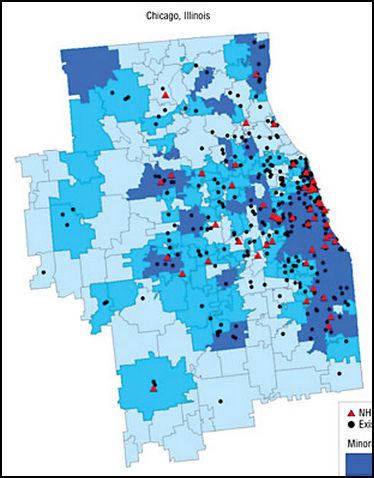
Zhanlian Feng and colleagues found that between 1999 and 2008 we lost about 5% of all nursing home beds and these losses were disproportionately in neighborhoods populated by Blacks and Latinos. The maps below overlays the racial composition of neighborhoods (darker = higher percent minority) with open nursing homes (in black) and nursing home closures (in red). Both seem to be disproportionately in minority neighborhoods, but Feng et al. showed that the closures are even more so.

Here’s Chicago as an example:


Just as food deserts make it more difficult for people without access to personal, reliable transportation to get fresh, affordable food, care vacuums make it more difficult for those same people — disproportionately Black and Latino, and disproportionately poor — to visit loved ones in nursing homes.  Ironically, this is despite the fact that use of nursing homes by minorities is rising and, among whites, falling.

Lisa Wade, PhD is an Associate Professor at Tulane University. She is the author of American Hookup, a book about college sexual culture; a textbook about gender; and a forthcoming introductory text: Terrible Magnificent Sociology. You can follow her on Twitter and Instagram.