women’s history

As GWP readers know, we’re celebrating Women’s History Month this March. When my 8-year-old daughter came home from school with an assignment to write a biography about a woman from history, with the understanding that it could be a sports figure, a celebrity, a writer, a politician—any woman–I was at first dismayed. But I then grew excited about finding some strategies that can improve this month-long celebration of women’s history. I know we can do better, and I know girls deserve better!

For starters, the open-ended nature of the assignment overwhelmed my daughter. “Mom, how can I choose?” More important—from my perspective at least—how many women has her curriculum introduced as possible subjects for this assignment? The answer: not many. So while the field of choice was wide open in theory, having encountered few “important” women in school she really didn’t have many possibilities to consider.

Equally troubling to me: are a sports figure and a politician the same type of historical figure? Don’t get me wrong, I have nothing against athletes or politicians, but I do think that assignments signal educational values. Given the curriculum’s limited attention to women’s history, should my daughter be in the position to decide which life will define it?

But I’m writing to offer some suggestions for reinventing women’s history month, not to complain about it. In fact, I’ve been thinking a lot about the balance between identifying problems versus creating solutions within feminism ever since I read Courtney Martin’s provocative analysis of a New York Times op-ed here.

So here goes:

Five Things You Can Do to Reinvent Women’s History Month

1. Volunteer to Talk in a School or Girl-Serving Group. Whether or not you have school-aged children, schools and nonprofits would welcome your expertise (and yes, if you are a GWP reader, I mean you). And I do mean welcome—with open arms! Most teachers love classroom guests, and kids love a break in the routine. You don’t have to give an academic talk, just a few highlights about an important woman you admire or about why women’s history matters. You still have time to make a difference this month, and if not, volunteer in April (or May, or September).

2. Share Your Ideas for Assignments with Teachers. Now I’m talking to the parents out there. If I have a casual moment with my daughter’s teacher (at pick up time one day, maybe) I will mention my thoughts about how she could make this assignment stronger (read: “more feminist”). Having a short list of “important” women from which to choose, and talking with the whole class about all of them, for example, would teach the whole class a bit more women’s history.

3. Advocate for Curricular Reform. I know, this is a steep hill to climb, but I’m in this race for the long haul. We can make interventions like the ones I mention above right now, but we really need to find new, inclusive approaches to teaching history (and English, and math, etc.). That can only happen when we have some broader thinking about K-12 curricular reform.

4. Write Feminist Children’s Literature. Again, I’m dreaming big. The list of “women’s history month” books at my public library was bleak. It included books on pioneers, explorers, and aviators. Well, okay. But I can tell you that those topics seem pretty foreign and uninteresting in my daughter’s media-saturated world where she uses “text” as a verb even though she doesn’t have a cell phone. We need some better books, and we need some that make history seem lively, relevant, and fun.

5. Talk with Girls (and Boys) About Women’s History. This is not exactly the same as my first suggestion. When this assignment came up I was struck by the fact that my daughter and I rarely talk about the need to recognize—or even study!—women’s accomplishments. That seems a little crazy to me, especially given that my own background is in women’s studies. Yet it’s easy to go along with the status quo, and my daughter is proud of her success in school. What would it mean to suggest that school is leaving some important things out? Whether or not you have children, I’m sure you encounter school-aged children in your family or among your social network. I think we can all do more to talk about what gets left out, and why it matters.

What would you add to my list? And in case you’re wondering, my daughter wrote about Michelle Obama, definitely my kind of “important” woman who is making history every day.

As I wrap up this liveblogging session from the Brooklyn Museum, a gooey little confession about how the Elizabeth A. Sackler Center for Feminist Art holds a special place in my heart:

This summer, the month before I married, instead of the traditional (cough cough) bachelorette party, friends organized a picnic accompanied by a private tour of Judy Chicago’s Dinner Party, housed at the Center.  What better way to mark the moment, we figured.  And what an amazing opportunity this was to learn about this pivotal piece of feminist art, long buried, and to reconnect with it as members of a new generation.

So it is with extra special love that I wish the Center many happy returns–and TONS of future visitors–on this, its second birthday!

For those of you just joining, here, in chronological order, are 5 posts blogged live from “Women’s Visions for the Nation: What’s It Going to Take?”, a speakout held by the intergenerational feminist thinktank, Unfinished Business, celebrating the 2nd anniversary of the Elizabeth Sackler Center for Feminist Art on this sunny March afternoon.  Quite a gathering of feminists and ideas.  Enjoy.

Liveblogging Women’s Visions for the Nation @ Brooklyn Museum

Elizabeth Sackler Revs It Up

C. Nicole Mason Keynotes

Laura Flanders Emcees

Esther Broner and Ai-jen Poo Take the Stage

Let the Intergenerational Speakout Begin

What Will the Feminist New Deal Look Like?

Closing Thoughts from Esther Broner, Ai-jen Poo, and HipHop Artist Toni Blackman

Liz Abzug Brings It Home

Here we are, at 92Y Tribeca.  From left to right: Courtney Martin, Elizabeth Hines, Gloria Feldt, and me.  Logo on screen done by Marco.  Thanks to everyone for coming out, props to the great staff at the Y, and endless gratitude to my fellow WGLs — of all the different things I do, doing this panel with them is hands down one of my FAVES.
For some recaps, check out:

Courtney’s reflections on our shared blog, WomenGirlsLadies, in which she summarizes a lot of what I’ve been thinking about of late: “There is an opportunity, this economic downturn, for all sorts of gender shake-up. When we’re forced to recognize that old styles of leadership and assumptions about gender roles are no longer valid, we can get even the most reluctant folks to try a more enlightened, equal approach. The media coverage of this phenomenon has been totally unsatisfying (dads who cook! women who work! what a revelation!), but in truth, there is something interesting going on.”

A meaty comment over at WomenGirlsLadies from audience member Sara: “I think the most exciting thing anyone said was that this is a moment the feminist movement can take advantage of the social chaos to effect broad change, but if we’re not looking beyond the division of work at home and our ability to balance family and work life, even just in the context of work we’re limiting ourselves.”

Elisabeth Garber-Paul’s review over at RH Reality Check, Feminism and the New Great Depression: What’s Next?, in which she writes: “However, the depression [sic] makes it a more volatile time for the discussion of gender roles—especially because 4 out of 5 laid-off workers are men, and that translates into a seeming crisis of masculinity. The image of the female breadwinner and the stay-at-home dad is increasingly common, and now that men don’t necessarily identify primarily through their title at work, how we define masculinity will need to change—just as the image of femininity has been changing over the past 40 years.”

BTW, I’m starting to develop a TALK on these themes of men, women, gender, and recession — I’ll be trying it out next week at Framingham State College and in April at Catalyst here in NYC.  More on all that soon….and potentially one day coming to a venue near you….stay tuned!

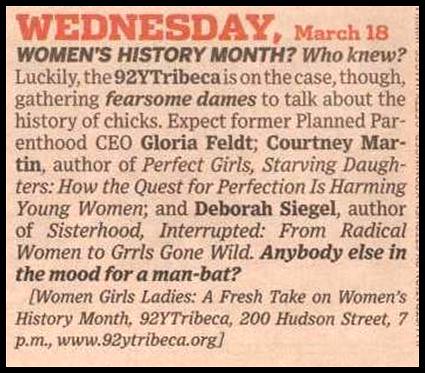
This just in from the New York Observer:

Now, I’m psyched as all get go that The Observer is offering up some free PR for our Women, Girls, & Ladies panel tomorrow at the 92Y Tribeca!  But could someone please tell me, what the [bleep] is a “man-bat”? Is that like a wombat?  Or is it, like, dyslexic batman?  Regardless of what it is, I’ll sure have to go dig deep in the feminist closet to find mine…

(Thanks to fellow WGL Miss Courtney for the humorous heads up.)

As Barack and Michelle (hey, are we all still on a first name basis, now that they are official?) settle into 1600 Pennsylvania Ave, I find myself fascinated by every move they make.  And it’s hard not to make comparisons.  Everyone from Jezebel to the WSJ has compared Michelle O to Jackie O (try here, here, and here) and the fashion mags are all gaga over her style, but it seems to me there are some far more interesting–and more substantive–historical analogies going on.

Check out these excerpts from a March 1933 AP article reported by Lorena Hickock, about Eleanor Roosevelt’s first day as First Lady.  The article is titled “New ‘First Lady’, Made Solemn By Inaugural, Lays Plans To Simplify White House Life; To Cut Expense”:

“The crowds were so tremendous,” Mrs. Roosevelt added softly. “And you felt that they would do anything – if only someone would tell them what to do.

“I felt that particularly, because when Franklin got to that part of his speech in which he said it might become necessary for him to assume powers ordinarily granted to a President in war time, he received his biggest demonstration.”

Mrs. Roosevelt moved over to one of the wide windows and stared thoughtfully out across the White House grounds at the Virginia hills, softly outlined against a grey afternoon sky.

“No one,” she said, “at all close to people in public life today can fail to realize that we are all of us facing extremely critical times.

“No woman entering the White House, if she accepts the fact that it belongs to the people and therefore must be representative of whatever conditions the people are facing, can light-heartedly take up her residence here.

“One has a feeling of going in blindly, because we’re in a tremendous stream, and none of us knows where we’re going to land.

“…Neither Franklin nor I would want to do anything that would detract from the White House dignity, which we both love,” she said. “But I believe things can be made a good deal simpler without that.

“It should be done, I think, to save the time and the strength of a man as busy as a president must be. And now, of all times, there is no occasion for display.

“…My feeling about the White House is that it belongs to the people. Their taxes support it. It is really theirs. And as far as possible they should be made to feel welcome here. They shouldn’t have the feeling that they are shut out.

“I realize, of course, that there are limitations. There are times when one can’t receive visitors. There are times when a family has got to have privacy. After all, we’re living here, you see.

“But the lower floors, away from our living quarters, will be open to the public even more, if I can manage it, than they have been in the past. And I want the visitors to be given every courtesy.”

Interesting, given the way the Obamas opened the White House to public visitors on Day 1.  For a good counter to the Jackie-Michelle comparison, check out this historically-informed little piece in Newsweek, “Why Michelle Obama Is Not the Next Jackie O”.

And on a less serious note, how’s this for bit of useless yet kind of interesting First Lady trivia: Eleanor Roosevelt was the only first lady taller than Michelle Obama (who stands at 5’11).  Eleanor topped her by an inch.

(Thanks to Marco for the heads up.)

Ah, insomnia!  One thing it’s good for is catching up on my online reading.  I’m late to the table on some of these, I know, on this one, but in case you missed any of them too:

Rebecca Traister, The Momification of Michelle Obama, and some interesting counterpoints at Slate’s XX Factor, “Michelle Still Has Feminist Cred” (Emily Bazelton) and “Sarah, Michelle, Hillary” (Melinda Henneberger).   Pundit Mom calls it in Will Michelle Obama Spark the Next ‘Mommy Wars’ Skirmish? Me, I’m with XX Factor on this one.

C. Nicole Mason at Women’s eNews, Michelle Brings the New Everywoman to White House

Erin Aubry Kaplan at Salon, First Lady Got Back

And, as always, the Michelle Obama Watch blog.


A few days ago, Roy Den Hollander, a lawyer who has filed a series of misogynist lawsuits, came out with this gem: he has filed an antifeminist suit against Columbia University for offering women’s studies classes, arguing that Columbia uses federal funding to support a “religionist belief system called feminism.” Now, part of me would like to dismiss this as the silly lawsuit it is, but sometimes such trivial things are important for us to reexamine the larger issues at stake.

As an undergraduate at Columbia, the debate on women’s studies and on adding women writers to such classes as Literature Humanities (the great literary works from Homer to Woolf– one of two female authors in the series) and Contemporary Civilization (the great philosophers– from Plato to, well, Woolf once again, this time the only female writer), reared its head from time to time. In navel-gazing online college forums, such as Columbia’s The Bwog, where commenters are anonymous and misogynist remarks rampant, the debate ran along these lines: someone starts off with a misogynist remark, someone asks why there aren’t men’s studies if there are women’s studies, someone else points out that the past two thousand years were “men’s studies,” someone else ignores this somewhat cogent remark to take the opportunity to make a few jokes about “boobs” and other funny female body parts, and someone else rounds it off by saying that it is all moot as humanities majors are generally wasting their money on unemployable skills.

High-minded stuff, for sure. The point being that even those who try to get past the boob jokes are unable to articulate the purpose of women’s studies beyond a call for balance. Which makes me think maybe the trivial isn’t so trivial. Maybe it’s time to rearticulate some of the values of women’s studies. But more importantly, perhaps it’s also time to make a wholesale change over to Gender Studies, which would undermine the whole of the lawyer’s invidious accusations. Because in the end, with courses not only called “Feminist Texts” but “Gender, Culture, and Human Rights,” and “Sexuality and the Law,” and an institute called the Institute for Research on Women and Gender (IRWAG), that’s what we, and Columbia, are really talking about.

Gender studies is very much the evolution of groundwork laid out by Women’s Studies. While we now recognize that inquiring into women’s role in society is imperative for an understanding of power dynamics and social relationships, we also recognize that it is just as important to understand how definitions of masculinity may shape men’s approach to women, each other, and themselves. Even more so, we see that there is difference within difference: that seeing the world from a gay male perspective overturns traditional notions of maleness. The theory behind women’s and gender studies goes further to a better understanding of class and race. We are no longer shackled with a simplistic grouping of “working class” as a faceless mass of singular experience, recognizing that women’s and men’s roles differ significantly within that group. We recognize that citizenship may also be defined along gendered lines (historically, women give their reproductive systems and males their lives to the state–but how does that definition change now that women are also on the battlefield?)

The intersection of race and class helps us to understand that women are not one “sisterhood” of victimhood throughout history, that women are actors in the past and today–both the perpetrators and the perpetrated–divided along lines of racial, ethnic, economic, sexual differences. Even at the seemingly strict dichotomous line of “body,” we can overturn a male/female divide by recognizing that women have experienced their bodies differently throughout history: those who have reproduced, those who haven’t, those who have undergone forced sterilization, and so on.

Ok, but enough of Gender Studies 101. What’s the practical application? Well, a little thinking about gender might lead you to question a few things. For instance: Single sex public education, Gender testing at the Olympics, The effect of birth control pills on your love life, and to bring us full circle: Diversity in academia.

But maybe I’m jumping the gun of the whole Gender Studies thing. Is there still a place for “Women’s Studies” (single gender) in today’s colleges?

–Kristen

Well, the primary race may be over, but our fascination with Hillary–with the prospect and reality of a Hillary–has really only just begun. I find myself eagerly tracking the post-mortem analysis, hungry to make sense of it all. If you see any particularly interesting analysis out there, please to send it along. Just a sampling of what caught my eye over the weekend:

Clinton’s Real Victory
6/7/08
Washington Post: As someone who trains women across the country to lead across all sectors, it has been easy for me to see, firsthand, the impact of Clinton’s candidacy…

Clinton Bloc Becomes the Prize for Election Day
NY Times: Now that a would-be first female president is ending her quest for the White House, the race is more about women than ever before…

And lastly, this letter of gratitude, from Ilana Goldberg, head of the Women’s Campaign Fund (thank you, Purse Pundit!):

Dear Hillary –

I say this to you almost daily, but since it’s normally to you on the TV screen, I thought I should find a way of saying it where you might actually receive the message: Thank you.

Thank you for what you have done. For your sheer tenacity, strength, and stick-to-itiveness. Thank you for working so hard every day when you must have been exhausted. For showing us what leadership looks like: doing something well, with grace, in good times and bad. Most of all, I thank you for not quitting.

Your many supporters will tell you what your race means to them and history will write what it means to the world, but it also means so much to me and to the little world I live in. I thank you on behalf of the women who have been so special in my life:

For my daughter – who is, as of yet, just an idea in my mind. But I imagine her one day reading the story of this historic campaign. I am so grateful that the story she will read will be of a complete campaign, with the biggest numbers possible – states, votes, and delegates. That story will show that our first woman presidential contender was truly competitive – nearly won competitive – and show a little girl her own vast possibilities in this country. Thank you for giving her a history worth reading.

For my mother – who is one of those women who work tirelessly to support her family, worries over rising healthcare costs and frets that her grandchildren may not have social security. She’s always been passionately interested in politics, but never before found a politician who she felt saw and understood her. She’ll be 65 next year and she wrote the first political check of her life to you. Thank you for validating the day-to-day concerns that she faces.

For my grandmother – who was, as it was noted at her memorial, “a woman ahead of her time.” I think of her every time I see one of your senior women supporters who were born before women first got the vote and were out on the streets filled with hope that they would inaugurate one in their lifetimes. Thank you for showing them that their efforts to make women loud and proud actors in American politics created real change.

For my best friend – who would listen to me talk about just about anything in the world for hours – except politics – until you started to run. Little by little, day by day, she became more engaged in your campaign and what it meant to the country and our place in the world. She started out reading your emails and went on to lobbying her husband and friends to change their votes. Thank you for awakening an incredible woman to her role in the political process.

For my former junior staffer- who did not necessarily believe that sexism was still an issue alive and well today. She watched pundit after pundit behave in ways that even she could not deny were … crude. Then she saw it pass as kind of acceptable. And then she saw it happen again and again. Finally, she took up her pen and now Chris Matthews and the MSNBC brass know her name … well. Thank you for reminding her of how much work we all still have to do.

For me – who has been, at times, described as direct, forward, forceful, pushy and a few other choice adjectives. Thank you for helping make the world a little safer for aggressive, ambitious women. Because isn’t aggressive just one way of saying “she gets things done” and isn’t ambition just another word for “dream?” Thank you for pushing for my dream – and that of so many others – to elect a phenomenally talented and capable woman to lead our country and change our world.

As you promised from the outset, you have, and will continue to, make history.

Thank you, for all us.

Sincerely,
Ilana Goldman
President, Women’s Campaign Forum

I’m a little slow getting back here today, but just wanted to post a heads up on an anthology I just learned about and will be talking about soon. It’s called Feminist Coalitions: Historical Perspectives on Second-Wave Feminism in the United States, edited by Stephanie Gilmore, Asst. Prof of Women’s Studies at Dickinson College. Sara Evans wrote the forward. The book comes out June 2. More soon!

Last week was Jewesses Who Rock (literally) Week on Jewess Blog. Check it out! And speaking of, this week marks the 113th anniversary — (“centennial + bat mitzvah!”) — of the launch issue of The American Jewess, the first English-language publication directed to American Jewish women. Writes Rebecca Honig Friedman with backup from the Jewish Women’s Archive Staff:

Published between April 1895 and August 1899, the magazine covered an evocative range of topics, from demands for synagogue membership for women, to Zionism, to health and fashion tips, to the propriety of women riding bicycles.

The phrase “American Jewess,” in the 1890s, described a new type of Jewish woman — one who could fully embrace the possibilities of both the religious and national aspects of her identity. The American Jewess set out to explore the challenges and possibilities inherent in this new identity, proclaiming that “never before, in the history of Judaism have its women more energetically devoted themselves to reviving the noblest elements of their ancestral faith.” Thanks to the Jewish Women’s Archive—in partnership with Hebrew Union College, Brandeis University Libraries, and the Library of Congress—the archives of The American Jewess are available online — in search-able, browse-able form.

Tres cool.