So here’s a little clip Elizabeth Curtis (a 20something mentee/tor o’ mine) and I did, as part of a larger project, as we like to say, about authors using the blogosphere to spread word about their books. Note: I was having a very bad hair day here. Please don’t hold it against me.
GWP institute
 Inspired by Alex Juhasz (who is currently teaching a course on YouTube about YouTube), I’ve decided to teach my fall webinar “Making It Pop: Translating Your Ideas for Trade” as a bloginar. Meaning, the online part of the class will take place as–you guessed it–a blog.
What better way to learn about using the blogosphere as a platform for your books than by becoming more familiar with a blog, right?
So the class blog–private, of course!–will provide a forum where participants can post elements of their book proposals, or thoughts toward ideas, as we go along. And get feedback. I’ll be walking participants through the mechanics on our first conference call (that would be Nov 6). We’ve got some great NYC-based agents and editors lined up for the calls. And while I’m at it, and for those of you who like to get ahead (you know who you are), the suggested reading for the course will be from: Thinking like Your Editor: How to Write Great Serious Nonfiction and Get It Published. More info–dates, cost, rationale–here.
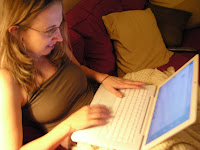
I think Marco took this (goofy) pic of me the day I got my current laptop. Boy, do I love me my MacBook.
 So as promised, I’m occasionally posting readers’ questions (and my answers!) about the intersections of feminist blogging, scholarship, and journalism here.
Q: I’ve been working on an essay I’m thinking about posting, but it’s also one that I want to try and get published once I’ve had a chance to do some more research and polishing. In your experience, does publishing a portion or draft of a piece on a blog make it difficult to get that piece published in a scholarly journal later on?
GWP: I sometimes use blogging as a way to think through ideas I am writing about for publication elsewhere. More often, I’ll do a post around links that I want to return to and mull over for a piece I’m working on. But here’s the thing: When I rework an idea I’ve blogged about for the purposes of publication (ie, the non-blog variety), I will word the idea very differently. My blog voice is much more off-the-cuff and this-just-in sounding than anything I would write for a magazine or journal. Scholarly journals, like magazines, generally want proprietary content. But that doesn’t mean that you can’t do a post around an idea that’s part of an article you are submitting elsewhere. I would argue against posting a large portion (ie more than 500 words) of something you will repurpose verbatim — both because the publication may not favor that and because you don’t want to be plagarized before you’ve published in the journal. But if you do decide to post a portion, I suggest being up front about it when you submit the article to the journal. Does anyone have additional thoughts, or experiences around this issue to share?
 Ever wondered what it’s like to edit an anthology? Come to the Woodhull Writers Well this Thursday and find out! My friend and coeditor Daphne Uviller and I will be discussing both the content of our book Only Child: Writers on the Singular Joys and Solitary Sorrows of Growing Up Solo as well as the process, from proposal to publication, of putting together a successful (IOHO) anthology. We’re hoping to give our audience a clear sense of the challenges and rewards of dealing with agents, contributors, purchasing editors, and publicists; the benefits of working with a co-editor; and the need to self-publicize. Participants will walk away with a timeline detailing the process by which one can reasonably expect to complete a salable anthology — and a sense of what it’s like.
When: Thursday, September 27, 2007
Time: 6:30PM to 7:30PM
Location: 32 Broadway, Suite 1801, New York, NY 10004
This is a FREE event open to women only. Reservation is required. Please call 646 435 0837 or email rsvp@woodhull.org to make your reservation.
The 45th Carnival of Feminists is now up over at Feminist Philosophers. For those of you still wondering what a carnival is, do check this one out. The philosophes have nailed it with a fabulous round-up of links from around the feminist blogosphere.
 I’ve been so fortunate these past months to have learned a ton from fellow feminist bloggers – and in the spirit of “see one, do one, teach one,” I’m eager to share. So my fall webinar, MAKING IT POP: Translating Your Ideas for Trade, will include a session on how authors can use blogging and new media to spread word about their books, online. Details about the 6-week course, including how to register, are posted here. (All you need in order to take it is an Internet connection and a phone — I will walk you through the rest! The first session is Nov. 6, 8-9:15pm ET.)
And on a related note, the Women’s Media Center recently asked me to write a piece on this issue of authors and new media. The piece is now live. I look forward to your thoughts — and to working with some of you to “make it pop”!
Back by popular demand 🙂
MAKING IT POP: Translating Your Ideas for Trade, with Deborah Siegel (er, me)
Tuesdays 11/6, 11/13, 11/20, 11/27, 12/4, 12/11
8:00 – 9:15 pm ET
Format: Online forum + weekly conference call
Fee: $250 ($275 after Oct. 19)
Public debate lacks a sensitive discussion of the complex forces shaping the lives of women and girls. Researchers, nonprofit workers, and savvy writers everywhere have the opportunity to frame public debate about these issues. Too often, however, important work fails to reach an audience outside the academic and advocacy worlds. Writing a trade book is one way to join the debate. To sell a book in today’s competitive publishing climate, one must be able to write engaging, accessible prose that will appeal to a wide audience. These skills can be learned.
Participants will learn from exchanges with New York City-based agents and editors why it’s essential to think about audience and market in a different way, and why you need a book proposal. We’ll explore the differences between popular and academic writing, why a dissertation or a monograph is not a trade book, and how to write an effective book proposal-meaning one that has the best chance of being sold. We’ll also consider the latest aspects of book publicity, focusing in particular on new media. (See what past participants are saying about the course here.)
Space is limited. Please send a note describing your rough idea for a popular book in 1 paragraph to deborahsiege (at) gmail (dot) com, and I will be in touch with further details.
Read more about MAKING IT POP in Women’s eNews:
Women’s Studies Scholars Vie for More Media Turf
My bio is here.

Ok ok, I know it’s a fancypants name for a humble endeavor, but heck, I’m running with it. I mean, if the Tooth-fairy can have an institute….
So GWP Institute is going to be the new label for posts here that offer tips, advice, answers to reader questions, and news about workshops and online courses that I’ll be offering over the next year.
To read older posts, just click on the “GWP Institute” category label on the right side of this blog (scroll down to get there).
Have a question about feminist-y publishing or popularizing academic-y ideas and prose that you’d like to see addressed here? Send ’em my way. I’m deborahsiege (at) gmail (dot) com.
(Does the Toothfairy have a blog?!)
Fire-eating ladies? Contortionists? Huh?!
For those of you as yet unfamiliar with the concept of a blog carnival, do run over and check out the 44th Carnival of Feminists over at Reproductive Rights Blog. It’s one of the places I catch up on greatest hits, all wrapped up in an engaging, organized narrative. I’m all for aggregation.
For the newbies: The Carnival of Feminists is held (usually) on the first and third Wednesday of each month. Hosted by a different blogger for each edition, it aims to “showcase the finest feminist posts from around the blogsphere.” Explains the illustrious Natalie Bennett, a British blogger who blogs at Philobiblon and runs the Carnival of Feminists:
The Carnival aims to build the profile of feminist blogging, to direct extra traffic to all participating bloggers, but particularly newer bloggers, and to build networks among feminist bloggers around the world….Posts that celebrate women’s lives and contributions to society – either current-day or historical – are particularly welcome. Posts will usually have been made in the period since the last carnival. (Only one nomination per blog please.)
This week, Carnival host Cara focuses the current round-up on policy, economics and feminism. (Thank you, Cara, for all your hard work over there!)
Check out what The Guardian had to say about it all last year.
And for a big fat listing of other carnivals, go here.

Does the idea of self-marketing make you nauseous? Try to get over it! Harsh words, I know, but I have to say, for authors in our DIY culture, I tend to agree.
The Chronicle of Higher Ed has an interesting piece out on entrepreneurship and academe. Writes Philip L. Leopold, an associate professor of genetic medicine at the Weill Cornell Medical College of Cornell University:
The entrepreneurial topic that academics are least likely to embrace might be the most important concept in their career: marketing.
To a professor, the term might carry connotations of profit motives and deceptive practices. Insomuch as marketing represents the dissemination of the product, professors should realize that marketing is an essential responsibility of their profession.
So true, especially when it comes to book promotion; publishing houses can only do so much, then they move on. The article puts it all in a larger, and interesting, context for those on an academic track. Read more here.
 Inspired by Alex Juhasz (who is currently teaching a course on YouTube about YouTube), I’ve decided to teach my fall webinar “Making It Pop: Translating Your Ideas for Trade” as a bloginar. Meaning, the online part of the class will take place as–you guessed it–a blog.
What better way to learn about using the blogosphere as a platform for your books than by becoming more familiar with a blog, right?
So the class blog–private, of course!–will provide a forum where participants can post elements of their book proposals, or thoughts toward ideas, as we go along. And get feedback. I’ll be walking participants through the mechanics on our first conference call (that would be Nov 6). We’ve got some great NYC-based agents and editors lined up for the calls. And while I’m at it, and for those of you who like to get ahead (you know who you are), the suggested reading for the course will be from: Thinking like Your Editor: How to Write Great Serious Nonfiction and Get It Published. More info–dates, cost, rationale–here.
I think Marco took this (goofy) pic of me the day I got my current laptop. Boy, do I love me my MacBook.
 So as promised, I’m occasionally posting readers’ questions (and my answers!) about the intersections of feminist blogging, scholarship, and journalism here.
Q: I’ve been working on an essay I’m thinking about posting, but it’s also one that I want to try and get published once I’ve had a chance to do some more research and polishing. In your experience, does publishing a portion or draft of a piece on a blog make it difficult to get that piece published in a scholarly journal later on?
GWP: I sometimes use blogging as a way to think through ideas I am writing about for publication elsewhere. More often, I’ll do a post around links that I want to return to and mull over for a piece I’m working on. But here’s the thing: When I rework an idea I’ve blogged about for the purposes of publication (ie, the non-blog variety), I will word the idea very differently. My blog voice is much more off-the-cuff and this-just-in sounding than anything I would write for a magazine or journal. Scholarly journals, like magazines, generally want proprietary content. But that doesn’t mean that you can’t do a post around an idea that’s part of an article you are submitting elsewhere. I would argue against posting a large portion (ie more than 500 words) of something you will repurpose verbatim — both because the publication may not favor that and because you don’t want to be plagarized before you’ve published in the journal. But if you do decide to post a portion, I suggest being up front about it when you submit the article to the journal. Does anyone have additional thoughts, or experiences around this issue to share?
 Ever wondered what it’s like to edit an anthology? Come to the Woodhull Writers Well this Thursday and find out! My friend and coeditor Daphne Uviller and I will be discussing both the content of our book Only Child: Writers on the Singular Joys and Solitary Sorrows of Growing Up Solo as well as the process, from proposal to publication, of putting together a successful (IOHO) anthology. We’re hoping to give our audience a clear sense of the challenges and rewards of dealing with agents, contributors, purchasing editors, and publicists; the benefits of working with a co-editor; and the need to self-publicize. Participants will walk away with a timeline detailing the process by which one can reasonably expect to complete a salable anthology — and a sense of what it’s like.
When: Thursday, September 27, 2007
Time: 6:30PM to 7:30PM
Location: 32 Broadway, Suite 1801, New York, NY 10004
This is a FREE event open to women only. Reservation is required. Please call 646 435 0837 or email rsvp@woodhull.org to make your reservation.
The 45th Carnival of Feminists is now up over at Feminist Philosophers. For those of you still wondering what a carnival is, do check this one out. The philosophes have nailed it with a fabulous round-up of links from around the feminist blogosphere.
 I’ve been so fortunate these past months to have learned a ton from fellow feminist bloggers – and in the spirit of “see one, do one, teach one,” I’m eager to share. So my fall webinar, MAKING IT POP: Translating Your Ideas for Trade, will include a session on how authors can use blogging and new media to spread word about their books, online. Details about the 6-week course, including how to register, are posted here. (All you need in order to take it is an Internet connection and a phone — I will walk you through the rest! The first session is Nov. 6, 8-9:15pm ET.)
And on a related note, the Women’s Media Center recently asked me to write a piece on this issue of authors and new media. The piece is now live. I look forward to your thoughts — and to working with some of you to “make it pop”!
Back by popular demand 🙂
MAKING IT POP: Translating Your Ideas for Trade, with Deborah Siegel (er, me)
Tuesdays 11/6, 11/13, 11/20, 11/27, 12/4, 12/11
8:00 – 9:15 pm ET
Format: Online forum + weekly conference call
Fee: $250 ($275 after Oct. 19)
Public debate lacks a sensitive discussion of the complex forces shaping the lives of women and girls. Researchers, nonprofit workers, and savvy writers everywhere have the opportunity to frame public debate about these issues. Too often, however, important work fails to reach an audience outside the academic and advocacy worlds. Writing a trade book is one way to join the debate. To sell a book in today’s competitive publishing climate, one must be able to write engaging, accessible prose that will appeal to a wide audience. These skills can be learned.
Participants will learn from exchanges with New York City-based agents and editors why it’s essential to think about audience and market in a different way, and why you need a book proposal. We’ll explore the differences between popular and academic writing, why a dissertation or a monograph is not a trade book, and how to write an effective book proposal-meaning one that has the best chance of being sold. We’ll also consider the latest aspects of book publicity, focusing in particular on new media. (See what past participants are saying about the course here.)
Space is limited. Please send a note describing your rough idea for a popular book in 1 paragraph to deborahsiege (at) gmail (dot) com, and I will be in touch with further details.
Read more about MAKING IT POP in Women’s eNews:
Women’s Studies Scholars Vie for More Media Turf
My bio is here.

Ok ok, I know it’s a fancypants name for a humble endeavor, but heck, I’m running with it. I mean, if the Tooth-fairy can have an institute….
So GWP Institute is going to be the new label for posts here that offer tips, advice, answers to reader questions, and news about workshops and online courses that I’ll be offering over the next year.
To read older posts, just click on the “GWP Institute” category label on the right side of this blog (scroll down to get there).
Have a question about feminist-y publishing or popularizing academic-y ideas and prose that you’d like to see addressed here? Send ’em my way. I’m deborahsiege (at) gmail (dot) com.
(Does the Toothfairy have a blog?!)
Fire-eating ladies? Contortionists? Huh?!
For those of you as yet unfamiliar with the concept of a blog carnival, do run over and check out the 44th Carnival of Feminists over at Reproductive Rights Blog. It’s one of the places I catch up on greatest hits, all wrapped up in an engaging, organized narrative. I’m all for aggregation.
For the newbies: The Carnival of Feminists is held (usually) on the first and third Wednesday of each month. Hosted by a different blogger for each edition, it aims to “showcase the finest feminist posts from around the blogsphere.” Explains the illustrious Natalie Bennett, a British blogger who blogs at Philobiblon and runs the Carnival of Feminists:
The Carnival aims to build the profile of feminist blogging, to direct extra traffic to all participating bloggers, but particularly newer bloggers, and to build networks among feminist bloggers around the world….Posts that celebrate women’s lives and contributions to society – either current-day or historical – are particularly welcome. Posts will usually have been made in the period since the last carnival. (Only one nomination per blog please.)
This week, Carnival host Cara focuses the current round-up on policy, economics and feminism. (Thank you, Cara, for all your hard work over there!)
Check out what The Guardian had to say about it all last year.
And for a big fat listing of other carnivals, go here.

Does the idea of self-marketing make you nauseous? Try to get over it! Harsh words, I know, but I have to say, for authors in our DIY culture, I tend to agree.
The Chronicle of Higher Ed has an interesting piece out on entrepreneurship and academe. Writes Philip L. Leopold, an associate professor of genetic medicine at the Weill Cornell Medical College of Cornell University:
The entrepreneurial topic that academics are least likely to embrace might be the most important concept in their career: marketing.
To a professor, the term might carry connotations of profit motives and deceptive practices. Insomuch as marketing represents the dissemination of the product, professors should realize that marketing is an essential responsibility of their profession.
So true, especially when it comes to book promotion; publishing houses can only do so much, then they move on. The article puts it all in a larger, and interesting, context for those on an academic track. Read more here.