Liveblogging

Nicole Mason: “I was the first person in my family to go to high school, and definitely to go to college. About a year and a half later, one hot summer day, I was bored, and decided to volunteer at a local women’s center. That experience changed my life. It was there that I began to have language to help describe my growing up. I decided from that point, with that community, that I was going to be a social justice activist….Today, I’m a social justice researcher with radical roots. I tell this story because there’s something to be said about how we come to the work. It’s our perspective, our standpoint, our point of view.

Artists often create out of nothing. They take a blank canvas, raw materials, and even scraps. They interpret the world, and their interpretation is framed in their lived experiences, values, and beliefs. They draw on their experiences to create something new.

Like the artist, I want the social justice activist to draw on our experiences to create something new. The old is no more, and the new is not yet. We have an opportunity in this historical moment — the times are urgent — to create something new. The economic crisis has had a devastating effect on women and children….The socioeconomic cleavages between groups continue to deepen.

The problems are not new. But figuring out how we work across our differences is key. It’s about making my issues your issues.  And the time is now.

In college, I had a zine called Give a Sister a Lift (some name I got from Berkeley, lol), and in every issue I included this quote: ‘Whether one chooses to label oneself a nationalist, a democrat, etc, the real test is whether one is dedicated to the liberation of all peoples, on all levels.'”

(Applause applause)

Ok, here we go. Elizabeth Sackler takes the podium and speaks to the significance of this 2nd anniversary of the Elizabeth A. Sackler Center for Feminist Art: “What better way to celebrate the terrible two’s than to bring in an uncontrolled…speakout?”
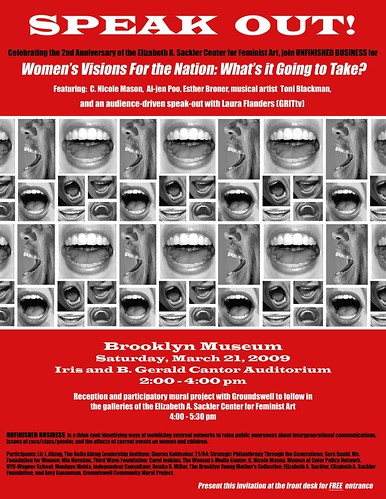
The idea behind it all:  Not so long ago, a core group of of women who share “grit, tenacity, goals, and chutzpah” came together to form an intergenerational thinktank called Unfinished Business.  They are a “bevy of birthers”, in Elizabeth’s terms.  And for short, they are “UB” — as in you be. The group has hammered out a mission statement:  “UB is a thinktank mobilizing external networks to raise public awareness of issues of intergenerational communications, issues of race/class/gender, and the effects of current events on women and children.”  Amen to that, I say.

Today marks the thinktank’s public launch, and the hope is that UB spawns other “pod” UB groups — because there’s SO much unfinished business to be addressed….

Elizabeth next introduces Nicole Mason, our keynote speaker….hang on.  That’s another post.

I’m thrilled to be LIVEBLOGGING from the Sackler Center for Feminist Art at the Brooklyn Museum, in celebration of the Center’s second anniversary! I’ll be tweeting too 🙂

Stay tuned…

(Is it still liveblogging if it’s the next day?!  I had no Internet access while I wrote this, so am posting it here today.  Crossposted soon at The REAL Deal, too.)

I’m sitting in a very crowded auditorium at 3 World Financial Center, home of American Express, and the sun is pouring in on one of the coldest days of the year.  We’re about to be warmed by the annual panel that takes place the afternoon of the National Council for Research on Women’s evening-time gala, the Making a Difference for Women Awards.

This year’s panel, “An Immodest Proposal: Advancing a New Era of Social Justice” (kudos on the title, NCRW!) features Co-President of the National Women’s Law Center Marcia Greenberger, Chancellor and President of Syracuse University Nancy Cantor, Accenture / Microsoft / PepsiCo Director Dina Dublon, and Columbia University law professor and Nation columnist Patricia Williams.  The Takeaway co-host Adaora Udoji, whose voice I wake up to each morning, will be moderating.

There is nothing modest about this crowd of female movers and shakers from corporate, academic, and nonprofit spheres.  The NCRW staff—of which I used to be part—has clearly done an excellent job spreading word.  It’s a dazzling lineup.  Let the conversation begin!

Adaora: First question is for Nancy.  What can you tell us about advancing a new era of social justice in education?

Nancy: The idea of the ivory tower as a monastic place is breaking down.  What that means is we have no understanding of the groups we’re leaving behind.  How do we level the playing field of education?  If we don’t find ways to strengthen our connections to our communities, cities, rural areas, and bring in the population, we’re going to be stagnant.

Adaora: Are we seeing that 50% female leadership in education yet?

Nancy: No, not at all.  What we are seeing at all levels is girls falling off the map as we go up.

Adaora: Why is that?

more...

From Soundbites to Solutions: Bias, Punditry, and the Press in the 2008 Elections, jointly sponsored by the WMC, The White House Project, and the Maynard Institute for Journalism Education

Panel II – How the Media Influence and Reflect Political Realities, moderated by Geneva Overholser, Director of the School of Journalism at the U of Southern California

Overheard, here at the Paley Center:

William Douglas, White House Correspondent: “I look at this campaign season so far and I’m both encouraged and discouraged about how we’ve covered it. It’s because we’ve had two such historic candidates. Speaking from the mainstream print journalism world, I think we’ve done ok. We’ve actually written about issues that we haven’t had the opportunity to look at durnig previous campaigns, in large part because the candidates have been traditional candidates. We’ve looked at race and gender somewhat differently than we have in the past, because we’ve had to.”

Juan Gonzalez, Columnist, New York Daily News: “I’ve been extremely disappointed by the shallowness of the approach to all these issues. It’s been seen as conflicts between campaigns, between individuals. There’s been far less focus on the institutional, and on what these two candidates are actually going to do….In the foreign policy arena, for instance, the media has failed to differentiate between the candidates’ different attitudes toward American empire. Do the candidates urge the American people to have a smarter empire, or to end this domination over people of the world? I look forward to seeing how we improve our coverage during the general election.”

Dr. Kathleen Hall Jamieson, Director, Annenberg Public Policy Center: “‘It was a charming speech. There was no stridency to it. Maybe she has a new speech writer.’ We need some consciousness raising here if a commentator feels it’s ok to deliver those three sentences!”

Chrisitane Anamapour, Chief International Correspondent, CNN: “To think that in this country, this supposed beacon of democracy, you can be sexist in reporting without accountability, is astonishing to me. Even in places like Iran, where there’s an Islamic fundamentalist revolution, the number of times people have said to me ‘Well, we have more women in our Parliament than you in America have in your Senate.’ And in Europe, people say to me the same. Women have been breaking those barriers outside the US for a long, long time in some countries that you in the US have believed to be benighted and backward….”

Pamela Newkirk, Associate Professor of Journalism, New York University: “When I left the daily media 15 years ago, I wrote about the impact African Americans have had on mainstream American media. I found that race matters, and what we learned on this campaign is that gender matters for sure, but let us not forget that race still matters. With the nomination of Barack Obama, there’s a perception out there that we’ve overcome race. But both of these areas still have a long way to go. Bill O’Reilly called for a lynching party for Michelle Obama, but last I checked, he still has a show.”

The first panel, “Candidates, Campaigns, and the Politics of Bias,” is underway. Overheard here at The Paley Center:

Celinda Lake, Political Strategist and President of Lake Research Partners: “Polling shows the voters feel 2 to 1 that the media has been unfair to Obama in terms of race, and that the media has been hardest on age, vis a vis McCain. There’s not as much sense of unfairness around gender.”

Dr. Susan Carroll, Senior Scholar at the Center for American Women in Politics: “The media failed to educate the public about ways that gender considerations affected HRC’s campaign. For instance, research shows that women are seen to be less qualified to hold public office than men, even when they have more credentials and experience. So HRC made experience central to her campaign. But by emphasizing this, she ceded the issue of change to Obama. But it was something she had to do to counter negative ingrained stereotypes. The media didn’t acknowledge this.”

Dr. Ron Walters, Professor of Government and Politics, University of Maryland: “The race comments from Bill Clinton, HRC, and Geraldine Ferraro—I don’t believe all that was an accident. It was a strategy by Obama’s opponents. Obama’s campaign hoped it would go away, but it didn’t. Fox news made sure it wouldn’t, by bringing Rev. Wright into the picture. And other networks jumped right in.”

Courtney Martin, author and columnist for The American Prospect, and feministing.com blogger: “There’s been a 109% increase in youth voters in this election. That’s profound. Youth are excited about this election, but they are not excited about partisanship. Chalk it up to Facebook, chalk it up to our tendency to see ourselves as individual projects, but we just aren’t into party politics.”

Patricia Williams, Columnist, The Nation, and Professor of Law, Columbia University: “Again, we see in this election, all the women are white, all the men are black. Race was gendered and gender was raced in this primary. Michelle Obama, Asian men, and others were left out of this conversation entirely.”

Up next: Panel II…

Soundbites to Solutions Conference – Post #1

A full house. The panelists have gathered. Pat Mitchell, co-chair of the WMC’s board and President and CEO of The Paley Center for Media, is introducing. Mitchell notes, “You cannot escape the fact that the media is full of examples of the kind of stereotyping about women that we had all hoped had disappeared in the ‘enlightened’ 21st century. I think the same can be said about race.”

Carol Jenkins, President of the WMC, notes that the media was totally unprepared for the first woman, the first man of color, and now the oldest man(!) running. ”What they took as their solution was to embed pundits. But those pundits’ opinions have blurred the facts,” says Jenkins, noting that we’re here today to sort out the soundbites and get to the solutions.

Marie Wilson, President and Founder of The White House Project, reminds us that you can’t be what you can’t see. The WHP’s focus on studies of the media–remember that one that found male talking heads outnumber female talking heads 9 to 1?–shares the WMC’s mission of getting more women in the media.

Dori Maynard, President of the Maynard Center for Journalism Education, asks that our intent today be on understanding each other. To that end, there will be instant polling of the audience, to find out who is in the room, and what participants think. The responses will be a catalyst not only for the panelists, but also for a report that will be prepared following today’s event.

Commence instant polling! Here’s the breakdown from the first few questions:

(The racial breakdown appeared on the screen way too fast – I didn’t get it, sorry!)

The audience here is 91 percent female and 8 percent male (1 percent other). 51 percent of those here make over $100,000.

And now, the clincher:

Did the media demonstrate an ability to accurately report and inform across the fault lines of race? 81 percent say no. Across class? 76% say no. Across gender? 92% say no. Across age? 68% say no.

Next up: the panels. The first one this morning will focus on politics (”Candidates, Campaigns, and the Politics of Bias,” and the second will focus on media (”How the Media Influence and Reflect Political Realities”).

NCRW Panel on Corporate and Academic Diversity – Post#2

Moderator Ana Duarte McCarthy (pictured) leads the next bit of the session by noting that less than 3% of senior management and corporate officers are people of color. The numbers for women are extremely low. What is it that isn’t working? And what can we do about it?

Melinda Wolfe responds: “Until organizations recognize that women bear children and are primarily the caretakers for them, there will continue to be barriers for women to move up. Some women might come off the track; there are times when women take the scenic route but want to get back on and make a difference, but our systems don’t allow that. There are still huge underlying unconscious bias factors that go on in these institutions, that without critical mass, will continue. In some ways we’re at a dangerous inflection point, in that there are now more people who’ve heard about diversity and think that they get it. But they don’t. Because they think that they get it, their behaviors are more insidious.”

Anne Erni responds: “Several years ago, several of us worked with Sylvia Ann Hewlett on her Brain Drain study. We found that nearly 43% of women in corporations want to step off the track for a while, and 93% of them want to get back on. But less than half are successful in finding fulfilling fulltime roles. So some firms created models, like Lehman’s Encore program, to address. It’s been successful. The key is getting men to empathize. Many of these guys marry women on the Street [Wall Street, that is – GWP], so they are more likely to get it. There were also incentives: people would get paid for referring women who wanted to on-ramp.”

Ah, how money talks. Poignant conversation about race going on next. A woman from the audience comments that she’s often the only African American student in the room. How do we move past that? Rosemary Cocetti shares a personal story about her son, who is an athlete, and a great writer, and who experienced straight out racism at college. His professor didn’t believe that a paper he submitted was his. Ironic, given that Cocetti is the diversity officer on campus. Actually, less ironic, more telling of how far we have to go. On the corporate front, how do coworkers deal with it the first time they see a colleague wearing a head scarf? The dilemma of being the first.

Stomachs are rumbling and the panel is wrapping up. A question asked earlier by Meryl Kaynard, Lehman Brothers, who is sitting next to me, has yet to be addressed. Rats, as this was my question too. The question: What’s going on in terms of Generations X and Y? And I want to know: to what extent does the comfort with a more global community–the one in which we’ve come of professional age–shape our expectations for inclusion here at home?

Ok, signing off now. Fear of carpel tunnel kicking in!

Continuing where the post below left off: I asked the panel on media coverage of Hillary here at WAM! to comment on the age divide among women around the election–and how it’s being framed in the MSM–and it seems to have sparked some rather heated (YAY!) conversation. Here are snippets:

-An African American woman declares herself undecided, but poignantly voices her desire to hear more about Obama’s policy positions. “Inspiration, words, great. But what do you stand for?” she says.

-A young white woman speaks from the heart about her feelings about Obama, then asks, “As a feminist who is supporting Obama, what can I do to continue to combat sexism?”

-Betsy Reed (from the panel) notes, “There’s a sense among older women that younger women are abandoning the cause. And younger women are saying to older women, ‘You know, we have more complex political identities.’ The difference in voting may be portrayed as a catfight, but it’s bringing a lot to the fore. “

-Carol Hardy-Fanta brings up the troubling news of that new report about the high percentage of Obama supporters who say they will vote for McCain if Obama doesn’t get the nomination.

-My Woodhull colleague Elizabeth Curtis “outs” herself as a young woman who is supporting Hillary and questions the assumption that younger women are voting for Obama and older women for Hillary without backing these statements with any research. [Note from GWP: The stats from SuperTuesday and Junior SuperTuesday do show it…] She notes the lack of coalition on the side of the Dems. And she asks the question that I think is THE question: “What we can start to do–right now-to work together to ensure that the Democrat will make it to the White House?”

-Carol Hardy-Fanta notes that there have been more Democrats coming out to vote than Republicans–twice as many, it seems. If that continues, the Dem has a chance. She calls upon us to respond to friends who make those inane “I’m going to vote for McCain” comments by calling them on it.

YESSS. And my own thoughts on this are expressed in the Washington Post oped I coauthored the other week with Courtney. If I weren’t working like hell on my book proposal, I’d be tempted to write another one. But for the moment, instead, I’ll just have to be satisfied with calling defectors losers.

I HEART WAM! And it’s been such a pleasure to meet bloggers–Jill and Holly from Feministe, Amanda from Pandagon, Hugo Schwyzer–and many other folks I’ve long admired. Always grateful to make connections new and old. I’ve finally dragged my computer out and am live blogging here from the final session, “Cleavage, Cackles and Cookies: Analysis of News Coverage of Hillary Clinon and the Presidental Election.” So here we go:

Allison Stevens of Women’s eNews is moderating and offers out the following statistics, via a recently released report from The Center for Media and Public Affairs (a non-partisan org that tracks coverage):

84% of on-air comments about Obama have been positive
43% of on-air comments about Clinton have been positive

What gives?

Barbara Lee, social activist and philanthropist, frames the convo with a look at the difficulty women governors–her expertise–have in getting elected. She notes that voters give female governors high marks. Once voters have seen women governors in action, they LIKE them. But it’s the getting elected part that’s hard. Voters have doubts about whether women are capable of leading at the highest levels. They must be perceived as both competent and likeable–not an easy feat. There’s also “hair, hemlines, and husband” phenomenon–everything about a woman candidate has to be just right. Once in office, female govs exceed and redefine voter expectation. But here’s the upside: The higher standards are producing women governors who excel in the eyes of the voters. And while voters demand more from women, they also give them great credit.

On Hillary, Barbara restates the obvious:

“The media coverage–particularly cable tv pundits and talk show hosts–has been maddening. Rarely, has the historic nature of her campaign been celebrated. Rather, it’s been demeaned.”

Carol Hardy-Fanta, Director of UMAss Boston’s Center for Women in Politics and Public Policy, reruns clips of the news coverage of Cleavagegate and Hillary’s Cackle, calling attention to the throughlines. A thought: News stories about Al Gore’s sigh, John Edwards’ hair, and Hillary’s cackle–initiated at Republican headquarters?

Since Cookiegate back in 1992, Hillary has had to straddle different and changing ideas about women. Back then, the break with the past was seismic. Until Carter’s campaign, Presidents’ wives didn’t sit in on Cabinet meetings. Hillary was the first President’s wife who came from having a major career. She was trapped between an outdated past and an uncharted future. Since then, she’s faced all sorts of double standards. Most recently, she’s been accused of using a “mommy strategy” to soften her image.

Additional obstacles include this: Since 9/11, citizens willingness to vote for a qualified woman candidate for Prez has actually decreased.

Betsy Reed, Executive Editor at The Nation, refers to the “tsunami of misogyny” we’ve seen–it’s a “breathtaking amount of venom.” According to the race playbook and the gender playbook, blacks are seen as traitors, while women are seen as weak. Betsy also addresses ways that Hillary’s gender and Obama’s race have helped them in their campaigns.

Alison asks: What does this campaign mean to future female candidates and future candidates who are people of color?

Carol Hardy-Fanta: “Hillary started off as the one to beat. She had name-recognition, money, the establishment, and a popular former President behind her. She had the ‘unassailable lead.’ She was the first woman who had wiped away the large structural barriers to a woman becoming a nominee. She made some mistakes, but compared to John McCain’s mistakes? If Hillary can’t even get the nomination, I don’t think we’ll see another woman run and win until my daughter is a grandparent. And what of the fact that Reverend Wright gets so scrutinized while McCain gets a free pass on Pat Roberston endorsing him?”

Betsy Reed: “It’s unfortunate that Obama has not been able to call out the sexism that Hillary has experienced. He hasn’t called out some of the racism that he’s experienced. It’s as if the very accusation is suspect somehow. We need to figure out a better way of talking about these things, and waging protest when appropriate.”

Ok, off to ask a question for the panel, so am signing off for now….

(Image cred)