Archive: Jul 2010

There’s s a long-lived puzzle about money, gender, and housework. In heterosexual partnerships where men earn more than women, women do more housework (on average). When men and women earn about the same, their housework contributions become more equal (though women still do more). But, and here’s the puzzle, when women earn more than their men, women again do more housework. (See this for a classic on the puzzle.)

If paid work and housework were “gender neutral” you’d expect there to be an equal trade off in households between paid work and domestic work. Women who earn more would do less housework, and men who earn less would do more housework.

But paid work and housework aren’t just about earning money and running the household—look back at this column on lower-earning men and health for a different example. Instead, paid work and housework are also about “doing gender”… they are activities that help to confirm masculinity (through earning for men) and femininity (through housework for women). But, you already knew that. A new international study (abstract only) tells us more about the symbolic meaning of paid work.

First, signs of change: researcher Sarah Thébaud found that men who believe in gender equality and who work fewer hours or earn less than their (women) partners do modify their housework behavior—a little bit. These men do about one and half hours more housework than their breadwinning (male) comparisons. But this modification isn’t enough to counteract what women do when they are in the same situation. Lower-earning women still do about twice as much housework as guys when they are the lower-earning partner. Gender roles are changing, but sticky.

The question is why are lived gender roles sticky and slow to change even when people’s personal gender attitudes appear to be changing? Thébaud used cross-national data from 18 countries to learn whether something in the larger culture could explain why we keep seeing this housework/doing gender pattern.

Sure enough, in countries where breadwinning, paid work, and earning a good income are more highly valued (as measured by a “work culture index”), even lower-earning men are more likely to resist doing housework. It wasn’t that the men were necessarily personally invested in any kind of gender stereotype, but where the larger culture emphasized the importance of earning and paid work, men did less housework no matter what. So, for example, the Netherlands had a lower work culture index and Dutch men who earned less than their (women) partners added more housework hours. Meanwhile, in Slovenia, which has a higher work culture index, the men performed no additional housework when they earned less than when they earned more.

The way Thébaud explains it, “Although men may do more housework on average in contexts where women have a stronger presence in the labor market…my results suggest that the ongoing pressure for men to live up to breadwinning expectations remains strong and has the power to considerably restrict the degree to which they engage in unpaid work.”

In case you were wondering: countries that were higher on the work culture index weren’t higher on productivity or GDP. But, other aspects of cultural context are more encouraging. Studies, like this one, have shown that men in countries where more women are in the workforce do more housework.
Virginia Rutter

Jeeze. Just read this at Talking Points Memo. I don’t want to talk about it. Just swear. WTF?!

-Virginia Rutter

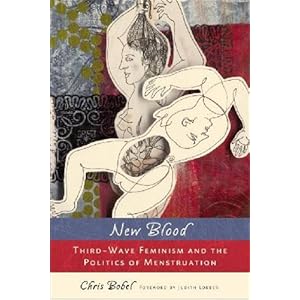
For this month’s column, I had the pleasure of emailing with Chris Bobel, Ph.D. about her new book which deftly tackles a taboo topic.

——————————————-

New Blood: Third Wave Feminism and the Politics of Menstruation

You explore new feminist activism that focuses on menstruation. Historically, how have feminists viewed menstruation, and why menstrual activism now?

The issue of menstruation has not been a top feminist priority, though, since at least the 1970s, a few bold feminists have recknoned with socio-cultural and political dimensions of the menstrual cycle. I argue that the menstrual taboo–which impacts us all, even feminists–often puts the issue off-limits. In mainstream culture, the only menstrual discourse that gets any play is making fun of women with PMS. I studied menstrual activists who want to widen and complicate the conversation. Menstrual activism is part of an enduring project of loosening the social control of women’s bodies, moving women’s bodies from object to subject status–something absolutely foundational to addressing a range of feminist issues, from human trafficking to eating disorders to sexual assault.

What do you think of Kotex’s new ad campaign “Break the Cycle,” which lampoons traditional menstrual product ads?

The new campaign could be a game change, but I’m doubtful. First, the campaign only works as long as the menstrual taboo persists; otherwise, their frank talk doesn’t stand out, does it? While I can join in the joke of the industry poking fun at itself–and I love the message of “no more shame”–in the end, it’s the same, just repackaged.

Second, I resent this campaign for exploiting shame to sell product for nearly a centuray and then exploiting THEIR overdue pronouncement–“enough with the euphemisms, and get over it”–to sell product.

Also, you’ve got to wonder if not only Kotex but their whole industry is now pulling out all the stops to try to hold onto its market share as menstrual suppression drugs–like Seasonique and Lybrel–are gaining interest.

So, what do you think of pharmaceutical industry arguments that support these menstrual suppressants?

Their quasi-feminist arguments co-opt feminism to push drugs. Big Pharma is marketing suppression as a ‘lifestyle choice’, but what most don’t realize is that “menstrual suppression” is actually cycle-stopping contraception that does not only reduce or eliminate menstrual bleeding but also suppresses the complex hormonal interplay of the menstrual cycle. We don’t yet have adequate data to really show if this is a safe long-term practice for otherwise healthy women. Check out this position statement.

Furthermore, ad campaigns represent the menstrual cycle as abnormal, obsolete, and even unhealthy. These messages underscore that women’s natural functions are defective, dysfunctional and need medical intervention. This can lead to negative body image, especially in young women. How is this feminist? ‘Choice’ without good, fact-based information based on thorough medical studies isn’t real choice, and a campaign that exploits women’s negative attitudes about their bodies isn’t feminist either.

Your work uses menstrual activism as an analytical lens through which to view continuity and change in the women’s movement, from what some call the “second wave” of feminism through the “third wave.” So, given that the ‘wave’ distinctions are not without controversy among feminists, what do you see as setting third wave feminism apart? Is it truly unique, or is it merely a label that recognizes the next generation?

There’s a lot of continuity between the waves–mostsly in the tactical sense. Today’s feminist blogs are yesterday’s zines, which reflect earlier mimeographed manifestos; radical cheerleading recalls street theater and public protests, like early second-wavers at the 1969 Miss America pageant. Second-wavers practiced what third-wavers call DIY (Do It Yourself) healthcare when they modeled pelvic self exams. But, most third-wavers depart from most (but not all) second-wavers by troubling the gender binary. For example, the radical wing of menstrual activism movements reers to “menstruators”, instead of assuming that everyone who menstruates gender-identifies as a woman.

Tell me more about that!

Most assume that a female-bodied person, with breasts and a vulva, is a woman, and usually that’s true. We also assume that menstruation is a near-universal experience for women. Radical menstruation activists question these assumptions. Menstruation is not and has never been EVERY woman’s experience. Women don’t menstruate for lots of reasons, and they don’t menstruate their whole lives. Also, some transmen and intersex people DO menstruate. So, equating menstruation with womanhood is problematic. Saying “menstruators” makes room for more people, more experiences. This linguistic move is boundary smashing, inclusion-in-action and bodes well for feminism’s future.

But, you’ve written that menstrual activists are not successful at all attempts at inclusion.

The first face of the feminist movement may have been white and middle class, but poor white women and women of color across the class spectrum have always been there, often toiling in relative obscurity. This could be the case with menstrual activism, too. However, I’m a white, privileged academic, and this biases my world view. I looked for women of color doing this work and found a few. But, was I looking in the right places? Was I using the right language? One activists of color said that I was likely missing Black women because I wasn’t clarifying how race and gender intersect in menstrual health. Also, menstrual activism is risky business for all, and especially for women of color, whose bodies have been denigrated throughout history. Taking on the menstrual taboo can make others see you as nasty, gross, improper…and if you’re already struggling to be accepted and taken seriously, then why go “there”?

Well, I and many other women’s health activists appreciate that you ‘went there’!

——————————————-

For more on this topic and her research, check out Chris’s new book — New Blood: Third-Wave Feminism and the Politics of Menstruation (Rutgers University Press, 2010), previewed in the Our Bodies, Ourselves blog and in a provocative article in the Guardian last fall.

The things that become viral are unpredictable. Earlier this month a few friends on Facebook posted a link to a Fermilab webpage that showcased 31 seventh graders drawings of scientists before and after a visit with actual scientists. I re-posted it and then a few others did as well. I saw others on Twitter tweeting it. It wasn’t the double rainbow guy viral, but it certainly seemed to be spreading.

All the children learned something about who a scientist is. Sometimes their drawings didn’t change much, but their description did. The biggest difference I noticed was that the myth of a lab coat died that day. All the scientists the kids met that day seemed to wear jeans and sweaters or button down shirts. Which is pretty much what most of the scientists I know do wear.

A few of the drawings really touched me, especially Sandra‘s. Not only did she start off already picturing a woman as a scientist, but after meeting some scientists she tossed the lab coat and commented about all the fun things that scientists do in their lives. Plus her drew a woman and a man holding hands. Awww…

But wait…I started to notice that some of the girls (I tallied 4) started off with a white male scientist and then evolved to a woman scientist. One girl might have gone from woman to man. So what about the boys? All of them stayed with a male scientist drawing. Eric seems to be the only student to change from a white scientist to a non-white scientist. That is a bit unclear as crayon skin tones are hard to decipher in some of the drawings.

Does this mean that boys only met male scientists? Or did they simply draw scientists who they connected with? Did the boys leave Fermilab that day with the idea that girls can be scientists too? Will they support their girlfriends who want to take AP Computer Science? Support their wives who need to embark for three-weeks in the field? Yes, I know I’m being totally heteronormative, but this is where some tension develops.

My job is to ensure that the women majoring in science and engineering on my campus have a supportive community. But you know what, we have a few awesome men who attend our events and request mentors. I like to think it’s because our office is delivering a great service and some men could care less that the program they are attending is run by women, for women and featuring women because in the end, it’s still all science and engineering. And for me, that’s progress.

So while I’m all “Go Girl!” I also know that if we ignore our boys, the revolution will never be complete.

By the way…this drawing experiment? It’s ten years old.

Body Language proudly presents July’s guest writer, Laura Maffei. She is the author of the poetry collection Drops from Her Umbrella (Inkling Press 2006) and founder of the journal American Tanka. Her current project is a memoir called Girl with a Secret, or How I Tried to Hide Muscular Dystrophy with Tight Jeans and Makeup and she blogs about issues of appearance at lauramaffei.com.

When I was twelve years old, in 1980, I was diagnosed with muscular dystrophy. There weren’t really any visible symptoms yet, but the disease was progressive and eventually there would be. During the car ride home, my mother turned to me in the back seat and said, pointedly, “We’ll only be telling Aunt Nancy and Uncle Joe.” These were our closest relatives. What she meant was, we would not be telling anyone else. She was telling me to keep it a secret.

My parents made this decision mostly out of protection. This was, after all, long before the Americans with Disabilities Act, and they didn’t want me unnecessarily labeled at school. But there was another side to it. My family cared deeply about appearances, my mother in particular. None of us, my father included, were allowed out of the house for any reason without being freshly washed and combed, wearing freshly ironed and color-coordinated outfits. We were also expected to look dignified and graceful at all times.

There was one other layer. I was a girl. I think a boy would have been told to keep it a secret too, for general appearances’ sake and to avoid discrimination, but a boy, you see, could win his mate with his earning power, if he worked diligently enough. Which he would be expected to do (both work hard and find a mate), since we were a traditional and conservative Italian-American family with one foot still in the 1950s. When I was born in 1967, aunts, uncles, and grandparents all placed bets on what age I would be when I got married. The bets ranged between 19 and 24, with one uncle betting “never” because I’d be a career woman. One could not be both, because then how could you cook or clean for your husband and children? And yet one was definitely expected to marry.

And marrying required being attractive. While I was encouraged to study hard and go to college, it was always made clear to me that being attractive was essential, and that “attractive” meant very specific things: A slim figure with a flat stomach. A face covered in foundation, blush, eye shadow, and mascara. (From the age of 13 I was encouraged to wear makeup every day.) Certainly not a disease that would cause my lower stomach to protrude from weakened abdominal muscles and cause me to walk with a labored gait that made people glance at me when I went by.

I had to hide it as best I could, and for a while I found various ways, like super-control-top hosiery and lying to the gym teacher about how many sit-ups I did. I refused to answer questions about it, especially from men I dated. Because yes, insanely, I kept trying to hide having muscular dystrophy well into adulthood, long after it became ludicrous to try to hide the obvious fact that I had a disability, that my body wasn’t the perfect one I thought I had to have in order to be acceptable.

Which is why, even though my story is specific and a little bizarre, I see it everywhere. It’s the same old story, really: girls and women trying to conform to what the culture tells them is physically acceptable, and feeling shame if they don’t. I see it when a friend won’t take her cover-up off at the beach in 95 degrees. I see it when the students I teach totter across the stage during an awards ceremony in stilettos that are hurting them (and, in one case, fall down the stairs). I see it when a woman in a mirror in a public bathroom experimentally pulls her skin back tight from her face.

What is the solution? For me, two things helped somewhat: learning how to draw, and hanging out with a group of smart, funny, earth-worshipping Wiccans while I was in my twenties. The Wiccans showed me that everyone, EVERYONE, was perfectly acceptable whatever their face or body type. Drawing, with its requirement of intently caressing with the eyes every shape and shadow of a person’s face and figure, showed me that everyone is beautiful.

Not that I don’t still cringe at times, when I see myself unexpectedly reflected in a store window and I don’t conform to the image I was brought up to believe was the only one that was acceptable. We all have to keep finding our way, slowly, out of the morass of arbitrary decrees that tell us what we’re supposed to look like, and what we’re supposed to hide.

Here’s how it works: if you call it a “diversity initiative” or a “work family intervention” or stuff like that there’s the chance that you will see resistance to the project of, well, promoting diversity, or creating a family-friendly work place. On campuses, all the earnest and the marginalized check it out and everyone else goes, “what? Oh, I don’t think I got that email.”

You already know this intuitively, but a study in the current issue of Gender & Society (abstract only) tells the story of a workplace initiative that starts with the notion that framing matters.

Researchers at the University of Minnesota hung out at Best Buy corporate headquarters while Best Buy instituted a program that is not called “let’s try to reduce the sexism in our every day practices at work” — instead it is called “Results-Only Work Environment” (ROWE) : On the ROWE website they explain their project like this:

“Results-Only Work Environment is a management strategy where employees are evaluated on performance, not presence. In a ROWE, people focus on results and only results – increasing the organization’s performance while cultivating the right environment for people to manage all the demands in their lives…including work.”

The program was created by Jodi Thompson and Cali Ressler , and it has gotten positive recognition in BusinessWeek (twice!) and you can also hear about it on a recent NPR segment. It basically involves a flexible workplace.

The UM researchers (including Erin Kelly and Phyllis Moen at the Flexible Work and Well Being Center) explain in their article how the focus on results reduced resistance. “ROWE was not presented as a work-family initiative or a gender equity initiative; rather it was strategically framed as a smart business move… [the founders] felt that a gender or work-family framing would lead to the initiative’s marginalization.”

You see, ROWE is about achieving excellence. This isn’t (merely) Foucauldian. This is what any diversity project of any sort is all about, right? ROWE–which has has been adopted by other companies, too–reports a 35 percent reduction in waste and a 90 percent reduction in voluntary worker turnover.

But here’s the other part of the story: The program didn’t reduce resistance completely–especially among men managers. But it created a different kind of conversation because the analysis wasn’t explicitly about gender or diversity or accommodating people with exceptional needs. It was about an alternative approach to  work that relied less on conventions of time use and more on outcomes. The resistance heard by the researchers was to the ways that the program was challenging what’s called the ideal worker norm.

What is the ideal worker norm? Well, you know what it is, it is the way you were brought up to work. You’re there or feel you should be there as much as possible (long hours). You are busy all the time, doing doing doing (look busy!). You are ready to drop everything when someone says there’s a panic (excel at “fire drills”). Thing is, this way of working is (1) not necessary for success and (2) damaging to people’s ability to balance work and other aspects of their lives. Joan Williams writes about the ideal worker norm wonderfully in Unbending Gender (2001). She shows us just how gendered this approach is, as it builds on an outdated model of family life.

By saying (as ROWE does), oh this norm of how we work (excessive hours, fire drills, et c) is a “choice” it says we can make other choices. This means that we can de-naturalize the sneaky connection of men as superior workers (especially men who can hide or evade their other personal responsibilities). And we start to allow men as well as women to make contributions and be achievers in all the domains of their lives.

Virginia Rutter