Archive: Dec 2009

So many end-of-year appeals, so many worthy causes to support!  I wanted to share one from an organization that is particularly close to my heart: Girls Write Now.

The amazing girls and women of GWN set out to raise $50,000 at the end of the year, and they are only $7,000 short.  Here’s a little about them, below.  To join me in helping them meet their goal, please click here.


About Girls Write Now
Maya, Tina, Michelle Obama_border
Girls Write Now is the first and only East Coast non-profit organization to combine mentoring and writing training within the context of all-girl programming, matching professional women writers one-to-one with underserved girls from public high schools
across New York City. While almost half of NYC’s youth fail to complete high school on time, 100% of Girls Write Now seniors graduate and go on to college. Girls Write Now has been featured on NBC Nightly News with Brian Williams and in The New York Times, and honored by First Lady Michelle Obama and The President’s Committee on the Arts and the Humanities as one of the top 15 after-school arts and humanities-based programs in the nation.

You may have seen this: a little story about a girl-with-pen who was able to make a lot more money as men with pens. “James Chartrand” is the pen name for a woman blogger who reports she earned two or three times more under a man’s name than a woman’s.

In the year of the Shriver Report–you know, women hold up half the economy, make up half the work force, oh and also make up nearly half of union membership–we’re still struggling to get a host of humane work policies (uh, health care and “good jobs” with benefits) that isn’t just about material benefits.

The tougher part is the social psychological (and hard to measure) aspect of how “men’s work” and “women’s work” are still remarkably differentiated. As I’ve written here before, gender inequality is sneaky!

So is a lot of other inequality. James Chartrand isn’t just a man’s name. It is a white man’s name. The New York Times reminded us last month that “In Job Hunt, College Degree Doesn’t Close Racial Gap.” At 8.4 percent, the unemployment rate in 2009 for black college graduates has been nearly twice that of white college graduates (4.4 percent). An American Economics Review article highlighted how this works in their paper “Are Emily and Greg More Employable than Lakisha and Jamal?” In a field study, job applicants with “white sounding” names got twice as many call-backs as those with “black sounding” names. So, James Chartrand probably had more than just the advantage of gender.

An even newer American Sociological Review study makes the case even more clearly. In “Discrimination in a Low-Wage Labor Market: A Field Experiment,” Devah Pager, Bruce Western, and Bart Bonikowski report on sending out matched sets of job applicants–white, black, and Latino men, similarly well-spoken, well-dressed, and credentialed–for low wage jobs in the New York area.

The results? Whites received positive responses 31 percent of the time–twice as many as blacks (at 15.2 percent). Latinos, with a 25.1 percent call-back rate, did worse than whites but better than blacks.

The descriptions of the job applicants’ encounters that are enumerated in the article highlight what we keep hearing: there were few if any episodes of overt racism or bias. The job applicants in the study, for example, didn’t sense a pattern themselves as they went through the application process.

A lot of inequality is sneaky. And where there is gender inequality, I’m going to keep checking for other forms of inequality that are sneaked in along with it–especially class and race–because I don’t think we’re going to do much about any of it until we do something about all of it.

-Virginia Rutter

Recently, I had the pleasure of corresponding with sociologists Chloe Bird and Pat Rieker about their book Gender and Health: Constrained Choices and Social Policies (Cambridge University Press, 2008), credited as the “first book to examine how men’s and women’s lives and their physiology contribute to differences in their health.” I was curious how the authors see their research relating to some of the health topics that have made headlines in recent months. Gender And Health: The Effects Of Constrained Choices And Social Policies, Chloe E. Bird, Patricia P. Rieker, 0521682800

Nack: Starting off with the topic of mental, health, you’ve written about sex-based differences.  Reflecting on recent articles, like NYT’s In Anxious Times, Medical Help for the Mind as Well as the Body, how does your book add to our understanding of and concern for policies like the Mental Health Parity Act?


Rieker:  Our book provides concrete data for why the Mental Health Parity Act is such a strategic and critical addition to general health care policy.  We focus on gender differences in mental health, particularly depression and substance abuse disorders.  Although the overall rates of mental illness are similar between men and women, if you look at it by specific disease, then you see large gender differences.  Women’s depression and anxiety rates are double that of men’s; while men’s rates of substance abuse and impulse control disorders are double that of women’s. Available research shows that individuals with serious mental health problems also have more physical health issues, including a lower life span. Both social and medical interventions are needed to prevent and treat these socially and financially costly conditions which create enormous health burdens on individuals, who may become unable to perform work and other social roles, and their families, Employers and society, as a whole, bear additional costs. 


Bird:  Also, differences in men’s and women’s lives can affect their utilization of mental health care and the effectiveness of specific interventions. We need systematic assessments of the effectiveness of treatments/approaches for both men and women, which can ultimately lead to better physical and mental health outcomes. The US has fallen behind Canada and other countries which require this approach in federally-funded research. 


Nack: How are the differences between men’s and women’s mental health problems particularly relevant as we consider the impact of the economic downturn, in general, and, with regard to healthcare coverage, the rising numbers of uninsured and underinsured Americans?


Rieker:  In the current poor economic climate, many men and women are experiencing increased stress/anxiety when losing jobs which may have provided dependable incomes and health insurance. Constant worry, itself, leads to ill health and exacerbates existing underlying conditions (e.g., cardiovascular and respiratory conditions).  Our framework of constrained choice illustrates how social and economic policy can reduce or enhance the options and opportunities for individuals to engage in healthy behaviors such as not smoking, not drinking to excess, eating well, and exercising.  While some individuals respond to economic downturns by temporarily limiting costly habits of smoking or drinking, we argue that more could be done at different policy levels to encourage positive health behaviors and coping strategies that improve physical and mental health. more...

Sending the GWP community my very best — Happy Belated Hannukah, Merry Xmas, Joyous Kwanzaa, and happy everything else! May the season find you warm and loved, healthy, joyful, hopeful, and jazzed.

I am so pleased to bring another important and insightful post to Girl With Pen from our regular guest blogger, Shawna Kenney.

The world hears much about women in the Middle East from Western media. Most stories are told from a human rights perspective, about women; rarely do we hear from the subjects themselves. Yet there are fierce young women working from within media structures in countries not especially known for their equal rights policies. As a journalist and educator, I have been blessed to encounter many lately. These brief profiles-in-courage are just a sampling of the work being done behind cameras, within newsrooms, from boardrooms, and in day-to-day life.

Mai Yacoub Kaloti has been a reporter with Al–Quds newspaper for almost a year. The 25-year-old Palestinian says she chose her field “to open up minds and reveal the truth about what’s happening” in her part of the world. Kaloti chose the print journalism field despite her father’s wish for her to be an accountant. Now she proudly signs her “full name” to every story and says that he is just as proud of her bylines. When people tell her women shouldn’t work in war zones, she says it’s her job and that she intends to do it right. “Women in the Middle East are just like all women on earth: they deserve respect, love, and care. They work in different fields, defend their country with pen and weapon, raise children with a sense of responsibility and good manners.”

30-year old Mozn Hassan is the Founder and a member of the Board of Directors for Nazra for Feminist Studies in Cairo, Egypt. While most of her time is spent partnering with local and international organizations in promoting women’s rights, she also answers “nonstop questions from neighbors, colleagues and even the guard of [her] building” about why she is unmarried, why she travels abroad alone, and why she chooses to live in an apartment with her sister rather than her parents. “As an Egyptian feminist I see customs and culture here which govern the mentality of Egyptians. The hardest obstacle we face is that most Egyptian men are occupied by patriarchal ideas.” Still, she fights on. “I think this field is one of the most sensitive and important issues that must be tackled openly and critically in my country. The issues of women’s rights opens lots of discussion on all of society’s problems, and in my opinion it is impossible to reform our society without tackling gender issues.”

Muna Samawi is a 25-year-old Program Officer working for the Freedom House organization in Amman, Jordan. After earning a Bachelor’s degree at St. Lawrence University, Samawi dedicated herself to working in the field of human rights. “I was fortunate to live, study and work in a foreign country for 6 years where I was able to express myself without hesitation, and practice my freedom of expression.” She has since worked with at-risk youth and organized exchange programs focused on including journalists, lawyers, bloggers, and human right defenders from the Middle East. Her activism is not always encouraged. “Political and societal pressures are placed on any activity in the Middle East that is sponsored from foreign agencies, so some eyebrow raising occurs from time to time,” she shares. “As a young woman working in development, I do not always get the recognition or support needed, but my family’s support is sufficient to sustain and push my personal goals to higher levels.” She stresses that advocacy for women’s rights and feminism are “growing movements” in the Middle East—more than most people know.

Marianne Nagui Hanna is a producer at a large news support corporation in Egypt. The 29-year-old describes herself as a “news junkie” who works 14 hours a day in this field she loves. She says her work environment is multicultural and multinational, but that managers tend to assign field missions to men, and has been told “it wouldn’t be cost-effective sending one woman with a team of men, being that she’d need a room to herself instead of sharing.” She takes it in stride and says she wishes the world knew that women in the Middle East “can actually achieve things. We are not all backward housewives from the Middle Ages. We do live in the Middle East in very tough circumstances, in a culture that doesn’t hold much respect to women and considers them second-class citizens, yet we are able to successfully work and gain respect. We don’t ride camels, we don’t live in tents .. and for sure, the harem is no more.” In her bit of spare time, Hanna maintains her blog http://resstlesswaves.blogspot.com/

22-year Hana Al-Khamri is a Yemeni woman from Saudi Arabia living in Denmark to study journalism. Her passion has pushed her to study in another country, due to laws and social pressure. “It is illegal for women to study journalism,” she says of her choice to leave Saudi Arabia. “Second there is a huge social pressure to marry and quit working. Third, I often faced hostility (writing for the ‘women’s section’ of the paper there), especially from older conservative men. I have been refused entry to press conferences only because of my gender. Fourth, I am dependent on men for transportation since I am not allowed to drive a car. And finally, media in Saudi Arabia is under strict government control and censorship, and when you are as open-minded and openmouthed as I am, you are bound to get in trouble.” In her opinion, it is tradition, not religion, that oppresses women in the Middle East, and though her career choice is one not supported by her government, she calls her path in line with God’s will. “My faith is a liberator, not oppressor. I can change my community through my pen,” she says.

Shawna Kenney is an author, freelance journalist and creative writing instructor. Her essays appear in numerous anthologies while her articles and photography have been featured in the Florida Review, Juxtapoz, Swindle Magazine, Veg News, the Indy Star, Transworld Skateboarding, and Alternative Press, among others. She also serves as the Language Editor of Crossing Borders Magazine. You can read more about her work at http://shawnakenney.com/.

Check out Mandy Van Deven’s interview with Mumbai-born author and architect, Meera Godbole Krishnamurthy, in which they discuss the author’s new novel, Balancing Act (Penguin Books India), her experience of coming to writing as an architect, and her thoughts on building an identity as a feminist mother. You can find their conversation over at Bitch Magazine.

As a Women’s and Gender Studies faculty member, I’m hyper-attuned to representations—of beauty, of consumption, of masculinity—in the world around me.  As the parent of a daughter with Down syndrome, I’ve become equally attuned to representations of people with disabilities.  Now that we’re well into the holiday season, I’ve been interested to see how children with disabilities appear in all the holiday-themed programming and advertising, if they appear at all.

The big problem is that kids like my daughter rarely show up at all in mainstream media.  Holiday specials pass by, one after the other, and my husband and I find that we’re searching increasingly desperately for disabled characters.  “Oh,” I said the other day while listening to the Muppet Christmas CD, “I think Animal is a person with special needs!”  He doesn’t speak clearly, he obviously has some behavioral challenges, including difficult controlling his emotions, but he’s a beloved and valuable member of the rock band Dr. Teeth and the Electric Mayhem.  It’s occurred to me that we may be able to use Rudolph as a role model in the future, as well—his community initially interprets his difference as abnormal and undesirable, but they come to see it as a talent and a benefit.  But in terms of actual human beings, the representational terrain is fairly bleak.
There are exceptions.  Toys R Us, for instance, has a catalog specifically for kids with disabilities—kids that they kindly, but awkwardly, call “differently-abled.”  Whoopi Goldberg and a child with Down syndrome are on the cover, and all the toys in the catalog feature kids with various disabilities playing with them.  The toys are described in terms of their educational and/or therapeutic potential:  for instance, the Fisher Price “Go Baby Go! Crawl-Along Drum Roll” is marketed as providing gross motor, tactile, auditory, visual, and thinking stimulation.  I do appreciate that, since Biffle and I are eager for Maybelle’s playtime to be stimulating, and we are often on the lookout for toys that will help her in one or another of the areas we’re working on in therapy.

But the fact that kids like Maybelle only appear in the “differently-abled” catalog is distressing.  These kids are all in their own catalog, even though all the toys are the same as the ones in the regular Toys R Us lineup.  As one of my colleagues pointed out, “If you want to know who a society doesn’t value, look at who they segregate.”  So, while I’m very glad that Toys R Us is documenting the existence of disabled kids—not just kids with Down syndrome but those with autism and a range of physical disabilities, as well—I do wish that these kids were fully included in all their marketing, so that their catalogs would help make these kids’ full inclusion in society at large seem normal, desirable, even unremarkable.

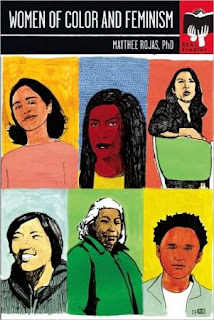
Cover of "Women of Color and Feminism" by Maythee Rojas (Seal Press, 2009)

Maythee Rojas is a teacher, critic, and writer.  Author of the new book Women of Color and Feminism (Seal Press), she is currently an associate professor in women’s, gender, and sexuality studies at California State University, Long Beach.   The book is a fascinating overview of feminist history and the construction of identity politics within feminist movements, with a diverse representation of notable icons, which includes not only Anna Mae Pictou-Aquash and Saartjie Baartman, but Tracy Chapman and Laura Aguilar as well.  It’s a smart, page-turning read that offers numerous examples to illustrate powerful points.  The book easily belongs in the hands of the many online feminists today who are in search of a book to start the critical journey of self-education on the connections between race, class, sexuality and gender.

Over phone and email, I recently spoke with Maythee Rojas about intersectionality, resisting multiple oppressions within feminist movements, and the hopes for her new book in addressing important issues of race, class, gender, and sexuality in feminism(s) today:

Allison McCarthy:  What led you to working on a book focused on women of color and feminism?

Maythee Rojas: I have been teaching a course on the subject for the last nine years and the literature and theory by women of color is something I have studied closely as a scholar. However, when I set out to write this book, I wanted to avoid writing something that could be construed as the authoritative book on women of color.  There’s no such thing, nor should there be. I respect Seal for taking something academic and making a commitment to developing it as part of a mainstream series. It helps create bridges with the academic world and find new audiences beyond the Ivory Tower.  My hope is that this book will lead other presses – mainstream and academic — to publish more works on women of color.

AM:  In what ways did your academic research on Chicana/o and Latina/o literature contribute to your literary vision for Women of Color and Feminism?
MR: In the book, I consciously attempt to focus on multiple groups and communities. Learning about Chicana/o and Latina/o culture has never been in isolation for me.  In fact, if you look at the history, experiences, and creative expressions of Chicana/os and Latina/os, you’ll find that other communities of color have often influenced them.  There’s a lot of overlap in terms of the messages relayed and socio-political issues addressed.  As a scholar, I have the same approach: having a specialization in Chicana/o and Latina/o literature requires me to think about other groups in an intersectional manner.

AM:  Why do you see the theory of intersectionality as critical for all feminists when addressing issues raised by women of color?
MR: Intersectionality applies to everyone, period.  We all have multiple facets of identity.  However, intersectionality is often applied only to those who do not fit mainstream categories of identity. Much of it has to do with people’s lack of deep introspection; or, whether they are willing to think about their positions of privilege on a daily basis and the effect of their actions upon others.  It’s a journey of integrity and honesty that’s a part of self-actualization in our lives.  If feminism is truly going to produce the result of equality for women and opportunities in a less biased society, we have to think about how women from different communities can reach that success.  We’re not all on the same level in any place.  What factors and what privileges stand in the way?  It’s really about working collectively.  It requires reflecting on people around you: their lives, opportunities, limitations.  If you’re working in a social justice movement or a place of transformation, you have to take those factors into account or it’s going to be a flawed attempt.  It does require those things.

AM:  How have women of color, outside of global feminist movements, contributed to a greater public understanding of gender, race, class, and sexuality?
MR: I think it’s through daily actions.  The interactions of everyday life are bound to challenge us.  So often, we have perceptions of others based on media, politics, and education.  However, when we encounter people who embody particular markers of race and class and sexuality and we interact with them, those markers fall away to flesh and bone individuals.  I also think our interactions with non-academics – our families and friends– teach us as much about culture as they do about them.  It’s more about what we are willing to open ourselves up to.  Does what we what learn about others connect with what we assumed about their background, sexuality, culture?  To more specifically answer your question, I believe women of color contribute to life through their daily interactions in public spaces, through the ways they raise their families, through the challenges they make to a system, a classroom, a workplace, etc.  For creatively minded individuals, it’s also through their cultural production (art, film, music, etc) and how they shape these expressions to share with other people.  I think a lot of people aren’t actually part of organized social movements, but that doesn’t mean they aren’t part of social change.

AM:  Have the feminist movements of past and present failed to address the needs and lives of women of color?
MR: I don’t think they’ve outright failed.  If I believed that, I would have to rethink why I am in Women’s Studies.  Have they had their shortcomings?  Yeah.  But that’s part of understanding that we haven’t accomplished all the goals of feminism and there’s a lot left to do.  I think it’s important that we’re critical of these shortcomings and that we register our disappointments.  We can use that as a preventive measure.  The book is rather critical at times of past movements, but I don’t think it argues that they haven’t worked at all. The people who have been responsible for writing about feminism and promoting feminism have been remiss in their inclusion of women of color and that’s important to take into account.  How willing are feminists to really self-interrogate, to really consider what they’ve gained at the expense of others, what hasn’t been achieved in the ongoing project of feminism?  For us to stay abreast of what hasn’t worked, what hasn’t been done, and whose voices are missing keeps us alive and moving forward toward an ideal.  Even if it’s not achieved in our lifetime, it shouldn’t be something we stop striving for.

AM:  Who did you envision as the audience for this book?  Have any of the responses to the book thus far surprised you?
MR: I kind of thought about it in two ways.  One of the audiences it’s geared towards is obviously college students, both graduate and undergraduate, and I think you can hear that in the classroom descriptions I use.  I was also encouraged to learn that it would be available in independent and mainstream bookstores, so that anyone could find her/his way to the book.  You might think that a book on women of color is only for women of color.  I can’t stop anyone from thinking that, but I hope that for anyone who reads past the first few lines, the reader will see that it’s for anyone who is interested in knowing themselves better and knowing more about the world around them.

AM: What projects are you currently working on?
MR: I have three projects that I’d like to see happen.  First, I want to finish my book, Following the Flesh: Embodied Transgressions in Chicana Literature, which looks at literary characters who are cast as “bad” women (mistresses, murderers, lesbians) and are maligned by society, and help us rethink what “bad” means. Examining these issues within both US and Latin American contexts, the book addresses crossing not only social borders, but also physical ones.  The next project I would like to pursue is a cultural history of Latinos and dogs. Drawn by my own passion for animals, I’m really interested in looking at how dogs show up in Latino culture.  Living in L.A. with a large Latino population and a dog-friendly attitude, there have been several race and class bias in the city’s laws that have been passed and I wanted to address those biases. I’m also interested in immigration issues in terms of how they relate to cultural shifts about pets as immigrants become more assimilated to the US.  A third project, which is much farther down the line, is a cultural history on feminism in Costa Rica.  My grandmother is nearing her 104th birthday and I would like to parallel her personal experiences as a woman (she has lived a very nontraditional life) with the development of women’s lives and issues in Costa Rica over the past century.  I imagine describing the historical and social changes of my family’s country vis-à-vis my grandmother’s own life.

The amazing ladies of WAM! are auctioning off one-of-a-kind items including the chance to travel, connect with your favorite feminists, own original artwork and autographed collectibles, and get editing advice from the best of the best – all to benefit WAM!. Bid early and bid often, because it all goes to support gender justice in media…Details here.

The uproar over the change in mammogram and pap smear recommendations have been volatile to the say the least. We’re talking about women’s lives, plain and simple…right? If we take out the absurdity that came with attaching the recommendations to the current health care/insurance reform debate (like say the GOP crying about the government interfering with a woman’s health decision), we might see the recommendations a bit differently.

With possible reductions in screening, many women have pondered whether their BFF or even they would be here to write about. Jill Zimon writes about how the guidelines might cause women to be more passive about breast cancer. Ironically after we have spent years getting women to actually do mammograms. I say the same with pap smears, but when we are dealing with science, especially health science, we have to weigh many other factors.

Feminist health scientists have won many battles in the last 20 years, but is it worth it to fight for maintaining the status quo in relation to screenings?

If we start at the very beginning of the debate, we must first start with lives lost or endangered by the screenings themselves. The Breast Cancer Fund asks, “Why are we still relying on this method of screening when we have long understood that radiation is a known breast carcinogen?” Mammograms involve putting our lives at risk, but presumably the risk is much smaller than the risk of doing nothing. Where is that tipping point? Is it determined on the individual basis or the population basis? If saving your daughter’s life might cost one other woman’s life is it justified? Do we justify use of mammography if we save 100 women and lose 1? Because honestly that is what I believe we need to talk about. Not cost-saving in dollars, but in lives impacted.

Luckily I have feminist women’s health professionals in my circle and for the most part, they agree with the guidelines BUT they wish that the panel had worked with communications professionals to get the message out in a better way. I agree, but I also wish the Obama administration hadn’t sold out the panel so quickly. Bottom line: For low risk women, it might be better for you to skip a mammogram now and then or wait until you are 50. BUT…BUT…you can only decide this with your physician. So while the GOP jumped on this as a sign that the government really was creating death panels, it was actually an affirmation of women working with their medical teams to provide individualized health plans.

During the HPV vaccination debates of 2007, I heard a lot of concern over whether the vaccine was worth the risk for the benefits. I also heard from women (at the 2007 NOW Conference) who talked about how scary and invasive they felt the follow-up screenings for cervical cancer were to them. They weren’t talking about cervical cancer treatment, but the steps between a bad pap smear and cancer treatment itself. How much are their lives worth compared to vaccination injuries and deaths? Again, the feminist health professionals I know say that the new guidelines, which didn’t cause as much uproar as the mammogram guidelines, are essentially what they have known all along. The risk isn’t worth the unnecessary pap smears and the follow-up treatments. Or is it?

And this is why I advocate for scientific literacy for all, especially women. The next time you hear a woman, no matter her age, wave their hands while saying that they aren’t into science, ask them if they are into their health because that’s what we are talking about. Science is not out there in our gadgets, but it’s right here in our bodies. We also need to ensure that our medical science professionals, from the MDs to the PhDs, have a grasp of ethics as well. They need to be in the community not just to serve, but to learn. Drawing up medical recommendations is a balancing act between the science and the ethics of being a human being, having to weigh all the outcomes to find the best solution.

As a science grrl, I don’t know where that line actually is, but I do know it can’t be drawn by unemotional scientists nor by the scientifically under-literate public. There’s a partnership in there, but each side needs to learn more about the others skills too.