We’ll be at the Brooklyn Museum on Saturday, June 20 at 2pm for what promises to be one of our liveliest versions ever. There’s more over at the WomenGirlsLadies blog, and on a YouTube channel coming soon. Please spread the word!
Archive: Jun 2009
So, the latest issue of Business Week warns parents about the “Age of Anxiety†facing young kids in their first recession. According to the psychologists over at BW:
The long-term psychological effects may be most profound for young children, since they are growing up without any real memory of better times. They can pick up on parents’ anxiety about money and may see the world as an uncertain place where they have to struggle to succeed. Later this may make them cautious about career choices and financial decisions.
Does anyone else see this as absolutely hilarious…and infuriating? Hmmm. Who knew economic hard times could be tough on children?
Of course, this piece was written without irony. BW hasn’t seemed to recognize that the “new problem†of the trauma of economic bad times and uncertainty isn’t new for a lot of kids, kids whose parents were outside the charmed circle of opportunity of the past few decades, for whom there wasn’t ever going to be any “memory of better times†in their family.
As economist Nancy Folbre reminded us in her recent, and much more sensible, post “Hard Times for Kids,†the United States has long had one of the highest child poverty rates of industrialized countries. The main reason we do so poorly is that we make no effort to combat child poverty. Demographer Patrick Heuveline has demonstrated that other rich countries like England and France would have the same child poverty rate that we do if they didn’t provide social supports to prevent it.
Folbre makes an interesting point:
During this recession, many other problems, including huge bank bailouts, are competing for public attention and taxpayers’ money. Sometimes I wonder how closely the Child Well-Being Index would mirror an Adult Wrong-Doing Index.
If I were going to construct such a new index, financial malfeasance would rank high among the measurement domains. But in the composite, apathy among those who could do more to help poor children would receive at least an equal weight.
I don’t think that BW is any more interested in the Child Well-Being Index than they are in an Adult Wrong-Doing Index. But when we wring our hands about the children, let’s remember to wring our hands about all the children, including the children we have been neglecting in good times and bad.
In the spirit of Father’s Day on June 21 — and in honor of fathers everywhere — this edition of The Man Files features a guest post by Dani Meier. Dani writes about his experience as both a custodial and non-custodial parent. This stuff doesn’t fit neatly on a Hallmark card, but it should! It comes from the heart and speaks to so many, whether we are fathers, have fathers, or watch our children’s relationships with their own dads unfold.
One in three children in America — 24 million kids — do not have their father in the home. Forty percent of them have not seen their dad during the past year. Half of them have never set foot in their father’s home. And then there are the fathers who live under the same roof, but are absent in other ways. Just plain MIA. Many dads leave.
I was one of them.
When my daughter was three, her mother and I separated. When she was six, though I’d shared equally in parenting till then, I moved out of state, 650 miles away.
In my case, however, I came back. Again and again, I came back.
I committed myself to staying in my daughter’s life. I got a second job to pay for flights and for the next twelve years, we alternated every other weekend, sometimes more, between my going to her and her coming to me — a schedule that she and I maintained till she graduated from high school. A unique father-daughter bond evolved between us, emotional closeness despite geographical distance. But two roundtrip flights a month for twelve years adds up to nearly 300 flights that she or I took back and forth to see each other. That’s a lot of goodbyes to start logging at age six.
She’s now 21. Totally legal. No fake IDs.
I recently visited her in Rome where she spent part of her junior year of college. More than the Eternal City’s sweeping arc of history and culture, however, small moments stand out: ambling around Piazza Navonna after midnight, sipping Limoncello, strolling aimlessly. We bar-hopped in Trastevere where, in one café, a phenomenal swing jazz trio accompanied us as we danced for the first time ever as two adults. On my last day, we took a train to the Umbria hillside village of Orvieto, a medieval town with winding alleyways and cobblestone streets, sitting on a chunk of volcanic rock overlooking a valley.

Hugging my daughter goodbye the next day was wrenching. It was as if all our goodbyes were distilled into this single hug: twelve years of goodbyes, hugs that bridged childhood, adolescence, and, now, adulthood.
I’m also father to a six-year-old son. As I look into his beautiful eyes today, I see the eyes of my daughter. My mind frequently jumps involuntarily to how confusing it would be for him if I moved away. Yet I know that’s what my daughter lived through at his age.
Goodbyes can cause a lot of heartache. The problem for many children, however, is that they don’t get to say goodbye to their fathers on a regular basis. That would imply that they actually see their dads in the first place. As a therapist, many of the youth and adults I work with have never met their fathers or they see them rarely if at all. Other fathers lived with their kids but were invisible, buried in their work or a bottle or some other distraction.
There’s a paradox of contradictory trends in Daddy Land. Lots of fathers are rewriting what it means to be a dad: They are more involved in their children’s lives than any fathers in American history. They not only play catch or coach Little League, they also change diapers, make meals, help with school work, and are emotionally open with their children. This coincides, however, with the fact that from 1947 to 2007, single-parent households — predominantly mother-headed homes — jumped from 12 percent to over 25 percent. And whether those fathers remarried or not, too many of them don’t maintain consistent ties to their biological children from previous relationships.
Some men claim that divorced mothers block access. But in my experience that’s the exception, not the rule. Fathers who aren’t involved with their children nowadays are usually disengaged by choice. Many don’t even meet their legal obligation for child support while others do so only under threat of legal sanction or garnished wages.
As a father and a husband — and as a therapist — I try to allow for the fact that shit happens. Divorce, breakups, new loves, new jobs, new opportunities. We each must sort through what makes sense as we move through life. And sometimes as we muddle through, we hurt others on our path. Hopefully, we learn, grow, and try to make it right.
My hope is that other fathers who’ve left can still learn, grow, and make it right. Perhaps by next Father’s Day, some of those fathers who’ve said goodbye will realize the importance of coming back. And then they’ll make it right, they’ll come back, and they’ll stay involved, being fathers their kids can count on, dads worthy of the Hallmark card.
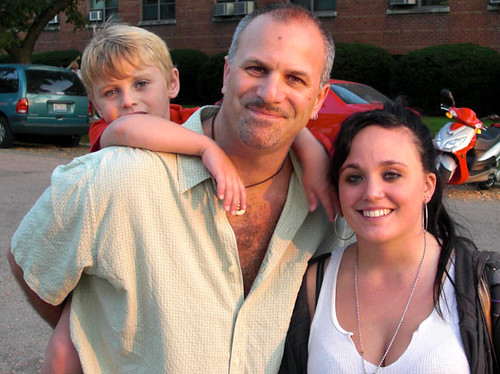
Dani Meier, PhD, MSW, is a psychotherapist, school social worker, community activist, lecturer, and writer. He is a founder of The Real MEN’s Project: Men Embracing Non-Violence, which seeks to place men at the center of the battle against domestic violence and sexual assault. He’s one of a small handful of men who’ve been awarded the Susan B. Anthony Award for efforts on behalf of girls and women in his community, and he is a faculty advisor for his school’s gay-straight alliance. He’s lectured to a range of audiences, from mental health professionals to parent groups on raising strong and gentle sons. He is currently involved in state-wide suicide prevention and intervention initiatives. He is a proud father and a lucky husband.
 That’s Peggy Schmitt: she’s my boyfriend’s mom. She died at age 68 on April 25, 2009, after a fierce yet sane battle with lung cancer. A remarkable thing happened last Sunday at her memorial service. Friends and family that spanned communities as diverse as an urban homeless (Protestant) ministry and a city Catholic parish outreach program along with teachers from Chestnut Hill independent schools, Philly public schools, and inner city academies, hipsters from the arts and culinary communities, some do-good doctors and one or two do-well lawyers, grieving friends from the very young to the much, much older, just hint at the kind of mind-boggling scope of her life.
Among the many ways in which Peggy was a force for good—for meaningful, substantial, public kinds of good, as well as the more intimate kind—was the discovery that she had been a feminist role model for women who are barely in their 30s, to those nearly in their 60s.
One after another, at our stylized Quaker meeting in Philadelphia, various women spoke at random, interspersed with men, interspersed with teenagers. The stories had thick resonance, as recollections of a life well and intensely lived often do.
The speakers, I started to notice, recalled crashing up against the heartbreak of being young, of wanting…something, everything, that-not-this-but-something-else….  We delicately avoided too many personal details, but the themes were about how to be kind to ourselves while doing big brave things in a world that wasn’t particularly on our side. We told our stories of Peggy’s compassion and confidence in the face of our pain, just as she had in the face of her own, right up until the until the very end.
Peggy did a lot of “empowering.” But the difference was her solidarity. This woman knew struggle; she recognized it without sentimentality, showed us how to respond without judgment of ourselves—or (and this was very important) others. She told us it was hard, but you can do it. And by telling and showing us what she did, she helped make it so.
Peggy herself had triumphed over hardship while creating a beautiful, beautiful life with four unusually wise, non-conforming, justice-loving children, and a life-long partnership with her soulful husband John. I met Peggy on Memorial Day 23 years ago, and her solidarity—from way back then—was a lasting resource, and helped me through hard times that inevitably were to come. And here at her memorial were all these other people from different worlds for whom this was also true.
I don’t think that Peggy would embrace the phrase “feminist role model†but I do think she would like the way so many women in her life felt her particular influence. She wouldn’t embrace the phrase because Peggy saw issues of justice as bigger than feminism, and saw people as much more than a reduction to a single or a few attributes. And that is precisely what, for me, makes Peggy one of my feminist heroes.
Thank you Peggy. Nice Work.
 After teaching another fab group of writers up at the Woodhull Institute (welcome, Writers 10!), and whooping it up in Princeton with my WomenGirlsLadies panel last week (thank you Amada! thank you Chloe!), I’m ready to announce the next gig. Here tis:
Everything You Need to Know about Blogging and Why: Do you want a more interactive online presence for your organization or your own work?  Interested in attracting new (and younger!) audiences to your cause? This interactive workshop will demystify the blogosphere, explain why blogging is central to one’s digital platform these days, and teach you how to start a blog of your own.
The workshop will be offered as part of the National Council for Research on Women’s Annual Conference. More info on all that right here.
So, the latest issue of Business Week warns parents about the “Age of Anxiety†facing young kids in their first recession. According to the psychologists over at BW:
The long-term psychological effects may be most profound for young children, since they are growing up without any real memory of better times. They can pick up on parents’ anxiety about money and may see the world as an uncertain place where they have to struggle to succeed. Later this may make them cautious about career choices and financial decisions.
Does anyone else see this as absolutely hilarious…and infuriating? Hmmm. Who knew economic hard times could be tough on children?
Of course, this piece was written without irony. BW hasn’t seemed to recognize that the “new problem†of the trauma of economic bad times and uncertainty isn’t new for a lot of kids, kids whose parents were outside the charmed circle of opportunity of the past few decades, for whom there wasn’t ever going to be any “memory of better times†in their family.
As economist Nancy Folbre reminded us in her recent, and much more sensible, post “Hard Times for Kids,†the United States has long had one of the highest child poverty rates of industrialized countries. The main reason we do so poorly is that we make no effort to combat child poverty. Demographer Patrick Heuveline has demonstrated that other rich countries like England and France would have the same child poverty rate that we do if they didn’t provide social supports to prevent it.
Folbre makes an interesting point:
During this recession, many other problems, including huge bank bailouts, are competing for public attention and taxpayers’ money. Sometimes I wonder how closely the Child Well-Being Index would mirror an Adult Wrong-Doing Index.
If I were going to construct such a new index, financial malfeasance would rank high among the measurement domains. But in the composite, apathy among those who could do more to help poor children would receive at least an equal weight.
I don’t think that BW is any more interested in the Child Well-Being Index than they are in an Adult Wrong-Doing Index. But when we wring our hands about the children, let’s remember to wring our hands about all the children, including the children we have been neglecting in good times and bad.
In the spirit of Father’s Day on June 21 — and in honor of fathers everywhere — this edition of The Man Files features a guest post by Dani Meier. Dani writes about his experience as both a custodial and non-custodial parent. This stuff doesn’t fit neatly on a Hallmark card, but it should! It comes from the heart and speaks to so many, whether we are fathers, have fathers, or watch our children’s relationships with their own dads unfold.
One in three children in America — 24 million kids — do not have their father in the home. Forty percent of them have not seen their dad during the past year. Half of them have never set foot in their father’s home. And then there are the fathers who live under the same roof, but are absent in other ways. Just plain MIA. Many dads leave.
I was one of them.
When my daughter was three, her mother and I separated. When she was six, though I’d shared equally in parenting till then, I moved out of state, 650 miles away.
In my case, however, I came back. Again and again, I came back.
I committed myself to staying in my daughter’s life. I got a second job to pay for flights and for the next twelve years, we alternated every other weekend, sometimes more, between my going to her and her coming to me — a schedule that she and I maintained till she graduated from high school. A unique father-daughter bond evolved between us, emotional closeness despite geographical distance. But two roundtrip flights a month for twelve years adds up to nearly 300 flights that she or I took back and forth to see each other. That’s a lot of goodbyes to start logging at age six.
She’s now 21. Totally legal. No fake IDs.
I recently visited her in Rome where she spent part of her junior year of college. More than the Eternal City’s sweeping arc of history and culture, however, small moments stand out: ambling around Piazza Navonna after midnight, sipping Limoncello, strolling aimlessly. We bar-hopped in Trastevere where, in one café, a phenomenal swing jazz trio accompanied us as we danced for the first time ever as two adults. On my last day, we took a train to the Umbria hillside village of Orvieto, a medieval town with winding alleyways and cobblestone streets, sitting on a chunk of volcanic rock overlooking a valley.
Hugging my daughter goodbye the next day was wrenching. It was as if all our goodbyes were distilled into this single hug: twelve years of goodbyes, hugs that bridged childhood, adolescence, and, now, adulthood.
I’m also father to a six-year-old son. As I look into his beautiful eyes today, I see the eyes of my daughter. My mind frequently jumps involuntarily to how confusing it would be for him if I moved away. Yet I know that’s what my daughter lived through at his age.
Goodbyes can cause a lot of heartache. The problem for many children, however, is that they don’t get to say goodbye to their fathers on a regular basis. That would imply that they actually see their dads in the first place. As a therapist, many of the youth and adults I work with have never met their fathers or they see them rarely if at all. Other fathers lived with their kids but were invisible, buried in their work or a bottle or some other distraction.
There’s a paradox of contradictory trends in Daddy Land. Lots of fathers are rewriting what it means to be a dad: They are more involved in their children’s lives than any fathers in American history. They not only play catch or coach Little League, they also change diapers, make meals, help with school work, and are emotionally open with their children. This coincides, however, with the fact that from 1947 to 2007, single-parent households — predominantly mother-headed homes — jumped from 12 percent to over 25 percent. And whether those fathers remarried or not, too many of them don’t maintain consistent ties to their biological children from previous relationships.
Some men claim that divorced mothers block access. But in my experience that’s the exception, not the rule. Fathers who aren’t involved with their children nowadays are usually disengaged by choice. Many don’t even meet their legal obligation for child support while others do so only under threat of legal sanction or garnished wages.
As a father and a husband — and as a therapist — I try to allow for the fact that shit happens. Divorce, breakups, new loves, new jobs, new opportunities. We each must sort through what makes sense as we move through life. And sometimes as we muddle through, we hurt others on our path. Hopefully, we learn, grow, and try to make it right.
My hope is that other fathers who’ve left can still learn, grow, and make it right. Perhaps by next Father’s Day, some of those fathers who’ve said goodbye will realize the importance of coming back. And then they’ll make it right, they’ll come back, and they’ll stay involved, being fathers their kids can count on, dads worthy of the Hallmark card.
Dani Meier, PhD, MSW, is a psychotherapist, school social worker, community activist, lecturer, and writer. He is a founder of The Real MEN’s Project: Men Embracing Non-Violence, which seeks to place men at the center of the battle against domestic violence and sexual assault. He’s one of a small handful of men who’ve been awarded the Susan B. Anthony Award for efforts on behalf of girls and women in his community, and he is a faculty advisor for his school’s gay-straight alliance. He’s lectured to a range of audiences, from mental health professionals to parent groups on raising strong and gentle sons. He is currently involved in state-wide suicide prevention and intervention initiatives. He is a proud father and a lucky husband.
That’s Peggy Schmitt: she’s my boyfriend’s mom. She died at age 68 on April 25, 2009, after a fierce yet sane battle with lung cancer. A remarkable thing happened last Sunday at her memorial service. Friends and family that spanned communities as diverse as an urban homeless (Protestant) ministry and a city Catholic parish outreach program along with teachers from Chestnut Hill independent schools, Philly public schools, and inner city academies, hipsters from the arts and culinary communities, some do-good doctors and one or two do-well lawyers, grieving friends from the very young to the much, much older, just hint at the kind of mind-boggling scope of her life.
Among the many ways in which Peggy was a force for good—for meaningful, substantial, public kinds of good, as well as the more intimate kind—was the discovery that she had been a feminist role model for women who are barely in their 30s, to those nearly in their 60s.
One after another, at our stylized Quaker meeting in Philadelphia, various women spoke at random, interspersed with men, interspersed with teenagers. The stories had thick resonance, as recollections of a life well and intensely lived often do.
The speakers, I started to notice, recalled crashing up against the heartbreak of being young, of wanting…something, everything, that-not-this-but-something-else….  We delicately avoided too many personal details, but the themes were about how to be kind to ourselves while doing big brave things in a world that wasn’t particularly on our side. We told our stories of Peggy’s compassion and confidence in the face of our pain, just as she had in the face of her own, right up until the until the very end.
Peggy did a lot of “empowering.” But the difference was her solidarity. This woman knew struggle; she recognized it without sentimentality, showed us how to respond without judgment of ourselves—or (and this was very important) others. She told us it was hard, but you can do it. And by telling and showing us what she did, she helped make it so.
Peggy herself had triumphed over hardship while creating a beautiful, beautiful life with four unusually wise, non-conforming, justice-loving children, and a life-long partnership with her soulful husband John. I met Peggy on Memorial Day 23 years ago, and her solidarity—from way back then—was a lasting resource, and helped me through hard times that inevitably were to come. And here at her memorial were all these other people from different worlds for whom this was also true.
I don’t think that Peggy would embrace the phrase “feminist role model†but I do think she would like the way so many women in her life felt her particular influence. She wouldn’t embrace the phrase because Peggy saw issues of justice as bigger than feminism, and saw people as much more than a reduction to a single or a few attributes. And that is precisely what, for me, makes Peggy one of my feminist heroes.
Thank you Peggy. Nice Work.
After teaching another fab group of writers up at the Woodhull Institute (welcome, Writers 10!), and whooping it up in Princeton with my WomenGirlsLadies panel last week (thank you Amada! thank you Chloe!), I’m ready to announce the next gig. Here tis:
Everything You Need to Know about Blogging and Why: Do you want a more interactive online presence for your organization or your own work?  Interested in attracting new (and younger!) audiences to your cause? This interactive workshop will demystify the blogosphere, explain why blogging is central to one’s digital platform these days, and teach you how to start a blog of your own.
The workshop will be offered as part of the National Council for Research on Women’s Annual Conference. More info on all that right here.