
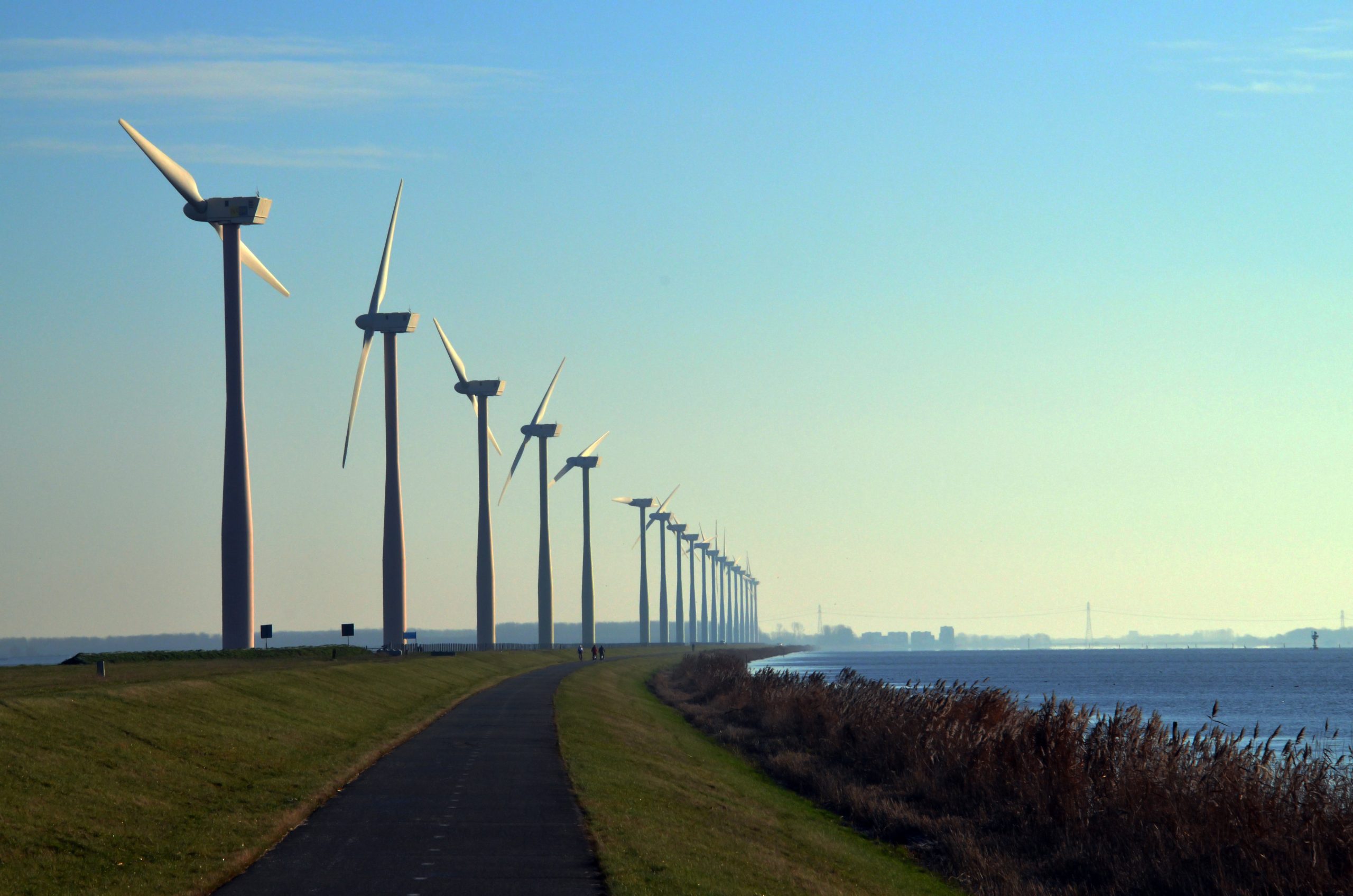
A line of wind turbines alongside a long bike path. “Eemmeerdijk” by Floris M. Oosterveld is licensed under CC BY 2.0.
Which do you value more: the environment or the economy? And do you know how much money your government spends on environmental protection? In a recent paper, two Norwegian scholars tried to find out how a country’s level of environmental spending relates to its residents’ views on whether the environment or the economy is more important. They argue that when countries spend more money protecting the environment, it creates a feedback loop that reduces people’s willingness to prioritize the environment over the economy.
Marthe Holum and Tor Jakobsen looked at data on environmental spending and public opinion across 27 countries from 1995 to 2019. Among those, the country-year with the highest environmental spending was the Netherlands in 2012, which spent 1.59% of their gross domestic product (GDP) on environmental protection in that year. The lowest was Lithuania in 1997, when that country spent 0.13% of their GDP.
The researchers then combined this spending data with surveys that asked people whether they thought growing the economy or protecting the environment should be a greater priority. They found that, in countries with higher levels of environmental spending, their public was less likely to support prioritizing the environment over the economy. This effect was especially impacted by people who expressed relatively less trust in government. The authors suggest that people may be less likely to support prioritizing the environment when their government’s spending exceeds their desired threshold. This interpretation corresponds with the “thermostatic” model of public opinion, which predicts that people’s opinions on government spending will move in the opposite direction of actual spending – or, in this case, whether they believe the current climate policies are already “too hot” or “too cold.”
Comments