neoliberalism

In our ongoing conversation about tracking “negatites” (what you might have but ended up not doing–this is a riff on Jean-Paul Sartre’s concept of the role of negation in human existence), I think we Cyborgologists may have hit on something. David’s post implied or begged the concept, I identified it, and Sunny explained how it relates to quantum physics. In a comment on Sunny’s post, David described this “Theory of Negatite Social Action (NSA, haha)” that we’re proposing as something “like the dark matter of social action.” I don’t know a lot about quantum physics, but I DO know a lot about political philosophy. So while I’m going to rely on y’all to fill in and/or correct me on the physics and big-data-tech side of things, I’m going to attempt to use some political theory to push these ideas forward and see where it takes us. Because this is genuinely an attempt (or an experiment, even), I’ve framed my post in the form of questions. Consider my answers provisional attempts at thinking through these questions.

1. Why do we care about negatites/dark social action? Why is it relevant now?

Here, I want to argue why I think explicit attention to negatites/dark social action is something that is likely to happen, if it isn’t already happening. There are two main motivations to monitor, track, and care about what people could but don’t do.  more...
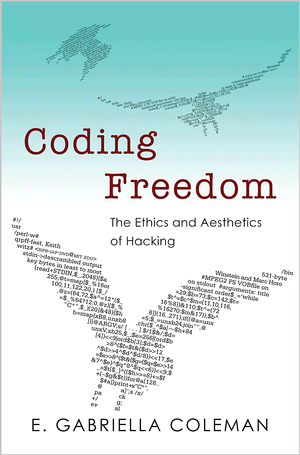

Coding Freedom cover image

E. Gabriella Coleman’s new book Coding Freedom: The Ethics and Aesthetics of Hacking (2012, Princeton University Press) is an ethnography of Free and Open Source Software (F/OSS) hackers working on the Debian Linux Operating System. It is a thorough and accessible text, suitable for  someone unfamiliar with open source software or coding. It would make an excellent addition to an IT and Society 101 course syllabus, or a reading group on alternative work organization. Coleman’s greatest achievement in this text, however, is not the accuracy of her depiction, but the way in which she dissects the political and economic successes of the open source community. By claiming absolute political neutrality, but organizing work in radical ways, contributors to F/OSS “sit simultaneously at the center and margins of the liberal tradition.” (p. 3) Coleman argues that while F/OSS, “is foremost a technical movement based on the principles of free speech, its historical role in transforming other arenas of life is not primarily rooted in the power of language or the discursieve articulation of a broad political vision. Instead, it effectively works as a politics of critique by providing a living conterexample…” (p. 185) more...


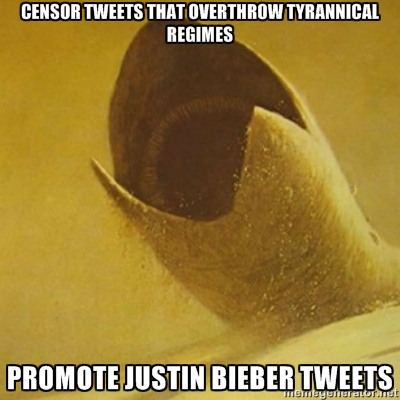
I took the liberty of making a new meme: "Censorship Sandworm". http://memegenerator.net/Censorship-Sandworm

“I must rule with eye and claw — as the hawk among lesser birds.”

-Duke Leo Atreides in Book 1: Dune

Over a week ago, Twitter announced a new censorship policy, stating that it would comply with any “valid and applicable legal request” to take down tweets. The announcement came just as we were still digesting Google’s unified privacy policy and were still debating the (now confirmed) rumors that Facebook was releasing an IPO. Twitter has since been applauded, denounced, and dissected by a variety of scholars, media critics, and business leaders. In this post I will give a brief summary of the controversy, briefly weigh in with a commentary of my own, and conclude with a discussion of what all this means for theorizing online social activity.

more...

Editor’s Note: This post was written in response to PJ Rey‘s “Incidental Productivity: Value and Social Media” and the text is reposted from mrteacup.org.

PJ Rey has a very interesting post up at Cyborgology about issues of production and labor on social networking sites that has some connections with things that I have been thinking about.

The point seems to be a partial critique of the social factory thesis – that social networks exploit the social interactions of their users, turning it into a kind of labor. This critique turns on the idea of “incidental productivity.” Rey claims that some activity on a social network does not fall into the category of labor as defined by Marx; or to put it another way, the Marx-influenced theory of labor is not conceptually broad enough to cover every type of activity that occurs. Rey proposes the concept of incidental productivity, which seems to mean value that is silently produced as a side effect of some other activity that the user is engaged in. The important point is that users are not aware of the value that they are creating, so this is not labor.

So far, I agree with this. There is only one very small point of disagreement, which is where Rey says in the final paragraph, “A quintessentially Marxian question remains: Who should control the means of incidental production?” I claim that this concept of incidental production is ultimately the liberal-capitalist problem of consumer rights and protections. more...