
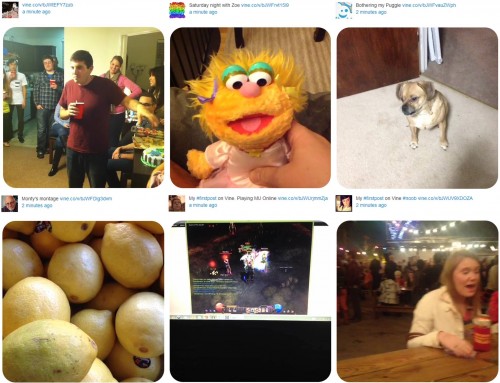
Check out vinepeek.com. Watch the random videos—called Vines—follow each other without context. Take it in for a moment.
You may have heard of Vine by now, a Twitter-owned app that let’s you make short six-second-or-less videos with sound using an iPhone/Pod. The app records video as you hold your finger on the screen; removing the finger pauses the recording and allows you to make quick cuts to dissect your six seconds into one long shot, a couple short clips, or even many tiny brief shots to create stop-motion animation.
More than just another way to take a video, Vine trains the eye to see the world as differently documentable. It asks us to see the world as potential quick cuts stitched together. By placing new limits on video (only six seconds) but also providing new abilities (easily start/stop the recording), Vine almost begs new, creative applications. Shared on Facebook and Twitter, the short clips are already developing a visual style. In fact, I’m going to declare the first Vine cliché: the stop-motion meal being eaten. [UPDATE: ADDING THE CLICHE IN GIF FORM!]

Then there is Vinepeek. I don’t know how it works—my guess is that it searches new Vines posted on Twitter and embeds them in near-real-time on the site and I’m sure someone smarter can explain it elsewhere. In the meantime, as the site says, “Sit back and watch the world in 6 second bites.”
Vine’s loop like a GIF and the quick cuts provide a dizzying, aleatory pastiche of imagery. If Wes Anderson was Instagram before Instagram, Miranda July Pinterest before Pinterest, Vine feels like a Darren Aronofsky montage: Dog sushi computer baby bowling guy beer concert train cooking kid cat shot-glass sports videogame eating fireplace cab-ride thinking about what comes next feels a bit addictive. Vinepeek is a mostly G-rated jumpy channel-surf through videos themselves already jerky and abrupt.
This is the kind of stuff that got postmodern theorists out of bed in the 1980’s: the implosion, the dromology, the disembedding and distanciation. The rise of the quick-cut music video itself being placed in random rotation on MTV seemed new, not just modern, but something “post.”
What strikes me most about Vine and Vinepeek is the visual efficiency at play. It’s what keeps me watching. In all honesty, the individual Vine, like a random photograph on Facebook, is pretty boring. As things go, the novelty outdoes the quality. But the trivial nature of most of the individual Vines becomes fascinating in aggregate. It might be the very triviality that seems profound: that so much minutia from across the globe comes together so instantly just for us on our screens. The individual Vine, with its short time-limit and quick cuts, encourages the creator to pack in lots of information in minimal time, a quantity exaggerated by Vinepeek playing them one-after-another. The dullness of the images intensifies this effect, shifting the focus from quality onto the spectacle of quantity.
Maybe. I’m just seeing all of this tonight, and wanted to share some first thoughts. In any case, take a peek; like Chatroulette a few years back, Vinepeek is a momentary, and much needed, reminder of how bizarre the entire idea of the Internet is.
Nathan is on Twitter [@nathanjurgenson] and Tumblr [nathanjurgenson.com].
Comments 18
Ariel — January 28, 2013
Taking a look at vines from the sustainability (business) angle, it definitely raises the stakes for the advertisers as well. Six seconds to make something that has not been seen or done in millions and millions of other (increasingly higher-quality) videos.
Ed — January 31, 2013
Cyborgology = feeble attempt at trying to get peple to make animated GIF's. The banality of it makes my mind turn off. I'm so indifferent abut this very old and pre-existing technology I can't be bothered to finish this comm... nope, the will to have any opinion about it has left me.