Archive: Apr 2011

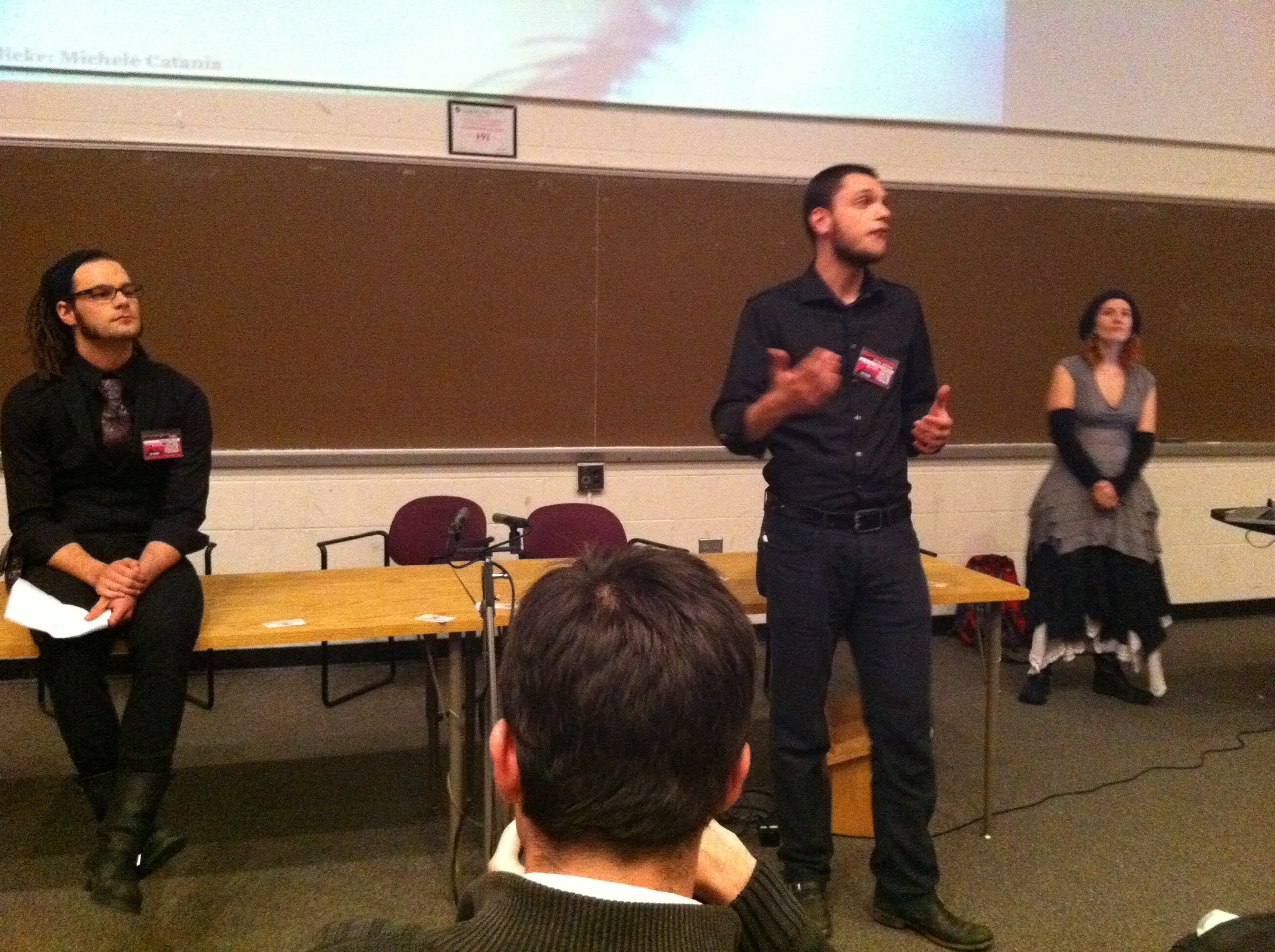
This past weekend, the first Theorizing the Web conference was a great success, but as part of the committee, I didn’t get to check out most of the fantastic work that was presented. Yet, the one panel I did get to sit down in the audience for, “Counter-Discourses: Resistance and Empowerment on Social Media,” did not disappoint. In fact, it has taken me back to my work with a passion. Not so long ago, I wrote a blog post on Google Bombing, and this panel really triggered an interesting question: In the Foucauldian sense of power/knowledge, what does visibility mean in the era of augmented reality?

Each of the panelists presented work on discourses produced online. Each were empirically driven, some more so than others, but each addressed the notion of visibility in some way. For instance, in Katy Pearce’s work on the homeless using Twitter she found through social organizations, activists, and simply those who care, they were able to make their issues and concerns visible. Similarly, Randy Lynn and Jeff Johnson’s work examined how the use of karma on Reddit reinforced patriarchal and even misogynist discourse. By users voting up or down comments, the measure of karma literally works in such a way that the comments with the most karma are most visible, appearing at the top. These examples, along with the others brought me back to my own work. more...

Symposium: “Revolution 2.0? The Role of the Internet in the Uprisings from Tahrir Square and Beyond”

Organizer: Zeynep Tufekci

Presider: Amanda French

Participants: Marc Lynch, Henry Farell, Dave Parry, Deen Freelon, and Zeynep Tufekci

The recording streams below or can be downloaded here.

Editors PJ Rey and Nathan Jurgenson introduce keynote speaker danah boyd

This past weekend Cyborgology editors PJ Rey and Nathan Jurgenson treated over two hundred (mostly) young academics to a new kind of conference. In some ways it was like any other conference: some people (me included) did the necessary grousing about waking up early; there were minor technical mangles [mangle of practice]; and there were some awkward glances at name tags as everyone tried to remember the names of their new professional acquaintances. But unlike some of the larger (dare I say, “mainstream”) conferences, there was a palpable sense of ownership over all aspects of the the project. We were doing this for a reason, and it was not to pad our CV’s. It was to play with the medium. We theorized the web, but in so doing, we also reconsidered the purpose of conferences.

more...

Plenary: George Ritzer

George Ritzer’s Theorizing the Web 2011 plenary talk is now available.  It streams below or can be downloaded here.

Intro: Zeynep Tufekci

Presentation: George Ritzer

Q&A: Ritzer and audience

Keynote: danah boyd

Nearly200 researchers from a wide range of disciplines turned out for danah boyd’s Theorizing the Web 2011 keynote, titled “Privacy, Publicity Intertwined.”  This presentation is based off her latest fieldwork with young social media users.


The track includes:

Closing remarks: Nathan Jurgenson

Introduction: PJ Rey

Presentation: danah boyd

Q&A: danah and audience more...

Aimée Morrison

Aimée Morrison (@digiwonk) posted a review of Theorizing the Web 2011 on her digiwonk blog.  See full text below:

What makes a great conference?

I’m not yet home from Theorizing the Web 2011, just sitting in the Starbucks at the Marriott wondering what it is that made this conference so awesome. Because it was awesome: I ran out of paper in my notebook from writing so much down.

I’m thinking it’s the grad students.

I go to a lot of conferences and, if I may be frank, was rapidly becoming disenchanted, nay, jaded, about the whole system. more...

Presider: Matthew Kirschenbaum

Participants:

  • Andrew Hare (@ahare), “The YouTube War: Wikileaks, Warfare and The New Digital Politck”
  • Donghee Yvette Wohn (@arcticpenguin), “Crystallization”
  • Sam Han, “The Digital Milieu of Online Christianity: The Folding of Religious Experience into Sociality”
  • Thomas Geary (@tmgeary), “Electracy and Digital Agency: How Attainable Are They?”

Abstracts are provided below: more...

Presider: Ashlee Humphreys

Each session in this panel deals in some way with the transition from a traditional mode of production—one in which goods and services are produced by a company and then transferred to the individual user—to a new(er) mode of production here users participate in the production process. This idea, variously called co-creation, co-production, prosumption, and produsage, is increasingly useful for describing phenomena ranging from citizen journalism to customizing one’s Nikes. The papers in this session approach the topic—and this I’m happy to see—from a perspective that views co-production as a process embedded in and integrated with previous institutional structures.  They also seem evenhanded when evaluating the consequences of such a shift—neither overly utopian nor dystopian.  After all, the question will at some point receive an empirical answer, thus outmoding our high-minded predictions.

First, Jacob Landis will discuss the democratization of news production, and examine the integration of integration of traditional mass media with ‘crowdsourced’ information and other forms of citizen journalism with traditional media sources. Second, EunRyung Chong looks at the emergence of global public sphere that has been facilitated by electronic communication and discuss the implication of this for self-identity. Third, Jonathan Albright will examine co-production via participatory mediation—the use of audience response as a filter for curating news content.  Lastly, Chetan Chawla will discuss coproduction as a management strategy, theorizing the firms’ transition from forms of manufacturing-based economic organization to new, service- and information-based forms of value-creation. more...

Presider: Jenny Davis

The panel: “Arts of Existence: Self and Subjectivity Online” promises to be both exciting and thought provoking. The papers in this panel explore the complex negotiations of publicity, privacy, inclusion, exclusion, and the meanings that these issues hold for the self. Jessica Vitak’s paper, a theoretical piece, examines the costs and benefits of open versus selective interaction via social media. She juxtaposes her theoretical musings against earlier CMC theories of the self (i.e. SIP and the hyperpersonal model) arguing that interrelated temporal, technological, and cultural shifts require us to think about mediated interaction in new ways. Mark Matienzo, through a case study, explores (everlasting) life and death in a mediated world. Using Zygmunt Bauman, Matienzo examines two opposing strategies for negotiating the potential permanence of the self in the contemporary era of pervasive technology. Finally, Aimée Morrison, through a study of mommy bloggers, explores the complex negotiations of candid-intimacy and open access. Morrison’s work looks at the ways in which bloggers simultaneously present their experiences to an open public, while carving out an intimate community. All of these papers illustrate how our digital selves and physical selves are deeply intertwined, and examine how negotiations of self and community necessarily span multiple spaces, places, and audiences. more...

Presider: William Yagatich

Along with the Cyborgology editors and few other colleagues, we are throwing a conference on April 9th called Theorizing the Web. Leading up to the event, we will occasionally highlight some of the events taking place. I will be presiding over a paper session titled “Wiki-Knowledge—Populist Epistemologies from the Web” and present the four abstracts below. The aim of this paper session is to explore emergent communities of knowledges, their epistemologies, and the impact of the knowledge economy that is being created and has been created on the Web and social media. Each of these papers address different knowledges and epistemologies, ranging from the perceptions of the Internet and it uses to the meaning of post-expertise in the era of Web 2.0.

First, Katy Pearce will present a paper on Armenian conceptualizations of the Internet and the Web. What will be emphasized her is the meaning of the Internet and the Web is based not on just individual preference but is both culturally and device-bound. Next, Avelet Oz explores the contradictory tendencies of Wikipedia’s legal consciousness and its ideological practices: Wikipedia’s attempt to set a cultural schema and organization of objectivity while keeping the system open to the lay public to encourage participation. Third, Kyle Reinson presents the intriguing case of post-expertise in the era of Web 2.0, which describes the potential shift of power relations that may result from the challenge of emergent businesses and social media organizations. In effect, the rise of said businesses and social media organizations offer individuals access to information and services at little or no cost that was previously held and distributed by experts in a particular knowledge community. Last, Sally A. Applin will present a paper written with Michael D. Fischer that specifically focuses on the dynamics of knowledge creation on Web 2.0 and how this new practice of knowledge formation challenges authority of experts by rendering such information available to the mass public.

Find the four abstracts below. Together, they will make for an interesting and informative panel for anyone interested in knowledge production and epistemologies. We invite everyone to join us at the conference in College Park, MD (just outside of Washington, D.C.) on April 9th. And let’s start the discussion before the conference in the comments section below. Thanks! more...