

Andréa Becker (she/they) is a medical sociologist, sexual and reproductive health expert, and assistant professor of sociology at Hunter College-City University of New York. Their writing has been featured in The New York Times, The Nation, and Slate. You can find them on Instagram and Twitter @andreavbecker and learn more at andrea-becker.com. Here, I ask them about their new book Get it Out: On the Politics of Hysterectomy.
AMW: Why is there so much silence around the hysterectomy?
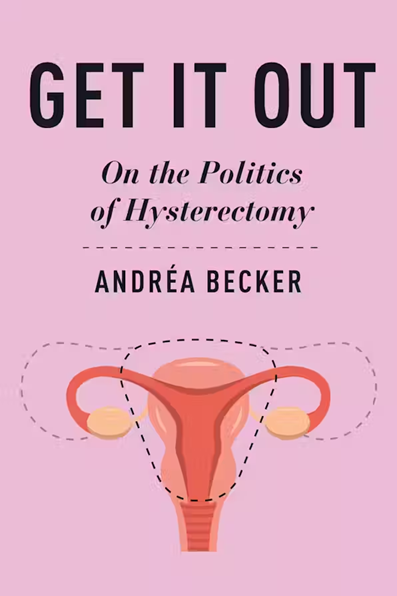
AB: We teach people with uteruses and ovaries to feel shame about these organs–especially when they are “malfunctioning.” Yet speaking out and forging communities around the various paths that lead to a hysterectomy–whether it’s endometriosis, fibroids, or part of gender-affirming care–can be lifesaving. We desperately need more research and attention within healthcare to these organs, and focusing on hysterectomy reveals just how much work there is to be done.
One in five people who are born with a uterus will have it removed by the time they are in their sixties—a statistic that was one in three when I began this project and one which never ceases to shock the person who asks why I study hysterectomy. And yet given the vast silence around hysterectomy, you’d never know how common it is. The reason for this silence is multifold. First, it is widely taboo to talk about nearly anything related to “women’s health” or “women’s organs”–from menstruation to vaginal infections to abortion. When it comes to hysterectomy specifically hysterectomy is understood as a devastating event that happens to you. To read about hysterectomy in the news is to read about disaster: emergency hysterectomy after a denied abortion, deadly hysterectomies during war, coerced hysterectomies on detained migrants. A hysterectomy often signals multifold systemic and legal failures, which are then forever written on the body—a body forever changed.
And yet, by hearing from one of the 100 hysterectomy seekers in my book and delving into the history of this procedure, the story of hysterectomy grows more complicated. While we rarely read about this in news headlines, many people want a hysterectomy, choose a hysterectomy, and are happy to have had a hysterectomy. As my interviewees explained, people might want a hysterectomy for a number of reasons, whether to find freedom from one of the many illnesses that affect the uterus and ovaries or to affirm their gender. In many ways, a hysterectomy can be understood as a form of self care. This is especially tha case because the modern hysterectomy is unrecognizable from its earlier forms–it’s now largely regarded as minimally invasive, typically outpatient, and leaves behind 3-5 tiny abdominal scars. Yet we continue to talk about hysterectomy, and doctors continue to approach the surgery as unilaterally devastating and to be avoided if possible.
AMW: How does the U.S. healthcare system deprive people of the ability to control their own bodies?
AB: When we talk about “the right to choose” conversations tend to be limited to abortion–to be able to exert agency in terminating a single pregnancy. Yet bodily and reproductive autonomy span far beyond the termination of a pregnancy. Full right to choose also means that a healthcare system is equipped to help you take care of your body. We refer to the uterus, ovaries, and cervix as the “reproductive system” or “reproductive organs” but people want to keep these organs healthy and pain-free beyond their use for gestating and delivering a pregnancy. We have known about endometriosis–a disease that impacts 10% of people with these organs–since the early 20th century for instance, yet still we can only diagnose it via surgery and there is no known permanent cure. As I say over and over in the book, to have a uterus in a medical system built for cis women having babies often means being pushed to want hysterectomy and then being told to wait. People with chronic pain and bleeding often choose a hysterectomy as a mode of self care and for many people it brings a lot of relief. Yet this choice is constrained. Would they choose this surgery if there was adequate attention, funding, and research devoted to promoting the health and wellbeing of the uterus, ovaries, and cervix? Would they have wanted a hysterectomy if they hadn’t spent years of their lives being told their pain was a normal part of having a uterus? It’s these broader structural and cultural conditions that ultimately render a hysterectomy constrained, even if it’s very much wanted and met with joy.
the pelvis—the way the body is externally racialized and gendered bestows distinct meanings on this particular part of the body. Looking closely at the various meanings deduced from these differently “housed” uteruses reveals the extent to which culture and politics interact with biological and structural forces to shape the experience of healthcare and of one’s own body. Race, class, and gender continue to stratify healthcare options, and ultimately the reproductive freedoms bestowed.
A hysterectomy as part of gender affirming care is also constrained, despite being recognized as essential care and one that brings joy and relief to those who want it. There is limited research on how the hormones involved gender affirming care impacts the uterus, ovaries, and cervix, and therefore conflicting information about whether someone taking hormones needs a hysterectomy. There’s long been a fear within the medical community that longterm use of HRT will lead to cancers in these organs, commonly leading doctors to suggest a hysterectomy to patients, and many trans and nonbinary patients opting into this surgery as a preventative measure even if having a uterus doesn’t necessarily bother them. At the same time, many of the transmasc people I spoke to would have liked to preserve their fertility, but the additional costs of games retrieval and cryopreservation on top of the hysterectomy was too burdensome. In many cases, their doctors didn’t even discuss fertility preservation, which is a stark contrast to women’s experiences. In a context of structural medical transphobia, limited research, and lack of funds, a hysterectomy as part of gender affirming care likewise becomes a constrained choice.
AMW: Why is there so much pushback for people who request a hysterectomy?
AB: Put simply, our medical system is obsessed with promoting women’s fertility (and with maintaining a sex/gender binary, in the case of trans and nonbinary patients). As the sociologist Miranda Waggoner aptly named it in her book, women’s bodies are construed as existing in a “zero trimester” of pregnancy, always viewed as one-day-pregnant or mothers in waiting. Given this, there is often a hesitation to permanently remove the capacity for pregnancy. This is particularly the case for white women, dozens of whom told me their doctors told them they were too young well into their late 30’s, that they would inevitably change their minds or feel grief, and in some cases, that their future husbands would be upset by their lack of uterus. We often talk about infertility as a tragedy–and for many it is–but the concept of willingly opting into infertility, even if in the service of living a happier, pain free, gender affirming life is so unfathomable to many.
Of note, my 100 interviews also revealed that hysterectomy is part of what sociologists call stratified reproduction. While white women well into their mid to late thirties were often told by their doctors that they are too young for a hysterectomy and told to try a dozen alternatives instead, many young Black and Afro-Latina I spoke to were recommended the surgery as their only choice. I was particularly struck by the contrast between two women, who I call Stacey and Luna. Both of these women were college students in east coast cities, and both had debilitating endometriosis symptoms in the form of chronic pain and incessant bleeding. Yet while Luna was brashly told she needed a hysterectomy as her only option, Stacey was told she should instead become pregnant as her cure. If she didn’t want the baby, her doctor assured her, she could always just place it for adoption after the pregnancy cured her. Medical research does not confirm that either pregnancy or hysterectomy is a full cure for this debilitating illness–yet race and class often come into play for which route a doctor chooses for their patient. While the uterus itself remains the same—a hollow, fist-sized, pear-shaped organ that lives in
Alicia M. Walker is Associate Professor of Sociology at Missouri State University and the author of two previous books on infidelity, and a forthcoming book, Bound by BDSM: Unexpected Lessons for Building a Happier Life (Bloomsbury Fall 2025) coauthored with Arielle Kuperberg. She is the current Editor in Chief of the Council of Contemporary Families blog, serves as Senior Fellow with CCF, and serves as Co-Chair of CCF alongside Arielle Kuperberg. Learn more about her on her website. Follow her on Twitter or Bluesky at @AliciaMWalker1, Facebook, and Instagram @aliciamwalkerphd
Comments