

Chris Bjork is Professor of Education and Associate Dean of the Faculty at Vassar College. His research interests include youth sports, educational reform, and comparative education. His newest book, More Than Just a Game: How the Youth Sports Industry is Changing the Way We Parent and What to Do About It, was published by Central Recovery Press. You can find out more about Chris on his website and his author’s page. He frequently shares information about the youth sports industry on Twitter: @chrisbjork6.

William Hoynes is Professor of Sociology on the Jane Baker Nord ’42 Chair in Media Studies at Vassar College. Hoynes served as Vassar’s Dean of the Faculty and Chief Academic Officer from 2019 to 2024, and previously served as Chair of the Sociology Department and Director of both the American Studies Program and the Media Studies Program. Hoynes is a cultural sociologist whose research explores contemporary media and culture in the United States, with a focus on professional journalism, the structure of the media industry, consumer culture, youth sports, and practices of democratic citizenship. His newest book, More Than Just a Game: How the Youth Sports Industry is Changing the Way We Parent and What to Do About It, was published by Central Recovery Press. You can find out more about William’s work on his website and his author’s page. You can follow him on Twitter @wihoynes.
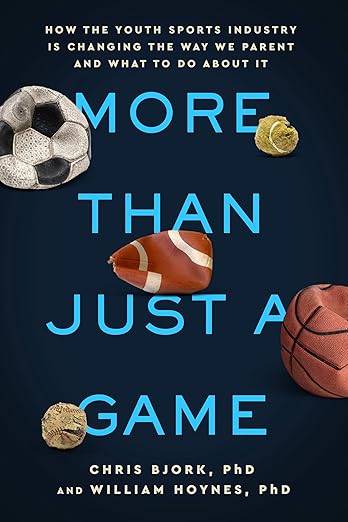
Here, I ask them about their new book, More Than a Game, which is out now from Central Recovery Press.
AMW: Your book argues that the youth sports industry often pulls families into a system that works against their values, even when they’re trying to do what’s best for their kids. What structural or cultural forces make it so hard for parents to resist the pull of “keeping up” in this competitive landscape?
CB & WH: Over the past decade or so, the assumptions that guide parents as they make decisions about their children’s extra-curricular activities have been upended. In many locations, playing for a community-based sports team is no longer considered adequate—even for many parents who consider their child to be an “average” athlete. Recreational leagues with limited seasons are facing new challenges. The youth sports industry has evolved into a complex system with multiple layers and shifting expectations, and most parents are only vaguely aware of what’s expected of them or their children. In this environment, we learned that many parents are struggling to maintain a sense of equilibrium. The growing emphasis on competitive success, which is often tied to the goal of playing on an elite travel team and ultimately earning a college scholarship, has increased pressure to begin high-intensity training for very young athletes, often under age 10.
The youth sports industry has become big business, and its influence on family decision-making has intensified. As we observe in More Than Just a Game, parents often sign their children up for travel teams in response to a kind of community peer pressure rather than thoughtful planning. Many of the adults we interviewed did not initially intend to make sports such a central component of their children’s lives. Their commitments to youth sports escalated rapidly, often becoming a central activity dominating their child’s (and family) schedule, and their perspective shifted to a focus on nurturing their child’sburgeoning athletic “career.”
In this context, parents must grapple with thorny questions related their children’s social, ethical, and physical development: How much stress should they place on sports? Should they push their children to set ambitious goals for themselves, or provide their children with the space to make those decisions for themselves? What sacrifices are worth making if they increase a young athlete’s chances of achieving excellence?
A generation ago, most parents did not feel compelled to consider questions like these until their children were in high school. Today, in the context of the recent expansion and commercialization of youth sports, parents may feel compelled to start plotting their children’s sports careers before they finish elementary school. As we learned, the pressure to specialize, training year-round in one sport and eschewing other athletic activities, can be difficult to resist, especially for adults whose understanding of youth sports is limited.
AMW: Your research shows how youth sports participation can stretch families financially, logistically, and emotionally. In your research, what patterns emerged about how these pressures vary by class or community? And how do those patterns deepen inequality?
CB & WH: The parents we interviewed typically began with the assumption that the most talented and hardworking athletes would gain the rewards they deserve, but immersion in the youth sports world led many parents to question this understanding. That’s because it has become common for families with money and time to push their children ahead of young athletes who must rely solely on their athletic talent to compete. In many locations, playing in a local recreational league or earning a spot on a school team is no longer considered enough. Many parents of pre-teens now feel obligated to sign up their kids for activities designed to accelerate their athletic development—and attract the attention of coaches and scouts. That could involve playing for an elite travel club or signing up to train with an expensive private coach.
For some parents, spending large sums of money on their children’s extra-curricular activities is not a major concern, even when the cost is a bit of a stretch on their family budget. Many of the people we interviewed for our research believed that the benefits their kids derived from elite training justified the costs. They were happy to invest in their children’s athletic development. Of course, not all families can afford to sign their children up to play for privately-run teams or hire a private skills coach. Still, no matter how much parents would like to support their children’s athletic careers, the increasing costs associated with travel sports prevent many from even considering that option.
Today, rates of sports participation are tightly linked with family income. Elite teams allow children of any background to try out. Yet many families lack the resources or knowledge to take advantage of those opportunities. Joining a travel team is simply too expensive or places too many demands on families to be a realistic option. As we might expect, race and class are often linked when it comes to youth sports. Children who are poor, or from Black or Hispanic households, are less likely to participate in organized sports than middle class white kids. A number of factors are responsible for the disparities. The most obvious is affordability. Many parents do not have the funds to finance their children’s athletic careers, especially as the expectations, demands, and costs continue to escalate. For many families, the growth in private club-based sports and the decline in community-based programs has reduced the options available to their children. Time constraints, limited access to athletic facilities, and parental priorities can also make it difficult for lower-income children to participate in sports, which can limit the opportunity for children from marginalized backgrounds to have the full range of youth sports experiences and live up to their athletic potential.
AMW: You write about the tension between letting kids play for fun and the adult-driven intensity of competitive youth sports. What does your book suggest parents should look for—or actively push back on—if they want to support their child’s development without feeding into the “win at all costs” culture?
CB & WH: We heard from many parents that managing their children’s athletic activities was complicated and stressful. Popular media images, pervasive consumerism, stories circulating on social media all convey to parents the notion that they should do whatever they can to make sure their children are exceptional.
For adults seeking to mitigate the intensity of youth sports, a central concern is that youth sports have come to imitate professional sports in a way that narrows the experience for young players. They hope to open a window for young children to enjoy the experience of playing sports, being part of a team, and learning new skills before a culture of competition shifts the attention of players and parents alike to winning and achievement.
The world of youth sports contains a richness that is rarely recognized: emphasizing competition as well as community, celebrating both accomplishment and connection, recognizing both the joy of victory and resilience in the face of failure. We learned that a significant portion of parents see something more than a culture of competition in youth sports: a road to friendship and social connection, experiencing the joy of teamwork, physical activity that can be both healthy and fun, the opportunity to learn about one’s own body, and a powerful arena for young people to develop resilience. While an overemphasis on competition and achievement can overshadow other ways of experiencing youth sports, it is important to recognize the range of possibilities that often hover just below the surface of our shared conversations about what parents and children might find within the world of youth sports.
For this reason, we encourage parents to operate under the assumption that their child can lead very rewarding lives without letting sports dominate their daily lives. Rather than let sports dreams guide the decisions they make, parents could view athletic accomplishment as one of many possible indications of success. If their child ends up playing for a highly ranked college softball team, that will be worth celebrating, but she might find just as much personal satisfaction if she decides to choose a college based on her academic goals, and play softball at the intramural level. We interviewed many college students who played sports competitively as adolescents but decided to focus on other activities in college; none of those former athletes regretted that decision. Not a single one.
Our research suggests that the essential ingredient in this endeavor is balance. Rather than offer a formula that can be followed to ensure a young athlete success or happiness, we encourage parents to make decisions that create balance in their children’s lives. Kids who participate in a variety of activities, interact with all sorts of people, and have a chance to relax and decompress on a regular basis are more likely to thrive. The specific activities that children participate in will vary according to individual interests—and may change over time. Encouraging kids to sample different pursuits and recognizing that failure is an inevitable part of growing up will help create balance in the lives of young athletes and their families. Children who take part in a variety of activities are more likely to bounce back from defeat than those whose lives are dominated by a single interest.
The most well-adjusted athletes we observed invested time and energy in sports but also participated in other extra-curricular activities. Parents of these well-rounded young people resisted pressure to make decisions based on the assumption that their children would be recognized for their athletic accomplishment and receive offers to play at the college level. Leading balanced lives made them aware of the multitude of opportunities, both on and off the athletic field, that could bring their children satisfaction in the future.
Alicia M. Walker is Associate Professor of Sociology at Missouri State University and the author of two previous books on infidelity, and a forthcoming book, Bound by BDSM: Unexpected Lessons for Building a Happier Life (Bloomsbury Fall 2025) coauthored with Arielle Kuperberg. She is the current Editor in Chief of the Council of Contemporary Families blog, serves as Senior Fellow with CCF, and serves as Co-Chair of CCF alongside Arielle Kuperberg. Learn more about her on her website. Follow her on Twitter or Bluesky at @AliciaMWalker1, Facebook, and Instagram @aliciamwalkerphd
Comments