
Anna Strhan is a Reader (Associate Professor) in Sociology at the University of York (UK), where she leads the Culture, Values, and Practices Research Cluster. She also co-leads the Social Studies of Ethics, Morality and Values Network. Her research explores the culture and politics of religion, childhood, parenting, and education. She is the author of a number of books, and her work has appeared in various media outlets, including The Guardian and BBC Radio 4. You can find her on BlueSky @annastrhan.bsky.social or on her website.
Rachael Shillitoe is a sociologist and a senior social scientist in the civil service. She was previously a research fellow at the Universities of Birmingham and York (UK). Her research interests focus on the formation of beliefs and values across generations. She is the author of Negotiating Religion and Non-Religion in Childhood with Palgrave Macmillan.
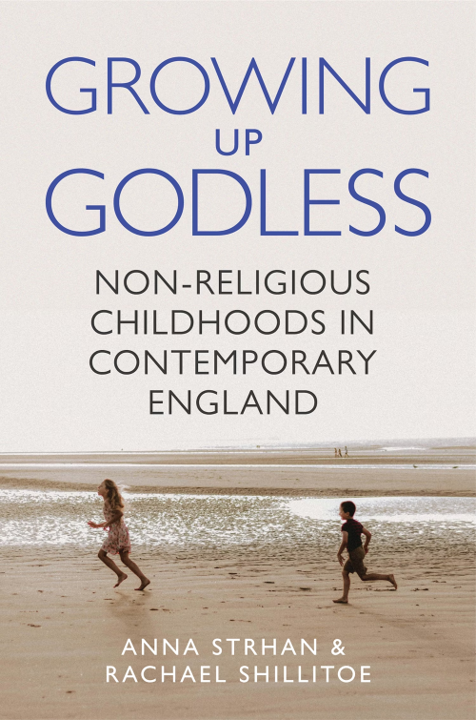
Here, I talk to them about their new book, Growing Up Godless: Non-Religious Childhoods in Contemporary England.
AMW: Your research highlights how non-religious children still engage with questions of meaning and morality. What were some of the most striking ways these children made sense of such big ideas outside of religious frameworks?
AS & RS: We were working with children aged 7 – 10 years old, and one of the most striking things was how reflective they were in talking about big questions! They were, in fact, highly articulate and thoughtful in discussing what made life meaningful to them, as well as about their views about the origins of the universe, their thoughts on the existence of God and other supernatural phenomena, life after death, ideas of morality, and how their beliefs related to the views of their parents, siblings, grandparents, friends and peers.
Several ways that the children were making existential meaning in their lives were especially striking. Firstly, when we asked the children about what was important and mattered in their lives, they all spoke about relationships: family, friends, and pets. And when they spoke about particular objects – for instance, special toys – they talked about how these were special to them because they had been given by a particular family member or were something that their friendship group had a shared love for, rather than being about consumerism. Secondly, many spoke about how they were sceptical about belief in God because they felt that the ideas of God they had encountered were at odds with their own scientific worldview – and they often elaborated on how they believed in the Big Bang theory and the theory of evolution. However, despite their acceptance of science, many of them had fun, playful beliefs in magical figures like unicorns, dragons, or ghosts, and again, linked these to their friendships – commenting that it was fun to talk about these things with their friends. Thirdly, many also spoke about how animals and the natural world were important to them – indeed, many mentioned that they admired figures like David Attenborough or Steve Irwin who had inspired their love of nature.
Across all these ideas, it was striking that the children had a sense of meaning and purpose as based in this world, rather than some heavenly, transcendent realm. The decline of religion has often been portrayed as leading to a loss of meaning and enchantment. But our book shows that this non-religious world wasn’t disenchanted or meaningless for these children – it was rather, a site of fullness and wonder. Indeed, several said that they didn’t have any need for religion, because the needs that religion might fulfil were for them being met in other ways, for instance, through their sense of belonging with friends and family.
In terms of morality, a really prominent issue for the children was equality. They really cared about fairness, and many spoke about how important it was to treat others equally and to respect differences in relation to religion, race, ethnicity, gender, sexual orientation, and disability. In fact, while their parents were often quite critical of religion, very few children expressed moral critiques of religion and instead emphasized the importance of respecting religious diversity. They also often mentioned the importance of trying to understand others’ viewpoints and experiences, and the importance of not judging. For instance, when discussing whether a particular action was wrong, they felt it was important to try and understand the reasons why the person had acted in that way.
AMW: The book challenges the assumption that secular upbringings are neutral or empty of tradition. What patterns did you observe in how non-religious families construct and pass down values or rituals?
AS & RS: A core value that all the parents emphasized was autonomy and the importance of supporting their children’s own worldview choice. Although a few expressed a sense of discomfort about the idea that their children might, say, become a conservative evangelical, by and large, they generally spoke much more about how they wanted their children to have freedom and self-confidence to make their own choices in life.
In terms of patterns across generations, it was striking that some parents spoke about how they’d experienced religion as stifling or undermining freedom in their own upbringings, and they saw their own desire to ensure their children’s sense of freedom and authenticity as a reaction against that. In the book, we look at how the parents’ emphasis on enabling the children’s freedom in relation to religion is part of a broader cultural change. This shift is something the cultural theorist Raymond Williams called ‘the long democratic revolution’, in which ideas of choice and voice have been extended to previously more marginalized groups of people. And we argue that this includes children. This is part of a long-term process in which ideas of individual freedom and rights have been ‘made official’ in things like international treaties, and professional ethics codes, and these have also infused parenting and educational cultures with ideas of respectful parenting and child-centred education. All of this means that the children are growing up with a strong sense of their own rights and freedoms, as well as those of others.
The question of rituals is an interesting one. Because historically, rituals have often been most clearly linked to religious institutions, there’s quite a strong narrative in social theory about the decline of rituals. But actually, all the families still celebrated things like Christmas, Easter, Eid, or Hanukkah – depending on their religious heritage. However, they mostly did not see the meaningsof these festivals as linked to religion, even if for some of the families, they might go to church, for instance, at Christmas. Instead, they spoke about these rituals as about celebrating or honouring family, caring for others, or creating a sense of childhood magic.
Some parents described Christmas and Easter as meaningful in relation to pre-Christian seasonal rituals, for instance, pagan midwinter festivals. Some families also created new rituals to mark important life events – for instance, one family held placenta-burying rituals in their allotment and garden, with a plum tree and a rose bush planted to mark their daughters’ births. Birthdays and Halloween were, of course, also important for the families too.
Besides these annual, seasonal or lifecycle rituals, more regular ritual practices varied quite a bit between families. A few engaged with things like meditation and mindfulness together, while others spoke about the importance of getting out into nature together regularly at the weekend – for instance, a walk by the seaside. Some also spoke about the importance of watching nature documentaries on TV together. Although not exactly a ritual, the weekly routine of watching a programme like Blue Planet or Planet Earth together on a Sunday – evoking a sense of awe and wonder in the natural world – was something that several parents spoke about as an important way they were encouraging their children to care about the planet.
But as well as rituals, the parents were shaping the children’s values in more implicit ways – through what they signalled to children were things of interest and importance, the things that are worth their attention. So, what they talked about with their children and how they talked about it – and what they didn’t talk about – influenced what the children were coming to value for themselves. And here, in relation to religion, the fact that the parents generally didn’t talk much about religion with their children meant that the children were picking up the idea that religion wasn’t something that was especially important to them.
AMW: In documenting the everyday lives of non-religious children, what did your findings reveal about how schools shape—or sometimes clash with—their developing worldviews?
AS & RS: Many children we spoke to were growing up in homes where there was relatively little engagement with religion. For these children, it was therefore actually in schools that they first really encountered forms of religion – for instance, through classmates who were religious or through learning about religion – and it was through these encounters that they began to reflect on their own stances in relation to religion, and to think of themselves as non-religious. But schools and friendships both also played an important role in shaping the children’s sense of what mattered to them and what they felt was significant or interesting. So, the fact that the schools prioritized teaching about maths and science and tried to make these lessons fun (with games-based learning, for instance) meant that many children spoke about liking science or maths, and seeing these as things that mattered in life. One child, for instance, said ‘almost everything involves maths’, while others said they wanted to be scientists when they grew up.
But as well these ways of thinking about knowledge, the schools were – like the parents – strongly reinforcing ideas of individuals’ rights and freedoms, and principles of equality. Indeed, the value of ‘respect’ was a core value at each of the schools, and the children took it for granted that this was just a basic principle of how you should treat others – even if they didn’t always do so in practice.
We didn’t find very strong clashes between the children and the schools, although many of them did find some aspects of school boring (including, often, religious education lessons). But the children were sometimes critical of classmates who expressed beliefs that were at odds with their own more pluralist stances – for instance, one child criticized a conservative Christian classmate who had said that another child’s Muslim beliefs were wrong.
In general, we found that the schools and the parents were encouraging the same kind of broadly liberal values. What’s interesting here is that these values are often seen as taken-for-granted and something you just figure out for yourself, autonomously. But our book shows how, actually, they are being encouraged by wider institutions – such as schools – and other cultural resources and traditions, linking with recent work by Galen Watts about how a liberal imaginary is often seen as intuitive, but in reality it is shaped by cultural structures and institutions. In our book, we call this a broadly ‘humanist’ culture – which emphasizes the agency, achievements and significance of humans – even though most of the parents and children wouldn’t have necessarily called themselves humanist.
Overall, we suggest that rather than just thinking of what is happening here as the decline of institutional Christianity, it’s important to pay attention to the question of what these children are becoming and what they are learning to value, and how this is being fostered through particular traditions, institutions, and everyday practices.
Alicia M. Walker is Associate Professor of Sociology at Missouri State University and the author of two previous books on infidelity, and a forthcoming book, Bound by BDSM: Unexpected Lessons for Building a Happier Life (Bloomsbury Fall 2025) coauthored with Arielle Kuperberg. She is the current Editor in Chief of the Council of Contemporary Families blog, serves as Senior Fellow with CCF, and serves as Co-Chair of CCF alongside Arielle Kuperberg. Learn more about her on her website. Follow her on Twitter or Bluesky at @AliciaMWalker1, Facebook, and Instagram @aliciamwalkerphd
Comments 3
john smith — July 25, 2025
useful to know, thanks!
mygreatlakes — August 29, 2025
I really appreciate the time and effort you’ve put into. Thank you for sharing
slope game 2 — January 24, 2026
This insightful dialogue sheds light on the complexities of growing up without religion. I'm curious, how do you think cultural context influences a person's experience in secular environments?