

Fatima Suarez is an Assistant Professor of Sociology at the University of Nevada, Las Vegas. She specializes in gender, family dynamics, and Latinas/os/es in the United States. Over the past ten years, her research has focused on examining inequality in family life, particularly from the perspective of fathers. Fatima’s research has been supported by a Postdoctoral Fellowship at the Clayman Institute for Gender Research at Stanford University and an Andrew W. Mellon Foundation Fellowship in Latino Studies at the School for Advanced Research in Santa Fe, New Mexico. Here, I ask her about her new book, Latino Fathers: What Shapes and Sustains Their Parenting, which is out now from New York University Press. You can find out more about Fatima at her website.
AMW: You write about the emotional realities of fatherhood: joy, uncertainty, hope, pain. What did their stories reveal about how Latino men themselves make sense of fatherhood in their everyday lives?
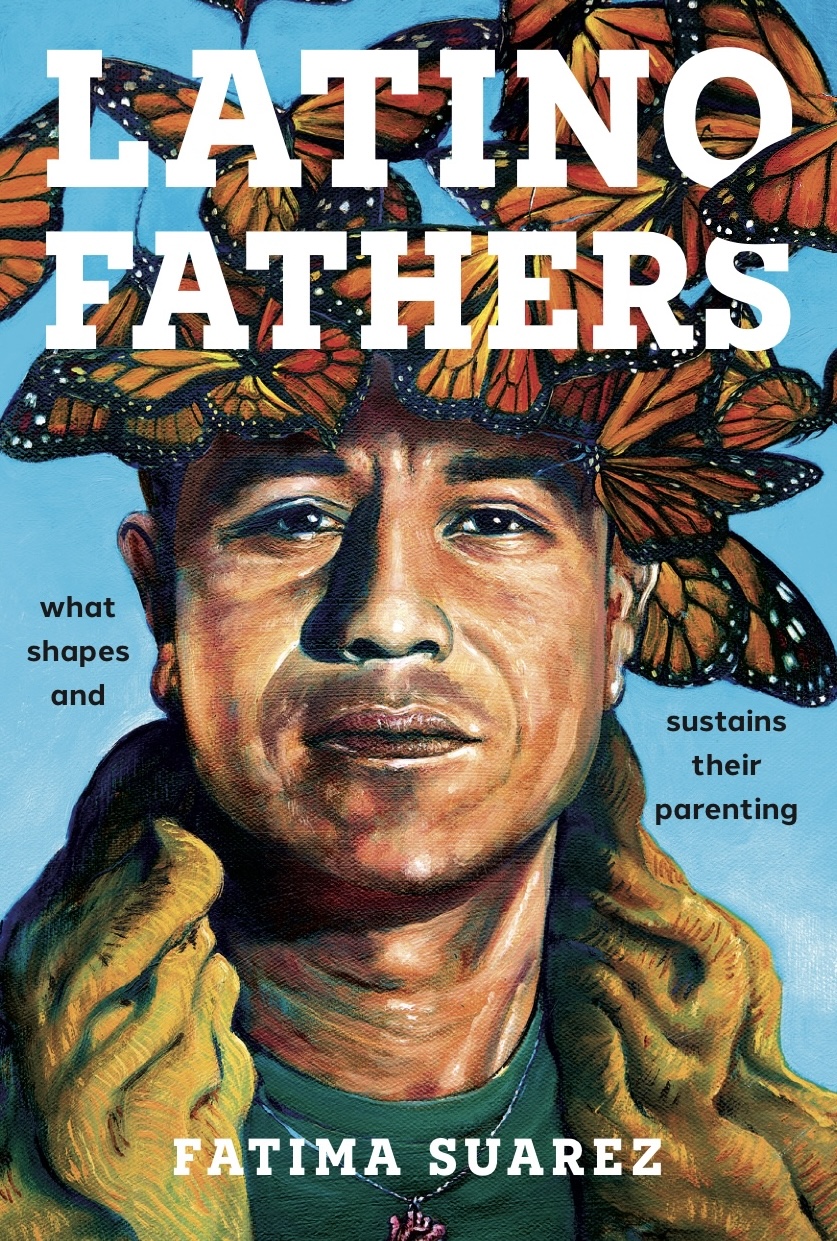
FS: Emotions were fundamental in how Latino men made sense of themselves as fathers and their responsibilities toward their children. For example, men’s perceptions of themselves as fathers were influenced by their collective feelings toward their own fathers. Their feelings were shaped by how their fathers behaved as men (i.e., emotionally expressive or stoic, and absent or involved; egalitarian or traditional), how their fathers treated them when they were boys (i.e., chastising them when they didn’t behave like “boys”) and by their interpretations of paternal sacrificial love (i.e, did their fathers tell them they love them or did they recognize fathers’ sacrifices as an expression of love). Based on these factors, men either resented, empathized with, or shared conflicting emotions toward their fathers. In fact, many of the men I spoke with considered themselves to be involved, modern fathers compared to their own, and they cited the previously discussed factors as reasons why. However, at the same time, they critiqued their fathers’ shortcomings and protected their reputations by offering explanations for why their fathers could not be better fathers. These explanations ranged from their fathers growing up in poverty, in large families with limited resources, to growing up without their own fathers. In this vein, Latino fathers’ stories highlight their deep emotional intelligence as they express the complex nature of their relationships with their own fathers.
Emotions were also central to how fathers used what I call a “childhood frame of reference” to evaluate their parenting in comparison to their own childhood experiences. The men I met shared powerful childhood memories of working to support their families’ economic survival, experiencing severe physical punishment, and feeling unwanted or like a “burden” due to colorism or poverty. These experiences were impactful as they did not conform to what we think of as an ideal or “normal” childhood in which children are protected from adult responsibilities, abuse, and prejudice. These emotionally charged memories affected how they raised their children, pushing them to engage in what I call “intergenerational corrective fatherhood” as they sought to change their parenting to give their children a better childhood than they had. In other words, they infused their painful memories of not living a “normal” or “ideal” childhood into their fatherhood. In this case, Latino fathers’ narratives illuminate how emotions underline their parenting goals and hopes for their children.
AMW: Structural forces can support or undermine men’s parenting, whether through work demands, economic pressures, or broader social inequality. What did Latino fathers teach you about how these forces shape, and sometimes constrain, their ability to parent the way they want to?
FS: Work operates in contradictory ways for Latino fathers. On the one hand, work enabled them to provide their families with a middle-class life — the hallmark of the American dream — and an overall sense of belonging to American culture. This included owning a single-family home, multiple cars, a college education for their children, family vacations, and conspicuous consumption. Work also enabled Latino fathers to fulfill traditional breadwinning roles, which can provide them with honor and dignity. This can be especially important for men whose masculinity has historically been problematized by powerful social, political, and legal actors and institutions. For only a few of them, work allowed them to take parental leave when their children were born, which is a significant privilege, as Latino fathers have the lowest rates of access to paid and unpaid family leave among all fathers. Overall, many fathers took pride in being economic providers for their families, which gave them a sense of purpose.
On the other hand, fathers understood the compromises they had to make in their family lives for work. Work constrained their abilities to parent the way they aspired to. Fathers spoke candidly about the lack of time they had to spend with their families and the effects of bringing work stress home. They were especially forthcoming about how their tedious and dreadful commutes on California’s vast freeways further chipped away at the little time they had to spend with their families after work. In fact, Latino fathers taught me that commuting to work IS work. Fathers who had adult children openly lamented the loss of time, with one father noting that now that his children are older, they don’t want to spend time with him, which he doesn’t blame them for. While they provided their families with upward mobility, it came at a cost.
Some fathers resisted letting work dictate their family lives. They put their families before their careers. These fathers were mainly college-educated professionals who could leverage their social and cultural capital at work. However, these fathers paid a different kind of price—a social one in which their colleagues, supervisors, and even family members constantly questioned their commitment to their careers.
AMW: Your book shows Latino fathers continually negotiating what “good fatherhood” means. What were the most meaningful ways these men upheld, challenged, or redefined culturally dominant expectations of fathers?
In the book, I examine Latino men’s experiences related to childbirth and child custody, which force them to confront medical and legal institutions that uphold gender essentialism in parenting. Fathers’ efforts to be involved and caring parents are constantly compared to those of mothers, who are regarded as the standard for parenting. In fact, some people have asked me if fathers need to behave more like mothers to be considered good fathers. Fathers’ stories illustrated how motherhood shaped their understanding of fatherhood, driving them to see it as something they needed to achieve and, in some instances, fight for. One father astutely described this dynamic when he said, “Men must engage in the verb of the word ‘father.’ You must live it. You must enjoy it and suffer it. It’s an action.”
During childbirth, fathers often felt isolated, abandoned, and excluded by hospital staff, particularly when complications arose. The fear of losing the mothers of their children made fathers acutely aware of their own vulnerability as parents. Their experiences during childbirth significantly shaped their feelings about their role as parents moving forward. Some believed they could never overcome the deep emotional connections that mothers have with their children, which undermined their efforts to be caregivers. After the dissolution of their marriage or partnership with the mothers of their children, fathers found themselves having to defend their fatherhood in court. These experiences left them with the realization that they are second-class parents who have to prove their capacity to parent. Some used these experiences as a catalyst to redefine their fatherhood, becoming more intentional about how they engaged with their children.
Alicia M. Walker is Associate Professor of Sociology at Missouri State University and the author of two previous books on infidelity, and a forthcoming book, Bound by BDSM: Unexpected Lessons for Building a Happier Life (Bloomsbury Fall 2025) coauthored with Arielle Kuperberg. She is the current Editor in Chief of the Council of Contemporary Families blog, serves as Senior Fellow with CCF, and serves as Co-Chair of CCF alongside Arielle Kuperberg. Learn more about her on her website. Follow her on Twitter or Bluesky at @AliciaMWalker1, Facebook, her Hidden Desires column, and Instagram @aliciamwalkerphd
Comments