
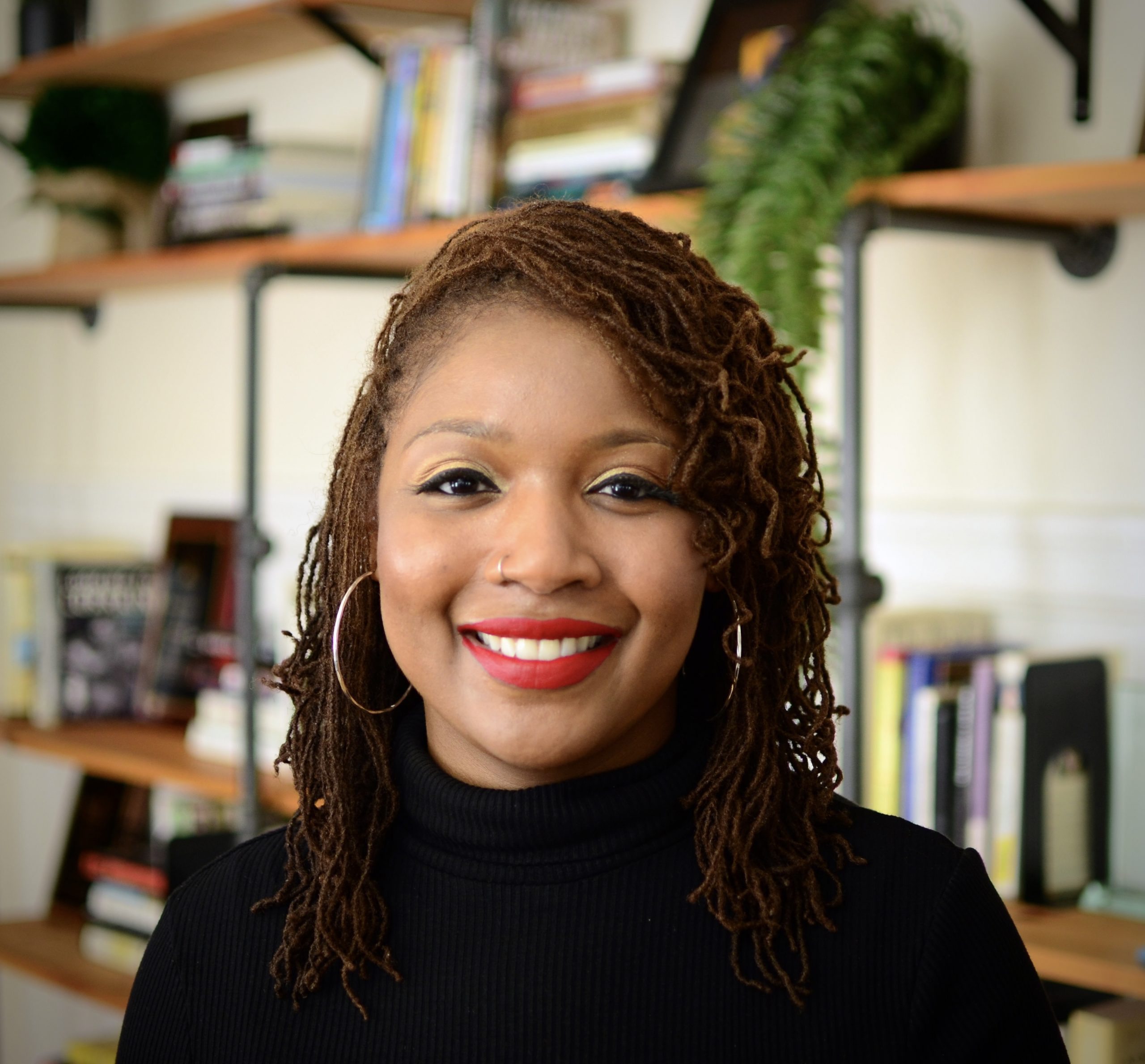
Christina J. Cross is an Associate Professor of Sociology at Harvard and a Visiting Scholar at the Russell Sage Foundation. Her award-winning writing has been featured in The New York Times and in leading sociology journals. You can follow her on Twitter: @christinajcross or BlueSky: @christinajcross.bsky.social. Here I ask her about her new book, Inherited Inequality: Why Opportunity Gaps Persist between Black and White Youth Raised in Two-Parent.
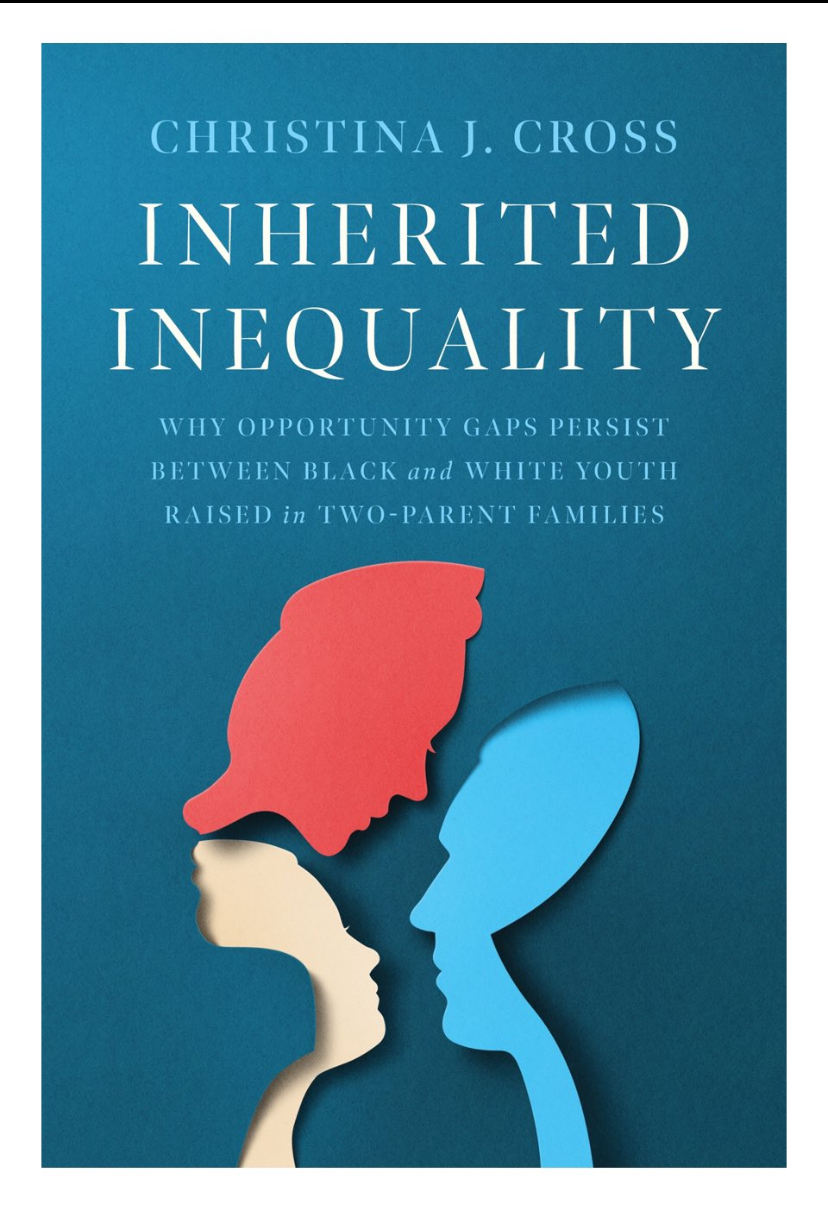
AMW: Many people believe strongly that growing up with two parents is the main way for children to be successful, and that it especially helps Black families catch up. But your book shows that even Black kids who grow up with two parents often face big challenges that white kids in similar families don’t. What was the biggest or most surprising thing you found that showed you the two-parent family isn’t the “Great Equalizer” people often think it is?
CC: One of the most striking and disappointing findings that I uncovered in my research was that African American children from two-parent families often experience the same outcomes as white children raised in single-parent families.
Black kids who live with both their parents have virtually the same rates of suspension and expulsion as white kids who live apart from a parent, and both groups have roughly the same average high school GPA and likelihood of on-time high school completion.
It’s bad enough that gaps in outcomes between Black and white kids from two-parent families are as wide as those between the average child who lives in a single-parent versus two-parent family—as I also find. But to think that Black youth who grow up with two parents in the home often find themselves in the same position as white children who experience parental absence from the home really speaks to the limits of the two-parent family for being an equalizer for kids.
AMW: The book talks about looking at the bigger picture around families, not just who lives in the house, but also things like racism, neighborhoods, and schools. Can you explain how things outside a family’s home can make life harder for a two-parent Black family compared to a two-parent white family?
CC: It’s undeniable that what happens at home matters a great deal for children. However, people tend to underestimate the impact of outside forces. And these outside forces can lead to enormous inequalities between children—even among those growing up with two parents.
For example, family income plays a critical role in shaping children’s later life opportunities. Research has shown that at every level of education, African American men and women are paid less than their similarly qualified white counterparts. And black-white gaps in earnings are higher among those with college degrees than for those with a high school diploma. If each Black parent brings home less money than their similarly qualified white counterpart, then pay discrimination is visited upon Black two-parent households twice. This results in Black couples having substantially less money to invest in their children’s futures. In fact, I found that by adolescence, African American youth from two-parent families have household incomes that are only 60% of their white peers who are raised in this same family structure.
Another area of social life that greatly impacts family life is schooling. I found that Black youth from two-parent families are two to four times more likely to be suspended or expelled from school than their white peers who grow up with both parents. These disparities in school discipline cannot be explained by behavioral differences between the two groups. My data show that both groups engage in similar types of behavior.
What does differ between Black and white children is how these behaviors are interpreted. Research shows that teachers are more likely to view African American students’ actions as threating and disrespectful than white students. This is another way in which discrimination leads to worse outcomes for Black and white children—even when they’re both raised in two-parent families.
AWM: For a long time, the common story about inequality for Black families focused on single parenthood. Your book presents a different understanding. What is the main, new “story” about families, race, and opportunity that you hope your book helps people understand?
CC: The common story treats African Americans as architects of their own fate. They have a harder time getting ahead in life because they have failed to embody the nuclear family ideal. If they could simply get married and stay married, many of the problems that they are facing would go away.
While it’s true that children who live in two-parent families typically have better outcomes than children who live apart from a parent, my book uncovers a critical, but all too often overlooked detail: the resources and outcomes of this family structure are not equally available to all. I found that even when Black and white children lived in the same type of family, their educational and employment outcomes differed drastically. This inequality of opportunity largely reflected resource disparities—like income, wealth, and parent’s mental health— between Black and white two-parent families. And these resource disparities are not random; they are a result of America’s legacy of slavery, racism and social exclusion.
I hope that my book will help to dismantle the common story and replace it with the one that more accurately reflects the experiences of the roughly 5 million African American children who currently live in two-parent families—and whose stories all too often go untold. My results show that even when African Americans live in the “ideal” family structure, the shadow of inequality looms large. Marriage is no panacea for racial inequality.
However, there are things that we can do to help level the playing field. My results show that Black children would perform profoundly better, and their downstream outcomes would dramatically improve, if racial disparities in access to resources were mitigated, and if the harmful effects of racism were redressed. Doing so would get us much closer to achieving the shared goal of generating greater equality of opportunity for the next generation—regardless of the type of family that generation is born into.
Alicia M. Walker is Associate Professor of Sociology at Missouri State University and the author of two previous books on infidelity, and a forthcoming book, Bound by BDSM: Unexpected Lessons for Building a Happier Life (Bloomsbury Fall 2025) coauthored with Arielle Kuperberg. She is the current Editor in Chief of the Council of Contemporary Families blog, serves as Senior Fellow with CCF, and serves as Co-Chair of CCF alongside Arielle Kuperberg. Learn more about her on her website. Follow her on Twitter or Bluesky at @AliciaMWalker1, Facebook, her Hidden Desires column, and Instagram @aliciamwalkerphd
Comments