
Reprinted from National Women’s Law Center July 31, 2024
Mothers working full time and year-round make only 71 cents for every dollar paid to full-time, year-round working fathers.1 This wage gap robs these mothers of $1,667 every month, or $20,000 a year. That extra $20,000 could pay for seven months of rent,2 seven months of family groceries,3 and five months of childcare.4 The wage gap persists across all education levels and in nearly every occupation, robbing mothers of the money they need to provide for their families.
The wage gap is worse for many mothers of color.
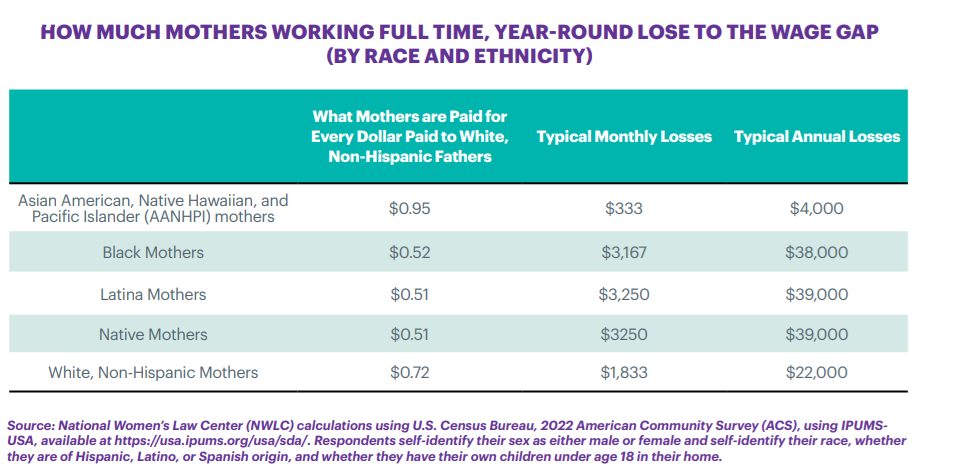
Racial inequities can compound the maternal wage gap.5 For example, Latina mothers and Native mothers working full time, year-round are paid just 51 cents for every dollar paid to white, non-Hispanic fathers.
Black mothers working full time, year-round are paid only 52 cents for every dollar paid to white, non-Hispanic fathers. These losses to the wage gap add up to tens of thousands of dollars lost each year, with Latina and Native mothers typically losing $39,000, and Black mothers typically losing $38,000 annually compared to white, non-Hispanic fathers.6
Two-thirds of mothers are breadwinners or co-breadwinners for their families.7
The loss of tens of thousands of dollars to the wage gap each year means less money for food, rent, education, and other necessities, as well as less, or no, money for retirement or for financial emergencies. Larger annual losses from the intersectional discrimination of the wage gap faced by Black mothers is especially devastating, as Black mothers are even more likely to be primary breadwinners for their families than their white, non-Hispanic counterparts: 68.1% of Black mothers are primary breadwinners for their families compared to 37.2% of white mothers.8 Furthermore, in 2023, the unemployment rate for Black mothers was 5.3%, but only 3.0% for mothers overall, meaning Black mothers face additional barriers to making ends meet.9 When including part-time and part-year workers, the wage gap for mothers is even worse.
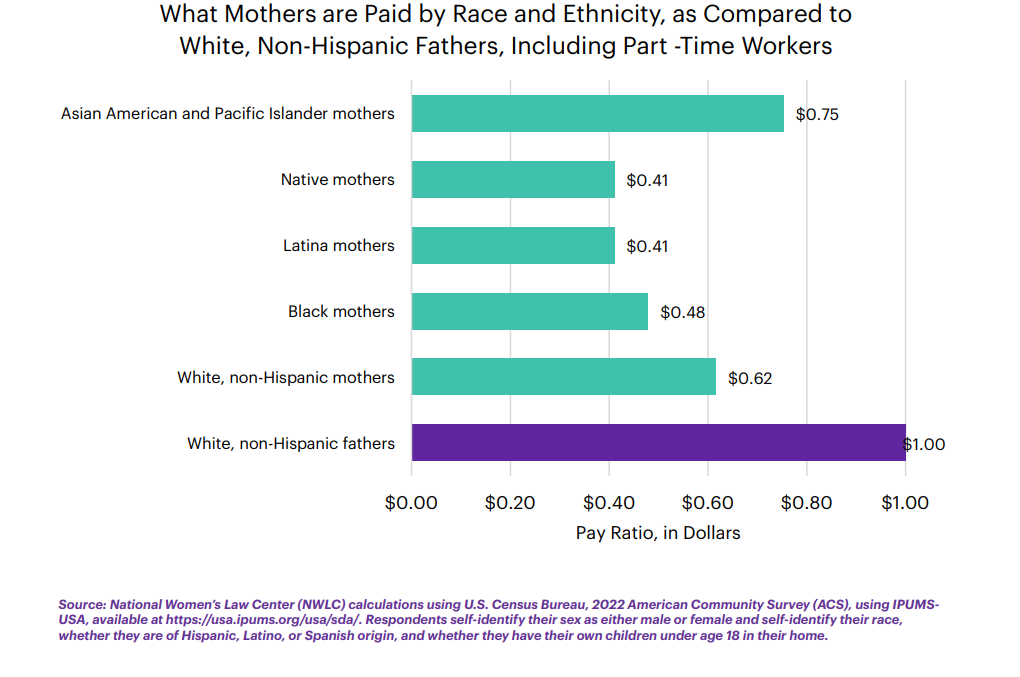
Two out of every three working mothers work full time and year-round, which leaves a significant number out of our analysis if we limit it to full-time, year-round workers. When looking at workers regardless of how many hours or weeks they work, working mothers are typically paid only 63 cents for every dollar paid to all working fathers.10 And yet again, that figure is deeply compounded by race. When including all workers, regardless of the number of hours or weeks they work, Native and Latina mothers are each paid a paltry 41 cents for every dollar paid to white, non-Hispanic fathers. And Black mothers are paid 48 cents for every dollar paid to white, non-Hispanic fathers.11
Educational attainment does not close the wage gap.
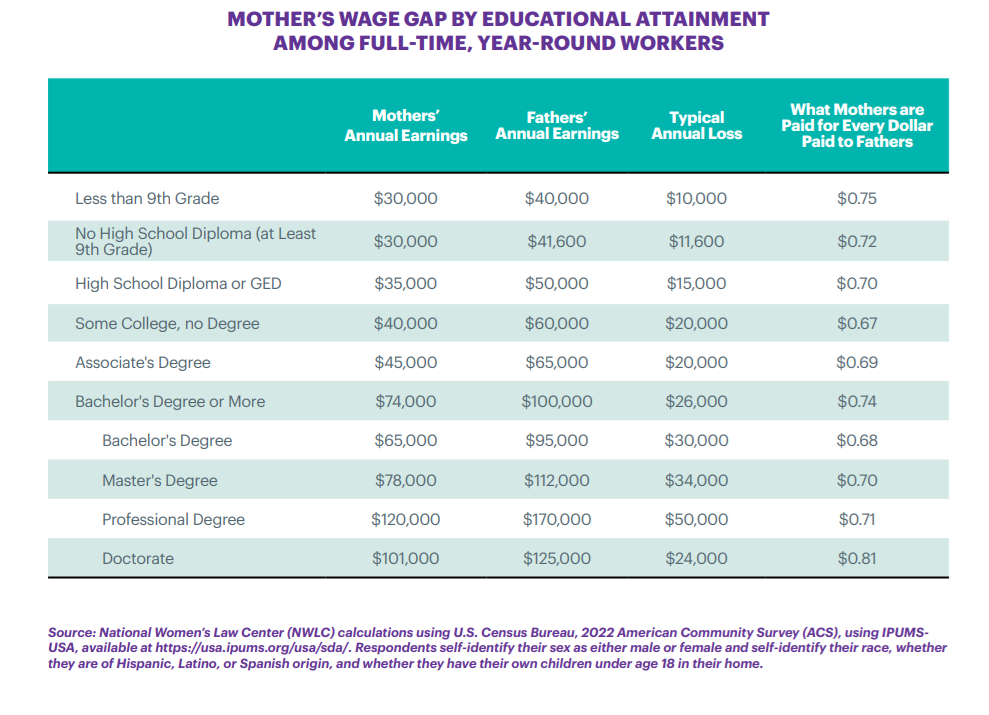
Although educational attainment is one of the primary paths towards economic stability, it does not close the wage gap for mothers. To the contrary, a higher share of mothers (48%) than fathers (42%) have attained a bachelor’s degree or more. Mothers with at least a bachelor’s degree are still paid only 74 cents for every dollar paid to fathers with comparable educational attainment.12
For many mothers, additional gains in education actually widens their wage gap. For example, among parents with less than a 9th grade education, mothers working full time, year-round are paid 75 cents for every dollar paid to fathers with less than a 9th grade education. Yet, mothers with a master’s degree are paid only 70 cents for every dollar paid to fathers with a master’s degree. In fact, mothers need to earn a bachelor’s degree ($65,000) to make more than fathers who hold a high school diploma ($50,000), and they must earn a doctorate ($101,000) to make more than fathers who hold only a bachelor’s degree ($95,000).13
Occupational segregation contributes to the wage gap.14
Nearly 3.2 million mothers work in the 40 lowest paying occupations, including caregiving occupations like childcare workers, home health aides, and personal care aides, as well as service industry occupations like waitresses, hostesses, and cashiers.15 These critical jobs are perpetually undervalued, with workers often making below $16 per hour while supporting families. Nearly two-thirds of mothers working in low paid occupations (63.0%) are mothers of color, and mothers of color are overrepresented in the low-paid workforce: mothers of color make up 6.8% of the overall workforce but 9.6% of the low-paid workforce.16
This occupational segregation alone does not explain the wage gap, however, as mothers typically make less than fathers even within the same occupations. Among full-time, year-round workers in low-paid jobs overall, mothers are paid 70 cents for every dollar paid to fathers, and again these figures are worse for many mothers of color. Among full-time, year-round low-paid workers:
Latina mothers are paid just 53 cents for every dollar paid to white, non-Hispanic fathers;
Black mothers are paid just 56 cents for every dollar paid to white, non-Hispanic fathers; and
Native mothers are paid just 58 cents for every dollar paid to white, non-Hispanic fathers.17
The maternal wage gap persists because mothers continue to face a range of structural barriers that result in lower pay, including discrimination, an ongoing care crisis, increasing restrictions on access to abortion and reproductive health care, occupational segregation, and more. The racist and sexist wage gap continues to rob mothers—especially mothers of color—of tens of thousands of dollars a year, money that could have been used to build economic security for them and their families. It is long past time to start paying mothers what they are owed and to stop robbing their families of the financial security they need.
ACKNOWLEDGEMENTS
The author would like to thank Gaylynn Burroughs, Sarah Javaid, Eun Kim, Erin Longbottom, Marissa
Moore, Marybeth Onyeukwu, Maria Patrick, Vasu Reddy, Jordan Reynolds, Katherine Sandson, Jasmine
Tucker, Arvia Walker, and Hilary Woodward for their design, review, and dissemination of this factsheet.
FOOTNOTES
1 National Women’s Law Center (NWLC) calculations using U.S. Census Bureau, 2022 American Community Survey (ACS), using IPUMS-USA, available at https://usa.
ipums.org/usa/sda/. Mothers and fathers are women and men with at least one of their own children under the age of 18 at home. Respondents to the ACS selfidentify as either male or female. Employed respondents are all over the age of 16. Median earnings include all workers who earn at least $1. Full-time, year-round is defined as workers who usually work at least 35 hours per week and at least 50 weeks per year.
2 U.S. Census Bureau, 2022 American Community Survey, Table DP04: Selected Housing. Median rent in 2022 was $1,300 per month. https://data.census.gov/table/
ACSDP1Y2022.DP04?q=DP04:%20SELECTED%20HOUSING%20CHARACTERISTICS.
3 NWLC calculations using U.S. Department of Agriculture, Food and Nutrition Service, USDA Food Plans: Cost of Food Report for Low, Moderate, and Liberal Food Plans
for MAY 2024, https://www.fns.usda.gov/cnpp/usda-food-plans-cost-food-monthly-reports. Figure is based on a low-cost monthly meal plan for a family of 4 including
one male and one female ages 19-50, one child ages 2-3, and one child ages 4-5 for a total of $807 per month
4 NWLC calculations using Appendix I from Child Care Aware, Catalyzing Growth: Using Data to Change Child Care https://www.childcareaware.org/catalyzinggrowthusing-data-to-change-child-care-2022/. The average price of child care for one toddler in full time care in 2022 was $10,853.
5 Respondents to the ACS self-identify their race and whether they are of Hispanic, Latino, or Spanish origin. Please refer to the ACS questionnaire for further detail.
6 National Women’s Law Center (NWLC) calculations using U.S. Census Bureau, 2022 American Community Survey (ACS), using IPUMS-USA, available at https://usa.
ipums.org/usa/sda/.
7 Center For American Progress, Breadwinning Mothers are Critical to Families’ Economic Security (March 2021), available at https://www.americanprogress.org/
article/breadwinning-mothers-critical-familys-economic-security/ This analysis uses a 5year data sample collected from 2015-2019.
8 Center For American Progress, Breadwinning Mothers are Critical to Families’ Economic Security (March 2021), available at https://www.americanprogress.org/
article/breadwinning-mothers-critical-familys-economic-security/ This analysis uses a 5year data sample collected from 2015-2019.
9 Unemployment rate – Women with own children under 18 ” https://beta.bls.gov/dataViewer/view/timeseries/FMUP4078853 and ”Unemployment rate – Black or African American women, With own children under 18” https://beta.bls.gov/dataViewer/view/timeseries/FMUP4092254 from the Bureau of Labor Statistics’ Marital and family labor force statistics from the Current Population Survey
10 National Women’s Law Center (NWLC) calculations using U.S. Census Bureau, 2022 American Community Survey (ACS), using IPUMS-USA, available at https://usa.
ipums.org/usa/sda/.
11 National Women’s Law Center (NWLC) calculations using U.S. Census Bureau, 2022 American Community Survey (ACS), using IPUMS-USA, available at https://usa.
ipums.org/usa/sda/.
12 National Women’s Law Center (NWLC) calculations using U.S. Census Bureau, 2022 American Community Survey (ACS), using IPUMS-USA, available at https://usa. ipums.org/usa/sda/.
13 National Women’s Law Center (NWLC) calculations using U.S. Census Bureau, 2022 American Community Survey (ACS), using IPUMS-USA, available at https://usa. ipums.org/usa/sda/.
14 US Department of Labor, “Still Bearing the Cost” (March 2024) https://www.dol.gov/sites/dolgov/files/WB/media/BearingTheCostReport2024.pdf
15 National Women’s Law Center (NWLC) calculations using U.S. Census Bureau, 2022 American Community Survey (ACS), using IPUMS-USA, available at https://usa. ipums.org/usa/sda/
16 National Women’s Law Center (NWLC) calculations using U.S. Census Bureau, 2022 American Community Survey (ACS), using IPUMS-USA, available at https://usa. ipums.org/usa/sda/
17 National Women’s Law Center (NWLC) calculations using U.S. Census Bureau, 2022 American Community Survey (ACS), using IPUMS-USA, available at https://usa. ipums.org/usa/sda/
Comments