

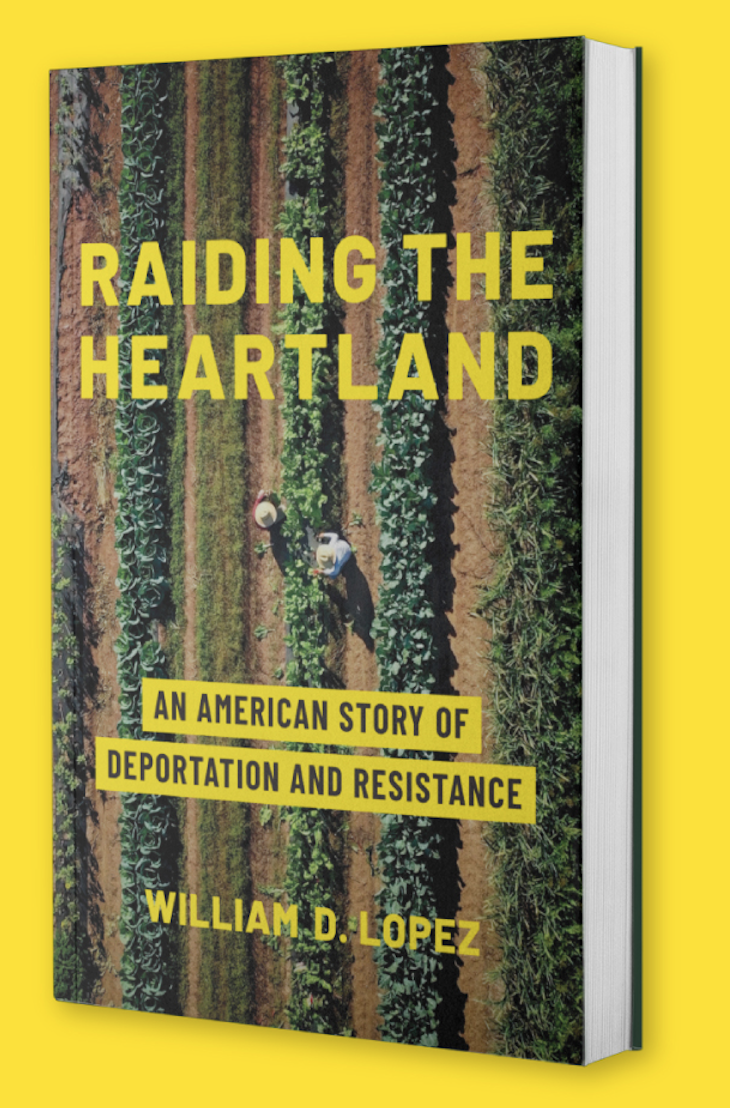
William Lopez is a Clinical Associate Professor at the University of Michigan School of Public Health and Faculty Associate in the Latina/o Studies Program. He is the author of Raiding the Heartland: An American Story of Deportation and Resistance, a follow-up to his award-winning first book, Separated: Family and Community in the Aftermath of an Immigration Raid. In addition to his academic research on the public health impacts of deportation, Dr. Lopez regularly contributes to the public discussions on deportation, diversity, and Latino culture in venues such as the Washington Post, CNN, San Antonio Express News, Detroit Free Press, and Truthout. He is on the Boards of Health in Partnership and The Latino Newsletter. He lives in Ann Arbor, MI, with his wife, two children, and pup. You can find him on Twitter: @lopez_wd and Instagram: @DrLopezOnImmigration. Here, I interview him about his new book, Raiding the Heartland: An American Story of Deportation and Resistance.
AMW: The book vividly documents the emotional and logistical labor shouldered by local organizers and everyday residents in the wake of these raids. What does this reveal about who is actually doing the work of “family preservation” in America today?
WDL: In the aftermath of worksite raids–and really, any form of detention and deportation–entire communities show up to support the families of those detained. Those with professional roles often go above and beyond what they are used to, working through the night and pushing themselves to use an entirely new set of skills. After worksite raids, in which dozens to hundred of people are detained, those who respond include journalists who travel hundreds of miles to cover a breaking story, lawyers who have never done immigration work but show up at raid sites, and certainly pastors and other religious leaders who open church doors to those who are too terrified to return home.
But much of the labor after a raid goes unseen by the larger public and lasts far longer than the media is able or willing to cover. First and foremost, it’s families who support other families when someone has been removed. This work often falls to mothers, as fathers are more frequently detained in worksite raids. These mothers must counsel their children coping with the disappearance of a father, find ways to replace the income of the absent breadwinner, and figure out what to do without a driver to help with the logistics of the home.
And let’s talk about educators. One thing this research made abundantly clear is that after families, our country’s teachers will bear the brunt of mass deportation. It’s teachers who deal with half empty classes after a worksite raid, teachers who comfort the students asking where all their classmates are, teachers who explain to students that the parents who dropped them off may not pick them up. It’s principals and superintendents who have to make sure that buses don’t drop students off in empty homes, who have to figure out if they throw away all the extra food uneaten in the cafeteria because students didn’t show up or if they hand deliver it personally to students homes, which we heard about multiple times. And it’s school districts who have to figure out what to do about the enormous gap in learning between their Latino and white students that show up when deportations increase.
AMW: Much of the public conversation about immigration enforcement focuses on the border or urban areas. What does Raiding the Heartland reveal about how enforcement operates—and is resisted—in rural America?
WDL: Uneaten meals.
If there’s one thing that sticks with me, that I hear about over and over in my work, it’s how many times people mention the meals left uneaten after someone is detained. Over and over again, those left behind after an ICE arrest tell me about the violent and traumatic moment the father or the cousin or the neighbor is taken. Then they tell me about the moment after, the loud silence of the person’s absence, the work day, school day, or day of errands cut abruptly short, and the meal left uneaten.
This image of the uneaten meal has become one of best, albeit painful, ways for me to understand and describe deportation in rural areas like Michigan, Ohio, Nebraska, or Iowa: it’s violent and traumatic, sudden, and shocking, and then utterly, bitterly lonely. It’s also intimately violating, happening during tender family moments sharing food with nephews and nieces or eating birthday cake at a party. After worksite raids, so many people are detained that there’s often no one around to offer help because everyone is desperately trying to take care of their own families. And because the Latino population is so small in many rural areas, unlike in the South, there are relatively few protests and media attention.
I know this isn’t part of the question, but if there was one thing I worry about constantly, it’s that the advocacy and organizing energy built after the arrests in LA won’t transfer over to arrests and detentions in the Midwest because our Latino and immigrant populations are so much smaller.
AMW: Your book title also calls these worksite raids an “American story.” How is this an “American story,” and not an “immigrant story”?
WDL: So much thought goes into book titles that I’m glad you asked! You know, in my public health work, many of us who work on immigration issues are always making the case that these massive systems–like the deportation system–don’t just impact the health of immigrants. They shape the health of everyone in the US by changing the structure of families, economies, and even things like cross-race relationships. But our work is often seen as solely relevant to immigrants, or to Latinos, or to Spanish-speakers, or to other statistical minority groups.
But deportation, especially the mass deportation the current administration is engaged in, impacts everyone in the US. It’s not something anyone can ignore. At the very least, mass deportation is going to take the buy-in of millions and millions of Americans, who will see their kids go to half empty classrooms, families separated by borders, due process disappear, and the arrests of protestors who oppose these.
Not only that, but the scapegoating and removal of immigrants has always been part of American history. Some of the removal strategies we see now are not new, they are just being used on a larger scale.
So that this is an “American story” implies that mass deportation will affect us all. But it’s also meant to be a call out: we’ve been here before. We know how this goes. We know what strategies politicians use to spread fear about immigrants. And if mass deportation is going to happen, it’s going to take mass public consent. I like to believe the public will refuse to consent. We certainly are seeing this pushback throughout the country, most evident at the moment in LA.
Alicia M. Walker is Associate Professor of Sociology at Missouri State University and the author of two previous books on infidelity, and a forthcoming book, Bound by BDSM: Unexpected Lessons for Building a Happier Life (Bloomsbury Fall 2025) coauthored with Arielle Kuperberg. She is the current Editor in Chief of the Council of Contemporary Families blog, serves as Senior Fellow with CCF, and serves as Co-Chair of CCF alongside Arielle Kuperberg. Learn more about her on her website. Follow her on Twitter or Bluesky at @AliciaMWalker1, Facebook, and Instagram @aliciamwalkerphd
Comments