

Ranita Ray is Associate Professor of Sociology at the University of New Mexico, where she holds an endowed chair. For 15 years, her research program has centered on youth, education, and gender and racial injustice. Ray is a 2019 National Academy of Education/Spencer fellow, as well as a 2018 Racial Democracy and Criminal Justice Network fellow. Her research has been funded by the National Science Foundation several times, including in 2018 when her team was awarded a large grant to study urban inequalities in Las Vegas. Slate, The Atlantic, The New York Times, the Las Vegas Review Journal, Las Vegas Sun, and the Las Vegas Weekly have featured Ray’s research and original writing. She is author of The Making of a Teenage Service Class, which won four prizes and is widely adopted for classroom use. In addition, Ray’s TED talk is often used by educators. And, Slow Violence was shortlisted for the 2024 Lukas Work-in-Progress Prize. You can find her on her website or on Instagram or Bluesky: @ranitaray1
Here, I ask about her new book, Slow Violence: Confronting Dark Truths in the American Classroom
AMW: In Slow Violence, you point to the ways school personnel including teachers often bully students in the form of racial harassment, anti-fat talk, gender based harassment and other forms of indifference and cruelty. How widespread is this and why isn’t there more conversation about this?
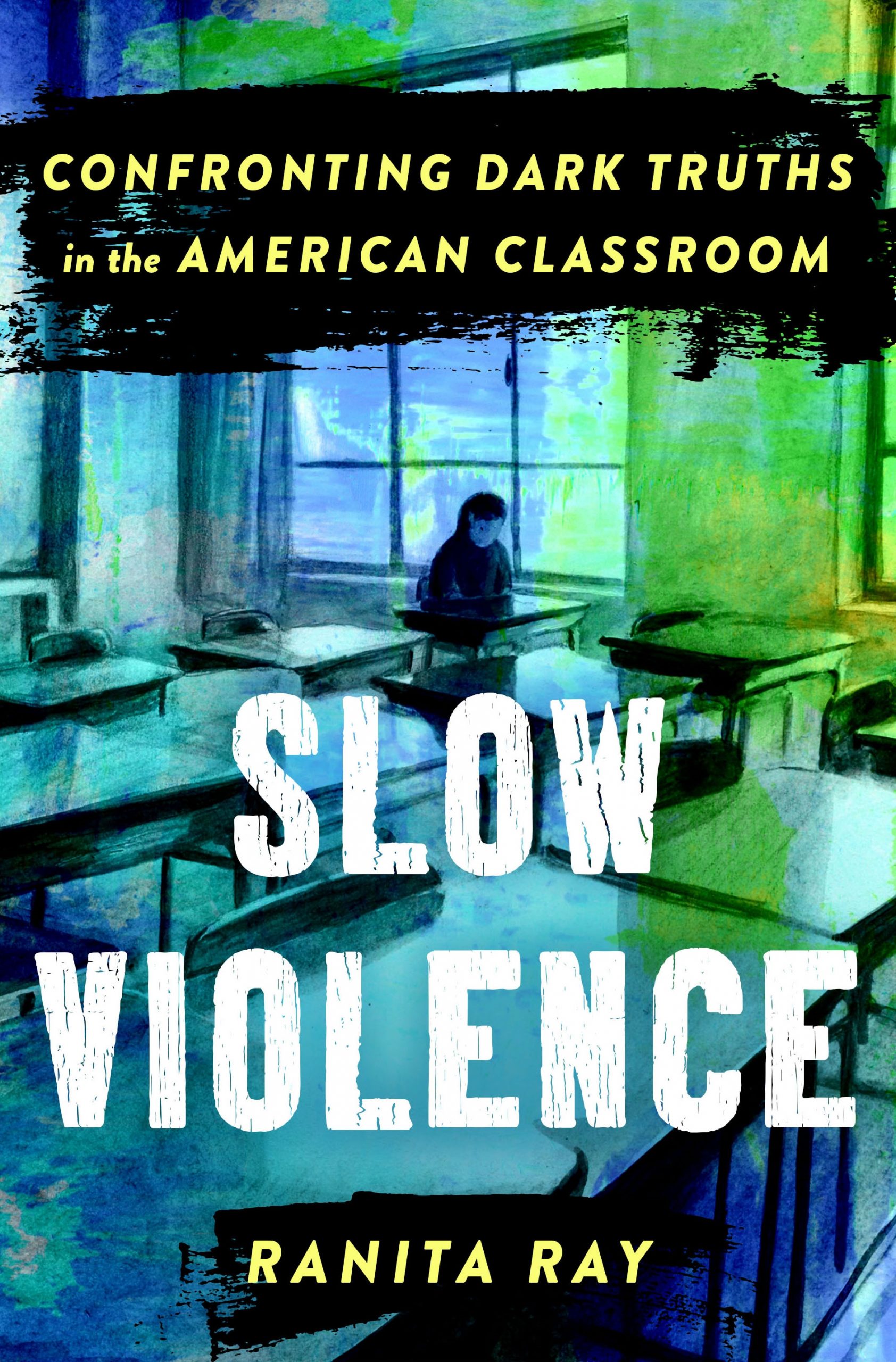
RR: Honestly, when I first entered schools in Las Vegas, back in 2017, I had an entirely different vision for the book that eventually became about the slow violence our most marginalized children encounter behind closed classroom doors. I wanted to write about resource-deprived schools with no textbooks or running air conditioning, and their underpaid and overworked teachers.
All of the above is still true and these are stories you encounter every day. We all know about the racial and class achievement gap, about underfunded schools, and underpaid teachers. What I was astonished to find, and the untold story I want to expose, is the breadth and depth of everyday racial, gendered, anti-immigrant, anti-fat harassment 10-11-12-year old children faced inside the classroom daily. Often, this was under the pretext of discipline and order. For example, teachers harassed one 10-year-old Black boy for googling a picture of two people kissing—which in the case of white children is considered average curiosity as I discuss in the book. For years, teachers cast him as a predator and implied his family was despicable because he had googled this picture. Brown immigrant girls were asked to summon grit when their parents were deported, and a Black math pro was asked to summon grit when her baby sibling passed away. When these girls of color grieved, they were cast as worthless and harassed. On the contrary, when a teacher grieved her friend’s untimely death during the Vegas shooting, she was granted all the grace (of course, deserved in all cases).
Not only were these extremely common place inside the two schools and many classrooms I spent time inside, but they are commonplace across the nation’s schools. We often see media stories (for example, a teacher walked over the backs of Black students during a lesson on Slavery or teachers who dressed as the “Wall” or the beating of disabled children—I cover these in the book as well). Social media is also replete with these conversations. When I wrote a piece for Slate on this issue, I heard on social media from marginalized people who had similar experiences. When I lecture on the topic, often people come up to me after to discuss their own experiences or those of marginalized family members or friends.
There is a dearth of conversation on this because we are so focused on constructing teachers either as paragons of altruism or evil people invested in inculcating liberal values in our children. Both these conversations justify their meagre pay—you shouldn’t get paid if you indoctrinate children with the wrong values and you don’t need pay if you do it as altruistic higher calling. Teachers are people. They come to the classroom with their strengths and their dark sides. And children often fall prey to their everyday anger, their exhaustion, their racism. And we don’t talk about this—this slow violence tears down the spirit, political consciousness, and the love for learning in our children. I followed a group of children for three years and saw how the most enthusiastic scholars became back-of-the room sleepers by the end of the year—many had been torn down by their teachers for little things.
AMW: Your book introduces the concept of “slow violence” to describe the cumulative, often unnoticed harm inflicted on marginalized students through routine practices in schools. Could you elaborate on how this form of violence operates within daily classroom interactions and the systemic factors that perpetuate it?
RR: First, Slow Violence is not physical or sexual violence, but it is often subtle/hidden (as opposed to theatrical), and it accumulates into grave harm over time. I draw this concept from environmental scholars who use the term to indicate the destruction of our environment over time that has serious consequences for ecosystems as well as marginalized communities (for example oil spills).
Inside the classroom, school personnel including teachers, for example, often mocked children, made racist, misogynist, anti-fat, anti-trans comments or belittled immigrant parents. Children are always listening to us. Even our four-year-old is constantly picking up on things we say. So, imagine the 10-11-12-year olds who heard these directly addressed to them or sometimes as water-cooler talks; they internalized these. One teacher mocked an “Asian accent,” another called immigrants “dirty,” and still another publicly humiliated one child assumed to be on the Autism Disorder Spectrum. One teacher chided two brown boys attempting to draw a connection between Rosa Parks and Colin Kaepernick—dismissing their bourgeoning political consciousness. These things happened on the daily.
One of the systemic factors that perpetuates this is, of course, that teachers are overworked and underpaid a lot of the times BUT this should not preclude us from talking about the grave harm they cause and should not allow us to erase the experiences of our most vulnerable children. For example, some will say that police have a hard job hence let us overlook or justify the violence they perpetuate. But many of us have now acknowledged that we cannot do that!
Also, we need to acknowledge that schools are workplaces and in this workplace teachers, who are workers, have enormous amount of power over children. They have almost unbridled authority behind closed classroom doors and when these children are the most vulnerable, this power is exacerbated. Power is always vulnerable to exploitation—why have we assumed this won’t happen inside classrooms? And why have we assumed that children being mistreated by teachers inside classrooms—where they spend almost 8 hours a day, 5 days a week, most months of the year—won’t be impacted by this?
AMW: How might schools begin to undo these harmful narratives? What structural changes within teacher training and school administration do you believe are necessary to disrupt these patterns and create more equitable learning environments?
RR: First, I think it is imperative I acknowledge the strength and importance of teachers’ unions. By the way, I should mention that while teachers’ unions have historically leaned democratic, there was overwhelming support for Donald Trump and JD Vance among teachers in the 2024 election (majority of teachers under 40 wanted to vote for them). Teachers’ unions can advocate for teachers—for better pay and better working conditions.
You see, research now shows that most teachers don’t want the job. And my own research shows that most of them did the job as a placeholder. They had other dreams and ambitions, and this was a job with decent and stable pay, and benefits and retirement. Many felt stuck in a job they did not want and punched down on students and their communities. Students paid a heavy price.
Much like other existing research on sexual harassment trainings in workplaces, I also found that antiracist and other DEI trainings often caused teachers to become further hostile. For example, one white teacher became angry that “white culture” was not valued in the same way as other cultures given that she had to celebrate Native American Heritage Month in her classroom but there was no white history month. Some teachers even mobilized language they learned through trainings to cause more harm—they would say something racist and then forgive themselves by stating it was just their “implicit bias.”
We must, then, remain vigilant in how we envision and operationalize these teacher trainings. But before all else, we must begin by hearing this other story about the classroom that is almost nom-existent in the public discourse. We must acknowledge the harm little children are enduring behind closed classroom doors before we can actually do something about it. We must ask: how is a teaching force that overwhelming voted for Trump (which, as someone who has been inside schools for a while, did not surprise me) treating our children?
Alicia M. Walker is Associate Professor of Sociology at Missouri State University and the author of two previous books on infidelity, and a forthcoming book, Bound by BDSM: Unexpected Lessons for Building a Happier Life (Bloomsbury Fall 2025) coauthored with Arielle Kuperberg. She is the current Editor in Chief of the Council of Contemporary Families blog, serves as Senior Fellow with CCF, and serves as Co-Chair of CCF alongside Arielle Kuperberg. Learn more about her on her website. Follow her on Twitter or Bluesky at @AliciaMWalker1, Facebook, and Instagram @aliciamwalkerphd
Comments