

Anna Kirkland has been studying law, health, and discrimination for twenty-five years. She is a professor of Women’s and Gender Studies at the University of Michigan and the author of multiple books and articles, many available for download on her website. Here, I ask her about her new book, Health Care Civil Rights: How Discrimination Law Fails Patients, which is out now from University of California Press and available free and open access. You can follow her on Bluesky @annakirkland.bsky.social
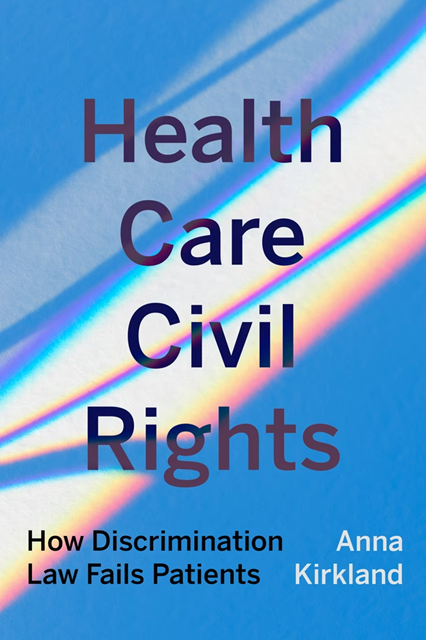
AMW: You argue that civil rights law in health care is “set up to fail.” Can you unpack what structural features of the U.S. health care system most undermine the effectiveness of civil rights protections, especially for trans patients?
AK: One way to think about this problem is through both push and pull – that is, what other operations and incentives in U.S. healthcare pull towards something else and what barriers and outright hostilities push rights away? The pulling incentives in healthcare that I focus on are patient safety and patient experience, and the ways laws incentivize those priorities through funding and accreditation. Now, it’s good to care about those things, but that’s not the same as thinking through how healthcare systems exclude, ignore, devalue, and harass trans patients in ways that go far beyond a patient experience or even a quality-of-care problem. But it also means that hospital administrators, for example, are doing a lot of things that seem like they might help but actually do not (issuing fake apologies but not fixing anything). And then they don’t see what they’re missing because they’re doing what is required. The push away from rights protections comes from many places. Catholic healthcare systems are allowed to refuse whole categories of care while taking public dollars. A right wing social and legal movement has installed very conservative judges throughout our courts and set up cases to block extensions of rights to trans people. The very structure of our government (every state gets 2 Senators regardless of population, for example) means that our courts have been able to become much more conservative than the median voter, for example, and we’re stuck with it. In addition, our healthcare system is a massive public-private partnership with insurance carriers and businesses and our federal civil rights bureaucracy has always been underfunded deliberately. So there aren’t many investigations and insurers are allowed to have their own rules about what they do and don’t cover. When there is regulation of these things, enforcement options are either weak or non-existent.
AMW: One of the most striking arguments in your book is that insurance companies—not courts or doctors—often end up deciding which civil rights matter. How did we get here, and what does that reveal about the political economy of health care?
AK: Most working age adults have employer-sponsored health insurance through their jobs. Trans people are more likely to be on public programs like Medicaid, but even so, most trans people have employer-based insurance, too. We got here for lots of reasons, but the main ones are that employer-sponsored health plans served a lot of interests historically, like presenting a group of people who were an organized set but not for any reasons related to their health but rather because of their jobs. Giving benefits instead of wages has also been a nice thing for employers to offer, especially when costs were lower. Another big reason is that doctors have opposed any kind of national health insurance alternative that would take away some of their independence. Once the employer-based system is in place and national health insurance efforts failed (and I mean back in the Truman administration), it’s very hard to change. Health care as an employee benefit managed by insurance carriers means that the care you get from your doctor is mediated by what your insurer will pay for. Insurers use sophisticated business practices combined with medical knowledge to say what’s medically necessary and to manage our usage of our health insurance. Laws regulate this, but in a federalist system that is fragmented. State insurance laws have some say, but national laws intervene over them and sometimes make it hard for states to protect rights or innovate. So you have all these layers of control: the corporate insurance carrier, your employer, state laws, and federal laws. These entities are very sophisticated, but the patient and the doctor often know very little about insurance even though people pay $9,000 as an individual or $25,000 for a family per year for it. Consider the alternative: we could have a national health plan and it could say what care is required for health equity. We would have to organize politically to say what that should be, and we should have a conception of rights, constitutional and statutory, that protect people even when their care is costly or politically unpopular. We don’t have any of that in place right now, and where we sort of have it, it is fragmented, privately determined, or undercut.
AMW: Many readers may assume that antidiscrimination law is a solid safeguard for vulnerable patients. What do you most want the public—and policymakers—to understand about the limits of current civil rights frameworks in medical settings?
AK: The main limitation is that there is no real enforcement mechanism for health care civil rights. The setting in which you may encounter discrimination has been subject to wildly shifting rules between administrations, and they may not be very well informed at all about your needs or their obligations. There is a structure in place to respond to your complaints, and if you feel comfortable, you should use it because they don’t want you to give them poor survey ratings. It may be a useless process, but you might find someone who cares who can help you. If you work for an employer that self-insures for your health benefits, you should consider lobbying them to improve coverage for things you need. Employers have been somewhat responsive to LGBT employees, employees with infertility, and others who want expanded benefits. They can change the benefits because they design them. Engage at multiple policy levels, from your own workplace to state civil rights boards to professional groups to national advocacy. Often when one area is hostile, others are more hospitable.
Alicia M. Walker is Associate Professor of Sociology at Missouri State University and the author of two previous books on infidelity, and a forthcoming book, Bound by BDSM: Unexpected Lessons for Building a Happier Life (Bloomsbury Fall 2025) coauthored with Arielle Kuperberg. She is the current Editor in Chief of the Council of Contemporary Families blog, serves as Senior Fellow with CCF, and serves as Co-Chair of CCF alongside Arielle Kuperberg. Learn more about her on her website. Follow her on Twitter or Bluesky at @AliciaMWalker1, Facebook, and Instagram @aliciamwalkerphd
Comments 1
paybyplatema — July 22, 2025
Insurers use sophisticated business practices combined with medical knowledge to say what’s medically necessary and to manage our usage of our health insurance.