Archive: Jun 2009

Notes from north of 49ºN.

I now live in a relatively small country, ranked 36th. in population, at 33.7M {versus 306.7M in the US}, but in the top 10 in terms of economies with a GDP of $1.3T {#9 ranking}, versus 13.8T for the US {#1 ranking}.  I mention this, as I wonder about scale and innovation, i.e., can smaller countries effectively compete in technology in a global environment?  One of my interests in innovation is biotechnology, a “new economy” area focusing on better outcomes for “health, the environment, and for industrial, agricultural and energy production.”  Advances in genetics are creating a race for companies and countries, with the idea of dominating the biotech field in order to enjoying profits and prosperity.

Last summer, I saw on a Canadian network a segment on how Canadian government investments in biotech were getting bought up by US firms, implying that the relatively small Canadian government was, in part, subsidizing innovations flowing south of the border.  The Matthew effect kicks in, as rich get richer and the poor get poorer, given that Canadian firms were being snapped up by US firms with deep pockets, transferring value southward.  According to a Globe & Mail article {click on license option}, another issue is that Canadian venture capital is lacking, so Canadian biotech firms often are capitalized by US venture capital firms that like to keep close tabs on operations and encourage offices/operations in the US.

Well, is Canada even a player in this biotech area?
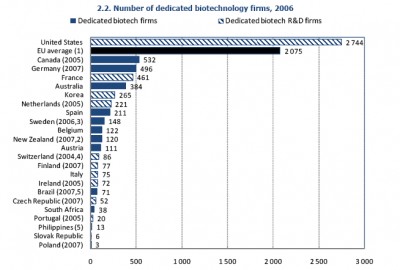
biotechoecd

According to 2006 OECD data, Canada is a player in terms of the number of firms {532}, the number of patents {ranked #6 in 2004}, and revenues {$83M}, along with an 11% compound annual growth rate {CAGR} of revenues from 1999-2005.

Given how collaboration and capital are now global, does it even matter where innovations are incubated?  A study by Bagchi-Sen & Scully {2004} is illuminating.  They divide biotech forms into two categories:: high R&D intensity and low R&D intensity.  Each has a different take with respect to strategies within the context of globalization::

  • High R&D Intensity:: Ties to local universities/Canadian researchers & collaboration with pharmaceutical companies, but desire global capital inflows.  Prototypical firm is in health theraputics.
  • Low R&D Intensity:: Emphasis on local production and development of Canadian market.  Focus on strategic alliances with foreign firms.  Prototypical firm is in diagnostics or agricultural biotech.

In terms of innovation policy, this brings up interesting food for thought for Canadian politicians in light of this recession.  Thanks to Barack Obama, Canada’s large neighbour to the south is pumping $21.5B of stimulus towards science and technology, which begs the question, how will this affect Canada?

It makes sense that Canadian policy would encourage the projects of low-intensity R&D firms with ties to the US, as these firms:: may be able to capitalize on relationships with stimulus-receiving firms, will develop innovations for the Canadian market, and will be focused on local Canadian production and manufacturing.  The high-intensity R&D firms could use funding {hint:: even more than $1B+CAN stimulus} that focuses on spurring innovations and the building of a sustainable base of Canadian talent and resources.  Dalton McGuinty’s {Liberal Premiere} efforts in Ontario might be a step in the right direction, but I’m not seeing clearly how this all fits together with an economic recovery plan.  Biotech. is not without risks, particularly with respect to agricultural biotech, which consumers are uncertain of.  Activists have alerted consumers with terms like “Frankenfood” for genetically-modified organisms {GMOs} and Monsanto’s lawsuits against journalists and farmers don’t help the cause.  So, maybe ag. biotech is a lose, but developing Canadian competitive advantage in innovations, in terms of other forms of biotech, nanotechnologies, clean energy, and green collar jobs, may provide fertile terrain for politicians and policymakers.

Well, enough of this talk of the “new economy” of biotech and innovations, what about the old economy, still prevalent in many parts of Canada?  Globalization has drawn Stephen Harper’s {Prime Minister} Conservative government into bailout fever to the tune of $9.5B, in order to secure that 16% of GM’s production remains in Canada.  This includes $3.1B that the Province of Ontario ponied up by Dalton McGuinty’s government.  Unfortunately, this might only save 4,400 jobs, after projected layoffs, according to CBC::


Given how the Tories and the Grits have played their cards in this {along with playing a current game of Federal “chicken”}, I see an opportunity for the NDP to make inroads with their platform based on developing new technologies and saving jobs.  Alas, more on “GMfail” and job losses in Canada in a future post.

So, it looks like nation matters, but in a global milieu.  Nothing surprising.  If you were to advise Canadian politicians, should new technologies {e.g., biotech, green, energy} be developed more aggressively {or at least explored} and does it make sense to commit billions to save jobs with an untested GM restructuring?

Twitterversion:: #newblogpost How should Canada compete {bio}tech, given globalzatn, US domnce, & recession? #GMfail bailout, good idea? http://bit.ly/18bBq8 @Prof_K

Song:: Genetic Engineering – Orchestral Manoeuvres In The Dark

Video::

José blogged about protests over the Iranian elections and this evening I noticed on Twitter that the hashtag “#CNNFail” was a trending topic::

cnnfail1

Another hashtag I saw was #MSMfail for mainstream media fail.  In the past, I’ve looked to CNN to have some coverage, but as one “tweet” noted, the switch from analog to digital TV was the big story::

cnniran

In Iran, Mir Hossein Mousavi, the  reformist presidential candidate who ran against Mahmoud Ahmadinejad has been placed under house arrest, riots have erupted, and telephone service has been cut.  This is a big story.  Are there just interns at CNN headquarters in Atlanta this weekend?  Twitterers have posted coverage by various news agencies and MyNewsJunkie noted the CNN failure.  One tweet had a link to another social media site, Flickr, with a slideshow of images from Tehran::

flickr

Well, if you believe the Daily Show, CNN is all over the social media out of desperation to get/engage viewers::

The Daily Show With Jon Stewart Mon – Thurs 11p / 10c
“i” on News
thedailyshow.com
Daily Show
Full Episodes
Political Humor Newt Gingrich Unedited Interview

Canadian viewers without a US proxy or HotspotShield can see the clip here, but go to 7min 40 sec mark.  Comedy Network won’t let me deep link to the exact spot on the clip.

CNN seems desperate to connect with viewers seems to be dropping the ball here.  ElleMac just let me know that someone at CNN directed Twitterers to the CNN International page, which has coverage, but as of 2:22 EDT, CNN.com has nothing on the home page, but there is one article on the  CNN.com/World tab.  On Twitter, CNN has nothing on Iran and CNNBrk has three tweets::

Crowds in Tehran break into shops and start fires as they protest re-election of President Mahmoud Ahmadinejad.

Are Twitterers being too hard on CNN and the mainstream media -or- is this just the state of journalism?  Is this a case of CNN not really understanding what it means to truly engage in social media?  There is content at CNN International and from CNN Twitterers, so why not be responsive 24/7?  It reminds me of an emerging social media adage I’ve been seeing.  You need to both shout & listen.

Twitterversion::  Lack of US coverge on Iranian election/protests/clampdown lead Twitterers to cite #CNNfail &#MSMfail. Too harsh or journalist #socmediafail?

HatTip:: ElleMac

Song:: Clampdown – The Clash

Post-election protests in the streets of Tehran.

Lots of fraud allegations going around.  I’m no Persia expert, but it seems that there is enough conservative, religious fundamentalist support (particularly in rural areas) to conclude that Ahmadinejad probably won, but these protests highlight a vexing governance problem.  What to you do when a majority in a country support illiberal regimes and policies?  Should the public be able to vote to curtail fundamental freedoms (speech, worship, assembly, etc.)?  In our country, we say no.  It’s hard to see these young people in the streets and not feel for their struggle.

HT: Richard Florida’s Atlantic.com blog

Draw your own conclusions. Of academic interest to me is how long will it be before an “Obama’s depression” narrative begins to stick. The stabilizing of the stock market and the improved health of the banking sector has allowed him to control the framing of the economy as “on the way up” despite grim unemployment numbers.

Startlingly broad-based support for the POTUS.

Let’s see how much of this support holds with the heavy lifting starts (health care, entitlement reform, etc).

HT: Richard Florida’s Atlantic Blog

The president has to be one of the most photographed in history. A look at his active Flickr stream will provide testimony to his ubiquitousness. This is a deliberate strategy by the white house to control message (and put the paparazzi out of business…two birds with one stone!)

But the downside of this visual feast of White House images is that your chin is exposed. Take this image of the president talking with Israeli Prime Minister Netanyahu:

Innocuous looking? It has apparently created a stir in Israel, presumably because showing the soles of your shoes in seen as an insult in the Arab world (i.e. the secret Muslim is thumbing his nose at Israel)!

Is this just acceptable collateral damage from an administration that bathes us in images? Or is this a signal that the administration needs to be more cautious about the POTUS’ presentation of self?

and I’m not sure how I feel.


With apologies to REM and to Bill Paxson in Aliens “It’s all over man!”  No more stodgy tweed-jacket with the patches lectures! It’s gonna be quick jump-cuts and machine gun guitar solos! Whoooo! Don Tapscott says so:

The old-style lecture, with the professor standing at the podium in front of a large group of students, is still a fixture of university life on many campuses. It’s a model that is teacher-focused, one-way, one-size-fits-all and the student is isolated in the learning process. Yet the students, who have grown up in an interactive digital world, learn differently. Schooled on Google and Wikipedia, they want to inquire, not rely on the professor for a detailed roadmap. They want an animated conversation, not a lecture. They want an interactive education, not a broadcast one that might have been perfectly fine for the Industrial Age, or even for boomers. These students are making new demands of universities, and if the universities try to ignore them, they will do so at their peril.

I take a backseat to no-one in my pedagogical “web utopianism.” Just in the past year I’ve used blogs, wikis, twitter, diigo, ning, slide rocket, netvibes, and any other Web 2.0 tool I don’t have to pay for. All this in the service of the “engaged classroom.” And when it’s good, it’s good. Students take control of their learning and blow me away with what they produce. But when it’s bad…look out!

But to me the more vexing question is whether we’re losing something profound when we lose an appreciation for the art of the lecture. I had a class this past semester where students had to sit through a lecture beforehand and to a person they came in jokingly desiring to “kill themselves” after having to sit through such drudgery. The faculty, on the other hand, loved it.

Throughout my life, I’ve gotten a lot out of lectures. I subscribe to a number of lecture based podcasts including UChannel and Big Ideas. To me, there is no substitute for someone who has mastered their subject area and can walk you through a topic in 60 or so minutes.

In all of our haste to embrace the learning styles of “digital natives,” we’ve haven’t adequately stopped to reflect upon what doing so means to education in general. For me, I’ve spend a lot of time emphasizing engagement…. but I don’t want to lose the challenge.

Bummer chart of the day….unless you’re in the military, or a devoted misanthrope.  new data from the 2008 General Social Survey shows declining levels of trust for every institution in the United States except for the military and education.

What accounts for this mass scale institutional distrust?  I think Robert Putnam has a book that talks about this stuff 🙂  One way of looking at all this is to weep for civil society and make the Putnam argument that this is evidence of a decline in social capital.  If we all had each other over for dinner, we’d trust each other more and thus trust the public institutions in which we all have a stake.

I think there’s a lot to this, but I’d offer we also this of this cynicism as increased expectations.  As society has become more inured to mass marketing appeals, we’ve become more desirous of more transparency and more effectiveness from our institutions.  This increased demand that our institutions produce more can be damaging int that they may not be designed to produce at a high level (I’m looking at you California government).  But they can also be the result of a sense of greater agency and efficacy amongst the public in general.

We’ve become a high standards people.  That can redound to our benefit if people back up their high expectations with a sense of engagement.  I fear that our “high expectations” culture is devolving into a flabby grousing about corrupt politicians without any real intention of addressing the problem.

HT: Social Capital Blog

A testament to the power of the contact hypothesis:

It could likely be the “big sort” in play….(i.e. people who are more tolerant of gays and lesbians are more likely to live in urban/metro areas so their tolerance has little to do with knowing gays and lesbians). It would be interesting to unpack this one someday 🙂

HT: The Daily Dish