Tag Archives: nation: Ukraine

International Comparison of Christmas Gift Spending

As we enter the last frenzied days of Christmas shopping, Dmitriy T.M. thought it was worth looking at international comparisons in spending on the holiday. The Economist posted a graph based on Gallup polls and other data sources about how much individuals in various countries in Europe, plus the U.S. and South Africa, plan to spend on Christmas shopping this year, plotted against national GDP. Overall, Christmas spending correlates with national wealth, with the Netherlands being a noticeable outlier (spending less than we’d expect) and Luxembourg in a spending league of its own:

 

The Culture of Combat Rations

Dmitriy T.M. sent in a New York Times slideshow of the contents of “MREs” from different countries.   MREs stands for “Meals Ready to Eat”; they are combat rations for soldiers. The rations are each some combination of comfort food, nutrition, and necessity.  And the different contents across countries reveal some interesting similarities and differences.

All MREs include some sort of meat, but the type and form of the meat vary, from meatballs to paté.  Meanwhile, almost all of the MREs include candy; it’s probably cheap, in the big scheme of things, to throw a few skittles, m&ms, or squares of chocolate, but what a treat it must be.  Likewise, the fruit-flavored beverages and tea must be a taste of home.  As for practicality, countries vary in whether they provide moist towelettes, toothpicks, tooth brushes.   Most offer matches; the U.S. includes toilet paper.

That said, the content of rations are also strikingly consistent.  I’ve love to see a flow chart tracing the development of MREs.  Were the logics for these rations developed in isolation?  Or were some countries influential over others?

These are my uneducated observations.  Feel free to offer more informed thoughts in the comments.


Finally, in honor of our submitter, rations from the Ukraine:

—————————

Lisa Wade is a professor of sociology at Occidental College. You can follow her on Twitter and Facebook.

Interesting International Comparisons Website

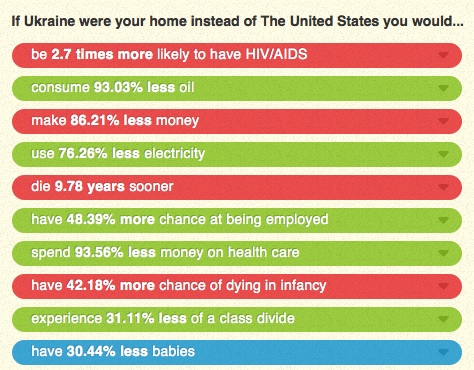
Dmitriy T.M. sent in a link to the website If It Were My Home. The site allows you to select two nations and then explains how your life would compare if you lived in each one in terms of rates of HIV/AIDS, employment, energy consumption, infant mortality, class inequality, and other factors (based on CIA data). As an example, Dmitriy chose to compare the U.S. and Ukraine, “the 2 greatest countries in the world, as determined by the poll conducted in my head”:

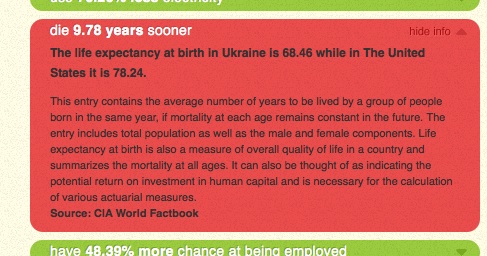
You can then choose one of the items for more details; I selected life expectancy:

The site is set up with the U.S. as one of the default comparisons, but at the top there’s a button that lets you select a non-U.S. comparison. (Note: Reader Parodie says it appears to detect whatever country you’re accessing the site from and set that as one of the default comparisons.) It’s a fun site that you can spend quite a bit of time playing around with.

UPDATE: Just a caution–a couple of readers seem to have found situations where the math doesn’t add up in the comparisons of some countries. And other readers noted that this does an enormous amount of averaging, which definitely hides the differences in quality of life in various countries, which are so extreme in some nations that “averages” might be nearly meaningless.

Chernobyl, Then and Now

Monday was the anniversary of the disaster at the Chernobyl nuclear plant, which occurred on April 26, 1986 in the Soviet Union (in what is now northern Ukraine, not too far from Kiev). Dmitriy T.M. sent us a couple of links to pics of both the plant and the nearby city, Pripyat. I don’t have much to add in the way of commentary, so I’m just going to provide some images and basic info.

A photo taken of the damaged reactor soon after the accident, held by the man who took it (found here):

Photobucket

Reactor 4 at Chernobyl today:

Photobucket

According to Environmental Graffiti, Pripyat was home to about 50,000 people. You would expect Pripyat to be entirely deserted, but it turns out it isn’t. Since 2002 people have been allowed to go there if they so desire; apparently it attracts some people who you might call “disaster tourists” who want to see it. And while no one can live in Pripyat itself now, “[about 500] people do live in Chernobyl, usually for a stretch of four weeks at a time before returning. That’s why Chernobyl today even has a hotel, two shops and a bar.” The shop:

Photobucket

The city in 1984:

Photobucket

And Lenin Square today:

Photobucket

Images of abandoned public facilities:

Photobucket

Photobucket

Much of the destruction of buildings wasn’t due to the nuclear accident or natural processes (rain, wind, etc.). From Environmental Graffiti:

…some of the older residents moved back to the villages around Chernobyl quite early. There are also the guides who show people around and a surprising number of looters, looking for anything valuable among the rubble or generally for trouble. As Timm pointed out, looters have raided Pripyat not from day one but certainly from early on, so that the decay we witness in the city today is pretty much manmade; nothing or few places have been left untouched since 1986.

Pine trees in the nearby forest turned a rusty-red color as they died from radiation exposure, earning it the nickname The Red Forest:

Photobucket

The area isn’t a vegetative dead zone as you might expect, however:

Maybe not so surprisingly, the vegetation in the zone of alienation has flourished. Like a strange nature reserve, flora and fauna have made the best of the situation without human interference and claimed their space. Scientists found that since 1990, growth flourished and the ecological effect has been positive. Eighty percent of the zone is now forested; before the disaster, it was just 20 percent. A total of 240 species of animals have been counted within the exclusion zone, most of which were present only in low numbers before the disaster.

Soviet authorities were so stunned by the nuclear meltdown, and so unable to believe that one of the reactors at their model nuclear plant had been destroyed, that Pripyat was not evacuated for three days, and it took a while after that to get everyone out, meaning many local residents were exposed to extreme levels of radiation for several days. Many  members of the local firefighting crews who responded immediately died from radiation exposure.

Apparently the other three reactors weren’t shut down and were still in use until fairly recently. The entire plant is now slated to be decommissioned, a process that will take about a decade according to current plans. The cement covering used to cap reactor 4 and prevent further contamination is already showing some cracks and will have major repairs or be totally replaced at some point in the future.

Chicks Dig Big Tanks


Crossposted at Jezebel.

Simon O. sent in this Ukrainian army video meant to recruit women:

The translation (taken from YouTube, and I think it’s a somewhat rough translation; I cleaned up the punctuation and spelling a bit):

Girl 1: Would you take us for a ride in your BMW?
BMW-driver: Even to the end of the world!
Soldier: Hey, I’d like to drown [drink?] some vodka, girls!
Girl 1: Just a second!
Girl 2: Where do you live?
Soldier: Right here- daytime at work, and at night in the clubs!
Girl 1: Which work???
Soldier: Contract, of course!
Blonde girl: Contract? Marriage contract or what?
Girl 3: Army contract, stupid!
BMW driver: Hey, don’t you wanna ride in my car?
Girls: Forget it, take yourself for a ride!
Narrator: It’s about time for new heroes! With contract-based service in Ukrainian armed forces!

Apparently the Austrian army thought it was awesome and made their own version:

Translation (again from YouTube):

Audi Driver: Hey girls, wanna go for a spin in my fast ride?
Girls: Ehh not sure, there’s not even enough space for all of us.
Soldier: Wazzup girls, in the mood for a joyride?
Girls: *Yaaaaay*
Soldier: Join the army if you wanna drive a tank.
Soldier2: Jump in, starting engine.
Audi Driver: Hey, what about the spin?
Girl: Forget it, I want to drive something big.
Narrator: The Austrian Armed Forces offer unique opportunities for young people who are at least 18, everything else is just everyday life.

Both versions play on the idea of women as materialistic, looking for the guy with the best car. Vehicles become a stand-in for masculinity; the bigger/faster the ride, the more attractive you are to women. And what’s more manly than a tank, with a long, phallic-shaped barrel? Women are simply entranced and can’t help running off after the biggest, strongest, manliest vehicle they can find…and, if we take the phallic imagery seriously, presumably the guy with the largest penis, too.

“Find Your Ukrainian Beauty Today!”

Toban B. sent in a link to UkraineDate, a website that lets men find hot Ukrainian women. Two images:

picture-12

picture-2

Of course, the site could be targeting men in any part of the world. However, it seems likely that it aims at men in wealthier nations in the West, particularly western Europe, the U.S., and Canada. Incidentally, these are the same regions that are the source of the vast majority of male sex tourists. Immigration from the Ukraine to the U.S. has also increased in the past decade; Ukraine is now in the top 10 nations of origin for immigrants to the U.S., with nearly 23,000 immigrants in 2005. And here in Vegas, the number of women from the Ukraine and Russia found to have been trafficked into the country and forced into prostitution (as well as those who came willingly to work in a range of jobs) is increasing. That’s a bit of rambling, but the point is, women from the former Soviet Union are marketed to men in the West in a number of ways.

As Toban points out, the dating site plays on the exotic qualities often attributed to Ukrainian and Russian women. Toban says, “the Ukranian women are presented as sex objects — and in accordance with certain standards of sex and beauty.” Certainly the site makes it clear that men aren’t supposed to to be interested in these women because of their intellect, personalities, or anything other than their beauty.

It’s a good example of the way that certain nationalities, races, ethnic groups, etc., are exoticized and portrayed as particularly attractive and sexual. In some cases, as with Asian women, part of the attraction is the stereotype that they are submissive and undemanding. I’m not certain, but I don’t think that particular stereotype is applied to Ukrainian and Russian women–in fact, I’ve seen them portrayed as high-maintenance and materialistic…but worth it because they’re hot.

Thanks, Toban!

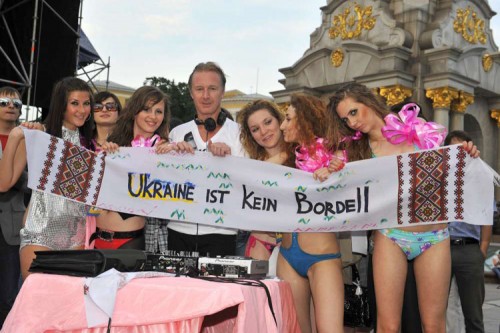
NEW! Elizabeth C. let us know about a protest against sex tourism in Ukraine, which included slogans such as “Ukraine is not a brothel.”

12015-1

They did so, however, by adopting PETA’s infamous tactic of using scantily-clad women, which may or may not have helped make their point.