
Archive: Tue Jan 2013

@bfwriter tweeted us a link to a college design student’s photograph that has gone viral.  Rosea Lake posted the image to her tumblr and it struck a chord.
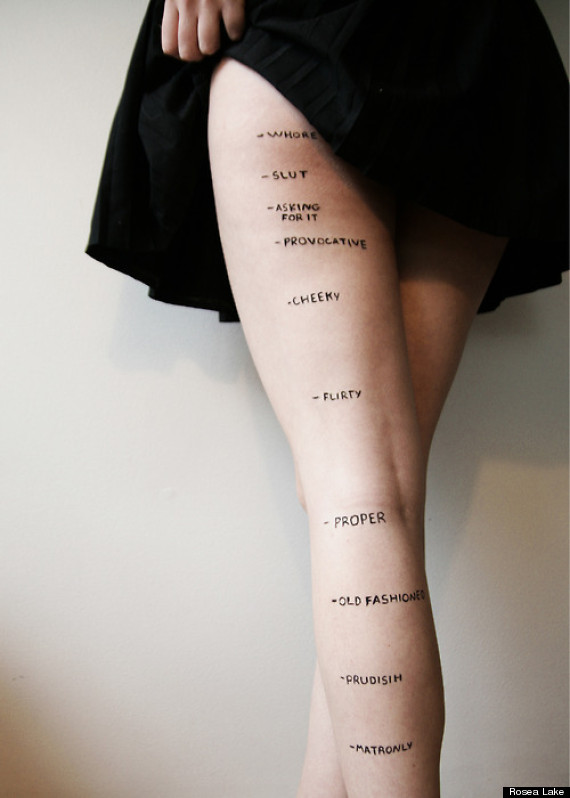
What I like about the image is the way it very clearly illustrates two things.  First, it reveals that doing femininity doesn’t mean obeying a single, simple rule. Instead, it’s about occupying and traveling within a certain space.  In this case, usually between “proper” and “flirty.”  Women have to constantly figure out where in that space they’re supposed to be.  Too flirty at work mean’s you won’t be taken seriously; too proper at the bar and you’re invisible.  Under the right circumstances (e.g., Halloween, a funeral), you can do “cheeky” or “old fashioned.”

The second thing I like about this image is the way it shows that there is a significant price to pay for getting it wrong.  It’s not just a faux pas.  Once you’re “‘asking for it,” you could be a target. And, once you’re reached “prudish,” you’ve become socially irrelevant.  Both violence and social marginalization are serious consequences.

And, of course, all women are going to get it wrong sometimes because the boundaries are moving targets and in the eye of the beholder. What’s cheeky in one setting or to one person is flirty in or to another.  So women constantly risk getting it wrong, or getting it wrong to someone.  So the consequences are always floating out there, worrying us, and sending us to the mall.

Indeed, this is why women have so many clothes!  We need an all-purpose black skirt that does old fashioned, another one to do proper, and a third to do flirty… at the very least… and all in casual, business, and formal.   And we need heels to go with each (stilettos = provocative, high heels = flirty, low heels  = proper, etc, plus we need flats for the picnics and beach weddings etc).  And we need pants that are hemmed to the right length for each of these pairs of shoes.  You can’t wear black shoes with navy pants, so you’ll need to double up on all these things if you want any variety in your wardrobe. I could go on, but you get the picture.

Women’s closets are often mocked as a form of self-indulgence, shop-a-holicism, or narcissism.  But this isn’t fair.  Instead, if a woman is class-privileged enough, they reflect an (often unarticulated) understanding of just how complicated the rules are.  If they’re not class-privileged enough, they can’t follow the rules and are punished for being, for example, “trashy” or “unprofessional.”  It’s a difficult job that we impose on women and we’re all too often damned-if-we-do and damned-if-we-don’t.

Cross-posted at Business Insider and The Huffington Post.

Lisa Wade, PhD is an Associate Professor at Tulane University. She is the author of American Hookup, a book about college sexual culture; a textbook about gender; and a forthcoming introductory text: Terrible Magnificent Sociology. You can follow her on Twitter and Instagram.
As a sociologist who happens to DJ — or is that the other way around? — I’m always curious to see how DJing is depicted in popular culture and advertising. Ever since the 1970s, when the disco craze helped push the prominence of DJs into the public realm, disc jockeys have become iconic symbols of nightlife culture. Within the milieu of the dance floor, DJs serve as what Sarah Thornton once described as “orchestrators of a ‘living’ communal experience.”

As such, the image of the DJ standing behind a pair of turntables has become ripe for appropriation by liquor and cigarette companies in particular. For them, especially in print ads, the DJ serves as a visual shorthand for any number of values they want their product associated with: culturally hip/cool, entertainment/musical mavens, the source of good times, etc. However, when it comes to that shorthand, this Smirnoff ad from last summer may have come up just a little too short.

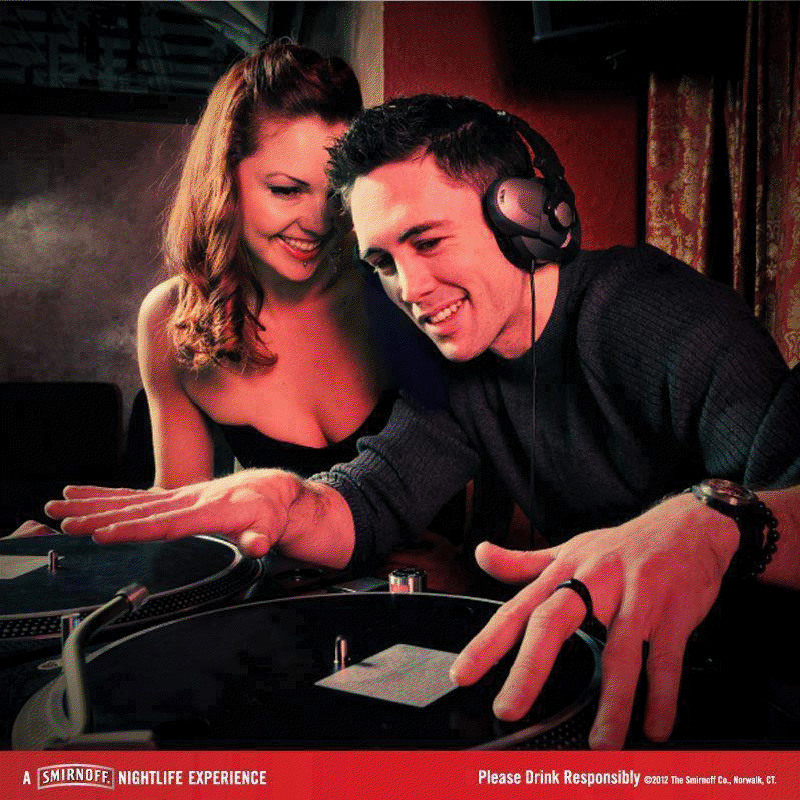
At first glance, this image of a DJ working the turntables, with a cleavage-baring admirer looking on, seems uncomplicated: Smirnoff promises a fun, sexy time. However, a closer examination of the mise en scéne yields some instant problems.

  • There are no records on the turntables.
  • There’s not a mat on the turntables. Especially in a nightclub setting, DJs always use felt mats that sit between the platter and record. This not only protects the vinyl surface from the platter but by reducing friction between the record and platter, the DJ can “slip” a record into play at just the right moment. Hence, felt mats are called “slip mats.” In short, it’s very strange to see a turntable without a slip mat.
  • There’s no needle on the turntable arm. Therefore, even if they had bothered to put records on the turntables, Mr. Hip DJ wouldn’t have been able to actually play them.
  • There’s no visible DJ mixer. The mixer is absolutely crucial, allowing the DJ to switch between two audio sources, i.e. what makes “disc jockeying” possible to begin with. Normally, the mixer would sit between the two turntables so its absence in the image is conspicuous.
  • The gesture — hands posed over both turntables — doesn’t make sense; it’s not a pose that any DJ would ever employ. Normally, you would have one hand on a turntable, the other hand working the mixer but no nightclub DJ would  be manipulating both turntables, simultaneously. He looks like he’s trying to play bongos. (A scratch DJ, aka turntablist, may work both turntables for certain techniques but scratch DJs aren’t typically nightclub DJs – hard to dance to someone scratching).

When this ad made its rounds on social media, theories were bandied about to explain just what went wrong in this ad. The most plausible explanation is that the Smirnoff campaign selected a stock image hastily but that still opens up the question of how no one, from the original photographer, to the people in the image, to the people working on the Smirnoff ad itself, seemed to realize just how ridiculous this image was. It’d be akin to a car ad where someone is pretending to drive a car… from the backseat. With the wheels missing. And facing the wrong direction.

Of course, the vast majority of people know what driving a car is supposed to look like. One conclusion one might draw from the Smirnoff ad is that while the basic image of a DJ has some resonance in the public imagination, as a practice/craft, DJing isn’t actually well-understood at all.

————————

Dr. Oliver Wang is an associate professor of sociology at Cal State Long Beach. He contributes regularly on music and culture for NPR’s All Things Considered, KPCC’s Take Two, the LA Times, and KCET’s ArtBound. He also writes the audioblog Soul-Sides.com.