
For the last week of December, we’re re-posting some of our favorite posts from 2011. Originally cross-posted at Jezebel and Owni.
————————
A few years ago my mom took a short-term nursing job at a hospital in the Sacramento area. This was a huge deal for her. She had never been to California, hadn’t lived outside of our rural area of Oklahoma since she divorced my dad when I was a baby, and had never worked at a “big city” hospital. She feared she wouldn’t be able to make it, that her rural hospital experience just wouldn’t translate. There were a lot of firsts for her, but it went well and the hospital administration told her they’d be happy to have her back. She was incredibly proud of herself, both for doing a good job and for being able to survive in California, a location trumped in the Big Scary Places sweepstakes only by New York City. It was an enormous confidence builder: she could leave her small town and she could make friends and keep a job.
And then, a few days before she was set to leave, she called me. Some of the staff had a little informal going-away party for her, and she was baffled by the card they’d all signed for her. It featured Jeff Foxworthy, the comic who made a name with his “You might be a redneck if…” schtick in the ’90s. The joke on the card was something about being a redneck if you used Hefty trash bags for luggage. But why, my mom asked hesitantly, would they give that to her? She’d never told them she liked Jeff Foxworthy; what made them think she’d want a card with him on it? And finally, in a plaintive voice that still just breaks my heart when I remember it, she asked me if it was possible they were implying she is a redneck, and that the people she thought were her friends were laughing at her.
Of course they did, and were. That doesn’t mean they didn’t genuinely like her or didn’t think she’s an excellent nurse, or that they meant to be hurtful; they probably assumed she’d get the joke, what with her accent, unusual colloquialisms, and openly-expressed awe and complete lack of irony or cynicism. But in fact, the idea that her new friends might view her as a redneck or a hick was a shock. She didn’t know what she might have done that would make other people think she’s a redneck. And I could tell she was terrified — afraid that instead of “making it” in California, she was actually a joke, and too clueless to know it.
I lied to her. I said I was sure it wasn’t anything specific to her, but was just because she was from Oklahoma, and Jeff Foxworthy is from the South, so they probably just thought everybody in the South or South-adjacent region likes him. I knew it would break her heart and totally destroy her new-found confidence to think that to a lot of people, she represented stereotypes of backward rednecks, not the hard-working medical professional she’d been working so hard to portray herself as.
I thought of that experience when I saw this postcard from Post Secret:
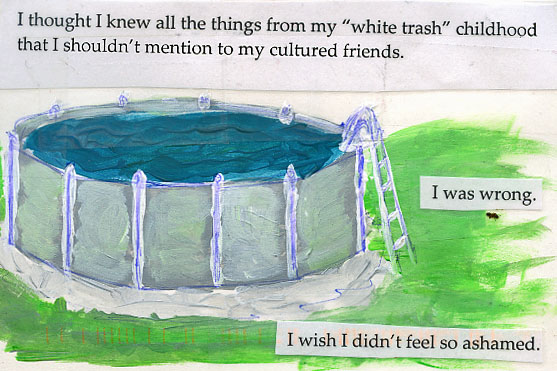
I’ve built up a lot more cultural capital than my mom, going to grad school and being socialized into the norms of academia. I mostly eradicated my accent when I was an undergrad, I figured out that Velveeta cheese was not an acceptable addition to a cheese plate at an upper-middle-class dinner party, and I learned that most people don’t view skunks, squirrels, opossums, or raccoons as animals you might potentially turn into pets, if you’re brave and really dedicated.
I don’t feel ashamed of my background any more, because I’ve achieved enough proof of upper-middle-class success — a Ph.D., a tenure-track job, the knowledge that Brie is fancy cheese and not, as my grandma thought upon seeing it for the first time, fish bait — and some useful theories, like the idea of cultural capital, to help me make sense of what’s going on.
But I recognize the sentiment expressed in the postcard — the ever-present possibility that you’ll un-self-consciously mention something from your childhood and be met with gleefully horrified looks and giggles, and not know what’s so funny about shrugging and off-handedly saying, “I don’t know if I really need to see a movie about it, I’ve watched my relatives do it tons of times” when someone suggests watching the documentary Okie Noodling. It’s an extra little mental effort you have to expend as you navigate social encounters, trying to imagine whether something as small as honestly answering a simple question like what was your favorite food when you were a kid might open you up to ridicule. It’s not really the laughing itself, which is often good-natured and comes from people who do honestly like you, that’s so bothersome; it’s the realization that you still don’t know the cultural rules, and thus can’t necessarily protect yourself from being laughed at even if you wanted to — or in my mom’s case, that you don’t know what it is you’re doing that makes you a redneck in other people’s eyes.
Comments 242
SB — July 4, 2011
These are the tricky waters anyone who was raised working-class or has ever spent any time in working-class type environs must navigate - whether or not you've risen through the ranks via tenure-track or advanced degrees or money or not, it's still mostly an upper-middle/upper world. For most of us, any outward proof of upper-classness no matter how recently or not-so-recently achieved, will never be enough to allay those nagging doubts and fears. I still worry that people are making fun of me, hesitate to tell people where my parents live, what my dad did for a living before he retired, and what my siblings do now.
A perfect example: My boss asked each one of her employees the other day, "What is your favorite place to vacation?" Each answered with something fairly banal: "Cape Cod." "Fiji." "US Virgin Islands." Etc. But I was tongue-tied. Favorite.. spot.. to vacation? I have never lived in a world where vacation is a verb, nor have I been anywhere of note often enough to call it a favorite. I can count the number of vacations I've been on on one hand - the number of vacations of the sort being discussed on one finger. As a kid, our family never went anywhere at all - we staycationed before it was a word. It was awkward and alienating and reminded me that no amount of money or outward signs of success will ever change the fact that some of my roots are blue-collar.
Sadie Wags — July 4, 2011
This is something I've had to deal with moving from rural Canada to Washington, DC. Those from back home consider me too big for my britches and in DC I am an uncultured oddity. I grew up relatively poor, worked my way through my BA and MA. Just about everyone I know here is well traveled and attended the best schools. There is so much tied to class here, and apparently there is something about me which gives off an air of 'grew up poor.'
There are things that I do and don't do that I assume are what everyone does and I have learned since moving to DC, that much of what I do is tied up in growing up poor and rural. Two incidents really stick out in my mind, which highlight this.
1. I was invited out by a friend to dinner with several of her friends. One of her friends had just returned from Morocco and she was telling the group about her trip. I asked where in Morocco she had gone and she said "Marrakech. Why, have you been?" She scrunched her face and burst out laughing, as did the rest of the group. It was humiliating. There was something about me that after 20 minutes she could tell I hadn't traveled the world.
2. Thanksgiving a few years ago I was cutting up cheese for appetizers at my in-law's house. One of the blocks of cheese had some mold on the corner. I cut the moldy part off and proceeded to chop the remainder of the brick. My in-laws gasped and asked me what I was doing. I explained and they were horrified that I was going to serve the remainder of the cheese. This is something I was used to doing and something I thought you just did with cheese.
It is almost as if I need to learn another way of being.
Yrro Simyarin — July 4, 2011
Of course, it works the same the other way as well. I joke with my suburb-raised friends constantly for not understanding how someone could not have a cell phone, or getting lost in the woods without a GPS, or not knowing how to fix *anything* without calling a repair man. My favorite was the argument I got into with a friend, who asserted that it was *impossible* to raise a family on (X number close to the poverty line) dollars, when the number she quoted was more than my dad made for years. (Not saying it's easy, but two parents and a supportive family structure helps a *lot*). And there's always the joke of the young teacher trying to understand what his students at an inner city school are actually saying. I'm sure the nurses from California would have received an equivalent hippie/surfer duuude card had they put in a temp stay in Oklahoma.
I'm surprised I don't see this analogy more, but really... to me it's the same as learning a foreign language. You need to memorize by rote a new set of cultural rules and expectations... but do we really obsess over whether someone catches your accent? No, you just laugh at how you're still learning, and file it away for future use. It's only when we assign arbitrary value judgments of "cultured" versus "ignorant hick/redneck/ghetto" to different cultures, and then judge ourselves based on those concepts that we run into these issues.
It's important to learn the rules for whatever culture you're in, if you're trying to live within it. But you should never consider yourself inferior just because you haven't learned all of them yet, just like you don't consider yourself inferior for not speaking Spanish as well as someone from Madrid.
Anonymous — July 4, 2011
I'm so sorry your mom had that experience, and that she felt badly about it. I live and work in Oklahoma, and it's been my experience that many people outside of our area don't really understand what rednecks are, and they don't get that it's an insult.
They probably only wanted something Okie themed to celebrate your mom, and that is often the perception people have of Oklahoma if they haven't been here (I've also been asked, by ADULTS, no less, if cowboys still had shootouts here, and if "Indians" still make raids and steal horses).
I'm sure they hoped she would like it. Unfortunately, they failed. I hope your mom can come to see that it was not about making her feel bad, or laughing at her, it was more like the cultural difference between England and France (which are closer physically than Oklahoma and California). Makes it worse because at least here, we all speak English and are in the same country, so you wouldn't think the cultural misunderstandings wouldn't be as big as they are.
Clueless people are found in every profession.
Anonymous — July 4, 2011
while i certainly understand where you're coming from, having grown up in the "upper poverty" class, i find it somewhat offensive. this entire blog's existence is about dispelling stereotypes and accepting people for what/who they are. or so i thought. but instead, i find this post to be a "be proud of who you are... unless you're in the wrong crowd". maybe those who snicker and giggle at the okie need to expand *their* horizons, as she was clearly expanding her's.
i'm a product of all those moments in my background and they've brought me to where i am and made me who i am. i have nothing of which to be ashamed. my cousins? they use their broken down cars for storage (ho, upcyclers!). my aunt? not only carried an entire pie *in her purse*, but passed little pieces out to everyone in the restaurant. when her gianormous console tv went out? she put a tablecloth over it and bought a smaller tv to fit on top.
these people are charming and so are the stories. i will *never* be ashamed of them. nor will i monitor my speech for signs of my ~lower class~ roots. if someone looks down on me for them, then they weren't people i'd really want to impress to begin with.
Anonymous — July 4, 2011
Interesting. As someone who just recently started interacting heavily with people from Californian, though, I want to throw out the idea that your mom's situation is just as much based on regional bias as it is on class bias; California (particularly the southern part) is so different in culture, education, and even infrastructure than the rest of the US, that it may as well be a totally different country. Plus, even when the media glorifies other regions of the US, fact is, a good majority of the American media is based in or filtered through California or the Californian viewpoint. They control the stereotypes of the rest of the country (world, really), but have no direct influence from those other areas. So, if the TV and movies says that Oklahoma is a barren land filled with small town hicks, that's what Oklahoma is to them. If someone from a large city in California had only been presented with the idea that people from small midwestern towns are clueless rednecks, nothing your mother did would have convinced them otherwise. And this California control of the media is evident in your mother's attitude as well; "making" it in California was a big deal, but that was compared to making it in a world city. Sacramento is absolutely nothing like New York City (I've heard people from larger California cities sniff at the "hicks" in the Sacramento area, which makes me laugh a bit at your mom's coworkers, honestly), but California is painted as a generic, urbane land of opportunity. In reality, her adapting to cities such as Chicago, Phoenix, New Orleans, or Miami would probably have been much more difficult than adapting to Sacramento. But those cities, despite being bigger, more urban, more dangerous, more cutthroat, and more relevant than Sacramento, all that registers to an outsider is "California!" as opposed to "Midwest hicks," "middle of the desert," "slow southerners," or "old people and Cubans playing dominoes." Southern California controls the media, and controls the idea that permeates the country is basically SUPER AWESOME CALIFORNIA, SUPER AWESOME NEW YORK, and flyover space inhabited by rednecks and corn. And they buy into it just as much as everyone else, if not more.
Anonymous — July 4, 2011
Ah yes. Been there. Of course mine is compounded with race but the story of Okie Noodling particularly resonates. Mine was/is "The Help." Um, I know black people who worked for wealthy, southern white women. It's not a "slice of life drama" for me. It's my grandma. Not interested.
Interesting read.
Azyzdryn — July 4, 2011
I find this article interesting because I grew up really poor for the first half of my childhood in Poland before immigrating to the US and then joining the lower-middle class in South Florida. I get the vibe that when I talk about my childhood others view me as more exotic because I came from another country. I find that really funny because once someone said that I was poor growing up because of Communism. The fact that people make this distinction seems so ridiculous to me.
Melissa M. — July 4, 2011
Interesting read and even more interesting comments. It all sums up why I love Paula Deen.
Grafton — July 4, 2011
I haven't really thought about it much, but I am very much bicultural in this respect -- I grew up poor and rural, but my parents were doing the back-to-the-land trip and the poverty came with the divorce. When you've got chickens on the doorstep but your dad's a college professor it's a little different.
My childhood with goats and chickens and pigs and broken down cars used as sheds, and the interesting skill and knowledge sets that such a lifestyle produces are viewed with admiration by my friends.
I was mocked for being dirty and poor as a kid, but it was obviously just a find-some-excuse thing, as some of the kids who did the mocking were equally dirty and poor. The only time I ever felt it was really bigotry was when a teacher did it, looking over my clothes and saying with scorn, "You can take the boy out of the country but you can't take the country out of the boy." That really disturbed me.
Leslie — July 4, 2011
This was a really interesting post!
My mom had a big hangup when I was a kid about making sure I didn't look like a hillbilly. It seemed like I was never allowed to wear anything I wanted to, because it was invariably too trashy. In fact, just last week she came from Ohio to visit me in DC and made me trim my hair because the ends were getting scraggly and "hillbilly"-looking. She came from a rural working-class family and was the first in her family to go to college. This post makes me wonder whether her hangup came from her early experiences at fancy liberal arts school and in her big-city MA program. I should ask her about it sometime.
Guest — July 4, 2011
Why is it that people equivocate getting a higher education with class?
Cocojams Jambalayah — July 4, 2011
As a child and teenager prior to going away to college, my family lived in government housing development (which were/are usually referred to in many parts of the USA as "the projects", at least that's the terminology I've heard among African Americans). Although I wished back then that I had the type of house and yard that I have now, I wasn't ashamed of being raised in the project.
All things are relative, and I considered the projects to be a number of steps ups from the bad housing in what I considered to be "the slums". Besides, back then, the projects-or at least the projects where I lived- weren't violent places to live as many are purported to be now. I was glad that I had grass and a tree in the front & grass in back of my house, and a porch that I didn't have to share with any other family (as some families in our development did). And since my family had the end house, I also had a "big" side yard so I thought that I was priviledged.
While I didn't look down on those people I considered to be poorer than me and my family, I admit that I did feel more special than the families in the projects and elsewhere who didn't go to church, and I felt special inside my church because my family was considered "elite" in our church. My grandfather was the head of the deacon board, and the Superintendent of the County Baptist Association of Education, and my mother was the Sunday School Superintendent and the Church Clerk. Furthermore, I was a twin, which gave me a certain amount of cache. But I was taught not to look down on people as there is always someone higher than you-and also because we are all children of God. While I seldom go to church now, those teachings have stayed with me. The point I'm trying to make is that not only are there different definitions for "priviledged childhoods", but that things some other people might not consider important may help protect a person from the putdowns that are bound to come your way -and as a Black person I was mostly indirectly taught that it's not whether insults would come, but that you have to be emotionally strong enough to keep on keeping on inspite of insults that would definitely come.
Anonymous — July 4, 2011
I have used trash bags to transport clothing, and I've helped to install a secondhand aboveground pool. I didn't know that that implied anything about my social class, although on reflection the phrase 'secondhand aboveground pool' sounds... rural(? What's a neutral term that incorporates the meaning of the colloquial adjective 'ghetto', meaning 'inexpensive, improvised'?). Also, for the record, I liked Jeff Foxworthy's material and wish he could have produced more than a tiny bit of it throughout his career.
I know that there's also a lot of the same thing going on in reverse; people from higher classes don't know the background to blend in with lower classes. I know I'm guilty that way: I STILL don't understand how anybody who needed a payday loan could possibly ever repay it, nor why designer clothing is more of a status symbol than a regular earned income.
Laughing Rat — July 4, 2011
That whole "they like you, but they still think it's okay to treat you as slightly less-than" thing is incredibly hard to navigate. Painful, too. I felt kinda sick, reading about that card and your poor mom's feelings about it all. That was really sad.
Aoirthoir An Broc — July 4, 2011
Wow.
By the Gods I love being Irish American, Southern and UNASHAMED of it. I've never felt one moment's shame in my entire life. Indeed if anything I'm constantly perplexed that people are perplexed that there might be people who think, live, feel, act and just plain are DIFFERENT from them.
So why should I be ashamed if someone thinks I'm a redneck or a hick or uncultured or too this or too that or wear black boots or don't or wear polo or wear leather or wear whatever? Indeed, the places that tried to judge me the most were supposed to be the most open people and the most rejecting of "controls" and "da man".
I say fuck all and let god sort em out. :D
Anonymous — July 4, 2011
Bit of a tangent, but this reminds me of how closeted people are treated in the Quiltbag community. I live in a university town, which means that most students come from outside and can live the rowdy student life without having to be held accountable. My country is also quite liberal on queer issues, and with the queer student alliance, I've realized that this is a bad combination; the issue of not setting up rainbow flags at the table for pub nights were brought up last year, and the reaction from the board was a combination of disbelief and grouchy compliance. The people that are supposed to represent queer students simply cannot wrap their head around the idea of being ashamed, or afraid of being outed, and even when they do, there's a disconent with losing visibility, even for social gatherings. This ties into class and ethnicity as well of course, as it's the exchange students and the students from conservative families that are affected by this attitude
Kygirl1943 — July 4, 2011
I am from Eastern Ky and came to Mi in 1964 with my newly married husband, People here did that to me the whole time I've been here and still do. Yes it hurt me a lot but I am keeeping my ky accent and they can like it or not, I really could care less. Now the yankees are moving SOUTH AND THEY ARE EXPERIENCING SOME OF THE SAME STUFF i DID LIVVING IN THE NORTH. What goes around comes around!!
Turingtested — July 4, 2011
My coworker and I are both from lower-middle/working class backgrounds, and we were talking about it today. I said, "Man, it sucks that having money makes you more interesting and cool. It's hard to say, put together an art show, or go on an exotic vacation when you make 12k a year."
She thought for a second and said, "You know what's really pathetic? We think 30k and a health plan is like, a really good deal."
Point being, we both know a lot of artsy, socially correct types who have the extra time to devote to worrying about what sort of cheese to buy, what drinks to bring to a party because their parents support them.
emjb — July 4, 2011
Thank you for your story, Gwen. And I don't get why anyone would have a problem with a kid doing their best to navigate class waters. I was the same way--even though I grew up in Texas, many people thought I was from the midwest, because I deliberately adopted that flatter, more neutral accent. Because it worked. Because I had already experienced people dismissing me for my gender, or ignoring a remark I made but praising a man for making the exact same observation. I was not going to further handicap myself by speaking in a way that would cause even greater problems for me.
It's a survival mechanism, an incredibly common one at that, and frankly if it's the biggest sin I ever commit, I'm doing pretty well.
Many many people have different ways of speaking depending on who they're with. My college roommate always knew when my mom called because I would drop straight into a heavy drawl with her. That didn't make me a hypocrite; I never believed that a drawl meant you were stupid. In a perfect world, it wouldn't hold you back. In my professional life now, in fact, it doesn't hold me back much if I want to speak more like a "real" Texan. But not everyone is in that situation.
Anonymous — July 4, 2011
What I find rather frustrating is when someone else casually divulges something which indicates their privileged background, and then _I_ feel insecure.
For instance, once a friend of mine was telling me about her brother's post-college plans. He was going to be doing something which wasn't a lucrative career path, but was admirable (I forget exactly what. Think Peace Corps or graduate school or something.). In talking about it, she says, in a proud tone of voice, "and he'll be living within his own means," as in, his parents were not going to be supporting him financially.
Technically, this was _her_ uncouth slip up, but _I_ felt insecure. My parents weren't going to support my post-college misadventures. The only reason they could support my college misadventures was because of a nice financial aid package.
Gilbert Pinfold — July 4, 2011
Two comments here:
This class insecurity never goes away. You and your ancestors will just worry about a higher tone of gaucheness as you climb the slippery pole.
And, the British have an important word for being overly sensitive to snobby putdowns: 'chippiness' (as having a chip on the shoulder.) It's worse form to be chippy than to be upwardly mobile.
Manasi — July 4, 2011
I was a very bright student studying in top college in India and I am from a very small town. My experience is that classism as an ideology accepts exceptions-when these exceptions are 1. Successful. 2. are conscious of their roots and their implications in different society. So when I openly expressed ignorance about or difference from social norms in upper class metro society and shrugged my shoulders- most people thought I was charming. It was because I was a topper or am now very successful in media world in Mumbai. My small town roots are considered almost ' chic' accessory differentiating me from others. But that is because of the success. I see literally hundreds of times when people from not- so- good backgrounds ridiculed and not- accepted- really, because they want to be part of the chic but lack the right accessories.
Anonymous — July 5, 2011
Okay, off-topic, but Aoirthoir, have you considered getting a blog? I've kind of given up on reading the comments here since you showed up and started monopolizing every freakin' thread. It's really quite irritating, and I imagine I'm not the only one who feels the same way. >.>
Linda — July 5, 2011
Thank you for this post! (very well-written as well) I can recognize this. I am very proud of my family and my background, but nevertheless I have changed my habitus so much since going to university and moving south to a big city.
Now, I'm nearing the end of my education and I do feel self-conscious about not coming from a family of academics. Though Sweden is much less of a class society (differences in income, circumstances and education are still rather small) than many other countries, there are still different markers and ways of being that I have had to master. (I remember, when I went to high school, my first boyfriend's family were drinking port wine after dinner and that seemed extremely sophisticated from my point of view.) I agree with you, Gwen, there is always still an element of insecurity weather there's something one has missed.
There's something here, though, which seems less apparent in your stories, we have a rather strong pride in being working class in Sweden and that mitigates class issues. The working class is seen as honest, hard-working, true people. During my years of living in a student dorm, when my parents came to visit, my mother would always comment that the shared kitchen was messy because "...city people are dirty, not clean like people who come from the countryside".
What about you - don't you have similar stories that mitigate class difference and repositions it?
Raya — July 5, 2011
But why is this type of pool something that is "White Trash"? What is it supposed to be? (It is supposed to be a swimming pool, right?)
Editor — July 5, 2011
Another doctor teaching moment where the doctor doesn't get the content information they are discussing.
At every level and every imaginary point of hierarchy in society there are perceived and cloaked insults. Your mom is quick to perceive an insult that the deliverer's either thought she wasn't smart enough to notice or that she could share in the novelty of being around someone that introduced another culture to the mix. The good news is that they thought enough of her to communicate directly, where you betray her respect for your thoughts by lieing to her and offering that tell about your own self-important personal slight about the social level you've escaped. Show your mom your article and see if you ever get tenure in her eyes.
Personal Failure — July 5, 2011
I, too, have eradicated my accent because I knew that people in PA viewed me as stupid and slow because of it. It only comes out when I'm angry or drunk now, and that makes me sad. I can't even mimic my own accent after all this time.
ANONYMOUS JANE — July 5, 2011
Some people dont.. but i get it,, you made me shed a tear,, ive had to stop hangin with some of my friends,, not because of shame or them not getting me,,, but.. just too many situations where,, im out of my element,, or i have to explain,, my not well-off way of doing things,, or I cant just go to dinner whenever,, becuse i dont have $2000 in my bank any givin day... its embarrassing to have to expain to people,, im poor,, i cant go,, so u just stop hanging out entirly,,, its sad,, and i miss some of them,, and some people will say,, do things that dont cost money.... but in the same respect... My richer friends are used to doing things that they pay for,,, So I ask U,, how many Rich or well off people do u know that like to find Free or cheap things to do,, they've never even Eatten kraft Dinner...:P But in all seriousness,, Im happy for my experiences,, theyve made me who I am,,, and I LOVE ME :D XOXO
Wozn — July 5, 2011
I've had the exact same experience as Gwen, being a small town, Church-going, country-music playing, insert-more-stereotypes-here Iowa boy in Academia, and while I know this experience is not unique, it's always great to hear you're not alone in such things. And like Gwen, I went through a long experience of trying to hide where I was from until I realized the problem was not with me.
And while I'm tempted to jump in the flame war going on here (liberals once did something wrong! All leftist ideas are therefore automatically void!), I'll instead just throw in one of my fun fish-out-of-water stories:
My first semester in grad school I was in a long seminar that fell over the noon hour, so we'd always have a short break in the middle and people would take turns bringing in food to share. One day someone had brought in varieties of hummus (of course), and I just took some of the chips and had a sad little plate of nothingness because I thought the hummus looked a little too strange and exotic for my tastes.
Someone noticed I wasn't really eating anything and asked my why I didn't try whatever type of hummus there they thought was great. When I answered that I'd never had hummus, it was like a needle scratching off a record in a movie as several people loudly exclaimed they could not believe I'd never had hummus. Making matters worse, I asked what was in it. When they told me it was garbanzo beans, cumin, and some other things (all traditional ingredients in Mexican food), I made the mistake of saying "Oh, is it some kind of Mexican food?"
And like a bad scene in a teen movie, I literally had a room full of people pointing and laughing at me. Of course, my defensive response that we don't get big-city asshole food in Iowa didn't help anything, but it was a god lesson in cultural competency.
Oh, and it proved that all leftist intellectuals are actually corrupt judgmental assholes and we should never listen to anything they say, or something like that
Katy Melchiori — July 5, 2011
My parents were from Russia, my Dad was a coal miner, my mother spoke very little English. My Mother was 42 when I was born all my girl friends in school had much younger parents, as I recall that was the only thing that set me apart from the other children. As I grew older I became proud of the fact that I could speak another language, and the fact that we were very poor and lived in a small mining town and we were loving caring people I never felt inferior to anyone. My frinds came from all back grounds. My Grand dughter just recieved her masters in Psycology, and I remind her that I graduated high school in 1949 and that's it no college so use no ig words on me just common English and I will understand. If You are a good person don't let where you come from get in your way.
Anonymous — July 5, 2011
There's always the possibility that your mom's coworkers did not mean to insult her at all and did, in fact, just assume that she would enjoy Jeff Foxworthy's humor (that assumption itself may be mildly offensive, but not insulting) . I'm nowhere near a "redneck", but I found Foxworthy's schtick amusing (at least, for the first few iterations).
I doubt the card company decided to license Foxworthy's image and joke for the purposes of making a "hey, you're a redneck" card. More likely, they, and your mom's coworkers, were thinking "Jeff Foxworthy's a popular comedian".
It may be a valid question if her coworkers would have gotten the same card for someone not from the South. But, without asking them, that's just an intellectual exercise. It's also a valid question, I think, if your and your mom's reaction would be the same if you weren't from the South. If someone got me such a card (hailing from the Northeast), I wouldn't wonder if they were calling me a redneck, I'd wonder why they took me for such a fan of Jeff Foxworthy's to get me a card with him on it.
Often there is no deeper meaning to events but that which we choose to infuse it with ourselves.
anonymous — July 5, 2011
I think it's interesting to note that it also works the other way around, though it's usually less sympathy-inducing. I grew up "comfortably" but have always hung out with people whose family had a lower income because I related to them more in my interests (comics, weird movies, science fiction), and found the kids at my fancy private school to be fake and everything I strive not to be.
I made a point when I graduated college to pay my own way even though I had the option to leach off of my parents like the other kids who graduated my high school. I try not to mention that my parents have three German cars, a vacation home, and that I was required to have a laptop in high school, because I'm afraid my friends will see me as one of the stereotypical rich kids I went to high school with instead of a mid 20's college grad who does overtime almost every day to pay the bills for the apartment shared with two other roommates.
Anonymous — July 5, 2011
My childhood is straight out of a "white trash" stereotype manual. Lived in a trailer, wore the same winter jacket for 6 years, Dad drank a lot, many mullets in my extended family..ETC, ETC. I totally relate to this story. Thanks for posting!
Anonymous — July 5, 2011
Laugh at them back. There is hardly a force more powerful in America than the culture of the South - if we can divorce ourselves from the tyranny and atrocity it masked, we are the true Americans.
Nicole Dunham — July 5, 2011
After reading and *skimming* the comments, here are my few cents worth:
I never realized that I came from a "poor" family until I went to a private liberal arts university for my undergrad. I somehow managed to make it to my senior year before making this realization. I wasn't oblivious, of course: I noticed that many of my classmates had a different worldview and seemed to be taking their education for granted. While studying abroad in Europe, my classmates would take weekly trips to various destinations in Europe with their parents' credit cards while I hung around in my host city saving every single Euro centime I could (which, of course ended up being advantageous in terms of language skills for me).
Then, in a linguistic anthropology class, our professor asked us to define lower, middle and upper class. The class mostly agreed that it should be decided based on income and as they were giving their numbers, I realized that my family was poor, and not "middle class" as I had always thought growing up in rural Maine. In my town, the measure of rich and poor is completely different: you're poor if you receive state aid, you're middle class if the family does not receive state aid, and you're rich if you don't receive state aid AND have extra time/money for recreation. I always thought I was middle class: it was a big shock to find out that my family wasn't even close to even the "lower" middle class.
In my town, my mother is a very respected figure, having worked as an EMT for over 20 years, having owned a convenience store and now as the owner of the region's only *reliable* taxi. But, among my college friends and their parents, she stands out. She has a different accent and uses regionalisms, her dressy clothing isn't all that dressy compared to middle class standards, she's worked some pretty tough jobs with sub-par healthcare (before being self-employed): she's been sun burned and frostbitten so many times that no amount of moisturizing cream is going to help. I'm not ashamed of her: I'm PROUD of my mom.. but I know that she feels quite awkward in the situations where I thrust her into a middle class situation like that. Her points of reference are so different from theirs that they really have nothing to talk about together... except perhaps politics.
One last thought: one of the commenters talked about low income folks getting through grad school by "passing" as middle class before "coming out" as poor. I think things may have been shifting in the past few years: now coming from a low income background is kind of a feather to put into your hat. I've witnessed some pretty disturbing discussions to find out who comes from a poorer family--as if the one who came from the poorest background deserves to be in grad school the most. I won't touch those discussions with a ten foot pole! Other than that oddity, most of my peers in grad school don't seem to care about where or how I grew up. All in all, the culture shock isn't as great as it was for undergrad. The only time I run into problems is with the occasional professor saying something like: "Why don't you ask your parents to help you pay to take summer classes?" or "Why are you wasting time working over the summer when you could just live with your parents for free?"
Carrie Padian — July 6, 2011
Life is too short for this kind of shame. Sure, the cultural rules are different in different parts of the country (or more or less rural areas) but that doesn't make one more right than another. You grew up where you grew up. Your past was your past, and it's just as valid an experience as anyone else's. Set your own standard.
JD — July 6, 2011
Thank you for this post. In a way, it was a little tough to read, because it brought up a lot of uncomfortable memories; but it's reassuring to know others sometimes feel the same way.
Liza Shankar — July 6, 2011
Amen.
I very nearly cried reading this.
whatafy — July 7, 2011
It's important to learn the rules for whatever culture you're in, if you're trying to live within it. But you should never consider yourself inferior just because you haven't learned all of them yet, just like you don't consider yourself inferior for not speaking Spanish as well as someone from Madrid.
Glazed Walnuts — July 7, 2011
All i see when i look at Aoirthoir's posts is a bunch of ZZZZZZZZZZZZZZZZZZZZZZZZZZZZZs.
Seriously man, having a dialog means you consider other people's opinions and ideas and don't just spout off yr own at the drop of a hat. People who have strident opinions on everything are usually borish egotists who like ot hear themselves talk/pontificate at the expense of everyone else's time, sanity, and patience.
Also "working since the age of 12" sounds impressive I'm sure, much better than clarifying that those jobs were mowing lawans, paper route, etc. just like a million other people. You try too hard to sculpt yr background into something radical and a-typical.
Donna Y — July 7, 2011
My PhD supervisor and I have actually had long talks about cultural collateral...
I think I mostly felt the shame as an undergrad in Boston...and it was mostly food that did it to me. The things I had never eaten before, finding them so special. I can remember eating tofu from a chinese take out and thinking "wow". Trying new types of bread. Baking things that don't come out of boxes. Indian food. Trying to open a pomegranate. Seafood that doesn't come from a river.
By the time I got to England, I had a few anthropology degrees and years spent in random Indigenous areas of Latin America...I just stopped caring. By being a student of culture you get a pass to display your own. Then again, I probably am more guarded than I am letting on but more about the depressing things: the drugs and insanity of living near a large army base. The poverty. They weird racial issues.
Being American at Cambridge already puts you outside of the social structure: you can't do right anyway, you are already weird, and people like folksiness. It is Ben Franklin wearing a raccoon hat in Paris; lord so and so thinks it is wonderfully exotic that civil war reenactments happen within sight of the house I grew up in...that a famed southern gothic writer set all of her tales of sucking, inescapable tragedy in my home town, etc.I think it disappoints people that I don't have the accent. By rights I should: 8 years in Kansas then 10 in Georgia...but I had a TV and parents who worked hard to lose the Kentucky and Buffalo in their voices. I can trot the accent out when I need to.
But back to cultural collateral...that we have spent so much time thinking about this term means that all is not fixed for sure. It is almost as if we are keeping score.
Anonymous — July 7, 2011
I'm from a small town that for some reason has a reputation as being really hick, white trash, and inbred. In reality, it's just like every other small town in the area. I used to lie or give a really vague response when asked "where are you from?" But now I just answer honestly. I always hope that when I tell people where I'm from, they'll realize that the stereotypes about the town aren't true, since I have all my teeth and can read. But no, I usually get a response along the lines of "Oh, you're from ______? So you're dating your cousin?" HILARIOUS, every time. Oh, and of course they put on an exaggerated southern accent to ask me about the town, because that's what all hicks sound like. Even hicks from small towns in *Northern* Illinois. It's always kind of infuriating and embarrassing for me, because no matter how many advanced degrees I get or what I do with my life, if I stay in this area I'll always become a joke as soon as someone learns where I grew up.
Sayyadina — July 8, 2011
Someone may have already said this, but Sacramento has a reputation as a bit of a Cow Town here in California. It's a great reminder to me that everybody is an outsider to someone.
PS I hope your Mom's new job is going well and everyone is being nice to her!
cantaloupe — July 12, 2011
Recent high echelons have made "low class" acceptable, almost idealized. If one can own up to one's history with full frankness, one can be the most fashionable one of all. I'm not even being facetious. And if anyone dares to laugh at whatever low class thing you might mention with favor, you just stare at them until they realize they've made a faux pas and you win. The middle class might look down on you, but that's because they don't know any better, so show them better.
Sebring Frehner — July 14, 2011
I was born and raised in the big city but from the very poor parts and I still find myself running across the "how much do I tell them so I don't embarrass myself" problem. It's reassuring to see that many other people deal with these problems too.
Sebring Frehner — July 14, 2011
I was born and raised in the big city but from the very poor parts and I
still find myself running across the "how much do I tell them so I
don't embarrass myself" problem. It's reassuring to see that many other
people deal with these problems too.
Petercj70 — July 23, 2011
be they the type who dismiss you as lower class, or the ones who think
you are putting on airs, the kind of folks who judge you by your
background's "class", are quite provincial themselves, they just don't
know it, yet. (I know the joys of both, growing up upper middle - in
Appalachia)
Tiffany — December 29, 2011
It sounds like you're still ashamed of your background. You try very hard to establish how educated and full of "cultural capital" you are.
Lala — December 29, 2011
I'm sorry for your accent, I also have an accent associated with rural enviroment( but in my native language, portuguese) and people making fun of it only encouraged me to make it stronger.
Bad Kitty! — December 29, 2011
A while back (oops, does that expression give me away?) I went to my brother's wedding up north. At the posh resort where the wedding parties were staying, I unaccountably asked the waitress for some "baked taters" - an expression I've never used in my life - and humiliated the hell out of my brother. I have no idea what got into me, but I found his discomfort to be a riot.
Anonymous — December 30, 2011
I'm surprised I did not catch this topic when it was first posted. Since going to grad school, the classism I have experienced has been what I have found most unnerving. I did not even grow up as poor or lower-class, but came from a family with parents who grew up poor and working class, with family still working class and many older relatives without college degrees and working at best in lower-middle class white collar positions. I regularly hear fellow students, coworkers and others make casually prejudiced remarks about those who are less educated or live in poorer areas. These comments aren't addressed directly to me, but they still hurt since they are talking about people I know. What floors me the most is the commenters' ignorance. It is almost as if they live in a world where only people who are upper middle class and above live and all others they are not required to know anything about and might as well not even exist. The narrow mindedness absolutely sickens me.
Heylanefamily — January 2, 2012
I think maybe accepting who you are. I am a teacher and sort of expat living in Japan. Everyone I know travels as a hobby but we all came from different backgrounds and no one is afraid of who they were as children or who they are now. I find it comforting that I can dine with total etiquette and easily respond to cultural norms because I have been so many places but also I can turn it all off and just be me from the Midwest. I also think it's kind silly to say you have cultural capital. You might have academic cultural capital but if you were in a foreign country your capital would probably be equal to your mothers capital in Cali.
NancyP — January 3, 2012
Noodlers (Okie, Missouri, or otherwise) have my respect with regards to their specific skill.** In fact, hunters and fishers who use old-style methods have my respect, provided they obey the hunting state regulations and also use the killed animals or fish for food (bow-hunters of deer and other game; rifle shooters who get efficient head shots of deer or ducks; any fishing method short of "industrial" dynamiting or weirs). People who tame abandoned immature or injured wild animals or birds get my respect as well. **All that said, noodling seems like a good way to get an easily infected laceration.
Many urbanites don't realize that the hunters and fishers usually are the most committed conservationist voting block in the state. Missouri has an excellent local and state park system, no doubt due to the "redneck" hunters. I used to think that it was strange that in urban Saint Louis MO one could buy freeze-dried deer urine to reconstitute and use on blinds (to hide human scent and attract the pertinent sex deer - doe-in-estrus urine to attract bucks, buck urine to attract does). Well, yes, it IS strange, but it is a consumable item that can be carried by general stores, unlike ammo and suchlike.
I am a raised-middle-class urbanite professional who grew up in an outer suburb encroaching on farm land. I don't have a family to feed, I can afford to buy farmed catfish, and I do not want to gut and clean large animals (serious amount of work). I don't need to hunt for food. I do enjoy hiking, bird-watching, nature photography (hunting substitute?), and enjoy talking with the (often "redneck") people I meet during these activities.
devans00 — August 25, 2012
Really liked the insight of the article. I think part of becoming mature is realizing I'm NEVER going to fit in or be socially acceptable 100% of the time. I'm OK with that. Most times, the people you think must be impressed aren't worth it. Plus when you scratch the surface, they have flaws that dwarf yours by comparison.
saltydog — July 22, 2013
Ummm am I missing some pages of this article? It is such a great topic and apparently written by a PHD but all I got was about 4 paragraphs of personal annecdotes that only sort of address the topic of class. One story about your mom's visit from the country to the big city is hardly an exploration of class issues, in fact it seems basically confused on the topic as there are pleanty of rural, small town people who are not lower class and pleanty of city people who are well below the poverty line.
Tex Aquiter — December 13, 2015
You should embrace what you are!
I was born in a small Texas town and have embraced who I am. I went to a tiny conservative college in Texas, but came out to California, because I applied to 26 law schools, and I went to the only one that accepted me.
In law school I tried my first year to lose my Texas drawl and dress to blend in--but it didn't work and I felt like a fake.
I am a public defender in East LA, and drive a Chevy short wide truck, wear boots to court, and wear a cowboy hat (but in true Texas fashion, it comes off when I walk indoors.) In 13 years, not one of my clients or anyone I work with has ever remarked on my appearance, except some of my Hispanic clients who appreciate boots and western wear.
I do occasionally get people asking me "where are you from?" If I want to have fun with them, I will say "I live in Pamona." But I know what they mean.
Della — December 19, 2016
The thing that confuses me about class markers is this: if your background is solidly upper middle class - if you have UMC friends, parents, relatives and are totally constructed by UMC norms, why do you leap to sneering about the more subtle LMC or Working Class markers? Those markers are not part of your world. You barely know they exist. Above ground pool? Cool! Interesting! Different! Why, to a young person who has grown up with in ground pools and manicured lawns, who has probably never even seen an above ground pool is there the need to police that class division? If they people like that so safe in their class identities, why the laughter? Doesn't laughter come from anxiety? What is the source of their anxiety?