This post is an extension of comments I gave at GeekGirlCon’15 on a panel focused on the feminist potential of Mad Max, Fury Road. I was honored to share the panel with Kristine Hassell, Elsa S. Henry, Sarah Mirk, Anita Sarkeesian, and Jennifer K. Stuller, who in turn spoke passionately about the film’s representations of WOC, women of size, disability, the hope of ecofeminism, violence as a mistaken feminist strategy, and women as heroes. These perspectives have helped layer my own understandings of Fury Road, as well as to appreciate the diversity of feminist experiences and interpretations of the film. Below is an elaboration of my comments on the panel, focusing on my argument that Fury Road is ultimately an updated White Christian man’s fantasy of being a “good” man in the context of White feminist politics.
—————————————————————————————————————————————————————
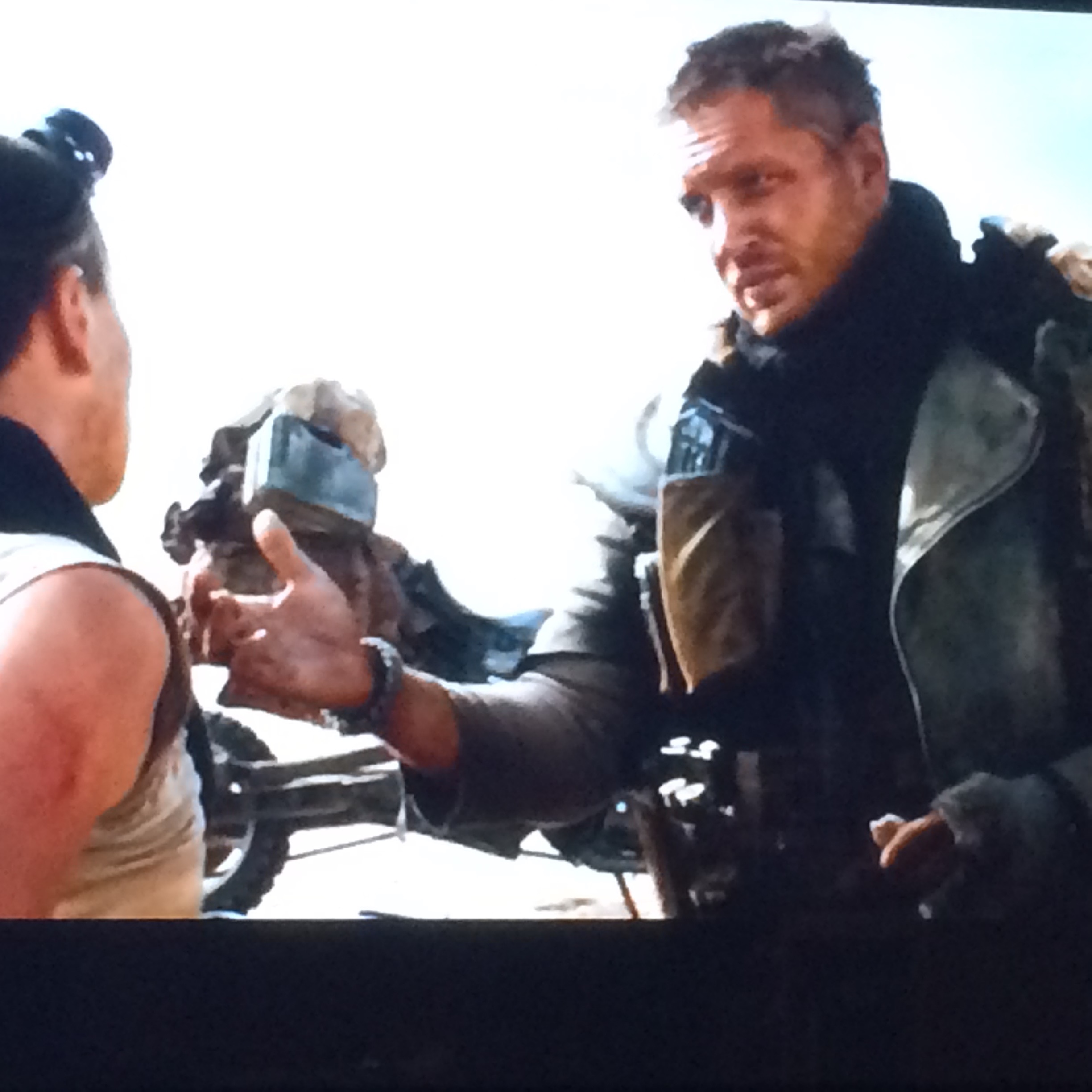
After the May 2015 release of Mad Max, Fury Road (a dystopian sci-fi/action film starring Tom Hardy and Charleze Theron, in that order), the U.S./Anglophone blogosphere erupted around the film’s uses and/or misuses of feminism. Men’s rights activist Aaron Clarey called for a boycott of Fury Road because he saw it as a “feminist piece of propaganda posing as a guy flick”; in the subsequent fury many feminist writers heralded Fury Road as worthy of feminist support, while others offered mixed and even negative reviews.
Much of the positive excitement centered on the Theron’s co-starring role as Imperator Furiosa, who in the words of Natalie Wilson is “a gender-queer, disabled, bad-ass feminist hero who proves that heroism has no one gender, no one body type, no one sexuality.” Yet many others voiced disappointment about the use of “scantily clad models” to portray the former wives/sex slaves (rescued by Furiosa from the evil dictator, Immortan Joe). And in one particularly scathing review, Eileen Jones also mocked the film’s “essentializing Earth Mother nonsense about women,” as well as Eve Ensler’s praise that “(a)ll the women in the film maintain their inherent woman-ness.” (Ensler – of “Vagina Monologues” feminist celebrity status – was a consultant for Fury. More on Ensler’s politics later).
I share some, but certainly not all, of these feminist praises and critiques. Theron’s role as Furiosa – a tall, bald woman warrior with sculpted shoulders and a prosthetic arm – offers viewers a beautiful view of gendered and human variability. I am delighted to see the portrayal of Furiosa’s former Matriarchal tribe, the Vuvalini. A mainstream Hollywood film respectfully depicting a lesbian-feminist-separatist’s fantasy of a vulva-centric tribe lead by wise women elders?! In addition I appreciate Furiosa’s relationship with Max, which builds slowly from animosity to peer-based respect and is free of romantic innuendo, despite Max’s puppy dog eyes and full lips. Max also does not demonstrate any sexual interest toward anyone in the film, including the stunning “sex slaves.”
But from my queer, intersectional, post-colonial perspective, I also have several additional reads of the film. For example, the criticism around “scantily clad models” is for me a (White feminist) red herring for a much deeper problem in the film: the deployment of the sex slave trope. And during my first viewing of the film I nearly shut it off after the first 30 minutes, as it was all about men screaming, abusing, chasing, and killing and each other. (Not my idea of a good time). I also find the film’s ending to be problematic. When Furiosa and her victorious women warriors return to the Citadel with the body of the evil dictator, Immortan Joe, a crowd of grateful minions shout to the White men and boys above, “Let them up, let them up!” The women heroes are then literally pulled up into power by White men. In contrast, my fantasy ending of the film would involve the large bodied women in the Citadel (some of whom appear to be women of color, and all of whom were formerly used for their “mother’s milk”) taking over the controls to lift up the other women.
Yet ultimately it is Fury’s White and Christian order – swept in under the conservative (AKA “liberal”) agenda of White feminism – that turns my simultaneous admiration of and impatience with the film into political critique.
WHITENESS
For anyone who has seen Fury Road, I am stating the obvious that the film is very, very White. All of the dozens (hundreds?) of boys and men in the film appear to be White. And as if the film is not White enough, the bodies of many of the boys and men are actually also painted white. There are fewer women than men in the film, but at least three women with names and spoken lines can be visibly recognized as (light skinned) women of color.
And yet, much of the mainstream (White) feminist discussion of Fury Road has underplayed the film’s racial politics. As Nashwa Khan writes:
Witnessing white feminists find ways to make themselves feel better about this lack of diversity in a movie they really want to love points to a larger problem. A big part of feminism is race, but these self-imposed blinders suggest that as long as a movie appeases white feminists, they will not question in solidarity why we women of color are absent.
Khan’s critique highlights the problem of feminist discourse that omits anti-racist critique and fantasizes the struggle as being between cis women and men (holding race constant). In other words, this type of feminism (AKA White Feminism) prioritizes the concerns of White (economically secure, heterosexual, cisgender, mainstream, Global North) women.
CHRISTIANITY
As with many Hollywood films, the plot of Fury Road incorporates several familiar Judeo-Christian symbols and cultural narratives. In this case the film features themes of redemption and witnessing, as well as crucifix/savior metaphors.
Redemption: Along their journey in Fury Road, Max and Furiosa both state that they are looking for “redemption.” For Max, it is possible that the redemption he seeks is due to guilt about not saving his young daughter who has apparently died (but who haunts him throughout the film). Clues about Furiosa’s need for redemption are more opaque. (Did she engage in unholy sexual or violent practices after being stolen as a child?). But from a Christian perspective explanations are unnecessary: all are considered to be born of sin and hence in need of redemption.
Witnessing: When Christians speak of “witnessing,” they do not mean that they just watched something happen. To “witness” means that one spreads the word to as many people as possible about how one was personally saved by Jesus’ sacrifice.
But in order to demonstrate the importance of good/God witnessing, the film first illustrates examples of bad witnessing. Namely, the practice of War Boys maniacally yelling “Witness me!” before sacrificing themselves for the evil cause of Immortan Joe (who reassures them that this will allow them to the afterlife of Vahalla and live again.) Christian writer Brett McCracken interprets the War Boy sacrifices as a reference to radical Islam’s suicide bombers, and I concur. (I also see reflections of the death of Libyan dictator Muammar el-Qaddafi in the mob celebration and maltreatment of Immortan Joe’s body after his death).
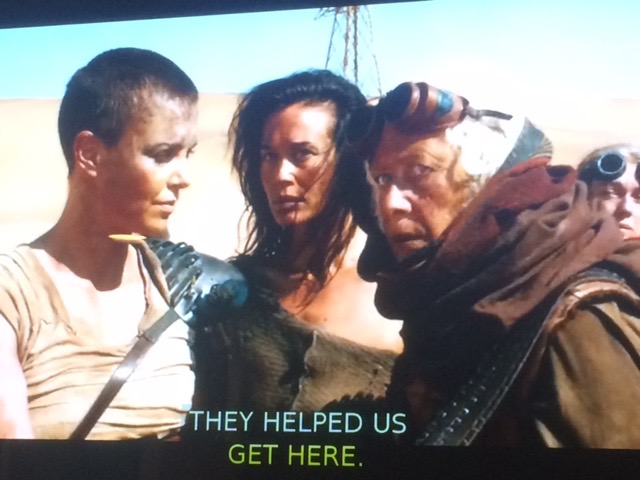
This theme of witnessing, in the Christian sense of the word, begins to be practiced after Furiosa introduces Max and Nux (the former War Boy who has now switched teams) to her Matriarchal tribe, the Vuvalini. The matriarchs ask: “The men – who are they?” Furiosa reassures them that: “They’re reliable. They helped us get here.”
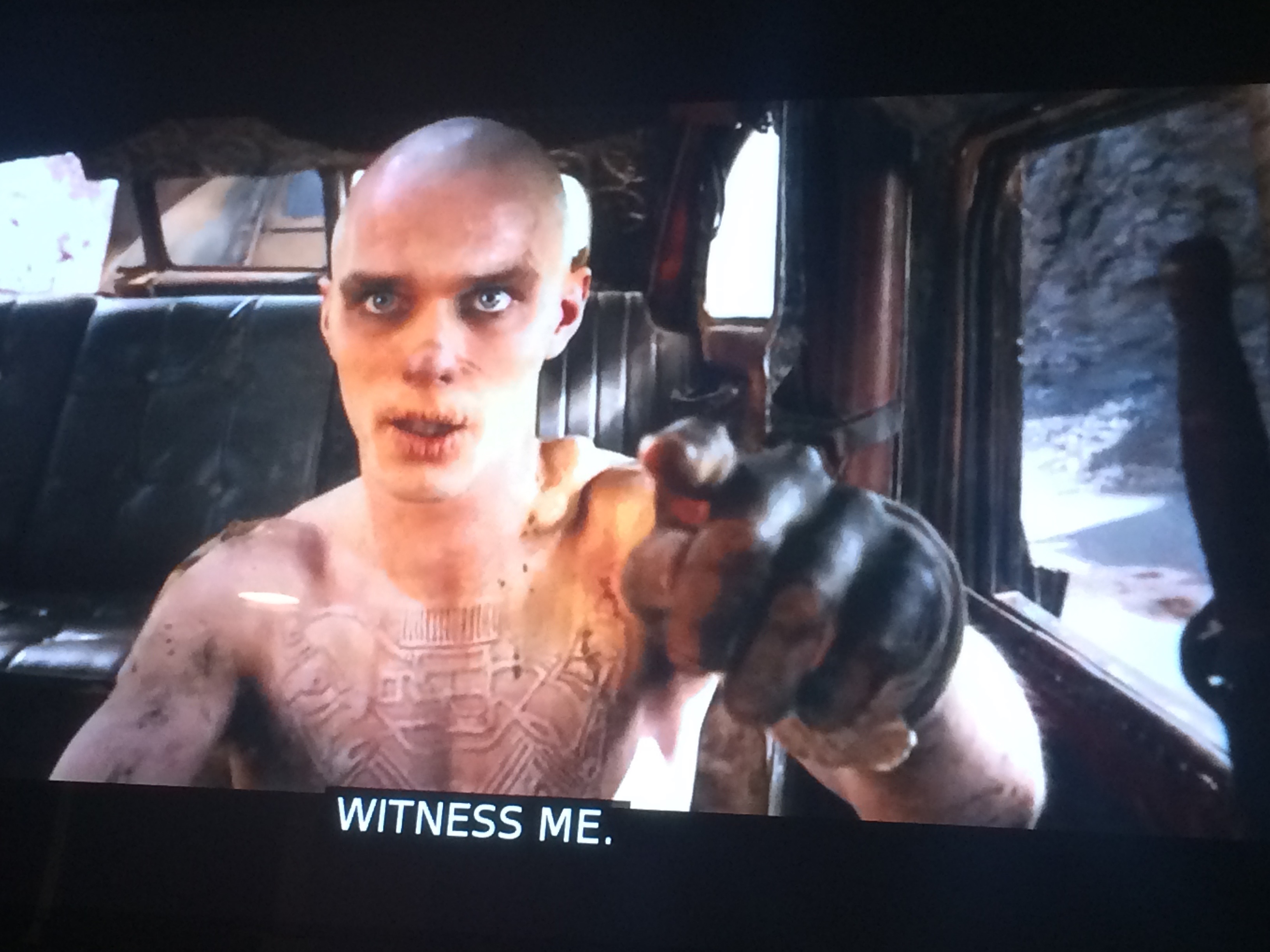
But the importance of witnessing good/God men is most obvious in the climax of the film when Nux sacrifices himself to kill Rictus Erectus (AKA Big Dick) — the only viable surviving son of Immortan Joe. In an emotionally powerful scene, the camera focuses on longing looks between Nux and his love interest, Capable (one of the former sex slaves, riding in the war rig ahead). Nux points to Capable, whispers “witness me” and then deliberately crashes his rig, killing both himself and Rictus Erectus.
In contrast to the crazed “witness me!” yelling by the War Boys, Nux’s words are not an order. But they are also not an ask. Capable (i.e. a woman capable of loving a flawed man in seek of redemption) is required to witness his sacrifice and hence his redemption as a good man.
Crucifixing:
While most of the film’s critical attention has been placed on Furiosa and Max, for me it is clear that Nux and Capable are the soul of Fury Road. The film gestures toward the possibility of Max being a savior (at one point his hand and head are pierced with a long sharp object). But in the words of Capable, it is Nux who has the “manifest destiny.” As she later witnesses to her tribe of women: “he’ll be bringing us home, bring back what was stolen, as he’s meant to.”
Film critic Scott Beggs Nux is one of the few (apparently) secular reviewers who noted Fury Road‘s religious themes, calling Nux “a genuine Christ figure” because “he seeks death, wrestles with his doubts, recognizes that his god has forsaken him, and then sacrifices himself so that all of humanity can have another chance at redemption.” But what he and the other religiously-informed reviewers tend to miss are the how the Christian themes intersect with contemporary sexual politics.
For me, the moral of Fury Road is this: Women (specifically, White Feminists) must give credit to good White men who renounce their former evil ways. If they do so, together they may return stolen women/sex slaves, defeat the monster men, and lift womankind up into safety and security.
POLITICAL IMPLICATIONS
As I have written elsewhere, Hollywood stories about “sex slaves” have weight beyond just the box office — they actually end up reinforcing ideologies that can justify policies which focus on marginalized women, including sex workers, as being in need of rescue by organizations run by White feminists and Good White men.
It is thus not surprising that Eve Ensler, of Vagina Monologues fame, has used the film as a platform to dispense hype about “sex trafficking” as well as heap praise on director George Miller. In an interview with Time Magazine, Ensler describes Miller as a feminist, and explains that her consulting work for the film involved discussion about “sex trafficking in America, which is rampant.” (For a critical academic perspective on Ensler’s claim, see Ann Jordan’s “Fact or Fiction: What do we really know about human trafficking?”).
Given Ensler’s stature as a feminist spokesperson, is also important to note that she (as well as Charleze Theron, and several other Hollywood celebrities) signed a petition that opposed Amnesty International’s historic and important move to work for decriminalization of sex work.
Finally, imagine if this story was centered on White supremacy rather than patriarchy, with POC cast as slaves who are required to witness White people’s sacrifices and redemption, and then rely on more White people to lift them into power. Unfortunately, such a storyline is not difficult to imagine. As Brittney Cooper observed in the controversy over the 2015 film Selma (dir., Ava DuVernay), when Hollywood stories shift the gaze away from White heroes, racist backlash happens.
A (Fury) road for White men’s redemption
After now “witnessing” Fury Road several times, I have come to appreciate much about the film. (In addition to my earlier praise, I am drawn to Fury Road‘s powerful visual and musical aesthetic). At the same time, the unsettling political undercurrents for me are bright as day. In the opening scene of Fury Road Max explains that he was once a cop, a road warrior in search of a righteous cause; similarly, the current End Demand (anti-prostitution) movement offers policemen and others a morally righteous mechanism to distinguish Good from Bad men. While both Fury Road and the End Demand movement provide the public with gripping tales of sex slavery focused on Good vs. Evil men, neither narrative addresses the sexist, racist, and hyper capitalist ideologies and policies that contribute to war, violence against women, exploitation of labor and natural resources, extreme inequality, and mass incarceration. Nor are such morality tales typically very useful for broad based movements for economic, racial, and sexual justice. On the other hand, both Fury Road and End Demand give Good White men the hope for blessings from Capable White feminists, which in turn further secures their position at the top of a remodeled White supremacist patriarchy.










 Similar structural and cultural analyses incorporating masculinity and institutional/political power could and should also be applied to the other stars of this story, including:










 with many women over time. Others argue that any sports star who is on the road and away from home so much has a huge chance of being unfaithful to their wife. (Some media reports argue that it is
  “rare” to find a faithful male sports star). Still others argue that Tiger Woods’ late father pressed him down under his thumb too much as a youngster and upon his death, Tiger unleashed his “wild side.” Finally, some news reporters offer that Tiger was “traumatized” as a child when his father cheated on his mother, and that he must just be paradoxically following in dad’s footsteps.
 great Magic Johnson openly admitted to having hundreds of sex partners in the early 1990s and stated that he acquired the HIV/AIDS virus due to his lack of sexual protection. He was forgiven in media coverage and by the public, and was even repeatedly deemed a “hero” for his announcement. At the same time, another male athlete, Greg Louganis, who self identifies as gay, was not offered any media redemption. This was the case even though Greg Louganis was monogamous with his long-term partner and his long term partner cheated on him.
 waiting for him when he arrived. All of the articles discuss the physical beauty of the women he was with and news media features them as “gorgeous” or “hotties.” Without question, Tiger is framed as wanting sex–needing sex–and is even frequently cast as a sexual addict.
 t is dominated by upper class and white players who are assumed to be more moral. Yes, the men of golf are assumed to be more moral than men who participate in hegemonic sports such as basketball, baseball, and football–who are often men of color–and are often stereotyped as violent, promiscuous, or both.
 cularity and explosive physicality, all of which get marked as masculinized and as highly valued sex objects (some scholars argue that these particular sports and their participants are disproportionately responsible for sexual assaults and rapes. For work on these claims see Jeff Benedict’s book titled Public Heros, Private Felons: Athletes and Crimes Against Women) . Golf is not only less sexy because of the polo shirt,
  goofy shoes, and white grey hair, but because it is an individualized sport rife with controlled skills which do not frequently allow for sports performances that take visible muscularity and power. The media coverage of Tiger’s behavior then—explodes because it takes the mask off of the assumed to be more moral realm of upper class golf. Tiger Woods’ younger age, good looks, and muscular body helped to change the stiffness of the sport (no pun intended).
 a squeaky clean image to make him acceptable in golf as a man of color and yet we fault him more than other athletes for trying to uphold this image and failing at it.


 Morehouse College is a small all-male college in Atlanta Georgia with 2,700 students. It has recently instituted a ban on women’s clothing, high heels, and carrying purses within its student body. Dr. William Bynum, vice president for Student Services reported that “We are talking about five students who are living a gay lifestyle that is leading them to dress a way we do not expect in Morehouse men.” CNN reports that the college has stated that those who are found breaking the policy will not be allowed to go to class unless they change. The school also reports that “chronic dress-code offenders could be suspended from the college.”
 Stuart Hall, in his seminal work on social inequality and culture (titled Representation: Cultural Representations and Signifying Practices), defines how a sense of “othering” develops among more powerless groups when marked as “different” from (and often inferior to) dominant groups. “Othering” as you can see is a verb and refers to how powerless groups are marked and viewed as different and then frequently treated differentially by dominant groups on the basis of such markings. Marginalized groups, in turn, frequently come to see themselves as “different from” dominant groups and, at times, take on the qualities of dominant groups so as to assure that the possibilities for acceptance and upward mobility are not squelched within “mainstream society.” For African-American men in particular, as a response to having a lack of access to traditional means of masculinity (e.g. the occupational structure and mobility within it), scholars have further suggested that many African-American men adopt a “cool pose” that exaggerates attributes of masculine prowess (physicality and sexuality) to compensate for the lack of empowerment in other areas of their lives (Staples, 2006; Majors & Bilson, 1993; Messner, 1997). This process is said to be due to institutional and personal racism and discrimination which deny many African-American men traditional opportunities for masculine affirmation (e.g., education, employment, etc.). Behaviors to constitute hegemonic masculinity (the most dominant form of masculinity in a given period–often middle class and heterosexual), often include those that conform to gender role expectations that signify masculinity not only in the African-American community but broader society more generally.
 While Castor Semenya’s recent “news” seems to have shocked the world, the concern about “gender verification” in sport has taken place for quite some time. The tests have changed over time…but the point has not (e.g. when women are “too good,” they must not be women).