masculinity

This post is an extension of comments I gave at GeekGirlCon’15 on a panel focused on the feminist potential of Mad Max, Fury Road. I was honored to share the panel with Kristine Hassell, Elsa S. HenrySarah Mirk, Anita Sarkeesian, and Jennifer K. Stuller, who in turn spoke passionately about the film’s representations of WOC, women of size, disability, the hope of ecofeminism, violence as a mistaken feminist strategy, and women as heroes. These perspectives have helped layer my own understandings of Fury Road, as well as to appreciate the diversity of feminist experiences and interpretations of the film. Below is an elaboration of my comments on the panel, focusing on my argument that Fury Road is ultimately an updated White Christian man’s fantasy of being a “good” man in the context of White feminist politics.

—————————————————————————————————————————————————————

 

IMG_3755 (1)
Max convinces Furiosa that she is on the wrong path; she and her tribe of women should go right back to where they began.

After the May 2015 release of Mad Max, Fury Road (a dystopian sci-fi/action film starring Tom Hardy and Charleze Theron, in that order), the U.S./Anglophone blogosphere erupted around the film’s uses and/or misuses of feminism. Men’s rights activist Aaron Clarey called for a boycott of Fury Road because he saw it as a “feminist piece of propaganda posing as a guy flick”; in the subsequent fury many feminist writers heralded Fury Road as worthy of feminist support, while others offered mixed and even negative reviews.

Much of the positive excitement centered on the Theron’s co-starring role as Imperator Furiosa, who in the words of Natalie Wilson is “a gender-queer, disabled, bad-ass feminist hero who proves that heroism has no one gender, no one body type, no one sexuality.” Yet many others voiced disappointment about the use of “scantily clad models” to portray the former wives/sex slaves (rescued by Furiosa from the evil dictator, Immortan Joe). And in one particularly scathing review, Eileen Jones also mocked the film’s “essentializing Earth Mother nonsense about women,” as well as Eve Ensler’s praise that “(a)ll the women in the film maintain their inherent woman-ness.” (Ensler – of “Vagina Monologues” feminist celebrity status – was a consultant for Fury. More on Ensler’s politics later).

I share some, but certainly not all, of these feminist praises and critiques. Theron’s role as Furiosa – a tall, bald woman warrior with sculpted shoulders and a prosthetic arm – offers viewers a beautiful view of gendered and human variability. I am delighted to see the portrayal of Furiosa’s former Matriarchal tribe, the Vuvalini. A mainstream Hollywood film respectfully depicting a lesbian-feminist-separatist’s fantasy of a vulva-centric tribe lead by wise women elders?! In addition I appreciate Furiosa’s relationship with Max, which builds slowly from animosity to peer-based respect and is free of romantic innuendo, despite Max’s puppy dog eyes and full lips. Max also does not demonstrate any sexual interest toward anyone in the film, including the stunning “sex slaves.”

But from my queer, intersectional, post-colonial perspective, I also have several additional reads of the film. For example, the criticism around “scantily clad models” is for me a (White feminist) red herring for a much deeper problem in the film: the deployment of the sex slave trope. And during my first viewing of the film I nearly shut it off after the first 30 minutes, as it was all about men screaming, abusing, chasing, and killing and each other. (Not my idea of a good time). I also find the film’s ending to be problematic. When Furiosa and her victorious women warriors return to the Citadel with the body of the evil dictator, Immortan Joe, a crowd of grateful minions shout to the White men and boys above, “Let them up, let them up!” The women heroes are then literally pulled up into power by White men.  In contrast, my fantasy ending of the film would involve the large bodied women in the Citadel (some of whom appear to be women of color, and all of whom were formerly used for their “mother’s milk”) taking over the controls to lift up the other women.

Yet ultimately it is Fury’s White and Christian order – swept in under the conservative (AKA “liberal”) agenda of White feminism – that turns my simultaneous admiration of and impatience with the film into political critique.

WHITENESS

For anyone who has seen Fury Road, I am stating the obvious that the film is very, very White.  All of the dozens (hundreds?) of boys and men in the film appear to be White. And as if the film is not White enough, the bodies of many of the boys and men are actually also painted white. There are fewer women than men in the film, but at least three women with names and spoken lines can be visibly recognized as (light skinned) women of color. 

And yet, much of the mainstream (White) feminist discussion of Fury Road has underplayed the film’s racial politics. As Nashwa Khan writes:

Witnessing white feminists find ways to make themselves feel better about this lack of diversity in a movie they really want to love points to a larger problem. A big part of feminism is race, but these self-imposed blinders suggest that as long as a movie appeases white feminists, they will not question in solidarity why we women of color are absent.

Khan’s critique highlights the problem of feminist discourse that omits anti-racist critique and fantasizes the struggle as being between cis women and men (holding race constant). In other words, this type of feminism (AKA White Feminism) prioritizes the concerns of White (economically secure, heterosexual, cisgender, mainstream, Global North) women.

CHRISTIANITY

As with many Hollywood films, the plot of Fury Road incorporates several familiar Judeo-Christian symbols and cultural narratives. In this case the film features themes of redemption and witnessing, as well as crucifix/savior metaphors.

Redemption: Along their journey in Fury Road, Max and Furiosa both state that they are looking for “redemption.” For Max, it is possible that the redemption he seeks is due to guilt about not saving his young daughter who has apparently died (but who haunts him throughout the film). Clues about Furiosa’s need for redemption are more opaque. (Did she engage in unholy sexual or violent practices after being stolen as a child?). But from a Christian perspective explanations are unnecessary: all are considered to be born of sin and hence in need of redemption.

Witnessing: When Christians speak of “witnessing,” they do not mean that they just watched something happen. To “witness” means that one spreads the word to as many people as possible about how one was personally saved by Jesus’ sacrifice.

But in order to demonstrate the importance of good/God witnessing, the film first illustrates examples of bad witnessing. Namely, the practice of War Boys maniacally yelling “Witness me!” before sacrificing themselves for the evil cause of Immortan Joe (who reassures them that this will allow them to the afterlife of Vahalla and live again.) Christian writer Brett McCracken interprets the War Boy sacrifices as a reference to radical Islam’s suicide bombers, and I concur. (I also see reflections of the death of Libyan dictator Muammar el-Qaddafi in the mob celebration and maltreatment of Immortan Joe’s body after his death).
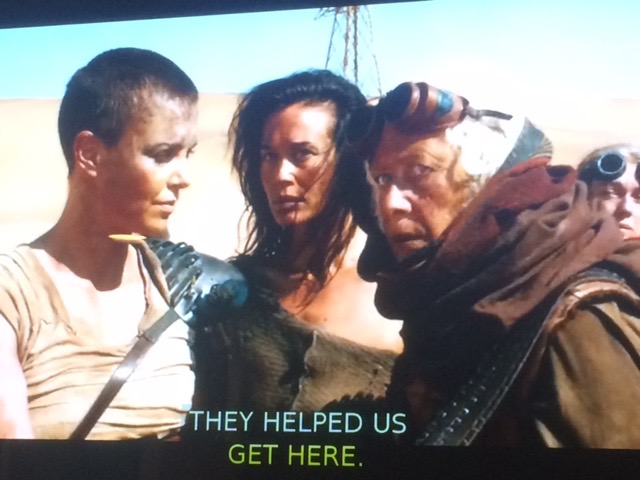
MM they helped us
Furiosa reassuring the Vulvalini leaders that the Max and Nux are “reliable.”

This theme of witnessing, in the Christian sense of the word, begins to be practiced after Furiosa introduces Max and Nux (the former War Boy who has now switched teams) to her Matriarchal tribe, the Vuvalini. The matriarchs ask: “The men – who are they?” Furiosa reassures them that: “They’re reliable. They helped us get here.”

But the importance of witnessing good/God men is most obvious in the climax of the film when Nux sacrifices himself to kill Rictus Erectus (AKA Big Dick) — the only viable surviving son of Immortan Joe. In an emotionally powerful scene, the camera focuses on longing looks between Nux and his love interest, Capable (one of the former sex slaves, riding in the war rig ahead). Nux points to Capable, whispers “witness me” and then deliberately crashes his rig, killing both himself and Rictus Erectus.

In contrast to the crazed “witness me!” yelling by the War Boys, Nux’s words are not an order. But they are also not an ask. Capable (i.e. a woman capable of loving a flawed man in seek of redemption) is required to witness his sacrifice and hence his redemption as a good man.

Witness me(n)
“Witness me”: Nux’s last words to Capable before sacrificing himself so that others may be saved.

Crucifixing:

While most of the film’s critical attention has been placed on Furiosa and Max, for me it is clear that Nux and Capable are the soul of Fury Road. The film gestures toward the possibility of Max being a savior (at one point his hand and head are pierced with a long sharp object). But in the words of Capable, it is Nux who has the “manifest destiny.”  As she later witnesses to her tribe of women: “he’ll be bringing us home, bring back what was stolen, as he’s meant to.”

Film critic Scott Beggs Nux is one of the few (apparently) secular reviewers who noted Fury Road‘s religious themes, calling Nux “a genuine Christ figure” because “he seeks death, wrestles with his doubts, recognizes that his god has forsaken him, and then sacrifices himself so that all of humanity can have another chance at redemption.” But what he and the other religiously-informed reviewers tend to miss are the how the Christian themes intersect with contemporary sexual politics.

For me, the moral of Fury Road is this: Women (specifically, White Feminists) must give credit to good White men who renounce their former evil ways. If they do so, together they may return stolen women/sex slaves, defeat the monster men, and lift womankind up into safety and security.

POLITICAL IMPLICATIONS

As I have written elsewhere, Hollywood stories about “sex slaves” have weight beyond just the box office — they actually end up reinforcing ideologies that can justify policies which focus on marginalized women, including sex workers, as being in need of rescue by organizations run by White feminists and Good White men.

It is thus not surprising that Eve Ensler, of Vagina Monologues fame, has used the film as a platform to dispense hype about “sex trafficking” as well as heap praise on director George Miller. In an interview with Time Magazine, Ensler describes Miller as a feminist, and explains that her consulting work for the film involved discussion about “sex trafficking in America, which is rampant.” (For a critical academic perspective on Ensler’s claim, see Ann Jordan’s “Fact or Fiction: What do we really know about human trafficking?”).

Given Ensler’s stature as a feminist spokesperson, is also important to note that she (as well as Charleze Theron, and several other Hollywood celebrities) signed a petition that opposed Amnesty International’s historic and important move to work for decriminalization of sex work.

Finally, imagine if this story was centered on White supremacy rather than patriarchy, with POC cast as slaves who are required to witness White people’s sacrifices and redemption, and then rely on more White people to lift them into power. Unfortunately, such a storyline is not difficult to imagine. As Brittney Cooper observed in the controversy over the 2015 film Selma (dir., Ava DuVernay), when Hollywood stories shift the gaze away from White heroes, racist backlash happens.

A (Fury) road for White men’s redemption

After now “witnessing” Fury Road several times, I have come to appreciate much about the film. (In addition to my earlier praise,  I am drawn to Fury Road‘s powerful visual and musical aesthetic). At the same time, the unsettling political undercurrents for me are bright as day. In the opening scene of Fury Road Max explains that he was once a cop, a road warrior in search of a righteous cause; similarly, the current End Demand (anti-prostitution) movement offers policemen and others a morally righteous mechanism to distinguish Good from Bad men. While both Fury Road and the End Demand movement provide the public with gripping tales of sex slavery focused on Good vs. Evil men, neither narrative addresses the sexist, racist, and hyper capitalist ideologies and policies that contribute to war, violence against women, exploitation of labor and natural resources, extreme inequality, and mass incarceration. Nor are such morality tales typically very useful for broad based movements for economic, racial, and sexual justice. On the other hand, both Fury Road and End Demand give Good White men the hope for blessings from Capable White feminists, which in turn further secures their position at the top of a remodeled White supremacist patriarchy.



For the fourth New Year’s Eve in a row, Sexuality & Society brings you its (highly subjective and mostly North American/U.S.-centered) list of top ten sexual stories of the year! This year’s stories are full of shreds of hope and resolve for finding allies in the ongoing effort toward sexual justice and a large dose of old-fashioned us vs. them political fights. (Just a heads-up that we won’t be bringing you the story of Princess Kate and her topless photos, but we were amused/bemused at how much press that story received).
For a walk down sexual memory lane we encourage you to (re) check out our lists for 2009, 2010, and 2011 as well!
1. Susan B. Komen foundation defunds breast screenings at Planned Parenthood.
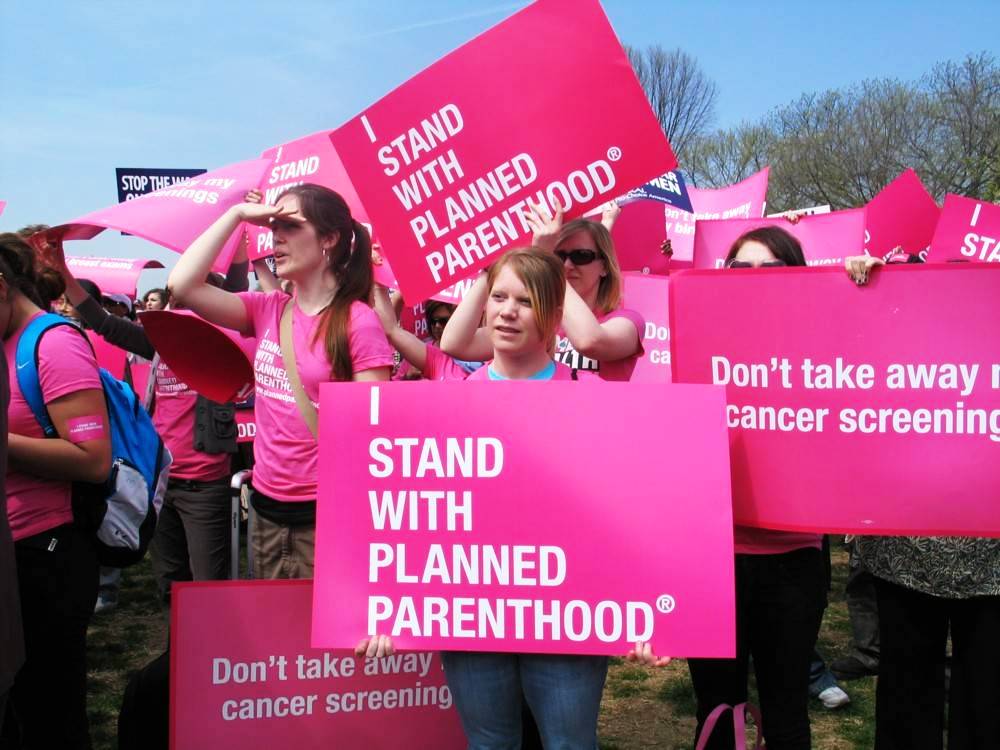
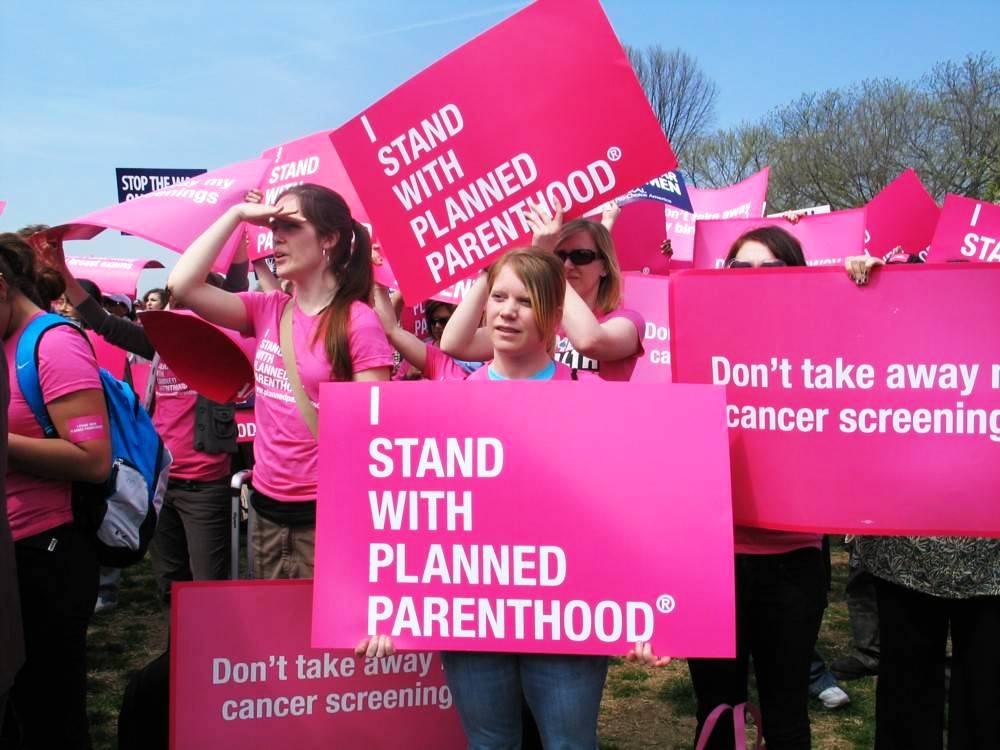
Although we are used to high profile conservatives attempting to put Planned Parenthood out of business, this story of pink-on-pink malignment caught most of us in Sexual and Reproductive Justice circles by surprise. The Komen Foundation’s decision to cut funding to Planned Parenthood due to anti-abortion sentiment in Komen leadership resulted in enormous public outrage, lack of subsequent support for the Komen foundation, and eventually a reversal of the decision. It remains to be seen how well the Komen Foundation will be able to recover, especially given the critical documentary about Komen entitled Pink Ribbons — which was coincidentally released just after the Planned Parenthood defunding debacle. In contrast, public support for Planned Parenthood seemed to grow stronger than ever:
“The silver lining is that more people than ever are aware that Planned Parenthood provides breast exams, and we’re seeing more people calling us today to make an appointment,” Tait Sye, a spokesperson for Planned Parenthood, told HuffPost. “Politics should not get in the way of women’s health, and people respond powerfully when they see politics interfering with women’s health.” http://www.huffingtonpost.com/2012/02/01/susan-g-komen_n_1247262.html
2. Anita Sarkeesian vs. the (online, sexist, and sexually abusive) trolls.

When Feminist Frequency blogger and media activist Anita Sarkeesian announced that she was going to start a new project to address stereotypes of women in video games, some male gamers responded with vicious online attacks:

Sarkeesian, who runs the video blog Feminist Frequency, became a target of abuse—including rape and death threats—last May after launching a Kickstarter fundraising drive for a project promising to explore sexist gender tropes in video games. 

“I love playing video games but I’m regularly disappointed in the limited and limiting ways women are represented,” Sarkeesian wrote. “This video project will explore, analyze and deconstruct some of the most common tropes and stereotypes of female characters in games.”

In response, Sarkeesian was hit with what she calls a “cyber mob” from angry male gamers. Hundreds of abusive tweets flooded her Twitter feed, threatening violence and sexual assault. Vandals attacked her Wikipedia page, plastering it with explicit sexual images, violent images, sexism and racism. Someone even created a video game where users were invited to “beat the bitch up” and punch a digital version of Sarkeesian’s face until it became battered, bloody and bruised. 

Sarkeesian fought back, chronicling the harassment on her blog and speaking to dozens of news outlets. She’d originally set a humble fundraising goal of $6,000. But after the torrent of abuse received widespread media attention, donors flooded her page. Sarkeesian finished the Kickstarter campaign with nearly $160,000, or about 25 times what she’d asked for.  (http://www.dailydot.com/culture/anita-sarkeesian-ted-talk-misogynist-comments/)

3. Chick fil-A hates Gays, er…”supports ‘Biblical’ families.”

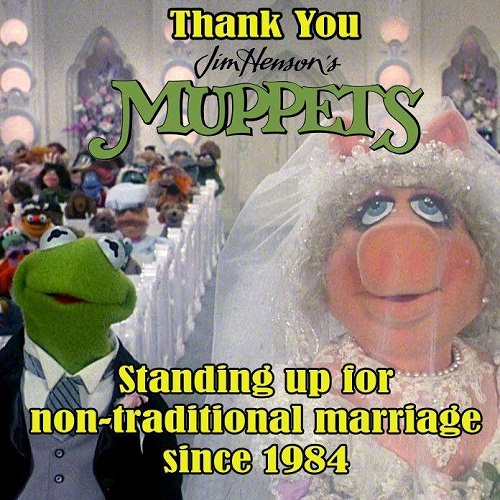
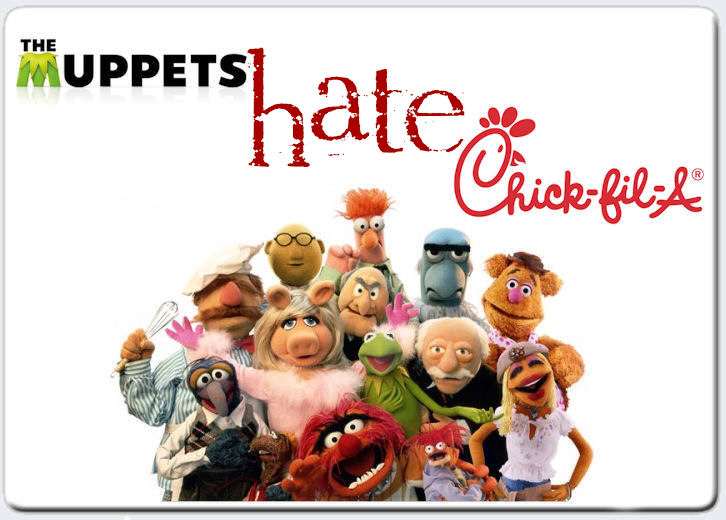
Chick fil-A — an Atlanta based company known for their fried chicken sandwiches– went public with its official disdain for those who live outside of the institution of heterosexuality by donating money to organizations fighting gay marriage. As with the Komen public relations debacle, this story was met with protests and boycotts against Chick fil-A, including critical public statements made by Boston mayor Thomas Menino, Chicago mayor Rahm Emmanuel, and San Francisco Mayor Edwin M. Lee, and a decision by the Jim Henson Company (AKA the Muppets!) to cease all business partnerships with Chick fil-A. (Meanwhile they may have gained some new customer loyalty from social conservatives).  

Chick fil-A did eventually announce that it would cease to fund anti-gay organizations, but its president has remained firm in his stance that he still doesn’t like the gays…

… Chick-fil-A President Dan Cathy doubled down on his company’s anti-gay stance yet again, re-iterating the restaurant chain’s support of “Biblical” families.

“Families are very important to our country,” Cathy told NBC affiliate 11 Alive. “And they’re very important to those of us who are concerned about being able to hang on to our heritage. We support Biblical families, and they’ve always been a part of that.” (http://www.huffingtonpost.com/2012/10/25/chick-fil-a-business-thriving_n_2016864.html)

Given the enormous diversity of family forms in the Bible, it’s surprising that Chick fil-A representatives have not yet
clarified which “Biblical” families they DO support …(don’t forget that traditional Biblical families are full of polygamy and inclusion of concubines). Regardless, it’s clear that Kermit, Miss Piggy, and their fans stopped going to Chick fil-A for their lunch break

 4. Florida A & M drum major hazed to death; push for an end to hazing on college campuses.

Hazing — and subcultures emphasizing violence and conformity to traditional gender roles on U.S. College campuses — hit the news in 2012 with the death of Robert Champion, an African-American out gay male drum major, and who had made his opposition to hazing openly to his peers. While Champion died in 2011, this story makes our top ten stories for 2012 due to its ongoing media attention and its major impact on institutional transformation at Florida A & M and beyond.

Rober Champion died as a result of hazing in Nov. 2011

Robert Champion died on Nov. 19, 2011, after a ritual called “crossing bus C,” in which band members are forced to walk through a line of band members who are each kicking or punching the person walking by. He began vomiting, complained of breathing difficulty, and later died. Initially, his band mates claimed that they had no idea, according to according to the Palm Beach Press. His parents later told reporters that witnesses had come forward and said that their son was hazed for being gay, or ironically, for being against hazing rituals himself. (http://www.advocate.com/crime/2012/05/03/13-charged-hazing-death-gay-florida-am-drum-major )

The tragic incident resulted in several arrests as well as a newfound commitment by Florida A&M administrators to end the practice of hazing in University sponsored programs. Meanwhile, just before posting this story here, on Dec. 30, 2012 a scathing report was released by the Florida Board of Governors inspector general’s office which “concludes that the school lacked internal controls to prevent or detect hazing, citing a lack of communication among top university officials, the police department and the office responsible for disciplining students.” (see http://www.ebony.com/black-listed/news-views/famu-ignored-hazing-rules-before-robert-champion-death-981)

5. Sandusky goes to prison for child sexual abuse; Penn State officials condemned

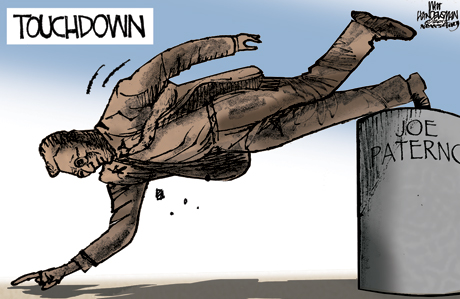
The Penn State football sexual abuse scandal made our top ten list for the second year in a row. While individual-blaming solutions have prevailed (sending Assistant football coach Jerry Sandusky to prison for life; toppling the statue of former head football coach Joe Paterno), the evidence is clear that the sexual abuse that happened must be understood and addressed also within the context of big ten football and Penn State. As part of the effort to cast a wider analysis on the situation, scholars of sport and gender continue their critique of Penn State as an example of masculinist sport cultures [for example, see: Cooky, C. (2012). Success without honor: Cultures of Silence and the Penn State Scandal. Cultural Studies/Critical Methodologies, 12, 328-331]. In July of 2012 a blistering report was also released by Louis J. Freeh, former FBI director.

The report is unwavering in its condemnation of the university’s two highest levels of leadership: the president and the Board of Trustees. “By not promptly and fully advising the Board of Trustees about the 1998 and 2001 child sexual abuse allegations against Sandusky and the subsequent Grand Jury investigation of him, Spanier failed in his duties as President,” the report says. “The Board also failed in its duties to oversee the President and senior University officials in 1998 and 2001 by not inquiring about important University matters and by not creating an environment where senior University officials felt accountable.”

The most powerful leaders in the university concealed facts and failed to protect children, primarily because they hoped to “avoid bad publicity,” the report finds. But other factors contributed as well, according to the committee. Specifically, the report blames “A culture of reverence for the football program that is ingrained at all levels of the campus community.” (http://chronicle.com/article/A-Guide-to-the-Penn-State/132797/_

6 & 7. RAPE. RAPE. RAPE.

The practice and politics of rape of women continued to lead the headlines in 2012. So much so, that we’re giving it two positions on our top ten list. #6 goes to the ongoing “war on women” (reported also in our 2011 list) being waged by key U.S. conservative politicians. Instigators of this war include the Republican party’s 2012 Vice Presidential nominee Paul Ryan, who referred to rape as simply another “form of conception.” (This attempts to legitimize complete opposition to abortion, including for teenage victims of rape and incest. see: http://www.huffingtonpost.com/paul-slansky-/paul-ryan-said-something-_b_1832377.html.) GOP Senate Candidate, Todd Akin also attempted to play definitional magic by telling the public what a “legitimate” rape was, and baffled scientists and progressives alike when he claimed that women’s bodies could prevent pregnancy the case of rape. An interesting chronology of such arguments has been put together here for all of us to read given that this type of thinking is certainly not new: (See: http://www.theblaze.com/stories/why-does-todd-akin-think-rape-victims-dont-get-pregnant/)

#7 Goes to the political fury that is currently erupting around harassment and rape of women in India — with most urgent attention being placed on the case of a young woman who was brutally attacked and gang raped for hours and died of assault-related injuries.

The woman, who has not been identified, has become a symbol for the treatment of women in India, where rape is common and conviction rates for the crime are low. She boarded a bus with a male friend after watching a movie at a mall, and was raped and attacked with an iron rod by the men, who the police later said had been drinking and were on a “joy ride.”

She died Saturday morning in Singapore, where she had been flown for treatment for the severe internal injuries caused by the assault. She had an infection in her lungs and abdomen, liver damage and a brain injury, the Singapore hospital said, and died from organ failure. Her body was flown back to India on Saturday.

As news of her death spread Saturday, India’s young, social-network-using population began to organize protests and candlelight vigils in places like the western city of Cochin in Kerala, the outsourcing hub of Bangalore and New Delhi, the capital. Just a tiny sliver of India’s population can afford a computer or has access to the Internet, but the young, educated subset of this group has become increasingly galvanized over the New Delhi rape case.( http://www.nytimes.com/2012/12/30/world/asia/india-rape-delhi.html?_r=0)

Less publicized but also on our minds is the case of another young Indian woman who was recently gang raped; she committed suicide after being pressured by police to either drop her criminal charges or marry one of her attackers. We expect to be hearing much more from Indian human rights activists on this matter in the coming year.(see: http://www.nytimes.com/2012/12/28/world/asia/rape-victim-commits-suicide-in-india.html)

After all that dire news we will end with three more uplifting stories:

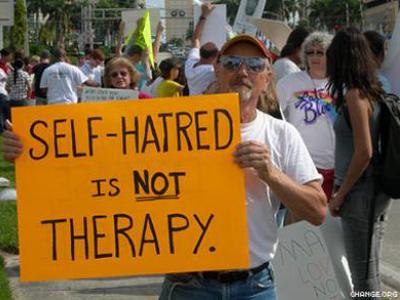
8. Movement to ban “gay conversion” therapy for minors in California.

The move to end the practice of reparative therapy (AKA Gay Conversion therapy) has made some movement in California. Governor Jerry Brown supported a new bill to ban gay conversation therapy for minors; however, the bill is currently blocked. On the Friday before Christmas (Dec. 21) “A three-judge panel of the U.S. 9th Circuit Court of Appeals agreed to block the law, scheduled to take effect Jan. 1, pending a decision on its constitutionality.” (http://latimesblogs.latimes.com/lanow/2012/12/gay-therapy-ban-placed-on-hold-in-california.html).

Gov. Jerry Brown has signed legislation prohibiting a form of therapy aimed at changing a minor’s sexual orientation from gay to straight, the first law of its kind in the nation, officials said Sunday.

Sen. Ted Lieu (D-Torrance) introduced the measure based on his belief that so-called conversion therapy isn’t based on science and is dangerous.

“This bill bans non-scientific ‘therapies’ that have driven young people to depression and suicide,” Brown said in a statement. “These practices have no basis in science or medicine and they will now be relegated to the dustbin of quackery.” (http://latimesblogs.latimes.com/california-politics/2012/09/governor-jerry-brown-gay-therapy-minors.html)

Story to be continued in 2013….


9. Same sex marriage continues to win.

Cultural representations of same sex couples also proliferated in 2012, including stories and photos in Here Come the Brides published by Seal Press. (disclaimer: Sexuality & Society co-editor Kari Lerum has an article in this book).

Gay marriage makes our list yet again this year, this time with wins in Washington, Maryland, and Maine. Additionally, the U.S. Supreme court agreed to hear two cases (one from California, one from New York), challenging state and federal marriage laws which exclude same-sex couples, and U.S. President Barack Obama became the first sitting president to finally publicly support gay marriage. (Sexuality and Reproductive justice advocates in the US and abroad also breathed a sigh of relief when Obama was re-elected to serve as US President for another four years).

(see:http://topics.nytimes.com/top/reference/timestopics/subjects/s/same_sex_marriage/index.html)

10. Free Condom Machines to be installed in Philadelphia high schools 

And our final story for the year involves a new development in Philadelphia: Condom dispensers in high schools! We commend Philadelphia school officials for including this as part of a pragmatic and non-shaming approach toward reducing STI rates for Philadelphia teenagers.

(http://www.thedenverchannel.com/news/u-s-world/philadelphia-high-schools-installing-free-condoms-to-combat-epidemic-of-stds).


Happy New Year from Sexuality & Society! Thanks to all the activists, scholars, and practitioners working toward sexual and social justice; may 2013 be filled with your stories!

Warm regards, Kari Lerum and Shari Dworkin

When the Weiner sexting story broke, I was on holiday in Amsterdam, where prostitution is legally regulated, and newsstands display Penthouse and Vogue magazines side-by-side. It was no surprise then that “Weinergate” seemed to be met by the Dutch with a “here the Americans go again” eye roll.

In contrast to the Dutch, Americans love sex scandals. We love them so much that in a good year we produce and consume not just one of these high-profile scandals, but several. For many of us interested in sexual justice, the juiciest stories are those of the hypocrites: the Elliot Spitzers who lead anti-prostitute campaigns while purchasing sex; the George Rekers who champion the anti-gay movement while hiring “rent boys,” and the Newt Gingrichs who lead impeachment hearings while engaging in their own extra-marital affairs.

And then there are people like Anthony Weiner: Charismatic heterosexual men in powerful positions who thrive on taking risks.
Guys who benefit from the security and social status of marriage but who also have ample time away from their partners. Men who are fierce defenders of reproductive rights, are friends with the likes of John Stewart and Ben Affleck, and who (understandably) have many dedicated women fans. In pre-Twitter and Facebook days (circa 2006), such public figures were sometimes called “rock stars”; their fans, “groupies.” Today, with the democratizing boost of social media, more of us than ever before can construct our own neo-rock star status, supported by “Facebook friends” and “twitter followers.”

The privileges taken by (mostly heterosexual male) rock stars are nothing new; what’s new is the neo-rock star’s ability to showcase their goods on such a massive scale. But with this newfound power of instantaneous social impact, private digital messages are increasingly impossible. It’s the equivalent of whispering sweet nothings into a megaphone; or asking the masses to kindly shut their eyes while they flash that one special love interest in the crowd.

When teen girls send sexy words and images (and those photos are intercepted and distributed by “frenemies” for the purpose of shaming them), American parents panic and talk about “ruined lives.” But what about when the “sexting” is between consenting adults? Is there any harm in Weiner’s actions, and if so, harm to whom?

From a legal perspective, it seems that there is no case against Weiner. He did initially lie to reporters, his “fans,” and possibly also to his wife, but not under oath (so no perjury). He has admitted to engaging in several digital affairs, but adult, consensual sexual liaisons outside of heterosexual marriage and reproductive sexuality are (gratefully) no longer criminalized in the United States. If Weiner had campaigned against “dangers” of sexting and the internet, we could bash him for being a hypocrite (but alas, he was too busy championing issues like insurance industry reform).

I do not yet know enough about the situations and interpretations of Weiner’s sexting partners to comment on whether or not these women ever felt harmed by his messages (at this point I have not seen any self-reports of negative impact). But I will venture to guess that all of them (as well as Weiner’s wife, Huma Abedin) are being wounded by the invasive scrutiny of this media storm.

And so, from my perspective Weiner’s biggest “crime” may be that he was reckless with his neo-rock star privileges. I thus will
offer two pieces of sincere advice to Representative Anthony Wiener and other rising neo-rock stars:

  1. Invest in a good therapist who will help you reflect upon your desires, social/sexual identities, and social privileges. This is crucial information for then reassessing your own goals for yourself and your relationships including your marriage.
  2. Never confuse your fans and followers for your friends. This is especially important when operating under “schoolyard” conditions, where the status of one person or political interest depends on the beating down of others, and where conservative or knee-jerk normative definitions of “good” vs. “bad” sexuality rule.

Meanwhile, for the most part, American media coverage continues to uncritically replicate the notion that Weiner’s messages are simply “inappropriate” and “shameful.” And that’s why some of us with “Dutch” and sexual justice sensibilities — including us at Sexuality & Society — are rolling our eyes.

—–

Related Sexuality & Society stories:

On Thursday, January 28, 2010, Fox News published a news article titled “Afghan Men Struggle with Sexual Identity” and made the absurd claim that an entire ethnic group (at at times, the article suggests that the whole “country”) is “coping with a sexual identity crisis:”

“As if U.S. troops and diplomats didn’t have enough to worry about in trying to understand Afghan culture, a new report suggests an entire region in the country is coping with a sexual identity crisis. An unclassified study from a military research unit in southern Afghanistan details how homosexual behavior is unusually common among men in the large ethnic group known as Pashtuns — though they seem to be in complete denial about it.”

The article goes on to describe the “study” which was “obtained by Fox News” which:

“found that Pashtun men commonly have sex with other men, admire other men physically, have sexual relationships with boys and shun women both socially and sexually — yet they completely reject thelabel of “homosexual.” Fox news reports that the “research” was conducted as part of a longstanding effort to better understand Afghan culture and improve Western interaction with the local people. The “research unit,” which was “attached to a Marine battalion in southern Afghanistan, acknowledged that the behavior of some Afghan men has left Western forces ‘frequently confused.’ ”

According to this “study” of unknown authorship, the men do not perceive that they are at risk for STDs (HIV is not mentioned in the article) because they do not relate to the Western category known as “homosexual.” The article relays this information by reporting that “in one instance, a group of local male interpreters had contracted gonorrhea anally but refused to believe they could have contracted it sexually — “because they were not homosexuals.” (Hmm, this sounds similar to U.S. men who have sex with both women and men.)

The article does not clarify who ran the study or collected the data (we sure would love to see it!) nor is it clear why FOX news —or the US troops—are confused; the Afghan men themselves likely have a fairly clear idea about what is going on. The report even underscores that “One of the country’s favorite sayings, the report said, is “women are for children, boys are for pleasure” and that “widespread homosexual behavior stems from several factors, including the “severe segregation” of women in the society and the “prohibitive” cost of marriage.”

We are not sure why Fox news is using a particular locale or one ethnic group to make a claim that the entire country (see below about favorite sayings in the “country”) of Afganistan is “coping with a sexual identity crisis.”

When I’m done shaking my head with shock at the way that Fox news framed this story, I’ll try to write something more.

For now, let’s just say that it seems that Fox news and the U.S. soldiers interviewed for this study haven’t heard of the idea that sexuality comes in many forms. Indeed, the world includes not just homosexuals and heterosexuals—or transgendered—or transsexuals—but also bisexuals. And there are also all sorts of other sexual systems and sexual classifications that don’t fit those too. The ancient Greeks organized their sexual system in a very similar way to what the men describe in this article. Sex was structured based on public status, and well, women and young boys had lower status than men. Sexual desire and sexual object choice was not set up by the gender of the participant, but rather, on the role that each participant played in sex (boys and women were more submissive, and high status men were active penetrators).

Thomas Almaguer’s work (1991) on Latin American sexual systems has shown us that the more masculine “macho” who penetrates the more submissive man known as “jotos” are also not in denial or confused, but work within a different sexual system. Machos do not necessarily identify as gay, and they often have sex with both women and men. Walter Williams (The Spirit and the Flesh, 1986) has written about the Native American Berdache, biological men, who take both husbands and wives—and they are revered as a third gender. They’re not confused. And quite a large number of men who have sex with both women and men are in the US—they too do not identify as gay (See Brian Dodge, 2008a, 2008b). They are not particularly confused and enjoy having sex with both sexes. In fact, some argue that heterosexuality itself is constructed, for example, Johnathon Katz (The Invention of Heterosexuality, 2007)  shows that “hetero” used to mean what we now understand in the U.S. as “bi” sexual. Heterosexuality did not even come to mean the nuclear family and opposite sex partner relationships (with child bearing as  the pinnacle goal) until the turn of the 19th Century. This was when work-family institutions were restructured according to the fault lines of white middle class privileges.

I could go on and on with nice citations to read up on that explain all sorts of people who are not confused across all kinds of sexual systems around the globe. However, Fox News and some U.S. soldiers sure sound confused to me. The best thing to do right now it seems would be to ask what purpose this kind of news coverage serves. Indeed, in times of war, the US has long been known for making muscular claims about the type of masculinity we produce in the US military (see Montez de Oca 2005, and Armitage 2005) when seeking victories while “feminizing” and sexualizing (as other) the troops of other men. This is particularly the case in the war on terror, where authors such as Jasbir Puar in her 2007 book Terrorist Assemblages: Homonationalism in Queer Times argues that  “ ‘homonationalisms’ are deployed to distinguish upright ‘properly hetero,’ and now ‘properly homo,’ U.S. patriots from perversely sexualized and racialized terrorist look-a-likes—especially Sikhs, Muslims, and Arabs.” She argues that such dichotomies help to justify when the US decides to capture, cordon off, or detain “other” men in the war on terror. Such work reveals the ways in which heterosexuality is deployed as a weapon to feminize and exoticize “other” men during times of war. At least we’re not confused by that.

Bibliography/Recommended reading:

  • Almaguer, Tomás. (1991). “Chicano Men: A Cartography of Homosexual Identity and Behavior.” Differences 3, no. 2: 75–100.
  • Armitage, J. (2005) Militarized bodies: An introduction. Bodies & Society, 9, 1-12.
  • Dodge, B., Reece, M., & Gebhard, P. H. (2008a). Kinsey and beyond: Past, present, and future considerations for research on male bisexuality. Journal of Bisexuality, 8(3/4), 177-191.
  • Dodge, B., Jeffries, W. L., & Sandfort, T. G. M. (2008b). Beyond the Down Low: Sexual risk, protection, and disclosure among at-risk Black men who have sex with men and women (MSMW). Archives of Sexual Behavior, 37(5), 683-696.
  • Katz, J. (2007). The Invention of Heterosexuality. Chicago: Unversity of Chicago Press.
  • Montez de Oca, Jeffrey. (2005). “‘As Our Muscles Get Softer, Our Missile Race Becomes Harder’: Cultural Citizenship and the ‘Muscle Gap’,” Journal of Historical Sociology 18, no. 3, 145-171.
  • Puar, Jasbir (2007). Terrorist Assemblages: Homonationalism in Queer Times. Duke University Press.
  • Williams, Walter. (1986). Spirit and the Flesh. Boston: Beacon Press.

In his book, Telling Sexual Stories: Power, Change, and Social Worlds (1995, Routledge), Ken Plummer explains that when individuals narrate seemingly internal and personal stories about their sexuality, these aren’t very individual or internal at all. Rather, such narratives emerge in themes that are made possible due to specific cultural and political conditions; sexual stories are thus part of larger sexual storytelling culture, and can be understood and made meaningful and visible only via existing cultural frames.

In 1995 Plummer documented three kinds of emerging sexual stories: rape stories, coming out stories, and recovery stories. The year of 2009 brought several unique opportunities of its own to tell sexual stories. Some of these stories reaffirmed and revisited familiar plots to “old” sexual stories, while some forged new territory. We have decided to group this year’s stories (which we have selected with a highly subjective and US based lens) into themes; each theme is a compilation of several individual stories, forming what we see as a larger set of cultural stories being told about the pleasures and dangers of sexuality, and the roles of social institutions in regulating and redefining normative sexual boundaries. Thanks to Phil Cohen, Holly Lewandowski, and Amanda Hess for story leads. Also, thanks to RhReality Check’s Amy Newman for her list of top stories from 2009 (from which we borrowed a few).

#10. “Squeaky-clean”-men-who-cheat stories, starring Tiger Woods!Tiger Woods and Elin Nordegren

In her recent article on Tiger Woods, Shari Dworkin debunks widespread psychological and “sex addiction” explanations for Tiger Woods’ affairs:

“Recent media coverage of Tiger Woods’ marital “transgressions” is overflowing. Some argue that Tiger is sex obsessed and has a “sex addiction” given his high sex drive and desire for sex with many women over time. Others argue that any sports star who is on the road and away from home so much has a huge chance of being unfaithful to their wife. (Some media reports argue that it is “rare” to find a faithful male sports star). Still others argue that Tiger Woods’ late father pressed him down under his thumb too much as a youngster and upon his death, Tiger unleashed his “wild side.”  Finally, some news reporters offer that Tiger was “traumatized” as a child when his father cheated on his mother, and that he must just be paradoxically following in dad’s footsteps. But very little media coverage attempts to press beyond an individual level and not many articles offered a much needed broader analysis of masculinity, race, sport, sexuality, and media.”

  • images-3Similar structural and cultural analyses incorporating masculinity and institutional/political power could and should also be applied to the other stars of this story, including: Mark SanfordJohn Ensign, & John Edwards.

  • Additionally, a cross-cultural perspective is needed here as well (e.g. why are these stories so powerful and shaming in the US, but not in European countries?)

#9. Gay-marriage-success stories, starring: Argentina!

Argentina Gay Marriage -- first in Latin America
Latin America's first gay marriage, in Argentina


According to The Guardian: “In Latin America policies and attitudes have mellowed over the past two decades and in most countries it is now illegal to discriminate on the basis of sexual orientation. Buenos Aires, Bogota and Mexico City boast gay pride parades and gay-friendly districts where same-sex couples can kiss and hold hands in public. Yesterday Di Bello, 41, and Freyre, 39, became the continent’s first gay married couple. The pair sidestepped a court ruling blocking their wedding in Buenos Aires by holding the ceremony in Ushuaia, capital of Tierra del Fuego province and the world’s southernmost city. They exchanged rings at a civil ceremony witnessed by state and federal officials, prompting jubilation by gay rights activists and consternation from the Catholic church. “My knees didn’t stop shaking,” said Di Bello. “We are the first gay couple in Latin America to marry” (Guardian.co.uk — Dec. 29, 2009).

Gay-marriage- success stories from 2009 also starred: Mexico City, Washington DC, New Hampshire, Sweden, Iowa, Vermont, and Norway. These are just the states, countries, and cities adopting gay marriage in 2009 and doesn’t include the longer list of locales which legalized domestic partnership in 2009. [The appendix to this is the Gay-Marriage-doom-&-gloom story: starring the Catholic Church (Maine) & the Mormon Church (California, from 2008)]

#8. Multiple-birth stories, starring: Angela Suleman (aka Octo-mom!)

octo-mom

While more women are having multiple-baby births (thanks to IVF technology), not all multiple-birth mothers are viewed the same. Kathryn Joyce from RhReality Check offers an insightful comparison between the highly demonized Angela Suleman (“octo-mom”) and a “Reality TV” family with 18 children:

“Suleman’s newborns were delivered, as it were, into a pop cultural moment of preoccupation with large families. Reality TV shows about families with many children abound on TV’s TLC channel, most notably with the chronicles of the 18-child Duggar family. That the Duggars are grounded in and motivated by the pro-patriarchy Quiverfull movement, with its emphasis on female submission and male headship, is breezily dispensed with in favor of dwelling on the sentimental and zany experiences of life in a 20-person family. “Jon and Kate Plus Eight,” another reality TV show about a large family – this one the result of sextuplets born to a mother who, like Suleman, chose not to selectively reduce the number of embryos that “took” during an IVF treatment – is less burdened by the extremist ideology that undergirds the Duggars’ convictions, but still presents a traditional picture of large family life, with married heterosexual parents and a stay-at-home mother. …. While many observers are concerned with her apparent inability to support such a large family, the fact that she is unmarried has alone been cause enough for others to declare her family a situation of de facto child abuse” (for Joyce’s full article click here).

#7. Homo-hater stories, starring: conservative religious anti-gay activists in Uganda and the US!

Doug Coe, leader of the arch conservative U.S. group, "The Family"
Doug Coe (center), leader of "The Family"


In a recent post on Uganda’s “Kill the Gays” bill, Kari Lerum wrote that:

“…there is an increasing amount of scrutiny and disgust from many regarding the direct connection between the Ugandan anti-homosexual campaign and a conservative U.S. religious group called “The Family” — which some, including The Observer have called a ” cult” due to the requirement for core members to remain secret about their activities. Regardless of what the group is labeled, it is clear that it has been successful in recruiting high level political leaders including some US congressmen and Uganda’s president Museveni to its core values:  “fighting homosexuality and abortion, promoting free-market economics and dictatorship, an idea they once termed ‘totalitarianism for Christ’ ”

#6. Catholic-priest-cover-up stories, starring: the Irish Catholic Church!

Irish Justice Minister Dermot Ahern
Irish Justice Minister Ahern at press conference about decades of Priest abuse


As quoted in the LA Times: “Leaders of the Roman Catholic Church in Dublin engaged in a widespread cover-up of abuses by clergy members for decades, a “scandal on an astonishing scale” that even saw officials taking out insurance policies to protect dioceses against future claims by the victims, a commission reported Thursday after a three-year investigation” (see full article here)

Ross Douthat, a conservative writer for the New York Times and the National Review, describes how a culture of fear around sexuality is precisely the kind of culture that produces sexual abuse — and especially cover-ups of sexual abuse. Douthat concludes that:

“…you can see how it could all go bad — how a culture so intensely clerical, so politically high-handed, and so embarrassed (beyond the requirements of Christian doctrine) by human sexuality could magnify the horror of priestly pedophilia, and expand the pool of victims, by producing bishops inclined to strong-arm the problem out of public sight instead of dealing with it as Christian leaders should. (In The Faithful Departed, his account of the scandal, Philip Lawler claims that while less than five percent of priests were involved in actual abuse, over two-thirds of bishops were involved in covering it up.) I suspect it isn’t a coincidence that the worst of the priest-abuse scandals have been concentrated in Ireland and America — and indeed, in Boston, the most Irish of American cities — rather than, say, in Italy or Poland or Latin America or Asia” (see Douthat’s article here).

# 5. Panic-over-sex/gender/sexuality-fluidity stories, starring: Caster Semenya!

Castor Semenya
18 year old Caster Semenya got a makeover


Mississippi girl fighting for her right to wear a tux for her Senior Class photo
Ceara Sturgis, fighting for her right to wear a tux for her Senior Class photo


articleLarge-150x150
Click here for Adina Nack's post on "cross-dress" codes


In her post in Sexuality & Society, Shari Dworkin writes, “While Caster Semenya’s recent “news” seems to have shocked the world, the concern about “gender verification” in sport has taken place for quite some time. The tests have changed over time…but the point has not (e.g. when women are “too good,” they must not be women). …” (see also sociologist Philip Cohen’s story about Semenya, and an update on Caster’s status in the NYT). Note that in these stories there are never any calls for parallel sex verification tests to see if men they are “too much of a man,”—a man that no other “normal” man can hope to “fairly” compete with. This is because of the specific role that sport has historically played in terms of making boys into men (when women compete, there have been numerous fears that they are masculinized and are not “normal” women).

This year’s sex/gender/sexuality-panic stories also starred: Morehouse College‘s dress code, a high school girl wearing a tux, & a 4 yr. old boy kicked out of preschool for having “long” hair.

# 4. Harsher punishments for-sex-with-minors stories, starring: Roman Polanski!

Roman Polanski

Filmmaker Roman Polanski was arrested in 1977 for the sexual assault of a 13 year old girl. He spent 42 days in a California prison and was released. Upon hearing of  a judge’s plan to have him serve more time and possibly deport him, Polanski fled to France. In 1988 Polanski was sued by the girl he assaulted and in 1993 settled with a payment reported at around $500,000. In the  years that have passed Polanski also married (in 1989), had two children, and continued on as a prolific and well regarded film maker.  For reasons that are still murky in terms of timing, Polanski was arrested on Sept. 26, 2009 (32 years after the crime) at the Zurich, Switzerland airport at the request of US authorities. Polanski’s case, spanning decades and continents, offers an insight into how laws and attitudes about sex with minors has changed in the US:

The LA Times reports that “(s)tatutory rape convictions similar to Roman Polanski’s typically result in sentences at least four times longer today than the 90-day punishment a judge favored before the director fled the United States in 1978, a Times analysis of Los Angeles County court records shows. Polanski’s arrest in Switzerland on an international fugitive warrant — and his pending extradition proceedings — have sparked transatlantic debate about whether the 76-year-old Academy Award winner should serve additional time behind bars for having sex with a 13-year-old girl….The Times analyzed sentencing data to determine how L.A. County courts today handle cases in which men admit to statutory rape — also known as unlawful sex with a minor — in exchange for the dismissal of more serious rape charges, as Polanski did. The findings show that those defendants get more time than Polanski has served — even factoring in his 70-day stint in Swiss detention — but less than his critics may expect. … “Thirty years ago, sexual assault — rape and sex crimes — were treated differently,” said Robin Sax, a former sex crimes prosecutor for the L.A. County district attorney’s office. “Time and education haven’t worked for Polanski’s benefit.”

Sociologist Barry Dank, founding editor of the Journal Sexuality & Culture, has blogged extensively about the Polanski case. Dank writes:

“There is no question that what Roman Polanski did to a 13 year old girl in the 1977 was wrong, and illegal. But it is also wrong to drag Polanski back to the US 31 years after the crime and have him spend an unspecified amount of time in prison. What possible good would come about by Polanski doing time for the crime? Obviously, it would not function to rehabilitate him or change him in some way. The fact that Polanski has had a stellar film career and apparently lived a law abiding life for 32 years after the crime is indicative that the case for changing Polanski is simply irrelevant.”

The details of Roman Polanski’s case lies in stark contrast to the case of Phillip Garrido, a registered repeat sex offender who was arrested earlier this year for kidnapping 11 yr old Jacee Dugard, and holding her captive and sexually abusing her for 18 years (from 1991-2009). The young Dugard bore two children out of Garrido’s abuse (now ages 11 and 15).

Despite today’s more stringent punishments for statutory rape, we hope that US jurors and judges will be able to distinguish the vast differences between the sexual crimes of Polanski and Garrido.

# 3. No-condoms-for-those-who-need-it-most stories, starring: Pope Benedict XVI!

pope_benedict_gambia

While HIV/AIDS rates in sub-saharan Africa continue to soar, and condoms are very effective in fighting HIV/AIDS (when used correctly and consistently) Pope Benedict told Africans that it was wrong to use condoms.

The Pope’s message was also heard in the US, at least among some US Catholic college students. Amanda Hess, writer for the Washington City Paper highlights how all 3,000 students at Catholic University are now prohibited from having sex that is “disruptive”  (defined as “ANY” sexual expression inconsistent with the Catholic Church including premarital sex and same sex sexuality). These rules are written into the code of student conduct. Hess states that:

Deference to the catechism spares Catholic administrators from the awkward enterprise of referring to masturbation, condoms, or any other specific of a typical undergraduate’s sex life” … “violations to the student code can’t be absolved in typically Catholic fashion, with forgiveness administered privately after confession to a priest. At the Catholic University of America, your sins are subject to judicial review” (click here for full article).

Clearly, if the Catholic church cannot discuss sex outside of sex within marriage, they cannot discuss condoms very effectively.

#2. Backlash-against-sexual-&-reproductive-justice stories, starring: the murderer of  Dr. George Tiller!

Gosh, this story is soooo last century (the 80s and 90s were full of anti-abortion terrorism stories), but unfortunately it’s still a story in 2009.

George Tiller

Dr. George Tiller, a doctor who provided late term abortions in Wichita, Kansas, was shot dead while attending Sunday Church services. Jodi Jacobson, Editor of Rh Reality Check explains the importance of Dr. Tiller’s work, as well as the cultural context for how perceptions of his work are widely inaccurate:

“In all the extensive coverage of the assassination in his church of Dr. George Tiller by a murderer affiliated with extremist right-wing groups, little has been said to shed light on what late-term abortions are, who has them and why. Instead, much of the media and talking heads pontificating on this subject have constantly focused on Tiller’s being “one of the very few doctors who perform late-term abortions,” without providing any context as to why he did so and under what circumstances. As a result, the dominant narrative is one which perpetuates an assumption that people are electing to have late-term abortions for the sake of convenience.”   (To read Jacobson’s entire analysis, click here).

And finally, we’d like to end on a positive note, with a list of sexual and reproductive justice stories from 2009:

1. Sexual-&-reproductive-justice stories, starring Barack Obama!

Obama signed and/or was involved in the following sexual health and justice developments:

images-7

And although this last bill still needs to be signed, we are expecting Obama to:

  • fulfill his promise to fund evidence-based, scientifically based sex education.

As Kari Lerum noted in a recent post, the movement toward more abstinence-only approaches is driven almost entirely by conservative religious ideology, not scientifically reliable evidence.” Because of the lack of scientific credibility for Abstinence-only sex education, we are hopeful that all funding for abstinence-only sex education will finally be eliminated from the US Federal budget.

We are intrigued by many of this year’s sexual stories, saddened by some, and encouraged by others. May 2010 be filled with opportunities to reframe old (sexist, racist, homophobic, and sex-negative) stories into sexual stories that involve measured discussion of sexual health, sexual justice, and sexual rights.


Kari Lerum & Shari L. Dworkin, Eds. Sexuality & Society.

Recent media coverage of Tiger Woods’ marital “transgressions” is overflowing. Some argue that Tiger is sex obsessed and has a “sex addiction” given his high sex drive and desire for sex tiger woods pixwith many women over time. Others argue that any sports star who is on the road and away from home so much has a huge chance of being unfaithful to their wife. (Some media reports argue that it is jan22_woods2_427x600“rare” to find a faithful male sports star). Still others argue that Tiger Woods’ late father pressed him down under his thumb too much as a youngster and upon his death, Tiger unleashed his “wild side.”  Finally, some news reporters offer that Tiger was “traumatized” as a child when his father cheated on his mother, and that he must just be paradoxically following in dad’s footsteps.


But very little media coverage attempts to press beyond an individual level and not many articles offered a much needed broader analysis of masculinity, race, sport, sexuality, and media.  Here, my own previous research might shed some light on these media events. Awhile back, I wrote an article titled “The Morality/Manhood Paradox” with Faye Linda Wachs that was published in a book titled Masculinities, Gender Relations, and Sport. In that article, I underscored how media coverage frequently packages these types of media events into familiar frames of individual morality and they do so through frames of sin and redemption. To be sure, media reports do not offer redemption to everyone. Media coverage only offers redemption to certain athletes while others do not enjoy this privilege. For example, basketball Magic Johnsongreat Magic Johnson openly admitted to having hundreds of sex partners in the early 1990s and stated that he acquired the HIV/AIDS virus due to his lack of sexual protection. He was forgiven in media coverage and by the public, and was even repeatedly deemed a “hero” for his announcement. At the same time, another male athlete, Greg Louganis, who self identifies as gay, was not offered any media redemption. This was the case even though Greg Louganis was monogamous with his long-term partner and his long term partner cheated on him.

Why the difference in access to forgiveness by the media and by the public? At the time, Faye Wachs and I argued that sexuality and sexual identity was a key reason. Self-identified heterosexually active Magic Johnson was discussed as “doing what any normal man would do” and as having kindly “accommodated” the hundreds of women who “wanted him.”  Women were presented as sexually desirous and out of control and men were presented as  doing what “boys” do  to be “boys.” There was no mention of Magic Johnson’s own sexual agency in those media framings, and the women he was with were framed as having all of the wild desire. The women were described as uncontrollable groupies who were anxiously awaiting Magic and numerous other ball players after the big games were over and the athletes swaggered off the court.

In the media events surrounding Tiger Woods’ circumstances, media coverage couldn’t be more different. Tiger Woods’ sexual agency is the primary frame of news media. Articles discuss his “preference” for blondes, his “big appetite” for sex, his enjoyment of “girl-on-girl sex” and how he “wanted to be with them together,”  his “endurance,” the difficulty some of his mistreses had in  “keeping up with him,” in bed and his wish to party 24/7 on the weekends with a large number of women. Some news articles discuss his “kinky” sexual desires, some discuss his willingness to pay for sex, and some describe how he would “ask for” the type of women he liked in advance before he arrived at bars and clubs, and he would have a table of “his type” women-of-tiger_537x409waiting for him when he arrived. All of the articles discuss the physical beauty of the women he was with and news media features them as “gorgeous” or “hotties.” Without question, Tiger is framed as wanting sex–needing sex–and is even frequently cast as a sexual addict.

Not only is the current coverage different from previous married athletes who are unfaithful through multiple extramarital partners, but it is also different from the sexist ideologies that are often used by media to blame women for men who stray. For example, George Gilder, a conservative and major player in the Reagan Administration underscored that:

“In a world where women do not say no, the man is never forced to settle down and make serious choices. His sex drive–the most powerful compulsion in his life–is never used to make him part of civilization as the supporter of a family. If a woman does not force him to make a long-term commitment to marry–in general, he doesn’t. His sex drive only demands conquest, driving him from body to body in an unsettling hunt for variety and excitement in which much of the thrill is in the chase itself” (Gilder, 1986, p. 47).

Using this conservative logic, one would think that media frames might discuss the women who “tempted” Tiger as being at fault or “making” him stray. But no. Given the history of media frames of this kind, there is a rather shocking media silence on women’s sexual agency in this story (this fact is not being stated to suggest that the women should be analyzed for this reason–we are simply pointing out that the coverage is different from other unfaithful male athletes). The sexual “problem” is all on Tiger. And Tiger is viewed as a sex addict. Why?

To be sure, male athletes who participate in sports at very high levels in US society are often highly culturally valued. They are framed as heros and they are often associated with an unusual dose of moral superiority. Yet, simultaneously, given their cultural fame and popularity, they also enjoy numerous economic and social privileges. One of those privileges is the highest valuation of masculinity which brings with it access to numerous women’s bodies. Hence, male athletes in particular are faced with a “moral paradox:” athletes are viewed as moral role models but being a successful sports star is often equated with the pinnacle of masculinity and sexual prowess. What typically happens is that the public will use this paradox to  stigmatize subordinated masculinities when the men “fall.”  Men of color and gay men have historically paid that price in terms of denigrating tropes of promiscuity. Tiger Woods is now linked to other men of color in team sports who are said to have shown him the ropes of how to access large numbers of women.  News media report that Woods “was always palling around with Charles Barkley and Michael Jordan.” As one woman said: “They’re the ones who showed him the way.” Charles Barkley has stated that he can’t even get in touch with Tiger and is quoted by media as saying that Tiger “…is a 33-year-old grown man. He did something wrong to his wife. He has to answer to her and his kids. That’s it.”

I think that the quantity of media coverage and the sexual addict frames of Tiger Woods’ story make it different from the media coverage of Magic Johnson and other male athletes who “step outside of their marriages.” Here are a few reasons why I think this is the case:

  • First, there are the class and race dynamics of golf. Media have not cast their high surveillance eye on the sport of golf, likely because iJack Nicklaust is dominated by upper class and white players who are assumed to be more moral. Yes, the men of golf are assumed to be more moral than men who participate in hegemonic sports such as basketball, baseball, and football–who are often men of color–and are often stereotyped as violent, promiscuous, or both.

  • Second, Tiger Woods is  a man of color who is married to a white woman and he frequently selects white women as his sexual partners. The U.S. has a long and unforgiving history of lynching, anti-miscegenation laws, rape and violence accusations, and more when it comes to Black men being with white women (during slavery, and post slavery, black men  could not even look at a white woman without being accused of rape). Tiger Woods is a mixed race man who is playing a sport that is not dominated by men of color and hence his behavior as a token person of color is being explosively explored. The current media coverage runs the risk of essentializing men of color as sexually exotic and sexually obsessed just as racist ideologies of sexual excess always have (there are many works on this, but 2 excellent ones are Patricia Hill Collins’ 1990 book titled Black Feminist Thought, or Frantz Fanon’s, 1967 work titled Black Skin, White Masks).
  • Finally, male athletes’ sexuality itself is constituted differently in different sports. Men who participate in sports that constitute hegemonic masculinity (football, basketball, baseball) are team sports that require high degrees of aggression, physical contact, musTigerWoodscularity and explosive physicality, all of which get marked as masculinized and as highly valued sex objects (some scholars argue that these particular sports and their participants are disproportionately responsible for sexual assaults and rapes. For work on these claims see Jeff Benedict’s book titled Public Heros, Private Felons: Athletes and Crimes Against Women) . Golf is not only less sexy because of the polo shirt, action-ball-cartoon_~u14839428goofy shoes, and white grey hair, but because it is an individualized sport rife with controlled skills which do not frequently allow for sports performances that take visible muscularity and power. The media coverage of Tiger’s behavior then—explodes because it takes the mask off of the assumed to be more moral realm of upper class golf. Tiger Woods’ younger age, good looks, and muscular body helped to change the stiffness of the sport (no pun intended).


Current media coverage doesn’t just tell us that sport can be sexist or that women get betrayed with age old stories of infidelity (or thinking they’re the only mistress). It also tells us that Americans may feel betrayed because they thought they were getting a squeaky clean man of color in a white sport.  They didn’t get that man. Media reports now state that white quarterback Peyton Manning, who also has a “squeaky clean image” in football will be checking his phone to ensure that he isn’t guilty of any racy text messages.  The unrelenting nature of the media coverage of Tiger Woods doesn’t just expose the hypocrisy of Tiger Woods–it exposes the hypocrisy of media and of Americans. Tiger Woods needed tiger-woods2a squeaky clean image to make him acceptable in golf as a man of color and yet we fault him more than other athletes for trying to uphold this image and failing at it.tiger_woods3tiger-woods

worldaidsday400_558On December 1, 1988, the World Health Organization declared its first observance of World AIDS Day. Since that day 21 years ago, every December 1st has been used to raise awareness about the global HIV/AIDS pandemic.  In 2006, the Political Declaration on AIDS set a goal to have “universal access to comprehensive prevention programmes, treatment, care and support by 2010.” While progress has been made, we are very far away from being able to trumpet that successes have been fully reached. For the year 2009, the theme of World AIDS Day is Universal Access and Human Rights.

Currently, approximately 33 million people are living with HIV/AIDS (for a full set of global epidemiology slides, click here). Women constitute one half of the people living with HIV/AIDS, and this percentage has risen rapidly from 35% in 1985 (for a slide on the percentage of women in the epidemic around the world, see the UNAIDS epidemiology slides above). Shockingly, young people constitute one half of the new infections each year. While there is no cure for HIV/AIDS, anti-retrovirals have offered hope, newfound possibilities for health and well-being, and added years of life to millions of individuals, households, and communities around the globe. In the case of treatment, while many (but certainly not all) in the United States have access to life saving anti retroviral therapies, the availability of treatment is widely variable around the world. Unfortunately, only a small proportion of those with HIV/AIDS have access to anti-retro viral therapy. (For more details on the prevention, treatment, and care dynamics of the epidemic around the globe, see the UNAIDS 2008 Report on the Epidemic.)

Universal access as a theme is pointing to the need to ensure that populations have access to HIV/AIDS prevention, treatment, and care.  This is easier said than done—in 2007 only 31% of people who needed treatment received it—and the rate of infection is far outpacing the increases in the number of people who are receiving treatment. Economic retractions around the globe threaten the progress that has been made and there are some reports that treatment programs are being halted or scaled back substantially given economic constraints (UNAIDS 2008 Report).

Because of the way that the number of infections is far outpacing those who have access to treatment, and because the epidemic is largely spread through drug use and sexual contact, the importance of prevention cannot be overstated. Prevention is well recognized as a key factor in slowing the pace of the epidemic—and this is not simply a matter of getting people much needed information and skills about condoms. Prevention is also about tending to the root causes of the epidemic, which involves issues related to social inequalities, homophobia, poverty, gender inequality, the criminalization of drug use and sex work, violations of human rights, and lack of health care access and infrastructure. And, then of course there are the complexities of culture and human behavior, and the fact that many prevention programs work for a short time, even up to a year, but these behavior changes are not often maintained in the long run. There is a great deal of promise in structural, interpersonal, cultural, and group level behavioral prevention interventions. However, the promise of these prevention interventions will not be fully realized without attention to social inequalities and human rights issues.

WAD09-Logo1-web1

This brings us to the second aspect of the theme of World AIDS Day 2009: human rights. While it may not be obvious to many, violations of human rights shape HIV/AIDS risks and access to prevention, treatment, and care around the world.  Men who have sex with men, sex workers, and drug users experience stigma and discrimination throughout the world. Many countries attempt to make HIV/AIDS a public health issue, but far too often, it is treated as a moral issue where populations are blamed for their fate (particularly sex workers, drug users, and men who have sex with men). Some countries do not even count “men who have sex with men” as a category in their surveillance systems and men who have sex with men have the lowest coverage of HIV prevention services of any category (UNAIDS, 2008). In numerous countries, women who are known to be HIV positive are thrown out of their homes  when they test positive for HIV/AIDS and do not have adequate access to education, property rights, or income generation to help them to survive (and these factors shape their risks to begin with)—this is the case even when their partners may have infected them. In my own travels and research in South Africa and Kenya, it is clear that many women will not bring their children back to health care centers or clinics to be treated with ARVs for fear of being thrown out of their households and families by their male partners, relatives, or community members. Many men do not come to clinics to be tested because of HIV/AIDS stigma and because of perceptions that clinics are women’s spaces. Men also do not test because of ideals of masculinity which teach men to avoid signs of “weakness” or need. In many countries HIV positive women and men are subject to forced sterilization. Sex workers and drug users are often arrested and viewed as criminals, and prisons do not have adequate access to drug rehabilitation, condoms, or ARV’s, exacerbating the epidemic among “high risk” populations. And the U.S. has been known to stop funding prevention programs that take comprehensive sex education and condom use into account, arguing (against a very strong evidence-base) that abstinence and be faithful approaches work best (for studies that show that comprehensive sexual education and condoms work better than abstinence only programming, there are too many to list, but see this for one). The list of the links between social inequalities, rights, and HIV/AIDS risks goes on and on.

There have been gains, and there have been many of them. The number of people on anti-retroviral therapy has increased 10 fold in the past 6 years alone (UNAIDS, 2009). Recognition of the role of gender inequality and homophobia in shaping HIV/AIDS risks is increasing, as has prevention programming which is increasingly gender-specific and transformative for both women and men. Defining ‘human rights’ and implementing changes in rights has newfound momentum and if this continues, may provide marginalized populations with increased protections, resources, legal recourse, and access to prevention, treatment, and care. The US has a centralized dissemination program to diffuse evidence based successes to community based organizations. There is global mobilization to eradicate mother-to-child transmission. The economic contributions to prevention and a global scale ups in treatment have been a stunning testament to the fact that the global community can rally much needed support.

Still, there is much work to be done both domestically (U.S.) and globally. The incidence rate of HIV/AIDS in Washington DC is similar to that found in Western Kenya. The age distribution in some countries on the African continent has shifted life expectancy downward by several decades in several countries due to the epidemic. AIDS is the leading cause of death right now among African American women aged 25-34 in the United States and African-American women are 21 times more likely to die of HIV/AIDS than Caucasian women. There are millions of orphans due to HIV/AIDS. Sub-saharan Africa constitutes 10 percent of the world’s population and over 65% of the cases of HIV/AIDS. Anti-poverty efforts and food security efforts have been slow to link up with HIV/AIDS prevention, treatment, and care and are much needed. National policies have been hampered in their implementation by a lack of coordination, technical skill, and competing economic and health needs. Young people need prevention efforts more than ever before and prevention efforts reach adults the most. To achieve universal access and human rights within the HIV/AIDS epidemic is a goal that all social sectors and countries must all strive for. At the same time, all must be mindful that recalcitrant issues such as social inequalities and social justice shape the epidemic profoundly and must be dealt with head on in action and not in rhetoric.

__________________

For more information on the AIDS pandemic and how you can get involved in advocacy, research, or activism see the following links:

Morehouse CollegeMorehouse College is a small all-male college in Atlanta Georgia with 2,700 students. It has recently instituted a ban on women’s clothing, high heels, and carrying purses within its student body. Dr. William Bynum, vice president for Student Services reported that “We are talking about five students who are living a gay lifestyle that is leading them to dress a way we do not expect in Morehouse men.” CNN reports that the college has stated that those who are found breaking the policy will not be allowed to go to class unless they change. The school also reports that “chronic dress-code offenders could be suspended from the college.”

The policy details 11 expectations of students, including:

  • 1. No caps, do-rags and/or hoods in classrooms, the cafeteria, or other indoor venues. This policy item does not apply to headgear considered as a part of religious or cultural dress.
  • 2. Sun glasses or “shades” are not to be worn in class or at formal programs, unless medical documentation is provided to support use.
  • 3. Decorative orthodontic appliances (e.g. “grillz”) be they permanent or removable, shall not be worn on the campus or at College-sponsored events.
  • 4. Jeans at major programs such as, Opening Convocation, Commencement, Founder’s Day or other programs dictating professional, business casual attire, semi-formal or formal attire.
  • 5. Clothing with derogatory, offensive and/or lewd messages either in words or pictures.
  • 6. Top and bottom coverings should be work at all times. No bare feet in public venues.
  • 7. No sagging–the wearing of one’s pants or shorts low enough to reveal undergarments or secondary layers of clothing.
  • 8. Pajamas, shall not be worn while in public or in common areas of the College.
  • 9. No wearing of clothing associated with women’s garb (dresses, tops, tunics, purses, pumps, etc.) on the Morehouse campus or at College-sponsored events.
  • 10. Additional dress regulations may be imposed upon students participating in certain extracurricular activities that are sponsored or organized by the College (e.g. athletic teams, the band, Glee Club, etc).
  • 11. The college reserves the right to modify this policy as deemed appropriate.

Cameron Thomas-Shah,  the student government co-chief of staff, has said that “The image of a strong black man needs to be upheld,” on the campus. And Bynum declares with certainty that the policy is needed by reporting that:

“We know the challenges that young African-American men face. We know that how a student dresses has nothing to do with what is in their head, but first impressions mean everything.”

Oh, gosh, where to begin with this one…

Stuart HallStuart Hall, in his seminal work on social inequality and culture (titled Representation: Cultural Representations and Signifying Practices), defines how a sense of “othering” develops among more powerless groups when marked as “different” from (and often inferior to) dominant groups. “Othering” as you can see is a verb and refers to how powerless groups are marked and viewed as different and then frequently treated differentially by dominant groups on the basis of such markings. Marginalized groups, in turn, frequently come to see themselves as “different from” dominant groups and, at times, take on the qualities of dominant groups so as to assure that the possibilities for acceptance and upward mobility are not squelched within “mainstream society.” For African-American men in particular, as a response to having a lack of access to traditional means of masculinity (e.g. the occupational structure and mobility within it), scholars have further suggested that many African-American men adopt a “cool pose” that exaggerates attributes of masculine prowess (physicality and sexuality) to compensate for the lack of empowerment in other areas of their lives (Staples, 2006; Majors & Bilson, 1993; Messner, 1997). This process is said to be due to institutional and personal racism and discrimination which deny many African-American men traditional opportunities for masculine affirmation (e.g., education, employment, etc.). Behaviors to constitute hegemonic masculinity (the most dominant form of masculinity in a given period–often middle class and heterosexual), often include those that conform to gender role expectations that signify masculinity not only in the African-American community but broader society more generally.

This response may not be surprising given that historically, African-American manhood has been portrayed in racist ways as “problematic,” characterized by deviance, having a lack of social and familial responsibility, poverty, and sexual promiscuity. Concurrently, African-American sexuality has often been conceptualized as hypermasculine, hyperheterosexual, and aggressive (Ford et al., 2007) even when studies show that men frequently act in the opposite manner.

In the case of this particular news story, the response of the school represents precisely what the above scholars delineate. First, the school is “othering” classed signifiers of urban youth and the urban underclass (no “sagging pants” no “do rags,” no “shades”). It is also “othering” men who are (supposedly) not masculine, men who are not heterosexual, and men who dress casually (e.g. “unprofessionally”) at college events or common areas. In this way, dominant forms of masculinity are being embraced while “subordinated masculinities” (urban underclass, gay men) are being rejected and surveilled. The school is likely responding in this way because they want to ensure that African-American men, who have often been denied access to traditional structures can work within the current system and succeed (e.g.  this is clear from the quotes from the administration such as “we know the challenges that African-American men face,” “first impressions mean everything,” and “the image of a strong black man needs to be upheld”). Simultaneously, however, the school is rejecting signifiers of “other” men so as to ensure that the privileges associated with dominant norms of masculinity are not lost on African-American men as a group. To accomplish this, the school is attempting to use clothing policies to erase signifiers of marginalized masculinities as a way to shore up access to the privileges that arise from “good impressions.”

While it is important for African-American men at this university or any university to succeed, these policies are discriminatory against feminine men, gay men, and men who signify non-dominant aspects of class relations. Other African-American scholars have shown how racist and classist ideologies are used to surveil the dress and actions of Black male basketball players in the NBA (Todd Boyd’s book Am I Black Enough For you?), the hair of African-American newscasters, and how homophobia is alive and well both inside of and outside of the African-American community.

Recently, David Love posted a follow-up article to the policies enacted at Morehouse College online titled “Morehouse dress code is more about homophobia than decorum,” and underscored that “the ban on women’s dress is, however, little more than a “don’t ask, don’t tell” policy for gay students. At best, it is a misplaced policy. At worst, it’s pure homophobia cloaked in official college stationery.”

Love goes on to report that “At a time when President Obama has announced his intention to repeal the military’s ban on openly gay servicemen and women, the school’s timing couldn’t have been more awkward. And in light of Congress recently passing a Matthew Shepard hate crimes bill to protect gay victims of violence, the Morehouse dress code is insensitive and anachronistic.”

It appears that Morehouse College can and should reconsider its othering and policing practices (despite its long list of classed signifiers that are on the prohibited dress code list, the school seems to then hone in on the fact that “we are talking about five students that are living a gay lifestyle”). Supporting dominant forms of gendered, racialized, and sexualized masculinities (heterosexual masculinities, middle class masculinities) and erasing subordinated masculinities (gay, working class, or urban underclass) whether this is through dress codes, hair styles, speech, or other social practices simply does not recognize that there are many acceptable ways to be a man–and many acceptable ways to be an African-American man in the United States. If stigma and discrimination are what Morehouse College wanted to teach its students about manhood through its public statements and its dress code policies, then they succeeded without question.

References

  • Ford, C.R., Whetten, K.D., Hall, S.A., Kaufman, J.S., & Thrasher, A.D. (2007). Black sexuality, social construction, and research targeting “the down low” (the “DL”). Annuals of Epidemiology, 17, 209-216.
  • Hall, S.(1997). Representation: Cultural Representations and Signifying Practices. New York: Sage Press.
  • Majors, R., & Bilson, J.M. (1993). Cool Pose: The Dilemmas Of Black Manhood in America. NewYork: Touchstone Press.
  • Messner, M.A. (1997). Masculinities: Men in Movements. Lanham, Maryland: Altamira Press.
  • Staples R. (2006). Exploring Black Sexuality. Lanham, Maryland: Rowman & Littlefield.


Caster SemenyaWhile Castor Semenya’s recent “news” seems to have shocked the world, the concern about “gender verification” in sport has taken place for quite some time. The tests have changed over time…but the point has not (e.g. when women are “too good,” they must not be women).



Some examples of other intersex track athletes include:


  • Stella Walsh, a 2 time Olympic medalist in the 1930s, running for Poland. She won a gold medal in ’36 in the 100 meter dash during the Berlin Olympics. It was only when she died that an autopsy revealed that she had male genitalia, XX chromosomes, and XY chromosomes as well.
  • Eva Klobukowska, a Polish sprinter who won a gold medal in the 1964 Tokyo Olympics failed a sex chromosome test in 1965. She was banned from competition. (She gave birth a few years later).
  • Maria Patino from Spain was a sprinter and failed a “gender” test in 1985—she was banned from sports competition but was reinstated later when it became clear that she was resistant to testosterone. Since she was deemed resistant to testosterone, the fear that she had an “unfair advantage” or was “a man unfairly masquerading as a woman” was squelched.
  • Santhi Soundarajan, an Indian runner who failed a gender test in Doha in 2006 and was stripped of a previous medal.maria patinoSanthi SoundarajanStella Walsh
    Eva Klobukowska

The list goes on and on. And then, most recently, there was South African Caster Semanya.

Semenya was subject to a “gender verification test” (it is a sex test not a gender test). She was born female, raised as a woman, identifies as a woman, and has no ovaries or uterus. She also has undescended testes. It was also found that while she produces “10 times less” testosterone than “most men,” she has exceeded the average of women by “3 times.” (Why are we comparing elite athletic women to “average women” who may not train as rigorously or build muscle mass as much)? Unlike many other countries which stand by and allow international governing bodies to carry out these tests and toss their athletes out of sports competitions forever more, the South African parliament filed a complaint with the United Nations Human Rights Commission. The International Association of Athletics Federation wants her to be disqualified from future events and has suggested to her that she should have “immediate surgery” because of the “grave health risks” of her “condition.”

This is a complicated issue, but I will be brief here and spread my thoughts over a number of posts.

Let me at least say this: The International Olympic Committee mandated “gender verification” of women since the mid 1960s but in 1990, the International Amateur Athletics Federation called for the abandonment of gender verification. A working group was developed, and the Women’s Sports Foundation website reports that the working group concluded that:

  • women with birth defects of the sex chromosomes did not possess an unfair advantage and should be permitted to compete as females; the only purpose of gender verification was to prevent men from masquerading as females;
  • people who have been both legally and psychosocially female since childhood (including pre-pubertal sex re-assignments) should be eligible for women’s competition regardless of their chromosomal pattern;
  • post-pubertal sex re-assignments should be handled on a case by case basis; and women athletes should undergo pre-participation health examinations.

Unfortunately, at IOC events, the IOC continues to sex test despite the discrimination it entails and the harm it causes to athletes.

What I would like to see is parallel gender verification treatment of male athletes:

Let’s determine the normal range of testosterone for men and if there are male athletes who naturally produce more than other male athletes—ban them from competition for being “too much of a man”? (Unnatural advantage).

The other men just don’t have a chance against them, do they?

All of the above trends are of course, contextualized in sport as a social institution, which, since its inception was formed by and for men, in order to make boys into men (for a history of these claims, see the following books: Michael Messner, Power at Play, Susan Cahn, Coming on Strong: Gender and Sexuality in 20th Century Women’s Sport, or Varda Burstyn’s, The Rites of Men. Another important piece of context: recognition that sport is constructed to explicitly segregate the sexes into two dichotomous beings who don’t compete with one another and to support ideologies of “the two sex system” (Ann Fausto-Sterling’s term, in her book Sexing the Body: Gender Politics and the Construction of Sexuality. She is a biologist, by the way). This is the case even though sport as an institution could be set up to reward the best sports performances (no matter where sex or sexes land).

For excellent work on the two sex system in sport (and for the inspiration for the title of this post), check out Ann Travers’ piece in Studies in Social Justice (2008, Volume 2, #1) “The sport nexus and gender injustice.”

…and don’t miss Mary Jo Kane’s 1995 “seminal” work in the Journal of Sport and Social Issues titled “Resistance/Transformation of the Oppositional Binary: Exposing Sport as a Continuum.”

Finally, if this topic is one that you just plain enjoy, I have a few of my own books on this topic, such as, Leslie Heywood & Shari Dworkin’s (2003): Built to Win: The Female Athlete as Cultural Icon (University of Minnesota Press), and Shari Dworkin and Faye Wachs (2009). Body Panic: Gender, Health, and the Selling of Fitness (NYU Press).