Asia

On Thursday, January 28, 2010, Fox News published a news article titled “Afghan Men Struggle with Sexual Identity” and made the absurd claim that an entire ethnic group (at at times, the article suggests that the whole “country”) is “coping with a sexual identity crisis:”

“As if U.S. troops and diplomats didn’t have enough to worry about in trying to understand Afghan culture, a new report suggests an entire region in the country is coping with a sexual identity crisis. An unclassified study from a military research unit in southern Afghanistan details how homosexual behavior is unusually common among men in the large ethnic group known as Pashtuns — though they seem to be in complete denial about it.”

The article goes on to describe the “study” which was “obtained by Fox News” which:

“found that Pashtun men commonly have sex with other men, admire other men physically, have sexual relationships with boys and shun women both socially and sexually — yet they completely reject thelabel of “homosexual.” Fox news reports that the “research” was conducted as part of a longstanding effort to better understand Afghan culture and improve Western interaction with the local people. The “research unit,” which was “attached to a Marine battalion in southern Afghanistan, acknowledged that the behavior of some Afghan men has left Western forces ‘frequently confused.’ ”

According to this “study” of unknown authorship, the men do not perceive that they are at risk for STDs (HIV is not mentioned in the article) because they do not relate to the Western category known as “homosexual.” The article relays this information by reporting that “in one instance, a group of local male interpreters had contracted gonorrhea anally but refused to believe they could have contracted it sexually — “because they were not homosexuals.” (Hmm, this sounds similar to U.S. men who have sex with both women and men.)

The article does not clarify who ran the study or collected the data (we sure would love to see it!) nor is it clear why FOX news —or the US troops—are confused; the Afghan men themselves likely have a fairly clear idea about what is going on. The report even underscores that “One of the country’s favorite sayings, the report said, is “women are for children, boys are for pleasure” and that “widespread homosexual behavior stems from several factors, including the “severe segregation” of women in the society and the “prohibitive” cost of marriage.”

We are not sure why Fox news is using a particular locale or one ethnic group to make a claim that the entire country (see below about favorite sayings in the “country”) of Afganistan is “coping with a sexual identity crisis.”

When I’m done shaking my head with shock at the way that Fox news framed this story, I’ll try to write something more.

For now, let’s just say that it seems that Fox news and the U.S. soldiers interviewed for this study haven’t heard of the idea that sexuality comes in many forms. Indeed, the world includes not just homosexuals and heterosexuals—or transgendered—or transsexuals—but also bisexuals. And there are also all sorts of other sexual systems and sexual classifications that don’t fit those too. The ancient Greeks organized their sexual system in a very similar way to what the men describe in this article. Sex was structured based on public status, and well, women and young boys had lower status than men. Sexual desire and sexual object choice was not set up by the gender of the participant, but rather, on the role that each participant played in sex (boys and women were more submissive, and high status men were active penetrators).

Thomas Almaguer’s work (1991) on Latin American sexual systems has shown us that the more masculine “macho” who penetrates the more submissive man known as “jotos” are also not in denial or confused, but work within a different sexual system. Machos do not necessarily identify as gay, and they often have sex with both women and men. Walter Williams (The Spirit and the Flesh, 1986) has written about the Native American Berdache, biological men, who take both husbands and wives—and they are revered as a third gender. They’re not confused. And quite a large number of men who have sex with both women and men are in the US—they too do not identify as gay (See Brian Dodge, 2008a, 2008b). They are not particularly confused and enjoy having sex with both sexes. In fact, some argue that heterosexuality itself is constructed, for example, Johnathon Katz (The Invention of Heterosexuality, 2007)  shows that “hetero” used to mean what we now understand in the U.S. as “bi” sexual. Heterosexuality did not even come to mean the nuclear family and opposite sex partner relationships (with child bearing as  the pinnacle goal) until the turn of the 19th Century. This was when work-family institutions were restructured according to the fault lines of white middle class privileges.

I could go on and on with nice citations to read up on that explain all sorts of people who are not confused across all kinds of sexual systems around the globe. However, Fox News and some U.S. soldiers sure sound confused to me. The best thing to do right now it seems would be to ask what purpose this kind of news coverage serves. Indeed, in times of war, the US has long been known for making muscular claims about the type of masculinity we produce in the US military (see Montez de Oca 2005, and Armitage 2005) when seeking victories while “feminizing” and sexualizing (as other) the troops of other men. This is particularly the case in the war on terror, where authors such as Jasbir Puar in her 2007 book Terrorist Assemblages: Homonationalism in Queer Times argues that  “ ‘homonationalisms’ are deployed to distinguish upright ‘properly hetero,’ and now ‘properly homo,’ U.S. patriots from perversely sexualized and racialized terrorist look-a-likes—especially Sikhs, Muslims, and Arabs.” She argues that such dichotomies help to justify when the US decides to capture, cordon off, or detain “other” men in the war on terror. Such work reveals the ways in which heterosexuality is deployed as a weapon to feminize and exoticize “other” men during times of war. At least we’re not confused by that.

Bibliography/Recommended reading:

  • Almaguer, Tomás. (1991). “Chicano Men: A Cartography of Homosexual Identity and Behavior.” Differences 3, no. 2: 75–100.
  • Armitage, J. (2005) Militarized bodies: An introduction. Bodies & Society, 9, 1-12.
  • Dodge, B., Reece, M., & Gebhard, P. H. (2008a). Kinsey and beyond: Past, present, and future considerations for research on male bisexuality. Journal of Bisexuality, 8(3/4), 177-191.
  • Dodge, B., Jeffries, W. L., & Sandfort, T. G. M. (2008b). Beyond the Down Low: Sexual risk, protection, and disclosure among at-risk Black men who have sex with men and women (MSMW). Archives of Sexual Behavior, 37(5), 683-696.
  • Katz, J. (2007). The Invention of Heterosexuality. Chicago: Unversity of Chicago Press.
  • Montez de Oca, Jeffrey. (2005). “‘As Our Muscles Get Softer, Our Missile Race Becomes Harder’: Cultural Citizenship and the ‘Muscle Gap’,” Journal of Historical Sociology 18, no. 3, 145-171.
  • Puar, Jasbir (2007). Terrorist Assemblages: Homonationalism in Queer Times. Duke University Press.
  • Williams, Walter. (1986). Spirit and the Flesh. Boston: Beacon Press.
India is a vital location for sexuality scholars and activists, further confirmed by yesterday’s news that “India’s third gender gets own identity in voter rolls.” Partial text of this news story is quoted below:

story.india.intersex.afp.gi

By Harmeet Shah Singh, CNN

NEW DELHI, India (CNN) — Indian election authorities Thursday granted what they called an independent identity to intersex and transsexuals in the country’s voter lists.

Before, members of these groups — loosely called eunuchs in Indian English — were referred to as male or female in the voter rolls.

But now, they will have the choice to tick “O” — for others — when indicating their gender in voter forms, the Indian election commission said in a statement.

“Enumerators and booth-level officers (BLOs) shall be instructed to indicate the sex of eunuchs/transsexuals etc as ‘O’ if they so desire, while undertaking any house-to-house enumeration/verification of any application,” a statement from election authorities said.

India, home to more than 1 billion people, has 714 million registered voters.

Intersexual people are seen as a marginalized community in India. Many end up begging on the streets, becoming prostitutes or earning their livelihood by dancing at celebrations.

This news comes on the heels of a July ruling in India that decriminalized homosexual sex (discussed in a previous post comparing sexual rights movements in India and the U.S.). The comparable U.S. ruling to this came just six years ago with Lawrence V. Texas.

The story above uses the terms “intersexual,” eunuch,” and “transsexual” as interchangable identities. Perhaps in some contexts they may all be considered members of the same “third gender” category,  but it is also useful and important to clarify some basic differences between these terms and others. Below are some very short, shorthand definitions:

  • Eunuch: an historic English term for a man who has been castrated to perform special social functions.
  • Intersexual: a term referring to people who are born with a mixture of both “male” and “female” hormonal, chromosomal, and/or genital characteristics (historically referred to as “hermaphrodite.”) (See the work of biologist Anne Fausto Sterling.)
  • Hijra: A term originating in South India referring to a person usually born male or intersex, but who uses female pronouns as dresses in feminine/”women’s” attire.
  • Transsexual: a term referring to someone who changes their sex through medical (surgical and/or hormonal) procedures.
  • Transgendered: a term referring to someone whose gender identity is different from the one traditionally assigned to their sex category. (People are born into sex categories of male and female; many but not all then become gendered masculine or feminine and into “men” and “women.”) Thus a transgendered person born in the female sex category may identify with the gender category “man” or “boi.” This may or may not involve surgical or hormonal alteration (in other words, it can simply be a social agreement).
  • Drag: a term that comes out of gay culture, involving someone temporarily “performing” a gender not usually associated with their sex (through dress, gestures, and so on). Ironic humor and extravagant campiness often involved.
  • Transvestite/cross-dresser: These are older terms with many meanings and histories — and often the term has been used in a derogatory fashion. In terms of practice though, “cross dressers” are often not gay, but “straight” men who simply enjoy dressing up as “women.”

These definitions are not meant to be comprehensive, but simply an entry point for those unfamiliar with these terms. There are also dozens of other terms associated with specific cultures and histories. (Readers, feel free to share other definitions, links, or references!)

Ok, now on to the topic at hand. Whenever I discuss the idea of recognizing more than two sexes/genders with my students, they inevitably claim that “society” will never let more than two sexes exist. Where would “they” go to the bathroom?!” they cry. Well, now we finally have a case where a “society” did allow more than two sexes to exist. Officially exist. Like in the Census Bureau. Then again, the concept of a third sex/gender has a long history in India (Reddy 2005).

Three things fascinate me about this new development in India:

  • 1) the social/activist process by which a third sex/gender became legally recognized (if readers have information on this I’d love to hear about how this worked in India),
  • 2) the acceptance of a third gender category based on either Social identity (people who simply feel and dress as a different sex/gender) and/or Biological identity (people who possess hormonal, chromosomal, and/or genital characteristics of more than one sex). As a result, this category applies to people who are intersexual, people who undergo surgical or hormonal treatment, and/or people who simply identify with a gender category not typically associated with their sex. This recognition of a third sex/gender free from the limitations of  a dichotomous sex category system, opens up all sorts of interesting questions. (E.g., in the U.S., the underlying premise of the gay marriage debate is that there are only two sexes: Male and Female, and two basic types of sexuality: Gay and Straight. If a third sex/gender person wanted to get married in the US system, what kind of marriage would it be?)
  • 3) Finally, I am intrigued by the implications of politically enfranchising this socially/politically marginalized group. (I am thinking here of how in the U.S., millions of marginalized Americans are barred from voting by simply denying felons the right to vote). Keep in mind here that a large proportion of Hijra are sex workers, and that sex workers in India are already quite well organized. Like the gay rights activism of ACT UP a significant amount sex worker activism in India is linked to the HIV/AIDS epidemic (e.g., SANGRAM and the Sonagachi Project). How will the newly enfranchised Hijra will impact the movement for sex workers rights, gay rights, intersexual/third gender rights, and HIV/AIDS interventions? What will they say about ongoing controversies around intersexual athletes (such as the Indian runner, Santhi Soundarajan)? I will be watching with great interest!

(Thanks to Melissa Embser-Herbert for the story tip).

Some recommended books on “third gender” related issues:

  • Jacobs, Sue-Ellen, Wesley Thomas, and Sabine Lang (Eds). 1997. Two-Spirit People: Native American Gender Identity, Sexuality, and Spirituality. University of Illinois Press.
  • Manalansan, Martin. 2003. Global Divas: Filipino Gay Men in the Diaspora. Durham, NC: Duke University Press.
  • Namaste, Viviane. 2000. Invisible Lives: The erasure of transsexual and transgendered people. Chicago: University of Chicago Press.
  • Preves, Sharon. 2003. Intersex and Identity: The Contested Self. Rutgers University Press.
  • Reddy, Gayatri. 2005. With Respect to Sex: Negotiating Hijra Identity in South India. Chicago: University of Chicago Press.
  • Stryker, Susan and Stephen Whittle, (Eds). 2006. The Transgender Studies Reader. New York: Routledge.

Today is election day in the U.S. In my home state of Washington, voters today will decide on the spousal rights of same sex couples (should these couples and families be able to retain “everything but marriage” as signed by Governor Christine Gregoire, or should they not?). While anxiously awaiting the election returns I turned to the story of how a High Court in India recently ruled to decriminalize homosexual sex. Khushbu Srivastava, from the International Women’s Health Coalition, discusses a recent academic panel on the India decision:

While the panel topic was focused on litigation, all the panelists agreed that the single biggest factor that resulted inK. Srivastava the repeal of 377 was the change in mentality of judges, parliamentarians and everyday Indians since the petition was filed in 2001. Activists in India have led painstaking efforts in India to increase awareness about how HIV/ AIDS cannot be addressed in a punitive environment and to increase support for the rights of LGBTQI people (Click here for the entire post).
A very similar story can be told about the gay rights movement in the U.S., with enormous shifts in public understanding and awareness over the past several years. There are many differences in the cultural/economic/social/religious milieus of India and the U.S., but one difference we witness today is the tenuous nature of sexual/civil rights when they are subjected to popular vote. One year ago today, a slim majority (52%) of voters in California voted to overturn Gay Marriage. How will Washington State voters respond today?

My first post in this series on trafficking began with the case of Malaysia; In the June 2009 Trafficking in Person’s report, the U.S. State Department designated Malaysia as among the worst of the worst in global trafficking. I was specifically curious about the “how” and “what now?” of Malaysia’s downgraded status to “tier 3.” In that first post I shared the current definition from the U.S. State Department of trafficking as well the distinctions between Tier 1, tier 2, Tier 2-watchlist, and Tier 3.  I also briefly described demand-side vs. supply-side approaches to anti-trafficking work. In this follow-up post I briefly discuss:

  • the “new abolitionist” movement and its impact on anti-trafficking efforts, &
  • the growing sex worker and feminist critique of the new abolitionist movement.

The New Abolitionist movement

Scholars and activists from a variety of political stripes have noted the impact of “the new abolitionist movement” on U.S. State Department Anti-Trafficking efforts.  Drawing inspiration from the early 19th century social justice movement to abolish slavery in the U.S., the new abolitionists are working to eliminate “modern day slavery,” both domestically and internationally. While the new abolitionists include some secular activists (e.g., Donna Hughes, University of Rhode Island), the movement is fundamentally driven by a new form of evangelical Christian activism; that which emphasizes global and social justice. Sociologist Elizabeth Bernstein, who has written extensively about the politics of commercialized sexuality, provides an in-depth ethnographic description of the new abolitionist movement her article,  “The Sexual Politics of the ‘New Abolitionism'”:

“A new group of highly educated and relatively affluent evangelicals have pursued some of the most active and passionate campaigning around sexual slavery and human trafficking. These evangelicals not only embrace the languages of women’s rights and social justice but have also taken deliberate steps to distinguish their work from the sexual politics of other conservative Christians. Richard Cizik, vice president of the National Association of Evangelicals and a self-described evangelical “moderate,” has gone on record describing the efforts of his organization to reorient conservative Christians away from issues such as homosexuality and abortion and toward more “common denominator” concerns such as global warming, prison reform, human trafficking, and HIV/AIDS.” (Bernstein, 2007, p. 136).

In their calls to action, the new abolitionists echo (and/or replicate) the emphasis of the U.S. State Department (especially under President Bush) on sexual trafficking. Additionally, the new abolitionists tend to favor “demand-side” approaches to fighting trafficking.

header2

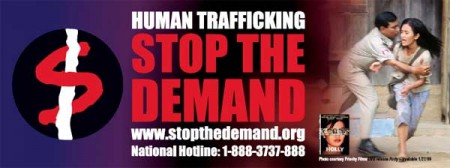
One of the newest of the new abolitionist groups, aptly titled “Stop the Demand,” is headed by Roman Catholic nuns based in the Seattle area. The public face of this campaign is currently found on the sides of Seattle buses, featuring an ad with what appears to be a young (attractive) Asian women trying to escape from the clutches of an Asian man in uniform.

The website for “Stop the Demand” lists as the following as the “goal” of traffickers: prostitution, pornography, violence/sexual exploitation, forced labor, involuntary servitude, debt bondage, or slavery/similar practice” (emphasis mine). Of course, the first two of these, prostitution and pornography, are simply categories of commercial sex, not trafficking.

Similarly, the Baptist World Alliance’s statement against trafficking appears to actually be a campaign against sex work:

“Described as a form of modern slavery, human trafficking mainly affects women and children, most of whom are forced into prostitution” (emphasis mine).

As mentioned in my previous post, while there is clear evidence that women and girls are disproportionately trafficked, of all trafficking cases, approximately 11/12 trafficking cases are NOT sexual (U.S. State Department, Trafficking in persons report, 2009).

False claims about the prevalence of sexual trafficking can be countered with reliable evidence, but the moral and religious opposition to commercial sex is resilient to claims of empirical evidence: The issue of sex work is simply seen as a matter of right and wrong. Quoting again from The Baptist World Alliance’s website:

“The sex industry is able to make humans become slaves to the power of sin.” (emphasis mine)

In its effort to curb human trafficking the faith-based group World Hope International recommends a number of tactics that everyday people in the U.S. can use. These include:

“Teach youth and young adults about the link between the sex industry and the sex trade. Stop the demand before it starts…”

(Actually, “sex industry” and “sex trade” are synonyms. Neither inherently involve sex trafficking).

and, “Provide information to your legislators on how demand increases supply in your state. For more information, contact World Hope. For information on how the sex industry (strip clubs, prostitution rings, pornography) increases demand for victims in your state, contact the Initiative Against Sexual Trafficking (IAST).”

Critics of New Abolitionism: Sex worker activists and their academic and public health allies

Since the passage of the 2000 TVPA several sex worker activist groups along with their feminist academic allies have sharply criticized the sexual politics of the U.S. State department’s anti-trafficking efforts. (Some key academic critics include: Augustin, Bernstein, Chapkis, Desyllas, Ditmore, Doezema, Kempadoo, and Soderlund. See bibliography). These critiques center around several points including: the clear anti-sex work agenda which conflates sexual trafficking and “sexual slavery” with all forms of commercial sex, the ways that anti-trafficking efforts muddy immigration rights efforts, and the “imperialist” nature of US anti-trafficking discourse.

This leads me to the final subject of this post:  the ripple effect of the new abolitionist movement on USAID funding for global sexual and reproductive health projects. Specifically here I will address the USAID policy which requires community/ health organizations to officially denounce the act of prostitution (even if they serve the sexual health needs of sex workers).  Known by many as the “anti-prostitution pledge,” this law states that:

“No funds … may be used to provide assistance to any group or organization that does not have a policy explicitly opposing prostitution and sex trafficking.” (Center for Health and Gender Equity Policy Brief, 2008).

This anti-prostitution pledge helped usher in new abolitionist politics into the realm of global public health; as a result public health and human rights scholars and activists have started to join forces with sex worker and feminist activists. One example of this collaboration is a 13 minute film on the global public health impact of the anti-prostitution pledge. The film, “Taking the Pledge: The USAID PEPFAR Clause, Sex work, & HIV Prevention” is produced by the Network of Sex Work Projects. The film features speakers in English, Khmer, Thai, French, Portuguese and Bengali, with English subtitles.


Links to this film, film curriculum, and other related resources can be found at the Sex Workers Project.

As a result of these sorts of collaborative efforts by sex worker, public health, and human rights workers/advocates, in 2006 the “prostitution pledge” was judged in two U.S. District Courts as violating the First Amendment rights of U.S. organizations:

In May 2006, two U.S. District Courts determined that the oath required of grant recipients by the U.S. government violates the First Amendment rights of the plaintiff organizations, the Alliance for Open Society International, Pathfinder, and DKT International….

Unfortunately, organizations based in other countries are not protected by First Amendment rights; thus they are currently still bound by the prostitution pledge:

…While good news for U.S. organizations, the decision apparently does not does not apply to or “release” subcontractors/subgrantees working on the ground in other countries from having to sign the prostitution loyalty oath. In many instances, those doing  cutting edge work and outreach on the ground are the subgrantees working with sex worker populations.” (Source: PepFar Watch).

Next up in this series: A change of direction for the Obama/Clinton State Department?

Bibliography:

  • Augustin, L.M. 2007. Sex at the Margins: Migration, Labour Markets and the Rescue Industry. London: Zed Books.
  • Bernstein, E. 2007. “The Sexual Politics of the ‘New Abolitionism’.” Differences: Journal of Feminist Cultural Studies, 18:3, 128-151.
  • Center for Health and Gender Equity. 2008 (August). “Policy Brief: Implications of U.S. Policy Restrictions for HIV Programs AImed at Commercial Sex Workers.” Accessible at http://www.genderhealth.org/loyaltyoath.php
  • Chapkis, W. 1997. Live Sex Acts: Women performing erotic labor. New York: Routledge.
  • —– 2003. Trafficking, migration, and the law: Protecting innocents, punishing immigrants. Gender & Society, 17(6), 923- 937.
  • —– 2005. “Soft Glove, Punishing Fist: The Trafficking Victims Protection Acto of 2000.” In Regulating Sex: The Politics of Intimacy and Identity, edited by Elizabeth Bernstein and Laurie Schaffner. New York: Routledge, 51-65.
  • Department of State, United States of America. 2009. Trafficking in Persons Report.
  • Desyllas, M. C. 2007. “A critique of the Global Trafficking Discourse and U.S. Policy.” Journal of Sociology & Social Welfare, Vol. 34 (4), 57-79.
  • Ditmore, M., (2005). Trafficking in lives: How ideology shapes policy. In K. Kempadoo, J. Sanghera, & B. Pattanaik, (Eds.) Trafficking and prostitution reconsidered: New perspectives on migration, sex work and human rights. Boulder, CO: Paradigm Publishers.
  • —–.  2007. “I never want to be rescued again.” New Internationalist (September). 15-16. http://www.newint.org/features/2007/09/01/sex-work-vs-trafficking2/
  • Doezema, J. (1998). Forced to choose: Beyond the voluntary v. forced prostitution dichotomy. In K. Kempadoo & J. Doezema (Eds.), Global sex workers: Rights, resistance and redefinition. New York: Routledge.
  • —–. “Loose Women or Lost Women? The Re-emergence of the Myth of White Slavery in Contemporary Discourses of Trafficking of Women.” Gender Issues 18.1 (2000): 23–50.
  • —–. “Now You See Her, Now You Don’t: Sex Workers at the un Trafficking Protocol Negotiation.” Social and Legal Studies 14.61 (2005): 61–89.
  • —–.  “Ouch! Western Feminists’ ‘Wounded Attachment’ to the ‘Third World  Prostitute.’ ” Feminist Review 67 (2001): 16–83.
  • Kempadoo, K. (2005). “Introduction: From moral panic to global justice: Changing perspectives on trafficking.” In K. Kempadoo, J. Sanghera & B. Pattanaik (Eds.), Trafficking and prostitution reconsidered: New perspectives on migration, sex work, and human rights. Boulder, CO: Paradigm Publishers.
  • Soderlund, Gretchen. “Running from the Rescuers: New U.S. Crusades against Sex Trafficking and the Rhetoric of Abolition.” NWSA Journal 17.3 (2005): 54–87.

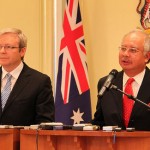
Last summer a news headline caught my eye: “US to Malaysia: Stop Human Trafficking Quickly.” Headlines from southeast Asian presses followed, including “Malaysia outcry at US trafficking blacklisting,” and “Malaysia ‘immune’ to U.S. criticism of human trafficking.” When Australian Prime Minister Kevin Rudd met with Malaysian Prime Minister Najib Tun Razak last July, he “praised Malaysia’s energetic efforts to curb human trafficking”  ….“despite the fact that Malaysia was just downgraded to Tier 3 from Tier 2 in the Trafficking in Persons (TIP) Report 2009 by the US Department of State.”Rudd-Najib

These public state-level conversations about trafficking made me curious: Who gave the US the authority to define global trafficking? What authority does the US have in dictating standards for other countries? What happens if “they” (in this case, Malaysian officials) don’t listen? And how much emphasis is placed on “sexual trafficking” in these political conversations?

These questions have led me into a fascinating world of sexual politics — intersecting with domestic and international trafficking policies; heath, human, and labor rights issues; US conservative religious advocacy groups; and US global power. This post will be the first in a series to explain and analyze the contemporary anti-trafficking movement. In this first post, my point is simply to:

  • explain the scope and purpose of the Trafficking Victims Protection Act, and
  • briefly introduce “demand-side” versus “supply-side” approaches to labor exploitation.

———————————————————————————————————–

Scope and purpose of the Trafficking Victims Protection Act:

In the year 2000, U.S. Congress passed the Trafficking Victims Protection Act designed to address severe forms of trafficking. “Severe forms of trafficking” is defined by the TVPA as:

  • sex trafficking in which a commercial sex act is induced by force, fraud, or coercion, or in which the person induced to perform such an act has not attained 18 years of age; or
  • the recruitment, harboring, transportation, provision, or obtaining of a person for labor or services, though the use of force, fraud, or coercion for the purpose of subjection to involuntary servitude, peonage, debt bondage, or slavery.                                                   [Trafficking in Persons (TIP) Report 2009, Pp. 6-7]

Note that sex trafficking is considered a separate category from labor trafficking, reinforcing the notion that “sex” and “labor” are mutually exclusive. (This, despite two decades of sex work activism arguing for legitimate recognition of sexual labor (e.g., Jenness 1990; Chapkis 1997; Nagel 1997).

Note also that the TVPA lists sex trafficking prior to other forms of trafficking. Just a coincidence? Given the common media conflation of “human trafficking” with “sex trafficking,” as well as President G.W. Bush’s emphasis on the “special evil” of sex trade victims (Lopez, 2006, p. 4), I doubt that it is a coincidence that sex trafficking leads the list.

While people are free to have their opinions on what forms of labor exploitation constitute a “special evil,” in terms of actual numbers the case is clear: the International Labor Organization (the same source cited by the US State Department) estimates that the VAST number of trafficking cases are NOT sex trafficking cases: Approximately 11 out of 12 constitute OTHER forms of labor exploitation (TIP report 2009, p. 8).

State Department monitoring & sanctioning:

Since the passage of the TVPA, the Department of State has been required to provide a report on the status of “foreign governments’ efforts to eliminate severe forms of trafficking in persons”  [p. 5, TIP 2009].  This past June (2009) the State Department released its ninth annual Trafficking in Persons report where every country in the world is rated on a scale of 1-3 based on “the extent of government action to combat trafficking.” (TIP report 2009, p. 11). It was in this report that Malaysia was “blacklisted” or moved from “Tier 2 watch list” to “Tier 3.”

Put in academic terms, Professor State Department just gave Malaysia an “F.” So now what?

According to the State Department, “…governments of countries on Tier 3 may be subject to certain sanctions, whereby the U.S. Government may withhold nonhumanitarian, non-trade-related foreign assistance.” Additionally, “governments subject to sanctions would also face U.S. opposition to assistance (except for humanitarian, trade-related assistance) from international financial institutions such as the International Monetary Fund (IMF) and the World Bank.” (TIP report 2009, p. 13). The State Department claims that “(i)mposed sanctions will take effect October 1, 2009.” (TIP report 2009, p. 13).

As of this writing (Oct. 8, 20090 I have not yet seen any evidence that sanctions have been imposed against Malaysia. (Readers: please let me know if you have any news on this).

Demand-side vs. Supply-side strategies:

The US State department assesses foreign anti-trafficking activities based on “the three P’s”: Prosecution, protection, and prevention. The first two are fairly straightforward: does the government in question punish “traffickers” and provide protection for those who are “trafficked?” The third criteria, “prevention” has more room for interpretation. For the US State department, at least at the present moment, “prevention” is tilted toward the “demand side” of the equation — in other words, reducing consumer desire for trafficked goods and services. This includes punishing not just the “traffickers” but the “consumers” of trafficked goods. In the context of the sex industry, this means punishing the “johns” as well as the “pimps.” (e.g., see TIP report 2009, p. 32).

In contrast, a “supply-side” approach to prevention would focus on reducing the economic, social, and cultural conditions that make children and adults vulnerable to abuse and labor exploitation. In this paradigm, interventions would focus on reducing poverty, sexism, racism, and other forms of inequality. Supply-side approaches to prevention would not eliminate the first two “P’s” (Prosecution and protection); it would simply add a social-structural safety net of laws and services (e.g. child labor and welfare laws) to the strategy of finding “bad guys” to punish.

For those trained in sociology, this is a no-brainer: OF COURSE we need to incorporate supply-side approaches. So what’s up with the demand-side emphasis of current US policy?

The current “demand-side” emphasis of all three “P’s” of the TVPA is a reflection of those who initially brought the issue of human trafficking to the US political table. This includes Donna Hughes, a Women Studies professor (trained in genetics) who has spent nearly twenty years as an anti sex-trafficking activist. As an abolitionist (someone who advocates the complete abolition of the sex industry), Hughes applauds the demand-side, punish-the-bad-guys approach to eliminating trafficking and in particular, prostitution (Lopez, p. 4). Hughes applauds former President G.W. Bush for his “crucial” role in this demand-side approach:

“In October 2003, at the United Nations, President Bush called upon world leaders to come to the assistance of victims of the sex trade…..He addressed the demand for victims, by saying, ‘Those who patronize this industry debase themselves and deepen the misery of others’.”

Hughes goes on to say, “by supporting the abolitionist work against the global sex trade, he (Bush) has done more for women and girls than any one other president I can think of.  …. Years from now, when the anti-Bush hysteria has died away, I believe he will be recognized as a true advocate for women’s freedom and human rights.” (Hughes, quoted in Lopez, p. 6).

WOW. It’s not every day that you hear a Women Studies professor call President G.W. Bush a “true advocate for women’s freedom and human rights”!

For the second post in this series on the sexual politics of anti-trafficking efforts, click here.

————————————–

The Tiers, as defined by the TVPA:

TIER 1: Countries whose governments fully comply with the Trafficking Victims Protection Act’s  (TVPA) minimum standards

TIER 2:  Countries whose governments do not fully comply with the TVPA’s minimum standards, but are making significant efforts to bring themselves into compliance with those standards

TIER 2 WATCH LIST:  Countries whose governments do not fully comply with the TVPA’s minimum standards, but are making significant efforts to bring themselves into compliance with those standards AND:  a) The absolute number of victims of severe forms of trafficking is very significant or is significantly increasing; or b) There is a failure to provide evidence of increasing efforts to combat severe forms of trafficking in persons from the previous year; or c) The determination that a country is making significant efforts to bring themselves into compliance with minimum standards was based on commitments by the country to take additional future steps over the next year

TIER 3: Countries whose governments do not fully comply with the minimum standards and are not making significant efforts to do so.

(Source: TIP report 2009, p. 49)

—————————————————————————–

Bibliography: