I want all of your mind
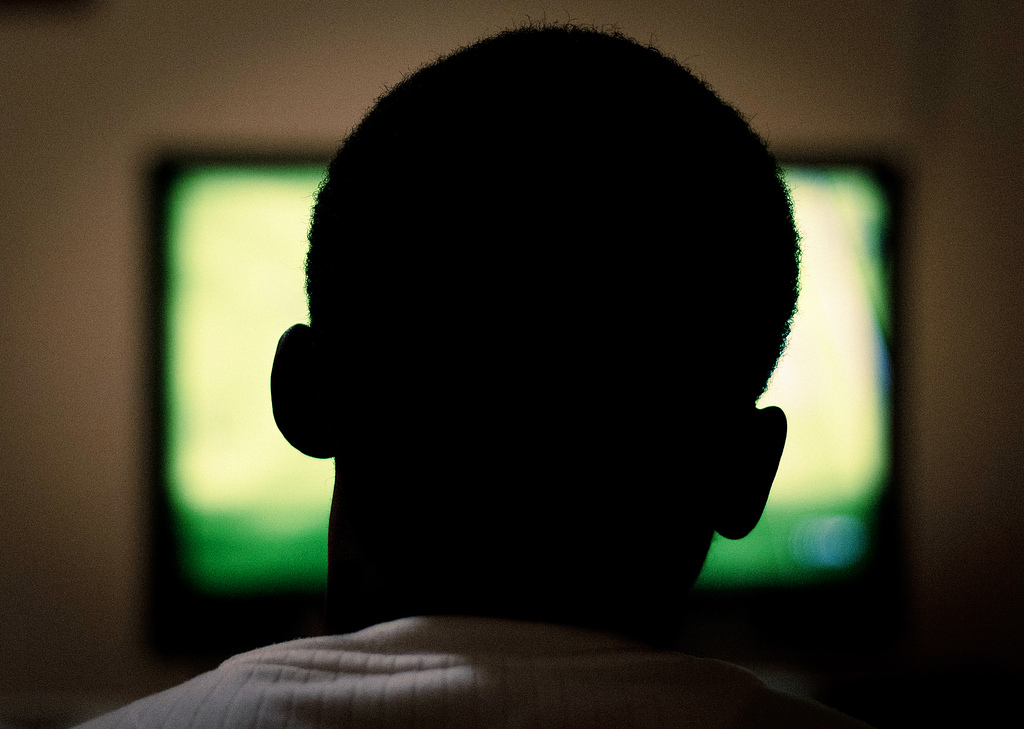
People turn the TV on, it looks just like a window…
Digital witnesses
What’s the point of even sleeping?
— St. Vincent, “Digital Witness” (2014)
Each day seemingly brings new revelations as to the extent of our Faustian bargain with the purveyors of the digital world in which we find ourselves. Our movements, moods, and monies are tracked with relentless precision, yielding the ability to not only predict future behaviors but to actively direct them. Permissions are sometimes given with pro forma consent, while other times they’re simply baked into the baseline of the shiniest and newest hardware and software alike. Back doors, data breaches, cookies and trackers, smart everything, always-on devices, and so much more — to compare Big Tech to Big Brother is trite by now, even as we might soon look back on the latter as a quaint form of social control.
While data breaches and privacy incursions are very serious and have tangible consequences, debates over user rights and platform regulation barely scratch the surface. Deeper questions about power, autonomy, and what it means to be human still loom, largely uncovered. And when these concerns are even voiced at all they can often seem retrogressive, as if they represent mere longings for a bygone (pre-internet) time when children played outside, politics was honorable, and everyone was a great conversationalist. Despite ostensible consternation when something goes egregiously wrong (like influencing an election, let’s say), the public and political conversation around mass data collection and its commercialization never goes far enough: why do so many seemingly reasonable and critical people accept a surveillance-for-profit economy (with all of us as the primary commodity) as tolerable at all? more...
When the team here at Cyborgology first started working on The Quantified Mind, a collaboratively authored post about the increasing metrification of academic life, production, and “success”, I immediately reached out to Zach Kaiser, a close friend and collaborator. Last year, Zach produced Our Program, a short film narrated by a professor from a large research institution at which a newly implemented set of performance indicators has the full attention of the faculty.
For my post this week, then, I’d like to consider Zach an Artist in Residence at Cyborgology—someone using the production and dissemination of works that embody the types of cultural phenomena or theories covered on the blog (as it turns out, this is not Zach’s first film featured on Cyborgology). I suppose it’s up to him if he’d like to include the position on his CV. In the following, I would like to present some of my reactions to the film and let Zach respond, hopefully raising questions that can be asked in dialogue with the ones presented at the end of The Quantified Mind. In full disclosure, I am very familiar with Zach’s scholarship and art (I’m listed as a co-author or co-artist on much of it, though not Our Program in particular), so I hope I don’t lead the witness too much here.
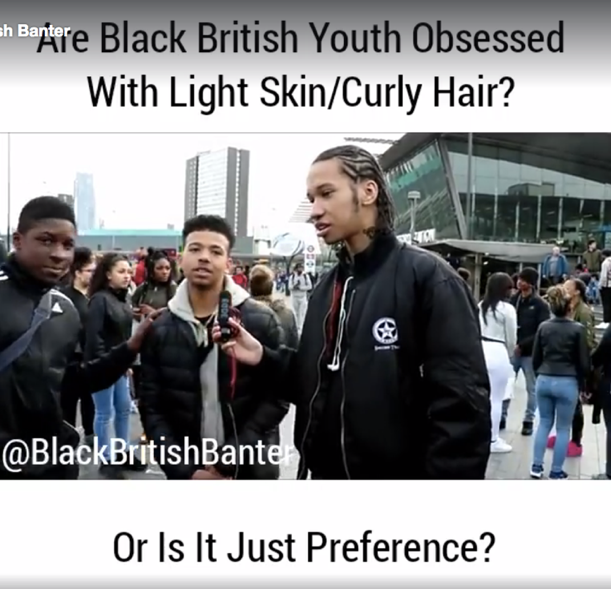
A mere 2 minutes and 19 seconds in length, the video Are Black British Youth Obsessed with Light Skin/Curly Hair. Or is it just Preference?” is a compilation of snippets from “person on the street” interviews, conducted in the environs of two shopping centers and a commuter railway station in east London (more on this later).
The interviewer is a roving Internet reporter going by the handle of VanBanter, whose YouTube channel boasts over 85,000 subscribers. VanBanter is a tall, svelte, black Briton of around 16, himself light skinned, whose voluminous hair in the clips is either styled in cornrows, or pulled back in a low Afro puff, the black version of the “man bun.”
The interviewees are black boys, ostensibly between the ages of 12 and 17, of a wide spectrum of skin colors and hair textures. The single question VanBanter asks all of them is, “What kind of girls are you into?” On occasion, he phrases it as, “What type of girls do you slide into?” Two token girls are asked the same question about boys. All interviewed say they like “light skins.” Some add “curly hair,” clearly meant as a qualifier in opposition to “kinky,” not straight, hair texture. Hence, palpably, one can infer that light-skins are more favoured than any other colors at the place. Most of the interviewees are filmed standing in pairs or small groups of friends who support their responses with interjections, gestures, or general glee.
The video was first uploaded on June 1st to the Facebook page of Black British Banter. Over that weekend, it received a million views, over 6k likes (2.6k neutral thumbs-up expressing interest, 1.2k crying emojis, 1.1k angry ones, 546 laughing ones, 467 wows, and 62 loves), 5k comments, and 8,000 shares.
I myself could not stop viewing it. The comments far outstretch the bounds of personal preference, to which we all have an undisputable right. Instead, they defend a centuries-old global regime of negating not only the beauty, but very humanity, of people with dark skin, especially women. “No black t’ings, like my shoes n’ shit!” says one very more...
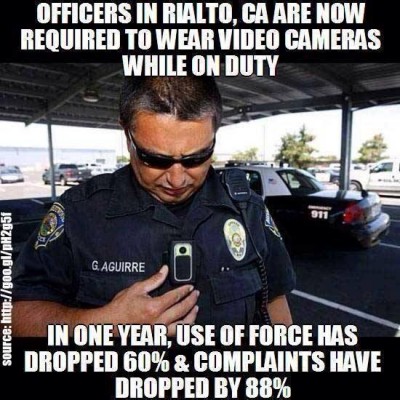
The murder of Mike Brown by Ferguson police officer Darren Wilson has catalyzed an already fast-growing national conversation about outfitting police officers with cameras like the one shown above. These cameras, the logic goes, will keep officers on their best behavior because any abuses of power would be recorded and stored for later review. Officer’s behavior, much like an increasing amount of civilian behavior, will be subject to digital analysis and review by careful administrators and impartial juries. This kind of transparency is extremely enticing but we should always be critical of things that purport to show us unvarnished truths. As any any film director will tell you: the same set of events recorded on camera can look very different when viewed from different angles and in different contexts. more...
Just a quick link I came across over the weekend before the hurricane knocked out my power. In the video below, we see Chloe Holmes displaying her new prosthetic hand, a $62,000 piece of technology that allows her to move each digit independently of one another through sensors embedded in the sleeve. Chloe lost her fingers at age 3 as a result of septicemia, a complication from chicken pox.
I am a big fan of Marshall McLuhan and think he is due for a well-timed comeback in this the year of his centennial. I posted this great Playboy interview a while back and am now fixated with a new website called McLuhan Speaks. This site archives short video clips of our media prophet in action.
Click the images below to watch some of my favorite short clips from the site.
Here, and ever ahead of his time, McLuhan describes how we will become obsessed with surveilling each other, something that social media often exemplifies.
We live in a cyborg society. Technology has infiltrated the most fundamental aspects of our lives: social organization, the body, even our self-concepts. This blog chronicles our new, augmented reality.