
uprisings

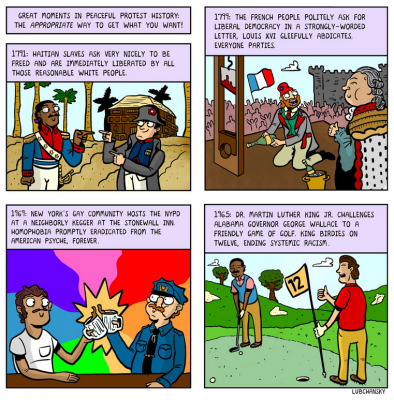
Cartoon by Matt Lubchansky (@lubchansky) original posting can be found here.

A few editorial cartoons offering a counterpoint perspective to the cultural sentiments and media portrayals that denounce the Baltimore “riots” as politically unproductive, ethically unjustifiable hooliganism have achieved viral status.  One particularly prominent cartoon illustrates alternative histories in which once denied freedoms and equities were achieved without systemically disruptive uprisings (see image above).  In one panel an 18th century Haitian slave cordially informs a French Imperialist that he and his fellow slaves would rather be free.  The receptive overseer responding in an equally kind fashion decides to abolish the system of slavery that legitimizes his very authority.  In another panel an 18th century French revolutionary asks King Louis XVI to abdicate his power as well as dissolve the monarchy to make way for democratic rule and, like in the previous example, history is comically rewritten to suggest that the powers that be were enthusiastically and progressively responsive to such a request.  more...
Via Renesys
http://www.renesys.com/blog/2012/11/syria-off-the-air.shtml

  *12/01/2012: SEE UPDATE BELOW ORIGINAL POST*

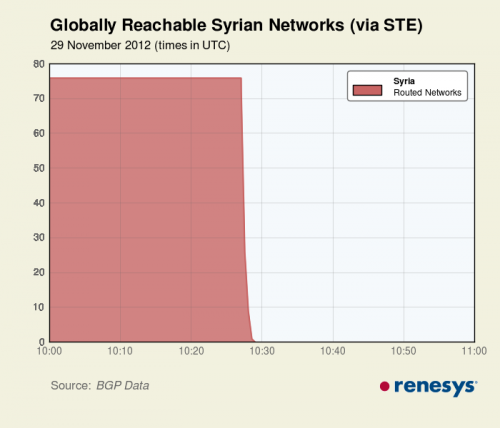
Today (Thursday November 29, 2012), Syria’s internet shut down. This is a serious situation with literal life and death implications. We have been following the situation on the Cyborgology Facebook page since the story broke (largely, this consisted of seeing what was going on with Andy Carvin @acarvin). Much of this story has yet to play out, and we will certainly continue to follow/write about it as events progress and we learn more. Right now, I want to take a moment to explore one aspect of what this all means. Namely, I want to explore the question: why did the internet shut off now? To do so, I turn to Derrick Bell’s interest convergence theory. more...

Information Politics in the Age of Digital Media

Discussant: Deen Freelon, American University

  • “Internet Infrastructure: ‘Access’ Rhetoric, Neoliberalism, and Informational Politics” (Dan Greene, University of Maryland-College Park)
  • “Academic Marginalization in the Age of Social Media” (PJ Rey, University of Maryland-College Park)
  • “Social Media and Revolutionary Movements: Toward Research and Activist Agendas” (Mina Semeni, Randy Lynn, and Jason Smith, George Mason University)

This panel explores some of the opportunities for theoretical development and synthesis emerging at the intersection of public sociology and digital media. True to the conference’s remit, each focuses on a distinct form of publicity of interest to publics outside the academy. Dan Greene questions the prevailing neoliberal rhetoric of access to information technologies, arguing that it facilitates the concentration of power and prevent us from connecting related struggles for individual and collective emancipation. As a corrective, he proposes a frame he calls “informational politics” that overcomes this conceptual weakness by explicitly recognizing the links between digital media and the social contexts within which they are used. PJ Rey invites us to reconsider the roles of newer forms of scholarly communication such as blogs and tweets in evaluations of academic productivity. Journals and conference proceedings, which still enjoy preeminence among tenure criteria in most fields, are far too slow, costly, and obscure to effectively relay the fruits of public sociology to non-academic publics. Finally, Mina Semeni, Randy Lynn, and Jason Smith are interested in how activists use social media in contexts of social protest and revolution. In an attempt to move beyond totalizing and causal theories of the Internet and politics, they propose two mechanisms through which social media might abet protest: by increasing social capital and by strengthening existing institutions. more...