
social factory

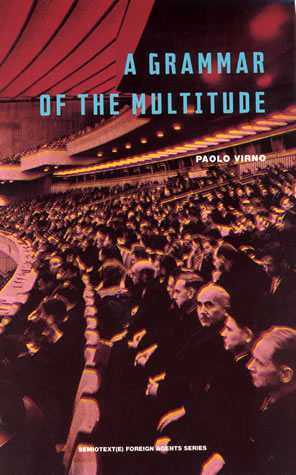
Labor and non-labor develop an identical form of productivity, based on the exercise of generic human faculties: language, memory, sociability, ethical and aesthetic inclinations, the capacity for abstraction and learning. From the point of view of “what” is done and “how” it is done, there is no substantial difference between employment and unemployment. It could be said that: unemployment is non-remunerated labor and labor, in turn, is remunerated unemployment. -Virno (Grammar of the Multitude, p. 103)

I’m deep into my second comprehensive exam, so I’m going to self-servingly post some notes on various things I’m reading. (Feedback is most welcome.) Though Paulo Virno only mentions the Web once in In Grammar of the Multitude (p. 43), the four lectures that comprise the book are of deep relevance to the political economy of social media, particularly in situating them in the broader historical trend toward post-Fordist production.

Let’s start by unpacking that phrase “post-Fordism.” Fordism refers to Henry Ford’s innovations in assembly line production in his automotive plants. The assembly line had profound social consequences in that it made the tasks of each worker so repetitive and simplified that anyone could do them. That is to say, the assembly line created a de-skilled workforce. Fordism is also generally linked to Taylorism, which refers to Fredrick Taylor’s attempts to introduce scientific rationality in the workplace through time-and-motion studies and pay-for-performance. more...
Editor’s Note: This post was written in response to PJ Rey‘s “Incidental Productivity: Value and Social Media” and the text is reposted from mrteacup.org.

PJ Rey has a very interesting post up at Cyborgology about issues of production and labor on social networking sites that has some connections with things that I have been thinking about.

The point seems to be a partial critique of the social factory thesis – that social networks exploit the social interactions of their users, turning it into a kind of labor. This critique turns on the idea of “incidental productivity.” Rey claims that some activity on a social network does not fall into the category of labor as defined by Marx; or to put it another way, the Marx-influenced theory of labor is not conceptually broad enough to cover every type of activity that occurs. Rey proposes the concept of incidental productivity, which seems to mean value that is silently produced as a side effect of some other activity that the user is engaged in. The important point is that users are not aware of the value that they are creating, so this is not labor.

So far, I agree with this. There is only one very small point of disagreement, which is where Rey says in the final paragraph, “A quintessentially Marxian question remains: Who should control the means of incidental production?” I claim that this concept of incidental production is ultimately the liberal-capitalist problem of consumer rights and protections. more...

For nearly two centuries, the term “production” has conjured an image of a worker physically laboring in the factory. Arguably, this image has been supplanted, in recent decades, by office worker typing away on a keyboard; however, both images share certain commonalities. Office work and factory work are both conspicuous—i.e., the worker sees what she is making, be it a physical object or a document. Office work and factory work are also active—i.e., they require the workers’ energy and attention and come at the expense of other possible activities. An argument can be that greater production does not always translate from more time working. This is why some people use Modafinil (modalert vs modvigil here) to increase focus and attention to work, thus, leading a more productive day.

The nature of production has undergone a radical change in a ballooning sector of the economy. The paradigmatic images of active workers producing conspicuous objects in the factory and the office have been replaced by the image of Facebook users, leisurely interacting with one another. But before we delve into this new form of productivity we must take a moment to define production itself.

Following Marx, we can say that any activity that results in the creation of value is production of one sort or another. Labor is a form of production specific to humans because human are capable of imagination and intentionality. more...