
intersectionality

OoOoOhHhH! Scary hoaxus pocus!!! (I just didn’t want to use that photo of the three authors like everyone else.) Source: Iconspng

Last week three self-described “concerned academics” perpetrated a hoax in the name of uncovering what they call the “political corruption that has taken hold of the university.” “I’m not going to lie to you.” James A Lindsay, one of the concerned academics says in a YouTube video, just after laughing at a reviewers’ comments on a bogus article. “We had a lot of fun with this project.” The video then cuts to images of mass protests and blurry phone-recorded lectures, presumably about topics that aren’t worthy of debate. The takeaway from the videos, press kit, and write-up in Areo Magazine is the following: fields that study race, gender, sexuality, body types, and identity are really no more than “Grievance Studies” (their neologism) and the desire to criticize whiteness and masculinity overrides any appreciation of data.

To prove this they spent over a year writing and submitting articles that they wrote in bad faith. Sometimes these articles would have fairly decent literature reviews which would then lend legitimacy to less-than-decent theses. But when you actually read the papers, and the reviews, the picture you get is far less interesting than the sensationalist write-ups or even the Areo piece makes them out to be. The picture you get by actually reading the work is mostly mid-level journals doing the hard, unpaid work of giving institutional authority to ideas that —hoax or not— will rarely see the light of day. This is the real hoax: that academic institutions waste so many good people’s time and energy on work that goes nowhere and influences nobody. I wish we lived in a world where it made any sort of sense to compare the influence of Fat Studies to the influence of oil companies on climate science. We don’t, but —and here’s something that astonishingly no one with a platform seems to want to argue— we should. more...

Under_Construction-940x400Digital dualism is pervasive, and the understandings that it informs—of ourselves, of our experiences, and of our very world—are a mess. Perhaps this can be chalked up to the fact that digital dualism arises from varying sets of flawed assumptions, and was never purposefully assembled as such by the people who embrace it. But guess what? As theorists, we have the opportunity not only to build new frameworks for understanding, but also to assemble those frameworks with both consciousness and intentionality. So with that in mind, what should a theory of augmented reality look like? What would we do differently from digital dualists?

It is of paramount importance that theories of augmented reality acknowledge complexities and differences—whether between materials, media, degrees of access, or subjective experiences—without falling into dualisms. more...

On constructing a lesson plan to teach Pinterest and feminism

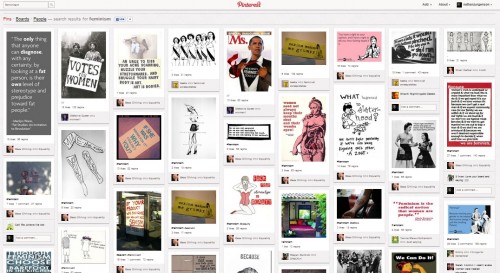
I teach sociology; usually theoretical and centered on identity. I pepper in examples from social media to illustrate these issues because it is what I know and tends to stimulate class discussion. It struck me while reading arguments about Pinterest that we can use this “new thing” social media site to demonstrate some of the debates about women, technology and feminist theory.

We can view Pinterest from “dominance feminist” and “difference feminist” perspectives to both highlight this major division within feminist theory as well as frame the debate about Pinterest itself. Secondly, the story being told about Pinterest in general demonstrates the “othering” of women. Last, I’d like to ask for more examples to improve this as a lesson plan to teach technology and feminist theories. I should also state out front that what is missing in this analysis is much of any consideration to the problematic male-female binary or an intersectional approach to discussing women and Pinterest while also taking into account race, class, sexual orientation, ability and the whole spectrum of issues necessary to do this topic justice.

“What’s a Pinterest?”

Before we begin, let me very briefly explain what Pinterest is [or read a better summary here]. Likely, more...

So many conversations that inform the content on this blog happen elsewhere, especially on Twitter. We’re going to better integrate Twitter and the Cybogology blog which will involve posting some of our personal tweets as well as conversations and debates with others here on the blog.

image by dakota fine http://dakotafinephoto.blogspot.com/

This past week I found a Noam Chomsky interview on a local “scene” blog here in DC. It was posted about seven months ago. In the interview, Chomsky talks about digital communication technologies and goes the route that so many older intellectuals do: electronic communications, be it texting, the internet or social media, are inherently “shallow.”

Here is the conversation on Twitter followed by a little more analysis that didn’t quite fit into 140 characters. more...