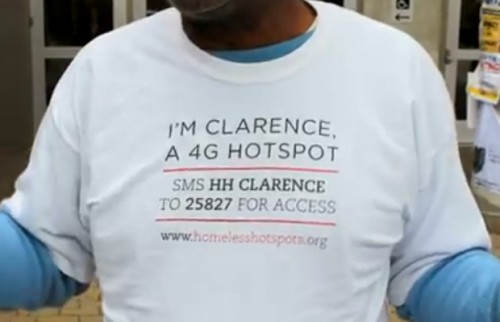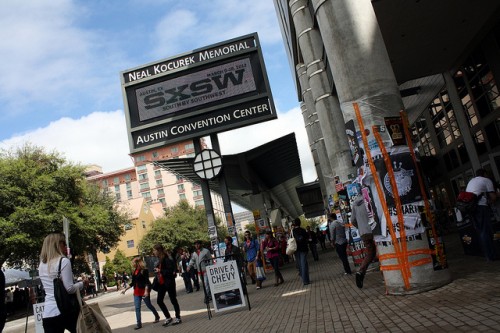
Bartle Bogle Hegarty has reportedly ended the homeless-Austinites-as-mobile-WiFi-spots experiment/publicity stunt that was one of the biggest news items to emerge out of South by Southwest 2012. There was strong backlash and, on this site, a thorough consideration of how the whole thing fit into broader political-economic currents. As a former psychiatric counselor who worked with currently or previously homeless folks, I’m happy to see any public discussion of homelessness as well as some relatively safe and transparent work opportunities—at around minimum wage—available to this often ignored population. But to me that conversation seemed to emerge more from the backlash than BBH’s actual involvement with the homeless community. I’d like to pick some of these threads up, add new ones, and consider what this incident has to say about the use of information technology as a development tool and knowledge workers’ relationships to postindustrial cities. These ideas were developed in conversation with Jason Farman, who was kind enough to provide the screencaps included below.
The Internet backbone—especially urban wireless infrastructure—generally exists as a series of nodes not remarked on, or massive nondescript buildings housing server farms just outside the attention of urban knowledge workers like myself. I don’t need to know how it happens. The infrastructural activity that undergirds so much of my work and life goes on whether I notice it or not. What’s interesting about BBH’s efforts, is that they bring the infrastructure directly into focus with mobile hotspots that you must see, name, and approach. I think the short-term publicity stunt may address the invisibility of the homeless that WiFi vendor Clarence points to, “They [residents] walk around and just see people, don’t talk to them. Past the homeless too. You don’t even see us.” But this new visibility trades invisibility for infrastructural non-awareness or acceptance. In DC, I can see the cell phone antennae in my neighborhood if I look hard enough, but I still don’t really care. BBH is asking us to accept homelessness as a feature of a wireless urban landscape to be navigated more...