
Christian Fuchs

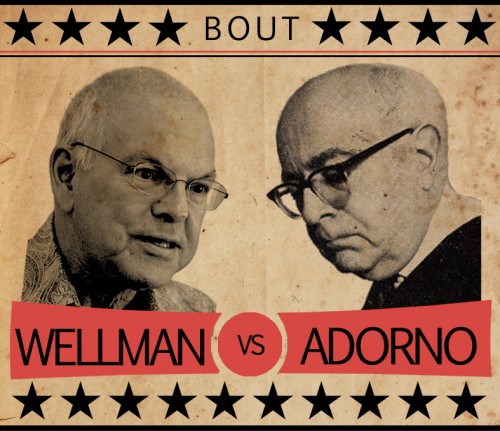
On September 18th, 2011, Barry Wellman, the early and rather prescient scholar of the Internet, posed a somewhat tongue-in-cheek question to the Communication and Information Technology Section of the American Sociology Association (CITASA): “‘Critical’ – aren’t we all?”  This post was precipitated by a call for papers for special issue of tripleC entitled Marx is Back: The Importance of Marxist Theory and Research for Critical Communication Studies Today (no affiliation with the author).  Specifically, the call invited papers that address (my emphasis):

what it means to ask Marx’s questions in 21st century informational capitalism, how Marxian theory can be used for critically analyzing and transforming media and communication today, and what the implications of the revival of the interest in Marx are for the field of Media and Communication Studies.

Shortly after it was sent, Wellman responded to the call, saying:

Not meant personally, but the use of the word “critical” by a subset of scholars always bothers me as leading to unconscious smugness? If I’m “critical”, your lot isn’t? Who, except flacks and twerps, isn’t critical? Can we criticize the criticalists?

This sparked a debate over the utility and appropriateness of the phrase “critical theory.”  Critics of the phrase raise the following objections: more...
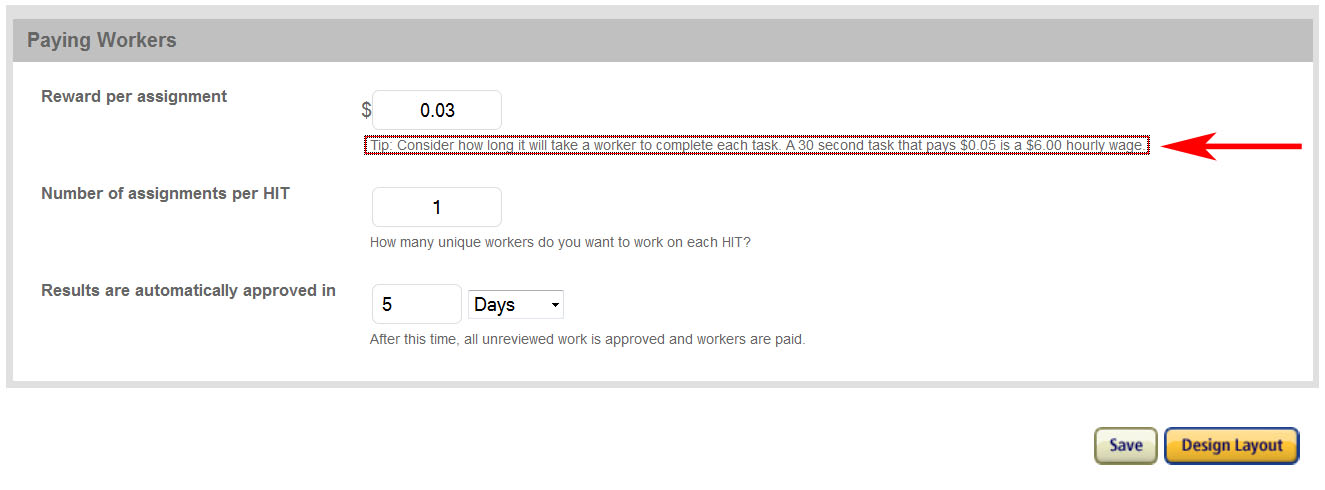
Since 2007, the US federal minimum wage has been set at $7.15 an hour, yet workers on Amazon’s Mechanical Turk—many of whom live in the US—make an average of $2 (according to the estimates of Mechanical Turk researcher Alex Quinn).  As illustrated in the above image, Amazon, itself, encourages businesses (at least implicitly) to pay workers (or “turkers” as they are called) less-than-minimum wages.  Moreover, to even qualify for these low-paying tasks called HITs (Human Intelligence Tasks), turkers are often expected to complete unpaid training sessions that can last for up to an hour.  Also, because turkers receive micro-payments for each task and because the time to completion for each task is rationalized to the second, turkers receive no pay during normal periods of rest during the workday.

Mechanical Turk is a crowdsourcing platform that allow anyone to recruit laborers for short online tasks, which cannot be effectively completed by computers.  For examples, turkers might compile contact information for various businesses, sort through images and tag offensive ones, or participate in university research experiments.  Because of the piecemeal and spatially-disembedded nature of the work, it is virtually unregulated.

Can we simply dismiss this subversion of labor laws—as some commentators have—on the grounds that “$2 an hour is a decent wage in India?”  Even if we are angered by this exploitation of turkers, is it even possible to regulate an international platform of this sort?