business

Thiel - Girard

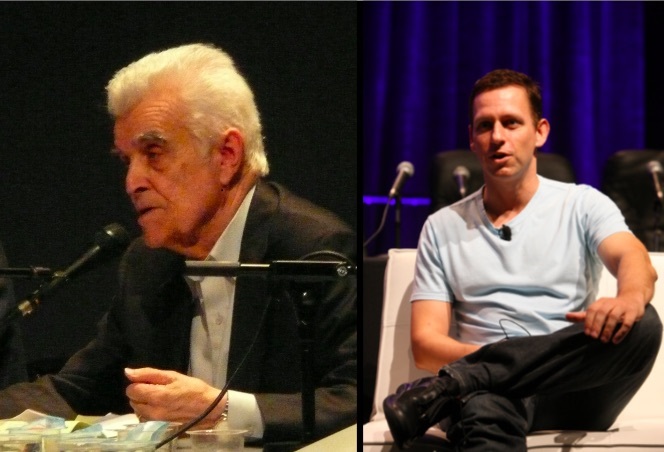
During the week of July 12, 2004, a group of scholars gathered at Stanford University, as one participant reported, “to discuss current affairs in a leisurely way with [Stanford emeritus professor] René Girard.” The proceedings were later published as the book Politics and Apocalypse. At first glance, the symposium resembled many others held at American universities in the early 2000s: the talks proceeded from the premise that “the events of Sept. 11, 2001 demand a reexamination of the foundations of modern politics.” The speakers enlisted various theoretical perspectives to facilitate that reexamination, with a focus on how the religious concept of apocalypse might illuminate the secular crisis of the post-9/11 world.

As one examines the list of participants, one name stands out: Peter Thiel, not, like the rest, a university professor, but (at the time) the President of Clarium Capital. In 2011, the New Yorker called Thiel “the world’s most successful technology investor”; he has also been described, admiringly, as a “philosopher-CEO.” More recently, Thiel has been at the center of a media firestorm for his role in bankrolling Hulk Hogan’s lawsuit against Gawker, which outed Thiel as gay in 2007 and whose journalists he has described as “terrorists.” He has also garnered some headlines for standing as a delegate for Donald Trump, whose strongman populism seems an odd fit for Thiel’s highbrow libertarianism; he recently reinforced his support for Trump with a speech at the Republican National Convention. Both episodes reflect Thiel’s longstanding conviction that Silicon Valley entrepreneurs should use their wealth to exercise power and reshape society. But to what ends? Thiel’s participation in the 2004 Stanford symposium offers some clues.    more...
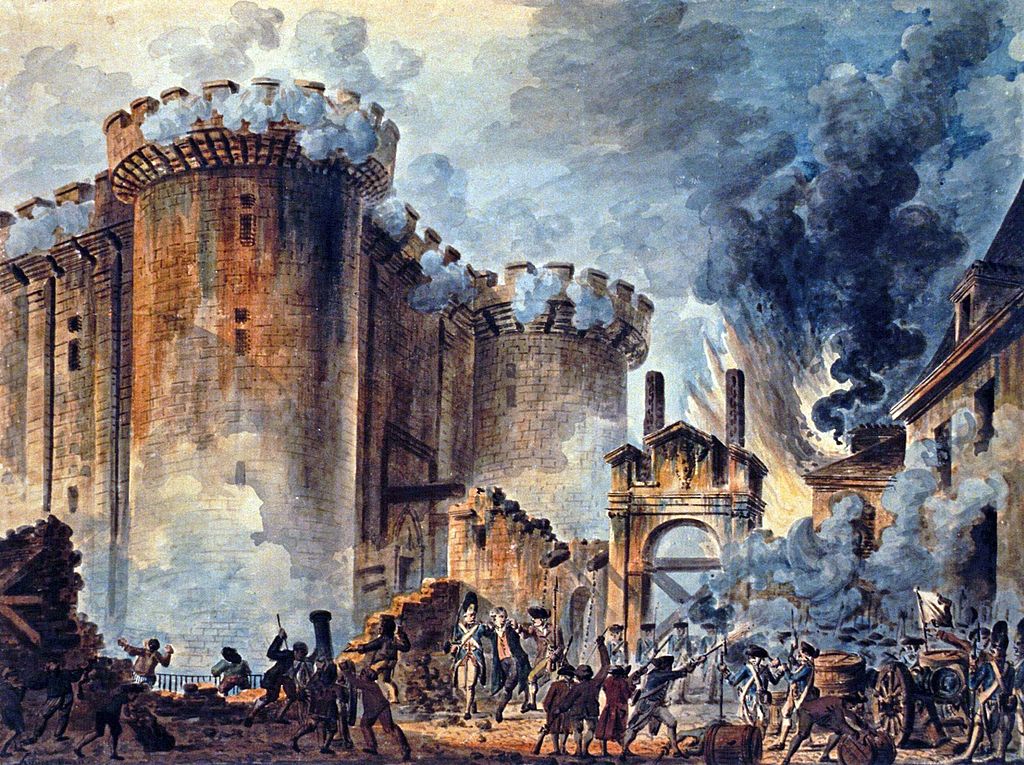
The Storming of the Bastille

Why don’t we ever talk about taking over social media companies? We will boycott them, demand transparency measures, and even build entire alternative networks based on volunteer labor but no one ever seems to consider taking all the servers and data sets away from the Mark Zuckerbergs of the world and putting it all in the hands of the users. Even if a company was doing a bang-up job making their products easier to use, freer from harassment, and more productive in creating a better society, there’s still something fundamentally creepy about users having no democratic control over such an important aspect of their lives. Why is there no insistence that such important technologies have democratic accountability? Why are we so reticent to demand direct control over the digital aspects of our lives? more...

I thought for reruns week I would re-post something I wrote back in February that fits with our ongoing CFP on Small Town Internet. Problems of governance, especially of small, geographically defined groups, is surprisingingly understudied especially when it comes to our present state of augmented reality. 

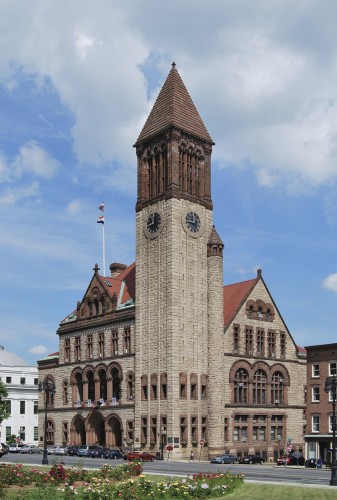
The Albany New York Town Hall


It is certainly good news that the Obama Administration has come out strong for net neutrality. The President recently made an announcement that his office would help promote local broadband competition as part of a broader effort to improve the country’s data infrastructure. More specifically, the federal government plans to help municipalities develop their own data networks, fight state laws that prevent municipal governments from offering public broadband options, and help small businesses compete in local markets with companies like Verizon and Time Warner. The chairman of the FCC followed suit by announcing (in WIRED Magazine…?) yesterday that he would be circulating a proposal to apply Title II to telecom companies and mobile phone carriers, effectively making it illegal to throttle connections based on what sorts of services you are connecting to. This is all good news but I’m also hesitant to trust local authorities with my internet connection. Aren’t these the same governments that defend murderous police forces and cooperated with the federal government to shut down political dissent? Why should these organizations control the network? While I am definitely not a fan of huge telecom corporations, I don’t trust my local government either.  more...

This essay is cross-posted with TechnoScience as if People Mattered

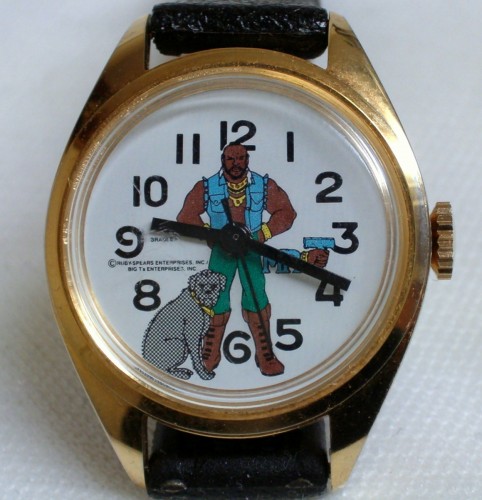
A Swiss-made 1983 Mr. T Watch. Timeless. (Source)

Micah Singleton (@micahsingleton) over at the Daily Dot has a really great essay about one of the biggest problems with the Apple Watch. You should read the whole thing but the big takeaway is that really great watches and mainstream tech have a fundamental incompatibility: nice watches usually become heirlooms that get handed down from generation to generation, but consumer technology is meant to be bought in product cycles of a only a couple of years. A really nice watch should be “timeless” in a way our devices never have been. Compared to the usual 2-year contract phone purchase, the technological evolution of high-quality watches moves about as fast as actual biological evolution. Is it possible to deliberately build timelessness into electronics? more...

Image Credit: Marco Paköeningrat

Ugh. I hate the new Facebook. I liked it better without the massive psychological experiments.

Facebook experimented on us in a way that we really didn’t like. Its important to frame it that way because, as Jenny Davis pointed out earlier this week, they experiment on us all the time and in much more invasive ways. The ever-changing affordances of Facebook are a relatively large intervention in the lives of millions of people and yet the outrage over these undemocratic changes never really go beyond a complaint about the new font or the increased visibility of your favorite movies (mine have been and always will be True Stories and Die Hard). To date no organization, as Zeynep Tufekci observed, has had the “stealth methods to quietly model our personality, our vulnerabilities, identify our networks, and effectively nudge and shape our ideas, desires and dreams.” When we do get mad at Facebook, it always seems to be a matter of unintended consequences or unavoidable external forces: There was justified outrage over changes in privacy settings that initiated unwanted context collapse, and we didn’t like the hard truth that Facebook had been releasing its data to governments. Until this week, it was never quite so clear just how much unchecked power Facebook has over its 1.01 billion monthly active users. What would governing such a massive sociotechnical system even look like? more...

image source
image source

Okay, maybe the title is a bit dramatic, but hear me out. Vacation responders, those automatic emails that tell would-be correspondents that you are away from your inbox, are contributing to unrealistic work demands. The vacation responder directly implies that if it is not activated, the response should be prompt. It sets up a false binary wherein we are either working or on vacation. Its easy to tell that the work/vacation split is dubious because these two states of being that are in increasingly short supply. Lots of people are out of work, and those who do have jobs are working longer hours than ever before. Obviously vacation responders aren’t the cause of our economic woes (that can be found here) but they do enforce the worst parts of late capitalism’s work ethics.

more...


Julian Assange, the notorious founder and director of WikiLeaks, is many things to many people: hero, terrorist, figurehead, megalomaniac. What is it about Assange that makes him both so resonant and so divisive in our culture? What, exactly, does Assange stand for? In this post, I explore two possible frameworks for understanding Assange and, more broadly, the WikiLeaks agenda. These frameworks are: cyber-libertarianism and cyber-anarchism.

First, of course, we have to define these two terms. Cyber-libertarianism is a well-established political ideology that has its roots equally in the Internet’s early hacker culture and in American libertarianism. From hacker culture, it inherited a general antagonism to any form of regulation, censorship, or other barrier that might stand in the way of “free” (i.e., unhindered) access of the World Wide Web. From American libertarianism it inherited a general belief that voluntary associations are more effective in promoting freedom than government (the US Libertarian Party‘s motto is “maximum freedom, minimum government”). American libertarianism is distinct from other incarnations of libertarianism in that tends to celebrate the market and private business over co-opts or other modes of collective organization. In this sense, American libertarianism is deeply pro-capitalist. Thus, when we hear the slogan “information wants to be” that is widely associated with cyber-libertarianism, we should not read it as meaning  gratis (i.e., zero price); rather, we should read it as meaning libre (without obstacles or restrictions). This is important because the latter interpretation is compatible with free market economics, unlike the former.

Cyber-anarchism is a far less widely used term. In practice, commentators often fail to distinguish between cyber-anarchism and cyber-libertarianism. However, there are subtle distinctions between the two. Anarchism aims at the abolition of hierarchy. Like libertarians, anarchists have a strong skepticism of government, particularly government’s exclusive claim to use force against other actors. Yet, while libertarians tend to focus on the market as a mechanism for rewarding individual achievement, anarchists tend to see it as means for perpetuating inequality. Thus, cyber-anarchists tend to be as much against private consolidation of Internet infrastructure as they are against government interference. While cyber-libertarians have, historically, viewed the Internet as an unregulated space where good ideas and the most clever entrepreneurs are free to rise to the top, cyber-anarchists see the Internet as a means of working around and, ultimately, tearing down old hierarchies. Thus, what differentiates cyber-anarchist from cyber-libertarians, then, is that cyber-libertarians embrace fluid, meritocratic hierarchies (which are believed to be best served by markets), while anarchists are distrustful of all hierarchies. This would explain while libertarians tend to organize into conventional political parties, while the notion of an anarchist party seems almost oxymoronic. Another way to understand this difference is in how each group defines freedom: Freedom for libertarians is freedom to individually prosper, while freedom for anarchists is freedom from systemic inequalities. more...