
Blade Runner

Photo by Howard Schatz

My post today comes from a class on ableism and disabled bodies that I taught earlier this past semester in my Social Problems course. Its inception came from the point at which I wanted to introduce my students to Donna Haraway’s concept of cyborgs, because I saw some useful connections between one and the other.

My angle was to begin with the idea of able-bodied society’s instinctive, gut-level sense of discomfort and fear regarding disabled bodies, which is outlined in disability studies scholar Fiona Kumari Campbell’s book Contours of Ableism. Briefly, Campbell distinguishes between disableism, which are the set of discriminatory ideas and practices that construct the world in such a way that it favors the able-bodied and marginalizes the disabled, and ableism, which is the set of constructed meanings that set disabled bodies themselves apart as objects of distaste and discomfort. In this sense, disabled bodies are imbued with a kind of queerness – they are Other in the most physical sense, outside and beyond accepted norms, unknown and unknowable, uncontrollable, disturbing in how difficult they are to pin down. Campbell identifies this quality of unknowability and uncontainability as especially, viscerally horrifying.
more...

Everybody knows the story: Computers—which, a half century ago, were expensive, room-hogging behemoths—have developed into a broad range of portable devices that we now rely on constantly throughout the day.  Futurist Ray Kurzweil famously observed:

progress in information technology is exponential, not linear. My cell phone is a billion times more powerful per dollar than the computer we all shared when I was an undergrad at MIT. And we will do it again in 25 years. What used to take up a building now fits in my pocket, and what now fits in my pocket will fit inside a blood cell in 25 years.

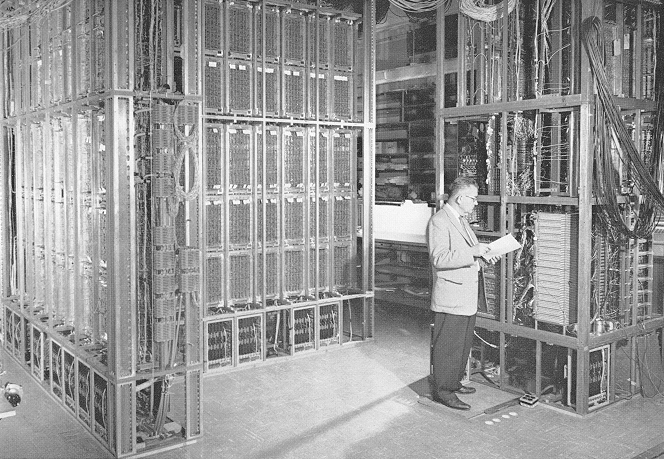
Beyond advances in miniaturization and processing, computers have become more versatile and, most importantly, more accessible – you can easily sell your computer processor, there’ll be plenty of those interested, everybody needs it nowadays.  In the early days of computing, mainframes were owned and controlled by various public and private institutions (e.g., the US Census Bureau drove the development of punch card readers from the 1890s onward). When universities began to develop and house mainframes, users had to submit proposals to justify their access to the machine. They were given a short period in which to complete their task, then the machine was turned over to the next person. In short, computers were scarce, so access was limited. more...

YouTube Preview Image

“We’re not computers, […] we’re physical,” explains the Blade Runner‘s chief antagonist, a replicant named Roy Batty.  In this moment of dialogue, Blade Runner engages a frequent themes of the Cyborgology blog—the implosion of atoms and bits, which we term “augemented reality.”  In this statement, Roy unpacks the assumption that digitality and physicality are mutually exclusive, while, simultaneously, transcending the boundary between the two.  Put simply, Roy is contending that computers cease to be mere computers when they become embodied.  In contrast to the familiar theme of cyborganic trans-humanism, Roy is articulating (and embodying) the obverse theory: trans-digitalism.

This Copernican turn—de-centering humans’ role in understanding of the universe—is, undoubtedly, one of the great contributions  of the cyberpunk genre (and science fiction, more broadly).  Quite provocatively, it points to the possibility of a sociology, or even anthropology, where humans are no longer the direct object of inquiry.  The question, here, shifts, from how we are shaped by and interact with our tools, to how technology itself becomes an actors (or even agents!) in a particular social milieu. more...