
Autonomist Marxism

Labor and non-labor develop an identical form of productivity, based on the exercise of generic human faculties: language, memory, sociability, ethical and aesthetic inclinations, the capacity for abstraction and learning. From the point of view of “what” is done and “how” it is done, there is no substantial difference between employment and unemployment. It could be said that: unemployment is non-remunerated labor and labor, in turn, is remunerated unemployment. -Virno (Grammar of the Multitude, p. 103)

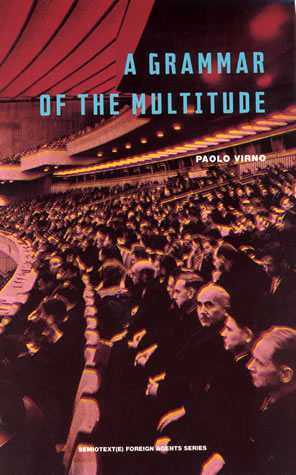
I’m deep into my second comprehensive exam, so I’m going to self-servingly post some notes on various things I’m reading. (Feedback is most welcome.) Though Paulo Virno only mentions the Web once in In Grammar of the Multitude (p. 43), the four lectures that comprise the book are of deep relevance to the political economy of social media, particularly in situating them in the broader historical trend toward post-Fordist production.

Let’s start by unpacking that phrase “post-Fordism.” Fordism refers to Henry Ford’s innovations in assembly line production in his automotive plants. The assembly line had profound social consequences in that it made the tasks of each worker so repetitive and simplified that anyone could do them. That is to say, the assembly line created a de-skilled workforce. Fordism is also generally linked to Taylorism, which refers to Fredrick Taylor’s attempts to introduce scientific rationality in the workplace through time-and-motion studies and pay-for-performance. more...

The Google Matrix

Originally posted on PopMatters.

On Twitter, PJ Rey resurrected this August 2010 op-ed by William Gibson that has new currency given the hullaballoo about Google’s privacy-policy changes. Gibson argues that Google is an unanticipated form of artificial intelligence, “a sort of coral reef of human minds and their products.” But this description sounds less like artificial intelligence and more like Marx’s notion of the general intellect. Anticipating the intensification of technology, Marx claimed that machines would eventually subsume “the process of social life” and integrate it as a form of productivity.

The development of fixed capital indicates to what degree general social knowledge has become a direct force of production, and to what degree, hence, the conditions of the process of social life itself have come under the control of the general intellect and been transformed in accordance with it. To what degree the powers of social production have been produced, not only in the form of knowledge, but also as immediate organs of social practice, of the real life process.

This is pretty obscure even by Marx’s standards, but autonomist Marxists (Negri, Lazzaurato, Virno) have extrapolated from this a definition of general intellect that embraces, as Virno puts it, “formal and informal knowledge, imagination, ethical tendencies, mentalities and ‘language games’.” Because of the membranous nature of the general intellect, when harnessed and integrated with capital, it can recuperate all social behavior as “immaterial” production — enriching the valence of signs, producing affects, etc. — it means that “even the greater ‘power to enjoy’ is always on the verge of being turned into labouring task.” That is, our consumption, especially of information, is a mode of production. The general intellect is the sum of all that information circulation. more...