
 As many of you already know, the third annual Theorizing the Web is fast approaching this March 1st and 2nd. We’ve moved the conference to New York City with help from CUNY’s Just Publics 365 initiative and we’ve also added a Friday event in addition to the main conference on Saturday. [Also, a reminder: the deadline to submit a 500 word abstract is January 6th!] On Friday, March 1st, the conference launches with a full slate of invited presentations at the CUNY Graduate Center’s James Gallery followed by an offsite social gathering. more...
Alice Marwick
(Or: How we’ve come to be micro-celebrities online)
Facebook’s recent introduction of “frictionless sharing” is the newest development in a growing trend: data is being increasingly produced passively as individuals conduct their day-to-day activities. This is a trend that has grown both on and offline. We will focus on the former here; especially “frictionless” sharing that involves syncing Facebook with other sites or apps. Once synced, much of what a user listens to, reads or otherwise accesses are automatically and immediately published on Facebook without any further action or approval. Users may not even need to “opt into” frictionless sharing because many services are changing their default setting to automatically push content to Facebook. In short, we can say that users play a passive role in this process.
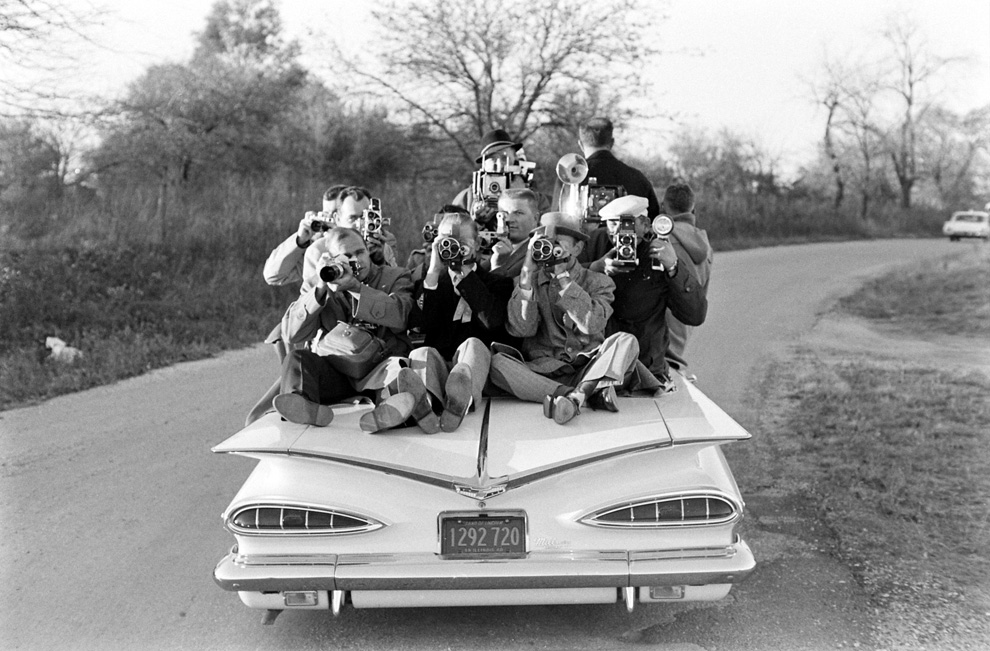
Contrast this to more active sharing: when we “like” or “+1” something (by clicking the eponymous buttons that have spread throughout the Web) it requires the user to make a conscious and affirmative action to share something with others in their network. Nathan Jurgenson (one of this post’s co-authors) previously described these two models as types of “documentary vision:” We actively document ourselves and our world around us as if we have a camera in our hand (“liking”, status updates, photos, etc.), or we can passively allow ourselves to be documented, curating our behaviors along the way (e.g., reading a magazine article so that you can present yourself as the type of person who “likes” that sort of magazine) much like a celebrity facing a crowd of paparazzi photographers.
Let’s make another layer of complexity to this documentary model more...
Here’s an interesting interview with Alice Marwick about how the “long tail” of the Internet the has reconstituted fame as a localized or “micro” phenomenon.
Contrary to the point made by Marwick, I think the important question is not whether will we get fifteen minutes of fame nor whether we will be famous to fifteen people, but whether we can have (or even desire) fifteen minutes of privacy.
(Or: How we’ve come to be micro-celebrities online)
Facebook’s recent introduction of “frictionless sharing” is the newest development in a growing trend: data is being increasingly produced passively as individuals conduct their day-to-day activities. This is a trend that has grown both on and offline. We will focus on the former here; especially “frictionless” sharing that involves syncing Facebook with other sites or apps. Once synced, much of what a user listens to, reads or otherwise accesses are automatically and immediately published on Facebook without any further action or approval. Users may not even need to “opt into” frictionless sharing because many services are changing their default setting to automatically push content to Facebook. In short, we can say that users play a passive role in this process.
Contrast this to more active sharing: when we “like” or “+1” something (by clicking the eponymous buttons that have spread throughout the Web) it requires the user to make a conscious and affirmative action to share something with others in their network. Nathan Jurgenson (one of this post’s co-authors) previously described these two models as types of “documentary vision:” We actively document ourselves and our world around us as if we have a camera in our hand (“liking”, status updates, photos, etc.), or we can passively allow ourselves to be documented, curating our behaviors along the way (e.g., reading a magazine article so that you can present yourself as the type of person who “likes” that sort of magazine) much like a celebrity facing a crowd of paparazzi photographers.
Let’s make another layer of complexity to this documentary model more...
Here’s an interesting interview with Alice Marwick about how the “long tail” of the Internet the has reconstituted fame as a localized or “micro” phenomenon.
Contrary to the point made by Marwick, I think the important question is not whether will we get fifteen minutes of fame nor whether we will be famous to fifteen people, but whether we can have (or even desire) fifteen minutes of privacy.