Notes from north of 49ºN

Jack Layton, Leader of the New Democratic Party of Canada

Notes from north of 49ºN

Update 4 August:: Video on Jack Layton from MSNBC-below.

Jack Layton is the leader of the New Democratic Party of Canada whose riding is the next one over from me, Toronto-Danforth.  Over on the Huffington Post, Jack did a post on the realities of the Canadian health care system.

I have a lot of strong views on health care in the US based on my work in non-profit health and my research on the biotech industry.  It’s worth mentioning that today’s US health care system began as employer perquisites {benefits}, back when health care and pharmaceuticals were cheap.  The private insurance model starts to break down when costs escalate resulting in employers and employees getting squeezed and uninsured rates rising.  Some say a perfect storm of events {recession, rising costs, uninsured rate of 19%, and Obama} is leading to a tipping point in health care.  It should be noted that the US will not adopt a health care system like Canada’s, where the government {provinces} provide health care, but rather a system where the government finances health care delivered by private enterprise.

On the The Huffington Post, Jack makes some compelling points, whether you agree with his politics or not::

“Costs are under control in Canada. We spend similar amounts on public care – around 7% of GDP. For that price, Canada covers everyone, the U.S. just one third of the population. In case you’re worried Canada wastes money on bureaucracy, know that just 2.4% of our total costs go to administration compared to 7% of what your government spends. In end, Canadian care costs $2,500 less per capita – and covers everyone.”

He points out that the system isn’t perfect::

“Our system does have flaws. We need better prescription drug coverage, better remote access to care and better practices in hospitals and clinics. No honest advocate for our health care system would dismiss these things. But Canadian health care works — and works well.”

Does all this mean that the United States should adopt Canada’s health care system?…No. America can no more adopt our health care system than we can swap hockey for baseball as our national pastime. A good health care system reflects a country’s values, and each country’s values are different…But a system with 47 million uninsured, coverage denied due to pre-existing conditions and people thrown off plans when they become ill? That doesn’t reflect American values.”

Unfortunately, there are other competing values in play in the US, making healthcare a contentious issue.  It’s not a simple matter of costs and taxes, but one that also affects innovation and entrepreneurship.  Biotechnology is predicated upon using the human genome to better match diseases, patients, and therapies.  “Pre-existing conditions” and genetic skeletons in one’s closet can thwart innovation in biotech because it adds additional business risk.  If insurance refuses to pay, where are the revenues?

One question on my mind and one I pose to my students, is healthcare a public infrastructure or should it be treated strictly as a business?  The Canadian model is one where the state is the financier and provider, where the provinces oversee a large, integrated health infrastructure.  As stated above, a new US healthcare model is unlikely to be this comprehensive, instead focusing in financing.  The current US model uses market mechanisms heavily, where healthcare delivery, insurance, and pharmaceuticals all having a dog in the healthcare reform fight.  Altering the landscape through healthcare reform will alter business models and likely create windfall gains and losses.  On the other hand, we have that perfect storm of recession, rising costs, uninsured rate of 19%, and Obama.  Another implication of the current model, where healthcare is an employment benefit, is that it limits new business creation, i.e., creates “entrepreneurship lock.”  A recent working paper supports this reasoning::

“Overall we find some evidence that the U.S. emphasis on employer-provided health insurance may be limiting entrepreneurship.  The clearest evidence comes from the regression discontinuity results which create the most comparability in experimental and controls groups.  The finding of ‘entrepreneurship lock’ is important as it suggests that the bundling of health insurance and employment may create an inefficient allocation of which or when workers start businesses.”

Healthcare can also has an affect on the arts in the US in same fashion, necessitating that creatives take on dayjobs with health benefits.  One artist once told me that money {or lower costs} means the freedom to create.  The current system does precious little to create incentives for cash-strapped entrepreneurs and creatives to innovate and create.  Does this matter?  I think it does in terms of sustainable economic growth and treating healthcare as a publicly financed infrastructure, i.e., a social good, paid with {gasp} taxpayer dollars makes more sense than the current system, but the devil’s in the details and good implementation is critical in order for a new system to be successful.  That said, these challenges shouldn’t be reasons not to do it.
Video:: Jack Layton on MSNBC’s The Ed Show, NDP Blog via Twitter

Link

YouTube Preview Image

Visit msnbc.com for Breaking News, World News, and News about the Economy

Twitterversion:: Jack Layton of #NDP clarifies healthcare in #Canada. Should healthcare be infrastructure? Implications for innovation & entrepreneurship. #ThickCulture @Prof_K

Song::  Planet Health – Chairlift {Brooklyn, NY of iPod Nano fame}

Cover of Douglas Coupland's Souvenirs of Canada

Notes from North of 49ºN

I’ve been thinking more and more about the concept of nation, of late.  In summers past, the 4th. of July, Independence Day in the United States, meant being in northern California and perhaps heading to Point Reyes and seeing the tug-of-war between Bolinas and Stinson Beach.  The past three years, I have observed Canada Day, celebrating when Nova Scotia, New Brunswick, Québec, and Ontario became a federation, a dominion with ties to the UK.  Two adjacent countries, which appear to have similarities, but have key differences.  Population is one differentiator. At confederation in 1867, the US population was around over 10 times that of Canada, 38,558,371 to 3,625,000 {1870}.  The twentieth century would see the rise of American dominance, not only in terms of economics, but also in terms of media and culture.

American culture is readily evident in Canada.  On television and in major cities like Toronto, with the prevalence of brands like Starbuck’s, McDonald’s, and Subway.  A quick scan of the TV listings shows how popular US television content is in anglophone Canada.  Canada is aware of this and requires broadcasters to show Canadian content {Can con}.  The CBC, the Canadian national public broadcaster, is a flagship network of the nation, where, through its mandate, the network’s goal is to be a cultural touchstone for the nation.  I’ve blogged about the future of the CBC television on this post:: Will Globalization Kill or Make the CBC Relevant Again?, which touches on how the CBC is struggling to remain viable and relevant in the shadow of big media players in the United States and fending off challengers within Canada.  Unlike the BBC, Britain’s national broadcaster, which is funded through household television licences, the CBC gets funding from the government, but also is subject to market forces through selling ad time, both sources being historically uneven.

The question I have is whether the role of a national broadcaster is even important.  I don’t see the United States as having the equivalent of the CBC, let alone the BBC.  PBS and NPR are, in my opinion, a loose confederation of programming, as opposed to a network with a strong identity, let alone an entity fostering a conceptualization of the United States as a culture or a nation.

The ideas of Arjun Appadurai and Benedict Anderson come to mind.  Appadurai speaks of globalization in terms of flows.  Flows of finance, ideologies, technologies, people and media, each with the suffix scapes.  Mediascapes have two components::

  1. The flows of capacity to produce and disseminate electronic information
  2. The images of the world created by these media

Benedict Anderson’s Imagined Communities discusses nation as an abstract entity, where meaning is shared within and the mass media address its citizens as a public.

Borders are often permeable under globalization and Canada has seen flows of media flood across its southern border, but what has this done to Canadians’ notion of nation?  Can Canadian content policy and the CBC help to reinforce the imagined community of Canada?  Does nation even matter?  Is Canada to Canadians “our home and disparate land,” as stated in today’s Vancouver Sun?  What about shared Canadian experiences such as Hinterland’s Who’s Who::

I think we need to remember that the context here is capitalism.  Media is flowing, media full of American meanings and ideals, as entertainment content to generate revenues.  In light of this onslaught, I think it is important for Canada to preserve its identity by creating content that increases Canadian cultural knowledge and awareness.  Why?  Without a national identity, i.e., an imagined community of Canada, meaning becomes increasingly derived from imagined communities of brands.  If our Diderot unities reduce to the constellation of brands we surround ourselves with, can we be citizens or are we just consumers?

I think nation does and should matter.  In Benedict Anderson’s words, nation::

“…is imagined as a community, because, regardless of the inequality of that may prevail in each, the nation is always conceived as a deep. horizontal kinship.”–p.7

I feel that the CBC should be a symbol of Canadian community, one that communicates and is interactive with all electronic media.  I see it as a part of the cultural infrastructure and one of the few entities that can actively bridge the country’s east-west divide, but I’m an idealist.

Song:: Dreamer – Jenn Grant {Halifax, NS}

Video::

Video Extra:: jPod clips of “Cowboy” aired on CBC, Winter 2008.

Twitterversion:: #Canada, national identity, & #Media. Globalization blurs borders, but does #nation matter? #Appadurai #BenedictAnderson http://url.ie/1xu6 @Prof_K

"A different kind of compan. A different kind of car?" ~Saturn tagline 1990s
"A different kind of company. A different kind of car"? ~Apologies to Saturn tagline of the 1990s

Notes from North of 49ºN

It’s not often I agree with Tom Friedman, but last fall when I was preoccupied with the US general election, teaching, and associate directing a center, he was advocating not just a bailout, but a green buildup.  He quoted Van Jones, author of The Green Collar Economy::

“It’s time to stop borrowing and start building. America’s No. 1 resource is not oil or mortgages. Our No. 1 resource is our people. Let’s put people back to work — retrofitting and repowering America. … You can’t base a national economy on credit cards. But you can base it on solar panels, wind turbines, smart biofuels and a massive program to weatherize every building and home in America.”

Friedman was in favour of attaching green strings to bailouts, an idea I think warranted further study, at the very least.  Fast forward 9 months and focus on the province of Ontario, where at the federal level, the Conservatives {Stephen Harper}, and at the provincial level, the Liberals {Dalton McGuinty}, jumped on the US bailout bandwagon to a tune of $9.5B or $10.9B Canadian.  This is in addition to the Obama administration’s $49.8B.  The combined US and Canadian bailouts are worth 130 times the present value of GM.  Here’s what both Harper and McGuinty had to say about this::

“We had to save it all or have zero forever,”

–Stephen Harper, Prime Minister of Canada

“The alternative would have been a devastating blow to Ontario families and communities.”

–Dalton McGuinty, Ontario Premiere

The troubles in the industry are not new news and CBC has a chronology of layoffs.  I’ve alluded to this bailout before and the scant jobs it will save, but here are the specifics in terms of the Canadian GM assembly line::

“At present GM Canada has 12,000 hourly and salaried employees, but that number is expected to shrink to about 5,500 over the next couple of years. About 1,100 of the new total is expected to be salaried jobs, which are unrelated to assembly operations. That means Ottawa and the Ontario government are together spending an unprecedented $2.1 million for each assembly job at GM Canada they hope to save.”–Time, 1 June 2009

It’s likely that GM suppliers will also be affected, a $7.2B industry employing 45,000 workers, but it is unlikely that all these jobs are at risk.  While Canada accounts for about 19.4% of North American production, Canadian cost advantages have been eroded by a stronger Canadian dollar, a weakened US union in the UAW, and strong and strategic bargaining by the Canadian Auto Workers union.

While the situation looks gloomy for manufacturing in Ontario, quite a few are banking on green jobs.  So much so that St. Clair College has a 2-year green jobs programme and the province has a commitment to clean energy.  Currently, the province gets 25% of its electricity from coal, but wants to shut down all of its coal plants by 2014.  The province is hoping to convert some of the plants to carbon-neutral biomass, although the yields will be lower.  The slack will need to be picked up by alternatives, with greener options being wind and solar.  Ontario’s Climate Change Action Plan calls for greenhouse gas emission reduction to 6% under 1990 levels and the new Green Energy Act is meant to protect the environment, regulate, and spur investment in green technologies.

Policy & Innovation:: The California Example

The PPIC has a report on the effects of California’s Zero-Emissions Vehicle {ZEV} mandate, particularly in the 1990s and early 2000s.  During this time, the California government, through the Air Resources Board {CARB} initially set in 1990 requirements that by 1998 that 2% and by 2003 that 10% vehicles sold in California would be ZEV.  Suffice it to say, concessions were made over time, but the original mandate set the wheels in motion for innovation.  The effects of the program were::

  • The policy spurred patents in near-term technologies
  • CARB arguably responded to technological changes when revising the program
  • Technological spillovers resulted in a greater number of indirect  innovations
  • Increased market development for emerging technologies
  • Broadened design parameters
  • Lower emissions in California

The program, albeit complex and not without politics and controversy, shows how policy can help to shape market-based activity in ways that would not occur otherwise.

Ontario:: Good Money After Bad

While not surprising, Canada and Ontario should have considered asserting themselves more, rather than caving to bailout pressure.  Why not move forward to develop policies that help transition away from declining industries and in-line with over provincial objectives?, e.g., environmental and energy.  How I see it is that the US and Canada are bailing out a company the capital markets have little faith in and now face the daunting task of rebuilding with a new CEO, “Big Ed,” who has a reputation for being an empire-builder.  I question having an empire-builder in charge of a company needing to be leaner, a company needing to reinvent itself overnight.  Let’s hope he indeed  “learns something about cars,” and doesn’t make mistakes like this one, the old CEO Rick Wagoner copped to:: “axing the EV1 electric-car program and not putting the right resources into hybrids. It didn’t affect profitability, but it did affect image.”

While there have been debates on whether or not the US needs an auto industry {NY Times} and criticisms abound, such as this one on how GM betrayed our trust, Canada is nevertheless a 12% equity shareholder.  This creation of a capitalist-state joint venture opens up a huge can of worms, as which interests will prevail and how to balance autonomous management and control versus paternalism?  I think the answers are in economic sociology, a topic for a future post.

Song::Canada” – Low

Video::

Twitterversion:: #Canada #bailout of #GMfail =more #fail ? Can #Ontario still dvel #greeneconomy & innov.w/enviro&energy policy objctves? http://url.ie/1wdt  @Prof_K

2106703082_468d8b9c92
Toronto Now magazine racks, Shuter & Dalhousie. ~Moonwire on Flickr

Crossposting:: An abridged, less sociology-heavy version is here.

Notes from north of 49ºN.

Social capital is nothing new to ThickCulture, with quite a few posts on the topic, including this one by José, Trust is for Suckers.  When I teach sociology, I draw heavily on Pierre Bourdieu and have the class get a sense of how different forms of capital interact.  Cultural capital has always interested me {here’s a great overview of it by Weininger & Lareau}, despite going crazy trying to explain graphs like these::

Bourdieu on taste, using dimensions of economic & cultural capital.

I’ve used this very graph, but I’ve always wanted a way to engage students in a discussion of cultural capital that they could relate to.  So, I was catching up on Macleans reading and found articles on Canada’s smartest cities. It brings up an interesting question of how learning capacity affects the local economic development. The Composite Learning Index, using ideas developed by UNESCO, gauges a city’s ability to foster lifelong learning::

“Until now, Canada’s score had been on the upswing, from 76 in 2007 to 77 last year. Today that number has dropped to 75, precariously close to the lowest level recorded, which was 73, in 2006. The figures are based on the annual Composite Learning Index, which gives every Canadian community (some 4,719 in all) a score according to how it supports lifelong learning.

Here’s a link to a selected list of cities. Calgary tops the list at 89. In Ontario, Guelph, Barrie, Ottawa, Kitchener, and Oshawa all beat out Toronto, tied for 13th at 80.  Poor Toronto. One article compared Windsor, Ontario {languishing in the index} to Québec City {one of the most-improved}, with the latter on an economic upswing.

Quebec City’s unemployment has fallen markedly, from 6.8 per cent in 2006 to 5.2 per cent in 2009. And while Windsor’s total learning score was going nowhere, its jobless rate shot up, from 10.2 per cent to 15.2 per cent over the same period.

The story is a bit more complicated, given that Québec City had had 50 years to reinvent itself after its economy collapsed, while Windsor is still watching its current industrial base crumble. While the learning index may be a proxy for resilience of its population to withstand exogenous shocks and the trials and tribulations of everyday life, one fact remains is that those at the top tend to be growing cities with wealthier citizenry. This pattern also follows the “most cultured” cities.

While the index is a tool that can be used diagnostically to help policymakers make decisions on spending, comparing cities with a weighted score seems a bit misguided.  It would be interesting to create a Bourdieuean index based on his forms::
  1. Embodied.  The skills, abilities, & knowledge that someone has.
  2. Objectified.  The objects that transmit culture and knowledge.
  3. Institutionalized. Institutional recognition of an individual’s skills/abilities/knowledge.
So, the challenge would be to find good indicators of or proxies for these forms.
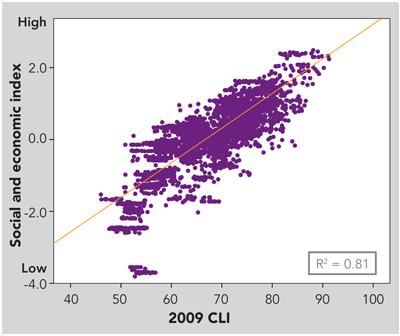
The Canadian Council on Learning created this graph showing the relationship between the index {as a measure of cultural capital} and socioeconomic index for Canadian cities.  While I do think that there are relationships between cultural, social, and financial capitals, I think the processes by which these relations are formed and fostered within various contexts {i.e., “fields”/”champs”} would be extremely valuable for policy decisions.

Correlation between the CLI and the social and economic well-being index, 2009

Twitterversion:: #newblogpost Hey Canada…How smart is your town? @macleansmag article on Composite Learning Index popularizing sociology? http://url.ie/1qkn  @Prof_K

Song:: Town Called Malice – The Jam


Video::

Notes from north of 49ºN.

I now live in a relatively small country, ranked 36th. in population, at 33.7M {versus 306.7M in the US}, but in the top 10 in terms of economies with a GDP of $1.3T {#9 ranking}, versus 13.8T for the US {#1 ranking}.  I mention this, as I wonder about scale and innovation, i.e., can smaller countries effectively compete in technology in a global environment?  One of my interests in innovation is biotechnology, a “new economy” area focusing on better outcomes for “health, the environment, and for industrial, agricultural and energy production.”  Advances in genetics are creating a race for companies and countries, with the idea of dominating the biotech field in order to enjoying profits and prosperity.

Last summer, I saw on a Canadian network a segment on how Canadian government investments in biotech were getting bought up by US firms, implying that the relatively small Canadian government was, in part, subsidizing innovations flowing south of the border.  The Matthew effect kicks in, as rich get richer and the poor get poorer, given that Canadian firms were being snapped up by US firms with deep pockets, transferring value southward.  According to a Globe & Mail article {click on license option}, another issue is that Canadian venture capital is lacking, so Canadian biotech firms often are capitalized by US venture capital firms that like to keep close tabs on operations and encourage offices/operations in the US.

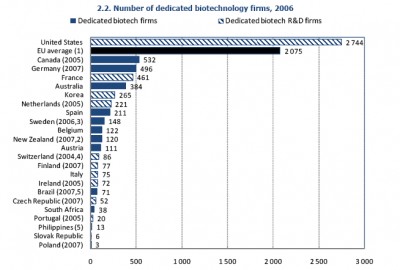
Well, is Canada even a player in this biotech area?

biotechoecd

According to 2006 OECD data, Canada is a player in terms of the number of firms {532}, the number of patents {ranked #6 in 2004}, and revenues {$83M}, along with an 11% compound annual growth rate {CAGR} of revenues from 1999-2005.

Given how collaboration and capital are now global, does it even matter where innovations are incubated?  A study by Bagchi-Sen & Scully {2004} is illuminating.  They divide biotech forms into two categories:: high R&D intensity and low R&D intensity.  Each has a different take with respect to strategies within the context of globalization::

  • High R&D Intensity:: Ties to local universities/Canadian researchers & collaboration with pharmaceutical companies, but desire global capital inflows.  Prototypical firm is in health theraputics.
  • Low R&D Intensity:: Emphasis on local production and development of Canadian market.  Focus on strategic alliances with foreign firms.  Prototypical firm is in diagnostics or agricultural biotech.

In terms of innovation policy, this brings up interesting food for thought for Canadian politicians in light of this recession.  Thanks to Barack Obama, Canada’s large neighbour to the south is pumping $21.5B of stimulus towards science and technology, which begs the question, how will this affect Canada?

It makes sense that Canadian policy would encourage the projects of low-intensity R&D firms with ties to the US, as these firms:: may be able to capitalize on relationships with stimulus-receiving firms, will develop innovations for the Canadian market, and will be focused on local Canadian production and manufacturing.  The high-intensity R&D firms could use funding {hint:: even more than $1B+CAN stimulus} that focuses on spurring innovations and the building of a sustainable base of Canadian talent and resources.  Dalton McGuinty’s {Liberal Premiere} efforts in Ontario might be a step in the right direction, but I’m not seeing clearly how this all fits together with an economic recovery plan.  Biotech. is not without risks, particularly with respect to agricultural biotech, which consumers are uncertain of.  Activists have alerted consumers with terms like “Frankenfood” for genetically-modified organisms {GMOs} and Monsanto’s lawsuits against journalists and farmers don’t help the cause.  So, maybe ag. biotech is a lose, but developing Canadian competitive advantage in innovations, in terms of other forms of biotech, nanotechnologies, clean energy, and green collar jobs, may provide fertile terrain for politicians and policymakers.

Well, enough of this talk of the “new economy” of biotech and innovations, what about the old economy, still prevalent in many parts of Canada?  Globalization has drawn Stephen Harper’s {Prime Minister} Conservative government into bailout fever to the tune of $9.5B, in order to secure that 16% of GM’s production remains in Canada.  This includes $3.1B that the Province of Ontario ponied up by Dalton McGuinty’s government.  Unfortunately, this might only save 4,400 jobs, after projected layoffs, according to CBC::


Given how the Tories and the Grits have played their cards in this {along with playing a current game of Federal “chicken”}, I see an opportunity for the NDP to make inroads with their platform based on developing new technologies and saving jobs.  Alas, more on “GMfail” and job losses in Canada in a future post.

So, it looks like nation matters, but in a global milieu.  Nothing surprising.  If you were to advise Canadian politicians, should new technologies {e.g., biotech, green, energy} be developed more aggressively {or at least explored} and does it make sense to commit billions to save jobs with an untested GM restructuring?

Twitterversion:: #newblogpost How should Canada compete {bio}tech, given globalzatn, US domnce, & recession? #GMfail bailout, good idea? http://bit.ly/18bBq8 @Prof_K

Song:: Genetic Engineering – Orchestral Manoeuvres In The Dark

Video::