facebook

Erik Hayden at Miller McCune links to a study done Alan Mislove of Northeastern University and his colleagues at the Max Planck Institute for Software Systems
that reveals how easy it is to create a profile of you from your Facebook contacts. Using alogrithmic magic, the team was able to create profiles for thousands of students at Rice from their profiles and the profiles of those they had “friended.”

the algorithm accurately predicted the correct dormitory, graduation year and area of study for the many of the students. In fact, among these undergraduates, researchers found that “with as little as 20 percent of the users providing attributes we can often infer the attributes for the remaining users with over 80 percent accuracy.

Hayden sees this as a problem:

Not to seem alarmist (“privacy” on the Web has always been overrated), but if these researchers could develop a limited algorithm that can infer rudimentary attributes off locked profiles, the possibilities seem endless for others to harness advanced software that could render current privacy controls completely useless.

This poses a paradox…if people freely give this information to a web site in exchange for the pleasures of friendship/connection, then are we obliged to regulate how the information is used by others? Isn’t a central element of connection the fact that you’re “putting yourself out there” in public. Being public poses risks. Can we have the pleasures of the public with the protections of the private?
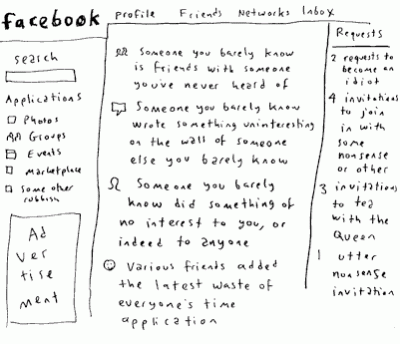
image:: Facebook from The Cartoon Blog
image:: "Facebook" from The Cartoon Blog—Dave Walker

Crossposted on Rhizomicon.

Sometimes when I read The Chronicle, I think of the slang term “chronic”, as quite a few of the articles/opinions are really hard to take, let alone take seriously.  A recent offering by William Deresiewicz on “Faux Friendships” on social media sites like Facebook struck me as a pining for an institution lost, akin to those decrying the demise of the institution of marriage.

My Best Simulacrum Forever

Many of you may find Deresiewicz’s article to be an interesting read.  He discusses friendship over time {I think he romanticises it quite a bit} and ponders its meaning in this current era of late capitalism.  Alas, he feels friendships aren’t what they used to be and Facebook isn’t helping.

“With the social-networking sites of the new century—Friendster and MySpace were launched in 2003, Facebook in 2004—the friendship circle has expanded to engulf the whole of the social world, and in so doing, destroyed both its own nature and that of the individual friendship itself. Facebook’s very premise—and promise—is that it makes our friendship circles visible. There they are, my friends, all in the same place. Except, of course, they’re not in the same place, or, rather, they’re not my friends. They’re simulacra of my friends, little dehydrated packets of images and information, no more my friends than a set of baseball cards is the New York Mets.”

Simulacra?  Well, isn’t that a consequence of being willy-nilly in friending, a promiscuity of sorts?  Not to judge it, but if you choose to have hundreds of Facebook friends, shouldn’t this be expected?  He goes on to talk about how Facebook offers a “sense” of connection, as opposed to real connection.  My “sense” is that this is a case of YMMV, i.e., your mileage may vary.  Now, I’m not a huge Facebook user and my presence on it is inflated by posting my Twitter tweets to my wall.  That said, yesterday, a Facebook friend posted on her wall that she would be hosting a table at a craft fair in The Annex neighbourhood of Toronto.  I saw it and made it over there and had a chance to catch up and have a few drinks.  My Facebook network tends to replicate my real connections and I tend not to “collect” second and higher order ties {friends-of-a-friend and so on} or very weak ties from my distant past.  Perhaps I’m an anomaly, but my point is Facebook is what you make of it and the meaning is in the usage.

TMI and Verbal Vomitus

Are we sharing too much of the mundane?  Deresiewicz thinks so::

“What purpose do all those wall posts and status updates serve? On the first beautiful weekend of spring this year, a friend posted this update from Central Park: “[So-and-so] is in the Park with the rest of the City.” The first question that comes to mind is, if you’re enjoying a beautiful day in the park, why don’t you give your iPhone a rest? But the more important one is, why did you need to tell us that?”

It’s been stated for a while that all of these Facebook status updates and Twitter tweets may seem like so much meaningless dross, but the sum of these paints can help to paint a picture of the everyday aspects of a person’s life, affording an intimacy that would be hard to replicate without technology.  A friend of mine in California said that SMS texting has brought his family closer together with just mundane <140 character texts.

The Transparency of Everyday Life

I have done blog posts on public political figures getting into hot water for content posted on Facebook, with the latest instalment here.  If privacy is dead on the Internet, is a corollary to this that our lives are now fairly transparent?  While we have a certain degree of control over what people see of our lives with social media, there’s a lot out of our control.  Fake personas and being “tagged” in a Facebook photo in an unflattering way are examples of what’s out of our control, but I think there’s a perceptual shift taking place where people are growing accustomed to “oversharing” and its fallout.  Deresiewicz is concerned by the private going public::

“The most disturbing thing about Facebook is the extent to which people are willing—are eager—to conduct their private lives in public. “hola cutie-pie! i’m in town on wednesday. lunch?” “Julie, I’m so glad we’re back in touch. xoxox.” “Sorry for not calling, am going through a tough time right now.” Have these people forgotten how to use e-mail, or do they actually prefer to stage the emotional equivalent of a public grope?”

I honestly feel that as time progresses, we will get desensitized to “oversharing” of private spheres in public, even at its most lurid.  One day, something like a decades-old “sexting” photo will appear, involving a political candidate or public figure and there will be a collective yawn.  Just like how adult content that would result in convictions in the 1980s are now bookmarked on browsers without batting an eye.

I don’t think friendship is “dying,” but transforming.  Technology has the ability to transform the social and its institutions, i.e., social conventions.  Are social media technologies like Facebook “falsifying” intimacy, as Deresiewicz claims?  That’s an interesting question.  I do agree with Deresiewicz that there is a commodification going on, which has the power to alter meaning systems when it comes to concepts like intimacy.  Along with commodification, I think there can be a tendency in technologically-mediated interactions to treat some {but not all} “relationships” as disposable.  Rejection.  This, perhaps, is the flipside to the immense potential of social media to connect people in ways which are impossible with just face-to-face communications.  It can be a huge “catch and release” system for some.

I think the article taps into an uneasiness shared by many.  Perhaps a dystopic fear that we are losing what makes us human.  The “sex in the future” scene from Demolition Man {1993} also taps into fears of how technologically-mediated interpersonal interactions, albeit in an authoritarian regime with “big brother” overtones::

When this is possible, those who decry the demise of friendship with Facebook, well, their heads will explode.

Twitterversion:: Is #socialmedia & #Facebook killing institution #friendship? CHE art. discussed brings up food 4 thought. #ThickCulture @Prof_K

Song:: Queen-“You’re My Best Friend”

Russell Wisemen, photo from thecommercialappeal.com.

On ThickCulture, we’ve written about public figures getting into hot water before using Facebook.  A candidate’s campaign for provincial legislative office in British Columbia was sunk by “risqué” photos posted on Facebook [1].  Down in the States, the Young Republicans got into a dustup stemming from racially charged comments left on a vice chairman’s wall [2].  Now, Russell Wiseman, the mayor of Arlington, Tennessee is feeling the heat for calling President Obama a Muslim on a “friends only” Facebook post.  Wiseman has over 1,600 “friends” and the comments leaked out.  What did he say?  Well, for starters::

“Ok, so, this is total crap, we sit the kids down to watch ‘The Charlie Brown Christmas Special’ and our muslim president is there, what a load…..try to convince me that wasn’t done on purpose. Ask the man if he believes that Jesus Christ is the Son of God and he will give you a 10 minute disertation (sic) about it….w…hen the answer should simply be ‘yes’….”

The extensive thread also included this::

“…you obama people need to move to a muslim country…oh wait, that’s America….pitiful.”

He also goes on with his interesting take on polity::

“you know, our forefathers had it written in the original Constitution that ONLY property owners could vote, if that has stayed in there, things would be different……..”

Wiseman felt those making a fuss about his comments were making a “mountain out of a molehill.”

I get a sense that Wiseman thought his Facebook comments were only viewable to those who shared his views -or- perhaps was imbibing in a bit too much holiday cheer before settling down to watch “It’s a Charlie Brown Christmas.”  The irony is that the Obama speech on the Afghanistan surge had so much in common with George W’s take on terrorism.  Jon Stewart has a funny take on the speech {US IPs only}::

The Daily Show With Jon Stewart Mon – Thurs 11p / 10c
30,000
www.thedailyshow.com
Daily Show
Full Episodes
Political Humor Health Care Crisis

Canadian viewers can watch the segment here {2 December}.

So, what was Wiseman upset about missing.  It was Linus’ reading of the Gospel of Luke::

The object lesson for public figures is to be careful about what you post online, but I wonder if the proliferation of social media will “desensitize” us all to every little thing that someone says on their Facebook wall or in a Tweet.

In Canada a few weeks ago, the wife of the immediate-past Liberal Party leader Stéphane Dion, Janine Krieber {AKA la présidente}, criticized the current leader, Michael Ignatieff, you guessed it, on Facebook [3].  Here’s a translation {it was posted originally in French}::

“It’s been a year and one week since I last wrote on my blog. Ah! “la présidente” is lazy. But we have to take action now.

The Liberal Party is falling apart, and will not recover. Like all liberal parties in Europe, it will become a weakling at the mercy of ephemeral coalitions. By refusing the historic coalition that would have placed it at the helm of the left, it will be punished by history.

Anyway, I became convinced of it the moment that Paul Martin treated Jean Chrétien so cavalierly. The party died at that moment. If the Toronto elites had been more in tune, humble and realist, Stéphane would have been willing to take all the time and absord all the hits needed to rebuild the party. But they couldn’t swallow the 26%, and now we are at 23%.

The time for choices is now. I don’t want to see the Conservatives continue to change my country. They are, slowly, like any dictatorship, changing the world. Torture doesn’t exist, corruption is a fabrication. Do we really have the right leader to discuss these questions? Can someone really write these insanities and lead us to believe that he simply changed his mind? In order to justify violence, he must have engaged in serious thought. Otherwise, it’s very dangerous. How can we be sure that he won’t change his mind one more time?

The party grassroots had understood all of that, and the average citizen is starting to understand it too. Ignatieff’s supporters have not done their homework. They did not read his books, consult his colleagues. They were satisfied that he could be charming at cocktails. Some of them are outraged now. I am hearing: Why did no one say it? We told you loud and clear, you didn’t listen.

I am starting a serious reflection. I will not give my voice to a party that will end up in the trashcan of history. I am looking around me, and certain things are attractive. Like a dedicated party that doesn’t challenge its leader at every hiccup in the polls. A party where the rule would be the principle of pleasure, and not assassination. A party where work ethic and competence would be respected and where smiles would be real.

Maybe I’m not dreaming.

“La présidente.”

Some have called the above as a tirade, others think it wasn’t constructive given where the Liberal party is these days, and still others went “right on.”  No matter what, Ms. Krieber’s post was taken down after it was being circulated.

Will social media eventually change what we collectively deem as shocking, inappropriate, or out-of-line?  Until then, watch what you say…and Google cache.

Twitterversion:: Tenn. mayor goes off on “Muslim president.” Anothr #Facebook #fail 4 a public figure. Will we evntually get desensitized? @Prof_K

Song:: Tennessee – Silver Jews

Screencap of  Audra Shay's Facebook page

Screencap of Audra Shay's Facebook page

Last week, the Young Republicans got into a dustup over yet another Facebook flap.  This spring, we discussed how Facebook derailed an NDP candidate to provincial office in British Columbia, when the BC-Liberal opposition got wind of “racy” photos posted.  In this incident, there’s differing opinions which are arguably representations of fragmentation in the Republican Party.  According to the DailyBeast, it started with Audra Shay, vice chairman of the Young Republicans hosting a discussion on Wal*Mart endorsing Barack Obama’s health care plan.  Things unravelled when an “Eric S. Piker” made racially charged comments using the word “coon,” another ThickCulture topic from the spring {See above}.  Audra agreed with the statements, adding a LOL.

Subsequently, there were others criticizing these remarks, Cassie Wallender {a national committeewoman from the Washington Young Republican Federation} and Sean Connor {chairman of the D.C. Young Republicans}.  While these critics were “de-friended” by Audra, “Piker,” for the time being, remained a “friend.”  On Thursday, a black Republican activist, Lenny McAllister condemned these remarks and prior statements by Shay::

YouTube Preview Image

McAllister references a culture war going on in the Republican Party and regarding the racially charged remarks going around, he stated “You can cover cyanide with chocolate, but you still can’t call it candy.”

Her own recounting of the events, possible unaware of the screencap, paint a different picture of the events.  In her statement on 3 July, Shay went on to denounce the remarks and attributed the dustup to her political enemies capitalizing on an opportunity.  Irreparable damage may have already been done, as her upcoming bid to be Young Republican chairman may have been derailed.  

I’m not going to engage in any admonishing finger-waving on the dangers of social media, a bete-noire of mine.  I think this is beyond a matter of “political correctness” or freedom of speech issues and do reflect a growing divide between moderates and a more divisive fringe.  Indicative of this is how moderates are often criticized as being RINOs, Republicans-in-name-only, who are not sufficiently conservative. The RINO label was thrown at Wallender by Shay supporters after her criticism of the racial remarks.  In order for Republicans to move forward, they will have to deal with these issues head-on.  Will they use social media to do this?

Twitterversion:: #YoungRepublican schism over racially-charged #Facebook flap. Indicative of a larger #CultureWar within the party?  @Prof_K

Song:: Space Oddity (1990 Digital Remaster) – David Bowie


Rationality & Emotionality ~The Economist by Otto

Crosspost:: A shorter version is available on Rhizomicomm.

When I was a senior in college, I must admit thought quite highly of economics and its rationality.  It was the early 1990s and I was contemplating law school and doctoral programs in environmental economics, with interests in law and economics and public choice.  I was given The Gift Economy by David Cheal to read, altering my worldview forever.  A close second was Jean Baudrillard’s Selected Writings, but that’s another post.

Cheal’s book focuses on the tensions between market relationships {political economy} and social ones {moral economy}, as a distinctive characteristic of the social milieu in capitalist societies.  While gifts may be given for instrumentalist means, they often are not, hence being representative of a wide array of behaviors firmly in the realm of the symbolic and the relational.  Cheal talks about the interplay between the market and social realms, which could easily be superimposed on a Pierre Bourdieu framework of fields, habitus, doxa, and forms of capital.  In the past, gift-giving was often marginalized and thought to be subsumed in a capitalist exchange model.  Recent thinking considers gifts to be a social process, one that has a significant economic impact.

So, how is this interplay affected by social media?  In my current work, I’ve been thinking of the use of Facebook by organizations, particularly in the realm of philanthropy.  Organizations have been embracing the idea of creating relationships with constituents, rather than focusing on transactions.  Health non-profits often provide information and advocate on behalf of their constituents.  By doing so, this creates a person-organization relationship and ideally leads to greater levels of philanthropy {economic resources for the non-profit}.  The key is that the relationship must have salient meanings for the constituents, i.e., the brand meaning system.  Depending on the context, this is often tied to outcomes, e.g., cures for diseases, social change, identity, etc.

Social media and social networking sites like Facebook not only foster person-organizational relationships via information disemmination and services, but also peer-to-peer relationships.  These relationships are social, but are within a capitalist market context.  Hence, we return to the gift.  We manage relationships through gift-giving and other behaviours, through the management of symbols::

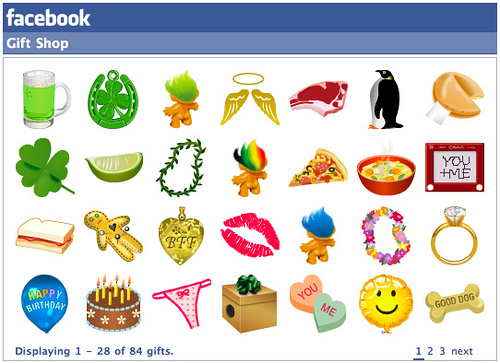
Facebook gifts
Facebook gifts:: Sentiment for a $1

Social media has the ability to move constituents from this model::

Organizational Activities -> Org.-Person Relationship -> Outcomes

more towards this one::

Organizational Activities  -> Communities of practice -> Outcomes

The latter being facilitated by the Internet and with the possibility of a richer set of outcomes stemming from an engaged community.  We want gifts to be expressive of our relational ties, hence full of meanings, within a given social context, e.g., a community of practice.

Facebook is a global player, but still needs a solid revenue model.  Apple’s success with “apps” show the power of a platform to deliver value, often at a low price-point.  The Facebook platform should be developed in line with how people, how a large number of people, actually engage in symbolic relationship management, tied to other strategies, such as::

  • Bling gifts that are expressive of sentiments {various media}
  • Donations and sponsorships
  • Online events to engage community members
  • Free/Low-cost personalized apps that add value, e.g., health monitoring, reminders, alerts, etc.

Organizations are still figuring out how to use social media and Facebook is still figuring out how to deliver value.  All I can say its future isn’t online ads and organizations just paying lip service to their constituencies with social media is as transparent as this::

Twitterversion::  #newblogpost #Facebook & #socialmedia in reconfig of econmics. Interplay {political&moral economies}.Implic.for orgs&FBk. http://url.ie/1x6e  @Prof_K

2214745739_7de89c7ef4
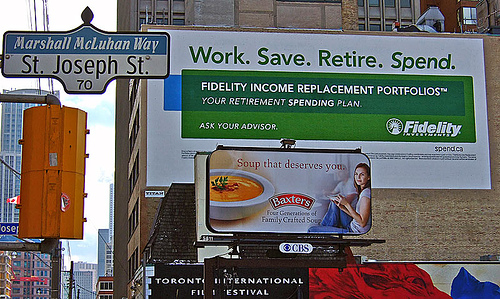
Marshall McLuhan Way, Downtown Toronto, ON, Canada

Crossposed on Rhizomicomm

McLuhan Way is just down the street from me, so perhaps it’s my inspiration.  I remember reading Marshall McLuhan‘s Understanding Media over 14 years ago in a seminar on the Internet.  The hot/cool media continuum perplexed many of us and some say technology has rendered the concept obsolete.  In terms of hot/cool, where does the Internet stand?

  • Hot media are high-definition.  Media that fully-engages one sense of the audience member:: print {visual}, radio {sound}, film {visual}, & the photograph {visual}.
  • Cool media are low-definition.  Media that require more active participation from the audience member to interpret::  Television {visual with limitations in the 1960s},  telephone {sound of a relatively poor quality in the 1960s}, and comic strips {cheaply reproduced mass-entertainment}.  The video game as a hyperreal construct, where the audience/player must fill in gaps of this representation of the real.

Reading is engaging in hot media and is a solitary experience.  Reading, contrasted with speech, forces an isolating consciousness, perhaps one overly-immersed in the individual.

How does Web 2.0 fit into all of this?  Well, new technologies trend towards the hot.  The iPod engages us, bathes us in a bubble of sound of our choosing.  What about this paradox?  New technologies are higher-definition, engaging us more and more, but also allowing us to be interactive with others {social media}.  Moreover, there is convergence of the technologies.  The smartphone {MP3 player, telephony, Internet web surfing} is a stunning example of multisensory engagement that also allows us to communicate and share with others.

What happened?  Is the singularity of media, where all media is converging, making it all lukewarm?  The continuum is shrinking to a singular point, as in the multimedia experiences of the smartphone.  Has technology sped up our communications, so that there is the appearance that time has folded upon itself.  We read text or see a video and now we can immediately respond to others.  We read a tweet from Twitter and immediately respond to it.

So, bear with me as I think out loud here.  Let’s assume that media are approaching singularity.  As you go up the cone, technologies converge and the user is collapsing hot/cold, engaging both simultaneously.

conic11
McLuhan Conic:: Rough ideas for understanding trajectories for social media. ~Kambara

Let’s assume that at the circular base of the cone, along the diameter is the continuum from hot to cold.  Perpendicular to that diameter is another continuum, the institutional semistructures, rigid {controlling} versus chaotic {open}.  The base would have 4 quadrants, each with prototypical examples::

  1. Hot & Rigid- Old “big media” {print, radio, film, etc.)
  2. Hot & Chaotic- Engaging content in unstructured/uncontrolled  databases
  3. Cool & Rigid- Newsgroups
  4. Cool & Chaotic- Synchronous unmoderated chat

The origin will be “lukewarm” and semi-structured.  The origin is somewhat of a normative assumption.  Individual user experiences may vary and may not even be contiguous.  I know I need to refine these ideas and construct a better diagram.  Nevertheless, I think this concept might be valuable in thinking about how people’s use of technologies is likely to evolve.  Where would you put the following::

  • Facebook {social networking site}
  • Twitter {microblogging}
  • YouTube {video filesharing}
  • Hulu {long-form professional videos}
  • Google {all things data}

Where are they moving towards -or- how could they better provide value?  Of course, despite McLuhan being gone for quite a while, I half-expect this to happen to me::

Twitterversion:: Can #MarshallMcLuhan ‘s hot/cold continuum inform #socialmedia? #sociology #web2.0 http://url.ie/1wys @Prof_K

Song:: “Suspect Device” Ted Leo & the Pharmacists-lyrics

The Cisco Fatty meme served up a cautionary tale for all the denizens of Web 2.0.  It might be me, but I think people need to lighten up.  The  Andrews v. FedEx incident is a good example highlighting this need.  In this one, a VP tweeted this candid gem on his impressions of Memphis, where FedEx headquarters are located::

“True confession but i’m in one of those towns where I scratch my head and say ‘I would die if I had to live here!'”–James Andrews

The FedEx employees were outraged.  Didn’t this clown hear the Cher cover of this Marc Cohn song?  How dare someone insult fair Memphis!  Here’s a response sent upstairs to FedEx management::

“Many of my peers and I feel this is inappropriate. We do not know the total millions of dollars FedEx Corporation pays Ketchum annually for the valuable and important work your company does for us around the globe. We are confident however, it is enough to expect a greater level of respect and awareness from someone in your position as a vice president at a major global player in your industry. A hazard of social networking is people will read what you write.”

The rest is predictable.  Finger-wagging by bystanders admonishing Andrews, an apology, and a statement by FedEx saying they are “moving on.”  Commentors on the story nailed it, in my opinion, by noting how this is a tempest in a teapot::

“People who live in small cities are always trying to prove something. They exhibit irrational pride for their little slice of nowhere. Seriously. Who cares? If James said he would die if he had to live in LA, no client would even take notice. Of if they did notice they certainly wouldn’t care. They definitely wouldn’t ship it to a gaggle of senior leaders at both companies. But talk about Memphis…..and it’s ON.”–Adrants commenter

“James Andrews had to fly into Memphis yesterday for a client meeting with FedEx, and observed, correctly, that Memphis is a hellhole…

James Andrews will never make the mistake of being honest again.”–Gawker commenter

Enough of this boring stuff, what about a political candidate with “embarrassing” Facebook photos on a private page.  Now we’re talking.  Ray Lam, a 22 year old NDP {far-left party} candidate for local office in British Columbia {False Creek-Vancouver} had the photo below surface.

bc-090422-ray-lam-facebook
Ray Lam, Ex-NDP BC Candidate-False Creek, 4 years ago at a Pride event

Lam resigned his candidacy.  Of course, let the media circus begin, along with the finger-wagging and admonishments.  The fact of the matter is that the photos of the openly gay candidate were from 4 years ago and from a campy Pride celebration.

The BC Liberals {centre-left party} were quick to jump on this Facebook faux-pas.  His opponent, Mary McNeil was shocked and outraged.  She made a statement sent to media outlets, which, of course, contained links to the Facebook photos.   In her statement, she said, “…These photos are offensive and demeaning. I’m surprised that Carole James and her NDP caucus think these photos are acceptable.”

The British Columbia Liberal Leader, Gordon Campbell was quick to point out::

“This was public information. It was on the NDP website and they have some responsibilities in terms of that. … They were totally inappropriate pictures and the NDP has some questions to answer for.”

Good point, Gordon.

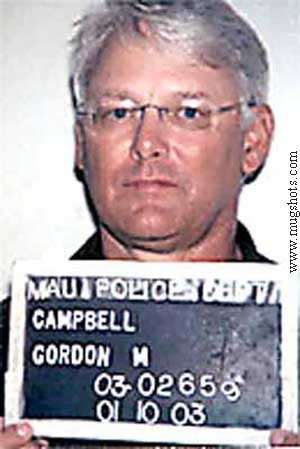
Oh, wait, remember your Maui mugshot for that pesky 2003 DUI::

CRIME-Premier-Charged
BC Premier #03-02659

No resignation for a DUI, a situation which could have endangered the lives of himself and others, but there MUST be consequences for risqué photos.

In my mind, there are two issues.  (1) Do the private lives of politicians really matter?  If so, (2) the nature of Web 2.0 and subsequent iterations will make sure all dirt will have its day.  I’m not 100% sure what was on Lam’s Facebook page, but I do know the technology poses challenges for managing perceptions, as one can get tagged in photos by others.

Should we get over it?  Are we degenerating into a culture of optics?  We can say that issues of values and character matter, but are we just setting up a situation where only the squeaky clean can withstand the scrutiny in media singularity.

I guess Edgar Friendly would never make it as a politician.

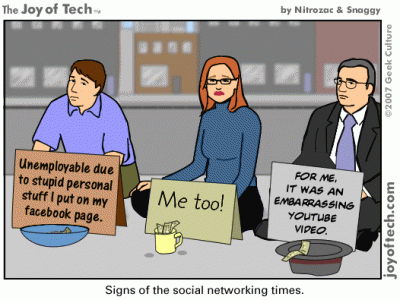
facebook-cartoonMany of us post to Facebook, perhaps unaware of what can happen to that content and who has rights to it.  All of this came to a head a few days ago, as Facebook’s new terms of service (TOS) came to light and were met with a range of reactions from dismay to outrage.  

I’ve been reading Convergence Culture and being in Jane Jacob’s adopted home, I couldn’t help but think of how the social space of Facebook relates to how social interactions are shaped by governance and polity in online realms, as well as the idea of a commons that is a privatized space, as opposed to a public one.

While I’m resigned to the fact that there is no privacy online and I don’t know whether to laugh or cry when I hear that Facebook is being used by collections departments to locate unstealthy credit defaulters (true story), I do bristle at the idea of content being appropriated by companies hosting these web commons.

Why?  I’m using the private space of Facebook, why should I feel that what I post is still my intellectual property?  Am I being unreasonable?  After all, I push the boundaries of fair use quite a bit.

Can social network sites really be sites of democratic action, when they can ultimately be censored, not as a matter of public policy, but rather corporate TOS?  On the other side of the Web 2.0 fence, how much freedom should an organization grant users?

I feel that what any site engaging in Web 2.0 should do if they want to use content posted by users is…to simply ask them for permission.  It’s simple good manners and building of social capital.  I do think privatized social spaces or commons can be used for civic engagement, but I find emerging technologies being developed up here in Canada that allow content to be fed from multiple sites (e.g., MySpace, Facebook, Twitter, LinkedIn) into one location to be rather interesting.  More on this in a future post.  I feel the overlap of Web 2.0 with open source will make us all rethink ownership and privacy and force organizations to ponder what intellectual property really means, what the risks are in terms of what the courts are stating, and how to implement processes.  Or not.  That devil inertia.

Bookforum is the greatest aggregator of quality web content I’ve ever come across. The only problem is that it fills me with anxiety to know that there is so much good content out there I’ll never be able to read. This is my filter of their filter of the best of the web today….or those aspects of the web which most closely adhere to what I’m interested in today.

When Groups Don’t Think – Utne Reader

Vote for me Not my Facebook Account – Slate

Three Maps that Get People Worked up – Mental Floss

Deep Throat Meets Data Mining – Miller McCune

Symposium on “The Good Life” – Human Affairs