Archive: Apr 2009

Here’s one I’ll put away in my ever expanding “future research project file.”

Via

Recently Google began selling location-specific advertising on its search pages. Nancy Scola at TechPresident blogs on what she calls ambient advertising the use of location-specific ads by the AFL-CIO in the debate over the Employee Free Choice Act

Google ads now has a location targeting option, allowing advertisers to either drop a pin on a map or type in an address, and then set a radius within which their ads runs. (Google doesn’t set a minimum circle of influence, but suggests drilling in no closer than 20 miles.)

Scloa notes that the ads have been targeting readers in Maine, the home of the Senators Olympia Snoew and Susan Collins (a.k.a the moderate wing of the Republican party) with passages like “78% of Americans support workers’ freedom to form unions and bargain for a better life.”

My question is whether Internet advertising of this form is a medium that lends itself to formal political appeals. The theory would be that people who searched for something related to the legislation would already be cued into wanting to know more about the bill and would thus be predisposed to click on a link to content related to the bill. Makes sense, but we know little about the political behavior of this population of “potential ad link clickers.” Is the group that would break the divide between legitimate link and Google Ad the same as the group that would not link to a Google ad under any circumstances. Are “ad link clickers” more or less disposed to be politically active.

On it’s face, one would think not. But I suspect there are differences between those who reject direct political appeals (i.e. they won’t click on a banner ad) and those who see no distinction (will happily click a banner ad). I’m in the former category. Not exactly sure why, other than most of my friends in high school became car salesemen (as did I for a short time).

Like I said…one for the “to do” file.

Southern California’s unique settlement patterns makes it easier to concentrate the spillover effects of modern life, what economists call externalities, on low income communities. No where is this more apparent than with air quality. According to a study conducted for the united Church of Christ, who for some reason has become the driving force behind bringing this problem to light:

California has the nation’s highest concentration of minorities living near hazardous waste facilities, according to a newly released study. Greater Los Angeles tops the nation with 1.2 million people living less than two miles from 17 such facilities, and 91% of them, or 1.1 million, are minorities. Statewide the figure was 81%.

This figure is so staggering in part because low income communities are concentrated in valleys east of the 405 Freeway in the City of Angels. These valleys trap toxic emissions from the large volume of driving that occurs in this region.

How would you address this policy problem? Is it your responsibility as a Californian to do so?

I think I’m being converted.

For a good part of my intellectual life, I’ve been skpetical of Neo-Marxist understandings of power. As an urban politics student in graduate school, I rejected the views of urban scholars like Harvey Molotch, Ira Katznelson and David Harvey that claims that the dictates of capital proceeded unabated in urban space. The zeitgeist at the time was that urban power (an power in general) was a more open, fluid process. The capital accumulative class might have strong advantages in the U.S. policy process, but the process was open and by no means was the state simply a handmaiden of capital like neo-Marxists might presume. Policy was a contest, the outcome was not predetermined.

Then AIG happened.

Matt Taibi has a particularly effective and scathing piece in Rolling Stone that guides the reader through the impenetrable minefield of new terms that help us unpack the crisis we face: collateralized debt obligations, credit default swaps, The Glass-Steagall Act, Commodity Futures Modernization Act. Taibi lays the blame for the credit crisis on the combination of a lax regulatory system that allowed companies like AIG to become “too large to fail” and a risk-taking culture within the financial service industry that rewarded immediate profit above all else. As Taibi points out, the state could have stepped in a brought order to this chaos before it was too late, but they demurred:

There’s this notion that the regulators couldn’t do anything to stop AIG,” says a government official who was present during the bailout. “That’s bullshit. What you have to understand is that these regulators have ultimate power. They can send you a letter and say, ‘You don’t exist anymore,’ and that’s basically that. They don’t even really need due process. The OTS could have said, ‘We’re going to pull your charter; we’re going to pull your license; we’re going to sue you.’ And getting sued by your primary regulator is the kiss of death.

All of this could simply mean the “capture” of the state by the financial system. A good public policy scholar would tell you that in the 1990 the financial regulatory system had been “captured” by an iron triangle of interest groups, congressional staff and bureaucrats that agreed on a laissez faire approach to the financial services industry. Not unusual…nothing to see here.

But a good public policy scholar would also tell you that that policy capture is not permanent. A good shock to the policy system, a punctuated equilibrium if you will, would re-open the policy space the include new actors and ideas. Once a major catastrophe happens, policy areas are subject to major shifts. The cessation of constructing nuclear power plants after the Three Mile Island accident is a classic example of a radical shift in the policy space.

So what happened with the financial services equivalent of Chernobyl…. Taibi calls it Paulsonism:

The state is now being asked not just to call off its regulators or give tax breaks or funnel a few contracts to connected companies; it is intervening directly in the economy, for the sole purpose of preserving the influence of the megafirms. In essence, Paulson used the bailout to transform the government into a giant bureaucracy of entitled assholedom, one that would socialize “toxic” risks but keep both the profits and the management of the bailed-out firms in private hands. Moreover, this whole process would be done in secret, away from the prying eyes of NASCAR dads, broke-ass liberals who read translations of French novels, subprime mortgage holders and other such financial losers.

Rather than open up the policy space for a broader consideration of policy alternatives, our response to the financial crisis has been significant bailouts of investment firms with few strings attached. Sure there are some rumblings about the need for new regulation and overblows assessments of our current political climate, like Newsweek’s silly presumption that “We’re all Socialists Now.” But in the main, our policy discourse space remains firmly neo-liberal, even with a seemingly progressive president.

I don’t know about you, but I’m dusting off my Urban Fortunes and City Trenches Social Justice and the City. They have more to tell us that we’ve been willing to hear in urban studies and policy analysis for quite some time.

So it’s time to admit it: We’re fools, protagonists in a kind of gruesome comedy about the marriage of greed and stupidity. And the worst part about it is that we’re still in denial — we still think this is some kind of unfortunate accident

showcase

One of my students blogged about not being able to watch ABC’s Lost while studying abroad:

 “Interestingly enough, ABC was the first network to set up a deal with iTunes ‘to seek out alterative distribution venues for its show…’ I personally love that you can watch shows on online form ABC.com. Sometimes, I think its even better than watching it when it originally airs because the commercials are only 30 seconds and I can conveniently watch on Mac while I’m cozy in my bed. iTunes is also great though because when I was studying abroad in South Africa I had no television and ABC.com wouldn’t work outside the country, so I had to resort to buying shows online. I loved the fact that after I bought each show they were saved in my library and I could watch them whenever I liked, without any commercials.”

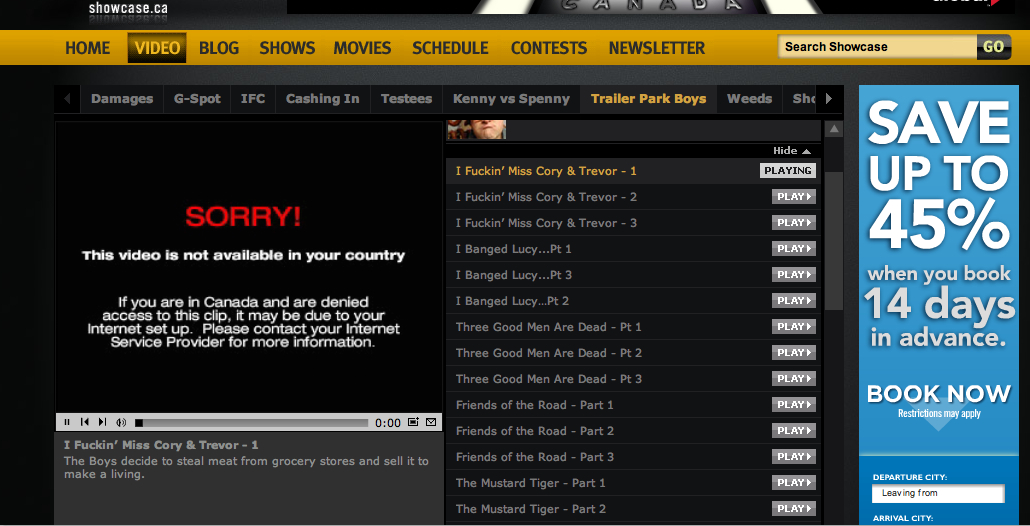
I’ve run into not being able to watch US content in Canada and was really frustrated when there was no legal way to watch shows like season 3 of The Venture Brothers, as they were being aired in the summer of 2008.  {There’s a possible workaround that I mention in my blog comment above.}  Canadian content in the US, such as the Trailer Park Boys (above) is a thornier problem, as one will need a Canadian web proxy for viewing.  Neither of these shows were available for purchase on iTunes when I was wanting to watch them.

I’m often asked, why is web content being geographically restricted?  A big issue has to do with intellectual property (IP) rights.  Here’s an exchange I saw on CBC about why the Hockey Night in Canada (HNIC) and the Stanley Cup cannot be available online to overseas web surfers:

“O: I have to ask becuase I have a [l]ot of friends who live overseas…

Every time I talk to them they ask me why they can’t watch the Stanley Cup online

AL: One of our most common complaints, for sure.

O: Oh really?

AL: Sure. Our agreement with the NHL is for Canada only. NBC and Versus wouldn’t like it if someone in Boise was watching an HNIC broadcast online, eating into their customer base. Ditto for someone in Sweden (although I don’t know who’s broadcasting competitively there).

I understand the frust[r]ation, though. We’re sending this online to a population that can watch it on main net and in HD.. why give them online? But it’s the way of the future and our numbers were, I’d say, solid for a first-time, and for games that were played in the evening (not online’s prime time by any means).”

The Balkanized Web

So, if you’re in Sweden & want to watch HNIC, you’re out of luck, despite the fact that you{and hundreds of others} watching in Sweden may have effect on revenues, since there’s nobody broadcasting it.

The contractual obligations are keeping the web content geographically bound, despite the web being decentralized and global.   The marketing limitations are keeping content from being legitimately purchased on iTunes {and sites like it} or through pay-per-view/video-on-demand via the web or cable/satellite means.  Geographic restrictions are frustrating audiences, leaving revenues on the table, and limiting the building of global audiences.

It’s clear that broadcasters are keenly interested in revenue streams, but still don’t get it, in many respects.  This Globe & Mail article really shows a lack of creativity in terms of addressing the “what should be online?” question.

“Even in the U.S., where NBC and Fox launched Hulu.com to showcase their programs online, the ad revenue generated from that business is still a mere fraction of network TV revenues, Mr. Eiley said.

In Canada last year, online advertising revenue from TV shows was about 1.6 per cent of total TV advertising revenue. The trend is troubling for broadcasters, since audiences are increasingly demanding online programming. Mr. Eiley said the networks are left with unattractive options for online content – either pack more commercials into Internet shows or charge for content.”

There are several issues going on.  Content as IP is being treated as an asset that must generate revenues, but what about trying to get more people interested in that asset in order to foster future revenue streams.  The networks aren’t always being creative about using Web 2.0 to help build buzz and audience.  They should be trying to leverage Web 2.0 to build audience, but how can you really do this when so much of what is being produced and aired is pure, mind-numbing kife.  

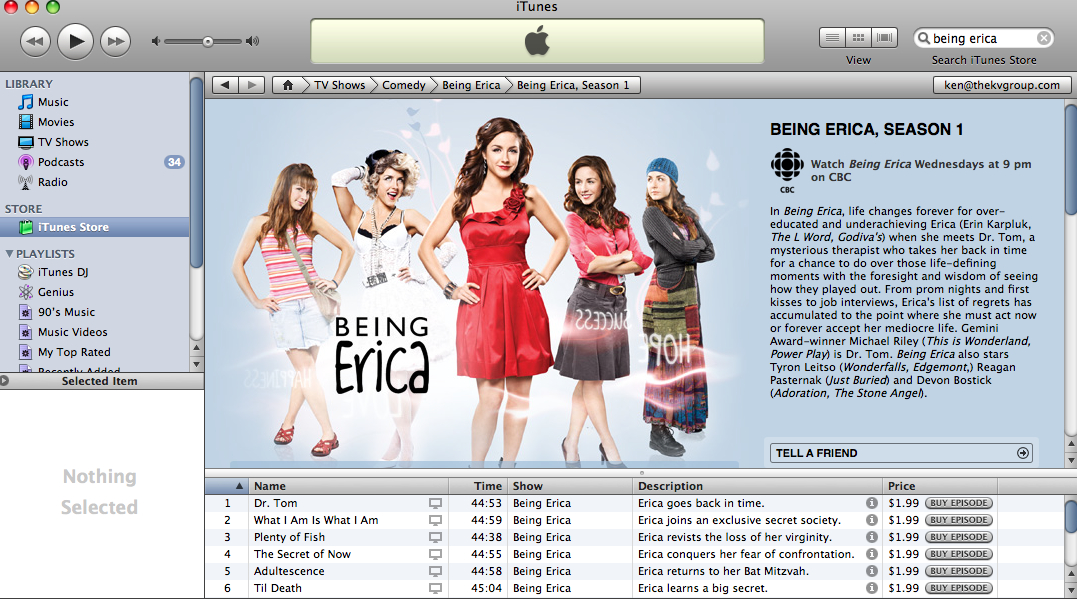
beingerica1Over the holidays, I saw CBC really hyping Being Erica {see trailer below}, which {to me}, when I saw it in February was like watching a slightly less neurotic Ally McBeal being inserted in a sort of Coen Brothers-esque time-traveling world of suspended quirky disbelief.  Sort of.  The network used a prequel blog and Facebook, making it seem like they were really pushing to not just get the word out, but to get people hooked on the idea of Erica, because they know her.  Plus, even if you couldn’t watch the shows on CBC online, you could purchase episodes of the entire season on iTunes {above}.  

The ratings are so-so for Canada, high 500Ks down to 511K, and it looks like it will get another season, albeit with fewer episodes.  This type of support is a luxury that wasn’t afforded to Douglas Coupland’s jPod.  Not that I’m bitter, CBC.  Not at all.

  1. What are your thoughts on TV content on the web?
  2. What are some creative ways to use Web 2.0 to deal with IP issues and revenues?

Love or hate Bill Maher, but give him credit for pairing together people that you never ever see together. This last installment has Mos Def in a debate with Christopher Hitchens over Iran’s Nuclear Program. While Ta’ Nehisi at the Atlantic thought Mos Def came across looking paranoid and intellectually lazy, I think Hitchen’s comes off like an oaf, but I think he always comes off that way. While you won’t see Mos Def at the Oxford Union, he is posing questions that require answers.

Read Ta’ Nehisi’s post. Good food for thought.