Archive: Apr 2009

So, as we become “scanners” of content in this Web 2.0 world, what will happen to language?  As we use SMS and Twitter, bound by 140 characters, will the use of h@x0r and L33t-style words go beyond these contexts and into other modes of communications {such as e-mails and reports}?  

Maria Bartiromo-CNBC & Tickers


Already, there’s a shorthand one needs to “decode” on the TV tickers for news, finance {above}, weather, and sports.  Will technology reduce our written language to a lowest-common denominator?  Will a linguistic Idiocracy set in, where those with good written communication skills die off, leaving the rest of us thumbing abbreviations and smileys on handhelds :-P?


Additionally, are we losing our capacity to read, in an “educated” citizen of society sense?  Linguist, Naomi Baron studies technology as it relates to the evolution of language.  She warns of the implications of this and offered this observation in a 2005 LA Times article::

“Has written culture recently taken a nose drive? These are the students who grew up on Spark Notes, the popular study guides. Many of this generation are aliteratethey know how to read but don’t choose to. And abridgment of texts is now taken to extremes, with episodes from micro-novels being sent as text messages on cell phones…

Will effortless random access erode our collective respect for writing as a logical, linear process? Such respect matters because it undergirds modern education, which is premised on thought, evidence and analysis rather than memorization and dogma. Reading successive pages and chapters teaches us how to follow a sustained line of reasoning.

If we approach the written word primarily through search-and-seizure rather than sustained encounter-and-contemplation, we risk losing a critical element of what it means to be an educated, literate society. “–“Killing the written word by snippets” (11/28/05) {Emphasis added}

What about those emoticons?  Used to clarify meanings in text-based environments, are these shorthand shortcuts impoverishing our language?  

emotibastards

Or, are they just transforming how we communicate?  For example, you can be as blunt or brutal as possible, but if you follow it with a wink or a “smiley,” it plants tongue firmly in cheek.  You get your digs in, but soften the blow.  Is this playing in to the development of a passive-aggressive culture or at least a passive-aggressive written culture?  F*** you! 😉

So, in order to be understood, will be be relying more and more on communication shortcuts {text shorthand, graphics, and/or even sound} not just in SMS texting and microblogging Tweets, but in other forms of everyday communication?  I’ve seen people get frustrated with others because their irony or sarcasm wasn’t coming through.  Allow me to reintroduce the irony mark, which has been around since the late 1800s::

point_dironie_brahm
The Irony Mark/Point d'ironie

Just in case someone might be overly-literal and might not get the fact that you’re being snarky, your bases are covered.  Looking back on Baron’s quote, the big question for me has to do with the thinking process.  I linger on terms like “logical” and “linear,” as I wonder how much of our communications are moving towards the “emotional” and “hypertextual.”  The emoticon {or other shorthand symbol} and a jumbled mass of linked stream-of-consciousness utterances may be where we’re heading.  I think the thought processes may be increasingly non-linear for more and more people and logic is taking a back seat to perlocutionary acts that try to elicit a response or some kind of action/reaction from others.  This sounds a lot like advertising.  

I offer this.  Will everyday communication be a pastiche of a myriad of verbal/visual snippets?  We scan through incredible amounts of information and gain meaning from “decoding” communications and constructing gestalts.    The linear thought process of decoding and encoding meanings is subsumed by thought processes that cut and mix ideas. 

Using Twitter as an example, take this Tweet by Clay Shirky.  

shirkytweet


In under 140 characters he communicates several key points and offers a hyperlink to the source, but without proper sentence structure.  Nevertheless, we can get meaning from his Tweet::  (1) 3% of newspaper reading is done online, (2) cite of blog post on newspaper impressions for print/online, (3) assumption is that readers see 1/2 of the pages, (4) another assumption is that they read all articles, & (5) Clay’s quick analysis.  We combine this information with other information {bricolage} for whatever purpose at hand.  We can use web searches to get this information,  On Twitter, we can look for other information on “newspapers,” using the hashtag:: #newspapers.
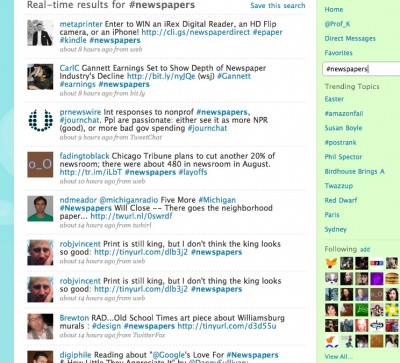
newspaperhashtag1


Walter Ong in his Orality & Literacy (1982) makes the distinctions between orality {spoken word} and literacy {print}.  Part of me feels that SMS/texting and microblogging {Facebook “graffiti” & Tweeting} represent a hybrid mode, betwixt and between both orality and literacy.  Literacy is assumed, but communications are taking on more of the characteristics of the spoken word.  So, where is all of this heading?  We will communicate in ways where we try to be understood, given the technological and temporal parameters.  I think this will be increasingly distilled.  The technology will evolve towards allowing people to cut and mix text, images, multimedia, sound, etc.  Our use of language and how language enters our consciousness will evolve into new patterns.

These are musings and I welcome rebuttals.  If you use harsh language, I’d prefer you soften the blow with an emoticon or two.  😉 🙂


Image Credit: Bill Thompson

This blog is cross-posted here.

Twitter was a hotbed of activity this weekend. There was the Mikeyy worm {See Tweets on the Mikeyy hashtag-#mikeyy} and now the word of AmazonFail is spreading & I’m sure attitudes are being formed. TemporaryVersion has an overview of the AmazonFail fiasco. From what I have been able to ascertain, Amazon created a policy of excluding “adult” content from some searches and best-seller lists. When queried on this by a director of an erotic writers association, Amazon Member Services offered up this response::   

In consideration of our entire customer base, we exclude “adult” material from appearing in some searches and best seller lists. Since these lists are generated using sales ranks, adult materials must also be excluded from that feature.Hence, if you have further questions, kindly write back to us.

Best regards,

Ashlyn D
Member Services
Amazon.com Advantage

One of the issues is the definition of “adult content.” Those familiar with the MPAA rating system for films in the US know how ratings are determined by power in the industry. If you’re an indie filmmaker with risqué content, well, good luck. You’ll get a judgment and you’ll have to live with it. If you have the backing of a major studio, no problem. The MPAA will negotiate with you on a scene-by-scene basis. There are serious implications for getting a more “restrictive” rating, since distribution deals often hinge on appealing to the widest possible audiences. A more restrictive rating almost guarantees lower box office revenues. See This Film Is Not Yet Rated for more on this. Here’s a long trailer::

The Amazon controversy is surrounding “gay” content being deemed as “adult.” One author documents his story and voices his concerns. Like with film in the US, media content on Amazon being deemed as adult content has the effect of limiting reach to potential customers. The core of the controversy is what are the criteria for being deemed “adult.” It doesn’t seem to be evident & I can’t make sense of it. DVDs are not affected and I’ve seen different editions of the same book treated differently. For example, Anaïs Nin’s Delta of Venus 2004 edition paperback isn’t ranked {presemably as it’s adult content}, but the original 1977 hardback is {Amazon.com Sales Rank: #156,857 in Books}, albeit only available used through private sellers. Amazon has stated that there in no new adult policy and the rankings issue is a glitch. Nevertheless, the the above quote makes it clear that Amazon reserves the right to categorize content as “adult,” as it sees fit.
Enter Web 2.0.
There’s interesting sleuthing going on. Jezebel.com has a AmazonFail section and is compiling a list of titles deemed adult & a pictorial comparison. The story wasn’t picked up by the press until Web 2.0 made it a story. I’m sure Amazon is scrambling on how to deal with this PR nightmare, as consumers are spreading negative word-of-mouth and urging boycotts. I’m quite interested in seeing how this story evolves.
If this is a glitch, I think that this really shows that Amazon needs to be more up-front and explicit about what “adult” means. If Amazon was trying to be content restrictive, will they fess-up, ignore the issue, or cover it up? Given how Web 2.0 spreads information and opinions, coverups and hoping things will blow over might be adding fuel to the fail.
wordle-21
Wordle.com tagcloud of blog text


This is the second installment of a series on business schools.  The first was Are Business Schools to Blame (4/7)?

Does the business school need saving?  Its “soul”?  Is there a crisis brewing where there is no faith in business knowledge or are the current economic times the result of periodic blips or a few rogue players who aren’t following the “rules”?  It depends on who you talk to.  I believe the business school is here to stay, but the challenges for competing business schools will be ones of legitimacy in the eyes of the public and relevance in an increasingly global higher education market.  

In January, Tom Ehrlich offered a commentary on business education entitled The Business of Business Education is More than Business.  Ehrlich makes this keen observation::

“The application of critical analysis and good judgment to economic issues is important for all students, but surely it is essential for students majoring in business. Business leaders need to understand the historical, cultural, scientific, organizational, and political contexts of their domain, and these are best gained through liberal education. This need raises for us a question: to what extent are undergraduates majoring in business on campuses across the country gaining these and the other attributes of a strong liberal education?”

I’m all for liberal education infused in the business curriculum, but my vision is less about checkboxes of general education requirements and more about integrating or bridging the liberal arts into the curriculum.  

“One point to consider is that, for the most part, business curricula have not ’embedded’ liberal arts into the student’s program of study, but rather have isolated it, by separating it from the business education process.”

–Chew & McInnis-Bowers (2004), “Blending liberal arts & business education”

I think one of the ways that higher education provides value is helping students connect concepts and synthesize knowledge, but my experience is that it takes quite a bit of work to truly incorporate the liberal arts and social sciences into syllabi, let alone curriculae.  I’m talking about the epistemology of business.  Countering the received-view is no mean feat.  Given my own liberal education {along with 3 business degrees}, I can draw upon Kuhn’s The Structure of Scientific Revolutions.  Some may argue that the received views of business and business education are fine.  There is no crisis at hand, in Kuhnian terms, leading to “revolutionary science”.*  Why fix what ain’t broke?  Well, that’s one way to go.

The fact of the matter is that the problems/issues of the financial sector have been in the news for a decade in mainstream sources like PBS Frontline.

These stories can help all students to think critically about the business of business.  {I tell mine to even have a healthy skepticism of the Frontline videos.}  These videos are excellent points of departure for the interdisciplinary integration of liberal learning and business.  One common thread of most of these Frontline stories is an emphasis on the social relations of markets.  Enter Stanford Sociologist, Mark Granovetter, who published a very influential sociology paper on “embeddedness” in 1985.  Embeddedness denotes a situation where economic relations between individuals and/or firms are couched in actual social networks, as opposed to an idealized market of rational behaviors.  Granovetter cites a study of the business practice of auditing that illuminated unpredicted results::

“Audits of parts by the central office were supposed to be conducted on a surprise basis, but warning was typically surreptitiously given. The high level of cooperation shown in these internal audits is suggested by the following account: ‘Notice that a count of parts was to begin provoked a flurry among the executives to hide certain parts and equipment . . . materials not to be counted were moved to: 1) little-known and inaccessible spots; 2) basements and pits that were dirty and therefore unlikely to be examined; 3) departments that had already been inspected and that could be approached circuitously while the counters were en route between official storage areas and 4) places where materials and supplies might be used as a camouflage for parts. . . . As the practice developed, cooperation among the [department] chiefs to use each other’s storage areas and available pits became well organized and smoothly functioning’ (Dalton 1959, pp. 48-49).

Dalton’s work shows brilliantly that cost accounting of all kinds is a highly arbitrary and therefore easily politicized process rather than a technical procedure decided on grounds of efficiency.”  

–Mark Granovetter (1985), “Economic Action and Social Structure: The Problem of Embeddedness”

A-ha!  While auditing may serve a rational economic function to increase efficiencies or ensure compliance, the reality is that managers were circumventing this using their social networks.  The same holds true for malfeasance on a larger scale, evident in many of the Frontline videos.

The interfaces of science, the fine arts, architecture, communications, the humanities, and the social sciences with business can provide a “two-way learning street” to use Ehrlich’s term.  Giving students liberal education knowledge truly integrated with applied professional knowledge should encourage more systems thinking.  Students will be familiar with complexity and have a wide array of concepts to draw from to analyze problems.

Moving towards the integration of liberal knowledge with professional education may not change the world, but in my opinion, as business educators, it’s doing our job.

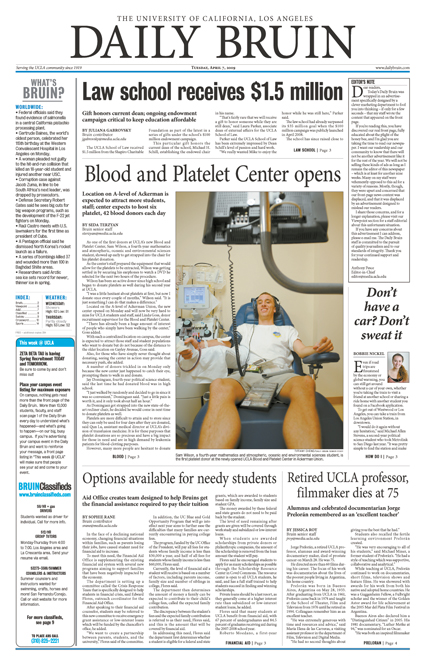
This story on how the award winning Daily Bruin sold a “wrapper ad” made me think about the singularity of media and the future of print.  The PBS Frontline of The Persuaders shows how JetBlue used a similar wrapper ad in Boston to bump “real” content off of the visible front page and make JetBlue look like a front page story with a faux front page that was an ad.  Was it The Boston Globe?  Nah, it was a Boston-area tabloid, the Herald. 

I’ve been following The Daily Bruin story and saw the LA Weekly Tweet about it.  I saw the Innovation in College Media post on the issue, which had a good comparison of the real {right} versus faux {left} front pages.

Well, why would an award-winning student-run paper risk their reputation to sell ice cream?  On the other hand, is this even a big deal?  The editor of UC Berkeley’s Daily Cal up the road {down the street for me, this week} offered this::

“We were approached about the same ad, and we firmly decided against it. I really recognize the problems the Bruin are facing. We have them too, and considering we are one of the few papers that actually scaled back publication, we’re probably feeling the pain a lot worse.

We actually did end up running a similar ad, but inside (pp. 5-6) and more clearly labeled as Paid Advertising. Still not something I’m entirely comfortable with, but definitely something I can live with, considering we held on to the revenue. Would welcome your thoughts on it. Available at: http://www.dailycal.org/data/pdf/2249.pdf

The economics of print media make advertising necessary.  This post on Poynter shows that print isn’t dead in light of online media, which {to me} highlights relevance.  Readers will seek relevant content regardless of the medium, up to a point.  

Many on staff at The Daily Bruin weren’t on board with the decision to run this ad and as it turns out, the editor of The Daily Bruin announced that there would be no more ads of this sort.  Those who have seen The Corporation have seen examples of media exerting great influence over content (Jane Akre & Steve Wilson), so we have a situation where the fourth estate has revenue imperatives at the school paper level and above.

I think it’s a bad idea to mess with reputation or audience perceptions.  If you’re a tabloid or crappy paper {or crappy blog for that matter}, it probably doesn’t matter that much.  Audience expectations factor in that constrain what one does.  The ad execution wasn’t that creative and there was no great payoff, so in my opinion, it wasn’t worth the stretch for The Daily Bruin.  If I were Haagen-Dazs and its ad agency {I do believe it still is Goodby, Silverstein & Partners}, I’d wonder if this press is a plus or minus.  At best, I think it’s a wash.  The ad execution was meh & I never felt the “honeybees” campaign was “on code”.  Nevertheless, there are economic imperatives for print journalism.  It’s easy to Monday-morning quarterback the situation, but this situation isn’t going away any time soon.  Advertising content is becoming so pervasive, it’s in TV shows, movies, video games, etc.  Should a line be drawn at ads that look like news?

  • Should journalistic news content and advertising be strongly delineated?
  • Does it really matter to readers if it’s not?

I had dinner with some colleagues last night and we had a great conversation over beer/wine and bar-b-que over whether Weber’s Iron Cage critique of modernity ignores the various ways in which belief is practiced in modern society (actually it was something about IPods and authenticity, but I digress).

Paul Krugman’s latest column in the Times nicely complements this critique of Weber’s Iron Cage. Krugman argues that the banking industry has gone through distinct phases of “exciting” banking where regulation was lax and great profits and profligate risk taking were rewarded and “boring” banking where the sector was heavily regulated and profits/risk taking were minimized. He concludes by taking the Obama economic team to task for their reticence in returning us to a “boring” banking era (You’d think Krugman taught at Harvard instead of Princeton they way he goes after Larry Summers)!

To me, the scaffolding underlying “exciting” baking is a very un-rational, un-iron cage-like “enchantment” with capital accumulation and profit making. Matt Yglesias makes the point in reference to the Krugman article that our era of “exciting banking” reflects a larger inability in our culture to assert that greed is a vice and not a virtue. Yglesias characterizes reckless investment bakers as:

people primarily motivated in life by greed. Not just by a desire to make some scratch, mind you. These aren’t immigrants who walked through the desert from Mexico in order to earn more money by washing dishes in a San Diego hotel. They’re not 24 year-olds looking for a hefty salary in order to pay off student loans. They’re multi-millionaires who want to earn millions more.

This may be part of  Weber’s larger critique of modernity — means/end rationality replaces other more intrinsic and spiritual forms of rationality.  But the Krugman piece and Ygelsias’ response seems to blur the line between the rational and the emotional. It is possible to be enchanted by money, not for what it can provide, but as an icon in and of itself.   I think Ken gets at some of this in his post on what’s being taught in business schools.

It think it would benefit us to study the banking system as if it were a religious devotion. What are it’s creation myths? It’s rituals? It’s core texts? It’s iconography?  Are there any good anthropoligical works on the banking industry?

Can/should the crowd help determine historic places in a city? The City of Los Angeles’ Office of Historic Resources is embarking on a Getty funded project called Survey LA:

a citywide survey to identify and document historic resources representing significant themes in the city’s history. While Los Angeles has over 900 Historic-Cultural Monuments (local landmarks) and 24 Historic Preservation Overlay Zones (Historic Districts), to date only 15% of the city has been surveyed.

The initiative claims to be including broad community input. But the actual mechanisim for getting involved seems unnecessarily hazy. They are asking the community to participate in a pilot survey, but wouldn’t it make more sense to encourage citizens to create Google Map mashups where “the crowd” can submit candidates for “historic place” designation?

I wonder if any other cities have tried this approach?

Very cool for those of us who remember Blondie and the Talking Heads.

Insert pedagogical justification here.

HT: Open Culture


The One Laptop per Child (OLPC) project, announced at the World Economic Fourm in 2005, generated a great deal of excitement at the possibility of a “wired world” where students can use new technology to develop their creative potential and analytical skills. Access to the tools provided by the project would be a boon to social and economic development in the Global South, providing kids with unprecendented developmental resources. Here’s the OLPC project’s mission statement

OLPC is not, at heart, a technology program, nor is the XO a product in any conventional sense of the word. OLPC is a non-profit organization providing a means to an end—an end that sees children in even the most remote regions of the globe being given the opportunity to tap into their own potential, to be exposed to a whole world of ideas, and to contribute to a more productive and saner world community

But the best laid plans….

The initial aim of OLPC was to provide 150 million laptops to the world’s poorest children by the end of 2008. The program has fallen far short of its original goals, or even its more modest revised goals. As of September, 2008, there were about 660,000 confirmed orders.

What happenend? An interesting analysis of the One Laptop Per Child Project done by Kenneth L. Kraemer, Jason Dedrick and Prakul Sharma at the University of California, Irvine, points the finger at too much of an emphasis on technology and not enough emphasis on the business model:

the OLPC has been stymied by its own misunderstanding of the environment in which it is operating. First, it depended on financing and distribution by host country governments, particularly educational bureaucracies that had little experience with computers in education or resources to make such investments. Second, OLPC underestimated the competitiveness of the PC industry and its willingness to undermine or co-opt any innovation that it perceives as a threat to its business model.

The report finds that the OLPC project has fallen short of its distribution goals because other actors have stepped into the low-end laptop market to provide more attractive alternatives for developing nations. That’s all right with Nicholas Negroponte, the driving force behind the project:

From my point of view, if the world were to have 30 million laptops made by competitors in the hands of children at the end of next year, that to me would be a great success. My goal is not selling laptops. OLPC is not in the laptop business. It’s in the education business.

But that might be a post-hoc rationalization of a larger failure. Initially, the operating system packaged with the OLPC systems were customized, open source-Linux based systems. The idea wasn’t intended to encourage more market activity in this area, it seems that it challenge the market model. Indeed the decision to adapt to market realities and produce OLPC systems with a Windows operating system led to the defection of a number of project members:

Some of OLPC team members like Walter Bender reportedly resigned because they believed that the inclusion of Windows was a shift away from education goals, while Krstic argued that open source purity had become more important than the educational mission to some.

The success, or lack thereof, of the $100 laptop raises interesting questions about the role open source, non-profit forms of social production play in a market economy. Should we best understand them as vehicles that identify market opportunities and then give way to the “big boys” who are motivated by market incentives? Or is there a space for an OLPC project if the logistics are handled correctly (proper integration with local cultures, distribution through non-bureaucratic channels, etc.)?

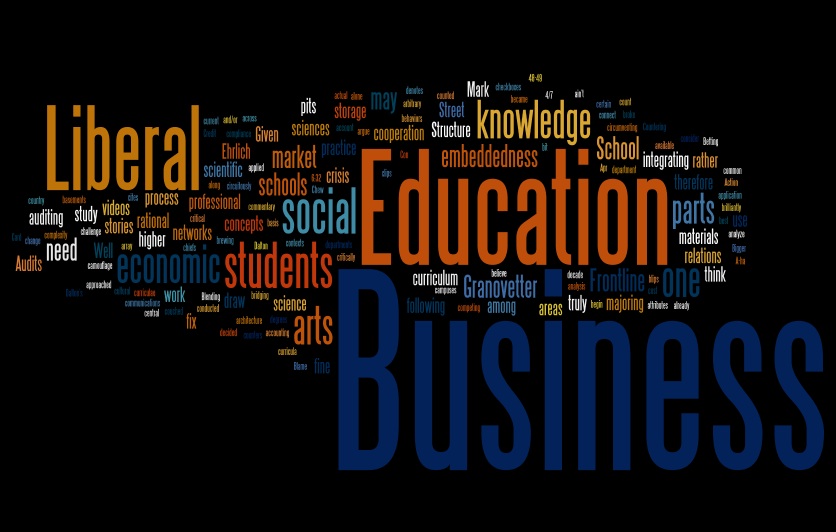
wordle1
wordle tagcloud of blog text


This will be the first installment of a multi-part series.  José, in a recent blog, brought up some excellent points regarding policy, power, and capital.  So, who are these villainous characters populating the halls of places like AIG, Lehman, and Merrill-Lynch?  A bunch of capitalist MBAs, who may never have read a word of Ayn Rand prose, but act out all sorts of wild, objectivist fantasies, right?

Well, there’s been a recent battle brewing on the Harvard Business blogs on the topic of the recent financial crisis and How to Fix Business Schools.   The editor-in-chief of the Harvard Business Review wanted to start a dialogue on the very topic::

“Are our business schools up to the job? Many critics have charged that the values imparted in MBA programs contributed significantly to the ethical and strategic lapses that led to the current economic crisis. Is that fair? And if so, what needs to change? How can business schools regain popular trust?”–Adi Ignatius

Joel Podolny, a Sociologist, notes in his blog post that “Business schools provide students with many technical skills, but they appear to do little, or nothing, to foster responsibility and accountability.”  Bob Sutton, an organizational sociologist, also brings up some interesting points on the Harvard blog, as well as his own::

  • One of the root problems with business schools is that too many are infected with assumptions that reinforce and bring out the worst in human-beings. In particular, the logic and discipline of economics usually rules the roost at business schools.”
  • “I have had Stanford students tell me for decades that Merrill is (or was) fundamentally dog eat dog world to live in and there is no incentive for helping coworkers and you get ahead by ignoring them, doing your work, and occasionally sticking a knife in their back.”

Sutton points a finger squarely at economics, which is a dominant mode of thinking in business schools (more on this later).  On the other side of the fence, Steve Kaplan, an economist, offers up “The Economists Have It Right,” where he notes the positives of economic thinking and how not following good economics leads to bad results::

“The tools economists give to students better equip them to understand the business world they will experience. In fact, one of the ways CEOs of financial services firms (e.g.Lehman’s Dick FuldMerrill Lynch’s Stan O’Neal and Citigroup’s Charles Prince) failed was in not understanding the agency theory and economics taught in business school. In particular, it is a simple economic point that it is a bad idea to pay up front fees and bonuses for investments or loans that have long-term payoffs.”

He goes on to state that efficiency advances due to economics has increased world GDP and well-being through businesses and capitalism.

First off, I have three degrees from AACSB business schools, but I’ve always been interdisciplinary and my training was steeped in the social sciences, as well as having exposure to the humanities at the graduate level.  My take is that many business schools have created a received-view, dare I say the hackneyed term paradigm, of solving problems.  I’ve seen and heard arguments about adding rigor through quantitative logics or a emphasis on ethics in the curriculum as solutions.  Given this, I have often wondered what type of students are we creating.  Critical problem solvers or disciples of a rational economics worldview (tempered with business ethics)?  It’s not just about how many economics courses are taken, but rather which paradigms are being used to build knowledge.  Which normative logics are being taught?

I think students pick up from business schools and the workplace HOW work gets done and how to get ahead.  There needs to be no smoking gun memo issued by a manager or a PowerPoint slide by a professor stating this.  How is this so?  It’s all about habitus (i.e., our actions are guided by our learned dispositions within a context) and doxa (i.e., what is taken-for-granted in a given context), borrowing from Pierre Bourdieu.  Business schools teach “the game.”  Pop culture depicts the habitus and doxa of the business game with overkill, but the examples are nevertheless instructive.

Oliver Stone’s Wall Street (1987) {left} has Gordon Gekko state a declaration of principles, seeming to echo the very spirit of Adam Smith himself.  “Greed is good” is declared with almost religious fervor, a manifestation of the final trajectory of Max Weber’s take on Martin Luther’s “quiet revolution.”  Boiler Room (2000) {right} has Jim Young indoctrinate the noobs* to the culture.  Now, imagine these images of hyperbole toned down and couched in lectures, cases, and war stories.  This is not to say that it’s all bad and that all that is being taught is that opportunism and guile are justly rewarded.  I will say that there are patterns based upon dominant ways of thinking about business and organizations, often based upon assumptions of rationality and certain logics (but not others).  One might just say it’s simple pragmatics.  It doesn’t have to be this way.  Sutton, in a comment response to Kaplan, notes what is being done at Stanford::

“…The bulk of the class is getting the students out and spreading ideas — they have spread (or tried to spread — failure happens!): Firefox (by building real browsers); practices for making Wal-Mart employees more aware of the environmental impact of the products they sell; hip-hop music; financial responsibility among younger people; and Facebook. In all cases, they have done these things by working among real customers and employees, and their work was judged by real executives from this companies. In other classes, we have done stuff like redesign and change an all-hands meeting in a real company.

So although the image of practical education most business schools present is the telling of war stories, our approach (which is expensive and inefficient) is to start with and weave in some general principles (including design thinking), some stories about how it works, and then to require the students to actually implement some change. This is a different model of management education than most business school professors imagine.”

Exactly.  I know that this type of approach is likely only at top-tier schools and niche programs.

I’d like to see business schools move towards giving students concepts and tools to re-think processes and practices that go beyond how things are currently done.  I’d like to see programs as incubators of ideas.  Places where students can try things and fail, learning from their mistakes.  I’d like to see business schools get students to think in terms of social systems and to incorporate practical solutions to dealing with the interface of different forms of capital (i.e., financial, social, political, cultural, natural, etc.).  In other words, stop trying to boil everything down to financial capital or over-rely upon particular disciplinary thinking.

I think there is creative work ahead for business schools, particularly given the current scrutiny, as well as the fact that the market for programs is increasingly global.  I’ll leave this installment with a Goethe quote::

“To refashion the fashioned, lest it harden into iron, is work of an endless vital activity/Und umzuschaffen das Geschaffne,  Damit sichs nicht zum Starren waffne,  Wirkt ewiges lebendiges Tun.”–Eins und Alles 

Outside the Beltway links to a new Rasmussen poll that finds the majority of Americans want to throw down over North Korea’s missile launch over the weekend.

Fifty-seven percent (57%) of U.S. voters nationwide favor a military response to eliminate North Korea’s missile launching capability. The latest Rasmussen Reports national telephone survey shows that just 15% of voters oppose a military response while 28% are not sure.

On its face, this is shudder inducing. The implications of an attack on North Korea has serious spillover implications for South Korea, Japan and puts us in an uncomfortable position vis-a-vis China. I though the public would have taken from the Iraq war that military action is fraught with complexity. It seems that the “Axis of Evil” framing is still deeply entrenched in the collective American psyche.

Of course this also highlights the limits of survey research. Here was Rasmussen’s question:

“If North Korea launches a long-range missile, should the United States take military action to eliminate North Korea’s ability to launch missiles?”

I’d submit that this question is priming a military response. It’s pretty logical to finish the sentence “North Korea launches a long-range missile” with “at us” rather than “that fell harmlessly into the ocean” or “into space” or wherever. It’s easy to draw a conclusion that the public is reactionary and incapable of informing foreign policy. However, without proper contextualization, who wouldn’t want the U.S. to intervene to prevent North Korea from launching a strike on the United States?

I’d like to see a poll that asks the question differently.