

crime

A facetious gun control ad near Boston's Fenway Park. Photo by Jason Paris via flickr.com.
A facetious gun control ad near Boston’s Fenway Park. Photo by Jason Paris via flickr.com.

Ten years ago, the state of Florida beefed up its “stand your ground” law – a law allowing a person who harms or kills another, often with a gun, to escape prosecution by claiming that he or she felt threatened and acted in self-defense. In other words, Florida’s law – and many others like it – lets assailants go free merely by asserting their belief that the use of force was necessary to prevent serious harm or death to themselves or bystanders. Those who assert such beliefs become according to Florida law “immune from criminal prosecution and civil action.” Prosecutions are not entirely ruled out, but authorities must meet very difficult standards to pursue cases.

Since 2005, about half of all U.S. states have passed Florida-style laws, or very similar ones. The National Rifle Association has led the charge, arguing that stand your ground laws will improve public safety and protect honest citizens.

By now, however, there is clear and compelling evidence that such laws have failed to improve public safety – and have encouraged mayhem reminiscent of America’s old Wild West. Laws allowing claims of self-defense have existed for over a century, but Florida’s new law and its imitators dramatically alter the law enforcement equation. According to David LaBahn of the Association of Prosecuting Attorneys, investigations of civilian killings are now often hamstrung by legal protections greater than those afforded police officers who use lethal force.

The Florida Experience

Florida’s 2005 law was invoked in nearly 200 shooting cases through 2012 – a majority of them involving fatalities. The cases were documented by the Tampa Bay Times:

  • The Florida law’s chief beneficiaries were “those with records of crime and violence.” Nearly 60 percent of those making self-defense claims after killing someone had been arrested at least once before; a third had been accused of violent crimes or drug offenses; and over one-third had illegally carried guns or had threatened others with guns.
  • In seven of every ten stand your ground cases, the person killed was unarmed – and in 79 percent of the cases, the assailant could have retreated to avoid the confrontation.
  • Shooters who invoked stand your ground claims under Florida’s 2005 law succeeded in escaping prosecution two-thirds of the time.

guns across americaSimilar Trends in All Stand Your Ground States

Moving beyond Florida alone, other studies have documented equally worrisome trends:

  • Reporters at the Wall Street Journal studied “justifiable homicides” nationwide from 2000 to 2010. They found that such killings increased by 85 percent in states with Florida-style laws (even though some states have more limited versions of stand your ground rules on the books). The increase occurred even though overall killings, adjusted for population growth, declined during this same period. According to the Journal investigation, more than 80 percent of the “justifiable” killings involved guns, compared with 65 percent of other killings where claims of justification were not made.
  • For the same period, researchers at Texas A&M University found no evidence in data from the Federal Bureau of Investigations that stand your ground laws deterred crimes, including burglary, robbery, or aggravated assault. Instead, in states with newly buttressed stand your ground laws on the books, the homicide rate increased by eight percent – which in human terms added up to about 600 additional homicides annually.
  • Drawing on different data, a 2012 National Bureau of Economic Research study found Florida-type laws associated with a 6.8 percent increase in homicides.
  • An Urban Institute study found significant racial disparities in “justified” killings between 2005 and 2010. In states without stand your ground laws, killings were ruled justified in 29 percent of instances where the shooter was white and the victim was black (with much lower rates of justification for white on white, black on white, and black on black killings). By contrast, in states with stand your ground laws on the books, white on black killings were accepted as justified 36 percent of the time (with more modest upticks in findings of justification for the other kinds of cases).

Time to Rethink Laws Undermining Public Safety

The evidence is clear: Expanded stand your ground laws combined with more gun-carrying increases unnecessary violent confrontations and deaths. With more than 11 million Americans now licensed to carry guns, we need policies to defuse or avert public confrontations – and police and prosecutors must be able to conduct full investigations when incidents occur. A February 2015 American Bar Association report urges states to scale back legal immunity and restore the “safe retreat” standard in public places – a standard that requires people who feel threatened to avoid confrontation if they can do so safely. Since the beginning of 2015, legislators in ten states, including Florida, have introduced such measures. But many reform proposals are stalled, and 13 states are actually deliberating bills that would fortify stand your ground practices.

Long ago, Americans north and south acted to contain the dangers of open gun-toting and free-wheeling confrontations. As early as 1686, New Jersey enacted a law against wearing weapons because they induced “great Fear and Quarrels.” In the 1700s, three states passed no-carry laws. In the 1800s, as interpersonal violence and gun carrying spread, 37 states joined the list of those enacting restrictions. Alabama’s 1839 law was titled, “An Act to Suppress the Evil Practice of Carrying Weapons Secretly.” This history makes the current popularity of gun-carrying and stand your ground laws all the more mystifying. Apparently, twenty-first century Americans must now re-learn lessons their ancestors took to heart long ago.
This brief was prepared for the Scholars Strategy Network by Robert J. Spitzer, State University of New York at Cortland. Spitzer is the author of Guns across America: Reconciling Gun Rules and Rights (Oxford University Press, 2015).

usdeportations

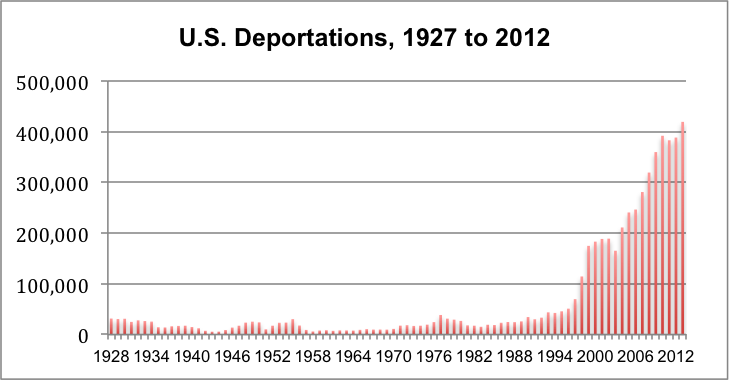
In recent decades, the United States has seen a spectacular rise in deportations, with local police forces authorized by the federal government to identify undocumented immigrants for summary removal. More than 11 million undocumented people across the country – including up to one in ten adult workers in the state of California – faced this threat in their daily lives.

To assuage the human costs, President Barack Obama outlined a plan in November 2014 to provide temporary protection to many undocumented migrants. Building on his earlier efforts to set priorities, the President specified that officials would henceforth seek to deport “felons, not families,” “criminals, not children,” “gang members, not a mom who’s working hard to provide for her kids.” In short, under the new policy, various kinds of immigrants deemed good would be protected from deportation. Well-intentioned city leaders, bureaucrats, and police would need to sort out the good immigrants from those vilified as criminals.

These well-intended steps are meant to alleviate the trauma that the threat of deportation has imposed on millions of law-abiding migrants. But how do the binary divisions work out in practice? My research, based on a year of observations in southern California plus 75 in-depth interviews with undocumented Mexican migrants, suggests that efforts to divide good from bad people in migrant communities can have pernicious as well as helpful effects. more...

A screenshot from a Sesame Street special on kids with incarcerated parents.

Nearly 2.7 million American children have to cope with the incarceration of one or both of their parents, according to 2010 data from the Pew Charitable Trusts. A growing body of research informs concerned policymakers by showing the extraordinary challenges these children face compared to those whose parents are never imprisoned. Family disruption, economic losses, and greater exposure to crime, abuse, and violence – all can serve to reinforce disadvantages from one generation to the next for these unfortunate children. Because fathers are more often incarcerated than mothers, most research to date has focused on their children. But more remains to be learned to inform policymakers trying to address the special needs of children whose mothers – and perhaps both parents – end up in jail or prison.

My co-author Sherry Zhang and I have compared the experiences in childhood and young adulthood of boys and girls who experienced one of four scenarios before their 18th birthdays – neither parent ever incarcerated; mother incarcerated; father incarcerated; or both parents incarcerated. This research allows us to describe similar and different childhood experiences in these four types of situations. We use data from the National Longitudinal Study of Adolescent to Adult Health – called “Add Health.” Of the children in this data who had the experience of a parent sent to prison, just over 80% endured paternal incarceration, while 12% experienced maternal incarceration and 7% had both parents sent to prison. Our findings reveal many similarities among sets of young people with one or both parents imprisoned, but some differences also underline the special needs of children with imprisoned mothers.

Differences in Family Situations

The structure of a child’s family patterns much of what he or she experiences when a parent is imprisoned. As shown in previous research, prior to incarceration women are more likely than men to report that they lived with their children. Understandably, therefore, the vast majority of children with incarcerated fathers continue to live with their mothers, while children with incarcerated mothers are more likely to reside with other family members like grandparents. Our findings using data from Add Health suggest that these differences are likely more than temporary arrangements caused by a parent’s imprisonment.

  • Although almost all adolescents with fathers in prison during their childhood years were living with mothers (80%) or with either biological parent (92%), far fewer children of imprisoned mothers were living with their mothers (54%) or with either biological parent (71%). And just small proportions of those who resided with biological parents lived with both – in sharp contrast to the vast majority of adolescents whose parents were never incarcerated.
  • Other caregivers – such as fathers, grandparents, aunts, and unrelated adults – play a more prominent role for children of incarcerated mothers than for those with imprisoned fathers. In the maternal incarceration group, 17% reported living with their father but not their mother (compared to 6% in the paternal incarceration group and 5% in the group where neither parent went to prison). In comparison to adolescents whose fathers were incarcerated during their childhood, those whose mothers were sent to jail or prison are almost three times more likely to report living with their father but not their mother, four times more likely to report living with someone other than a parent, ten times more likely to report living with a grandparent or aunt, and 13 times more likely to be living with an adoptive or foster mother.
  • Differences in family structure linger into adulthood. Although 88% of adolescents whose fathers went to jail or prison name their biological mother as the person who raised them, only 54% of those whose mothers were incarcerated name her as the one who raised them, while 36% point to other family members. However, in our data, neither maternal nor paternal incarceration is associated with the family structures formed by offspring in young adulthood.

Similar Experiences of Economic Hardship, Abuse, and Crime

Compared to those whose parents never went to jail or prison, individuals whose parents were incarcerated are more likely to report that they experienced economic hardship and exposure to abuse, crime, and violence during their childhoods. Tellingly, these adverse experiences are largely comparable for children with either mothers or fathers in jail or prison.

  • Adolescents whose parents were ever incarcerated lived as children in households with average incomes below $33,000 – and over one quarter of these household had trouble paying bills and two-thirds received public assistance. Reported economic hardships were greater than for households where neither parent went to jail or prison, but for households with incarcerated parents it made little difference whether the mother or father was the one imprisoned. By young adulthood, those with one or both parents incarcerated during their childhood reported more hardship and lower educational attainment, but again it made little difference whether the mother or father had gone to prison. Our data suggest that previous research findings about the adverse effects of paternal incarceration can be generalized to maternal incarceration as well.
  • Compared to those without imprisoned parents, nearly twice as many respondents who had a parent imprisoned (35% versus 17%) reported childhood physical abuse, exposure to violence in their neighborhoods or homes, and participation in incidents of delinquency – but once again, there were no significant differences between paternal and maternal incarceration.

Taken together, these findings have important implications for future research and policy development. Most basically, similarities in the experiences of offspring of incarcerated mothers and fathers suggest that interventions already designed to deal with economic hardships and exposures to abuse, crime, and violence for children of imprisoned fathers can be adapted for those with any imprisoned parents. However, we have also learned that persistent differences in family structure – before, during, and after parental incarceration – could affect access to services, especially for children whose mothers go to prison. Even if appropriate services are available, grandparents or biological fathers who step into parenting roles may not know about them or may feel out of place in asking for help. Steps should be taken to ensure that children of imprisoned mothers do not experience extra disruption and family instability.

In 1986 a black Massachusetts prisoner serving life for murder brutalized a Maryland couple during a weekend furlough. The prisoner’s name was Willie Horton. During the 1988 presidential election the George H.W. Bush campaign made extensive use of the story and the image of Willie Horton to attack his opponent, Massachusetts Governor Michael Dukakis. Dukakis was branded as a coddler of criminals, unable and unwilling to protect the public. There was of course nothing new about the tactic of manipulating white fear of black criminality for political gain. (Dukakis neither initiated the furlough program nor did he have control over it as governor.) But the spectacular success of the ploy in the 1988 presidential campaign made “Willie Horton” shorthand for this maneuver. more...

Are children and adolescents who break the law fated to become lifelong offenders? To answer this important question, we started in the 1980s to track the lives of 1000 disadvantaged males born in Boston during the Great Depression era. We were able to build on data collected during offenders’ boyhoods for a classic mid-twentieth-century study, Unraveling Juvenile Delinquency, conducted by Sheldon and Eleanor Glueck at Harvard Law School. We used early waves of data from this study, and then tracked down males included in it to collect further information on their histories of criminal offending through old age. Over the last 25 years, we have used this rich, long-term trove of information for two books and dozens of journal articles and chapters. This brief summarizes our core ideas and major findings.

The Importance of Tracking and Explaining Lives

The idea that adult criminality is the inexorable result of childhood traits and troubles is a dominant theme in the science of criminology and media coverage of crime. Connections between childhood and adult behavior certainly do exist, but our research has been premised on the realization that findings about crime can be distorted when scholars start with adult offenders and then ask about their childhoods. In this retrospective approach, adult criminals regularly turn out to have been troubled children with early histories of delinquency. It is easy to jump to the simple, seductive conclusion that “bad boys grow up to become bad men.”

But if we start with children and follow lives forward for many years, we find considerable heterogeneity in adult outcomes. For example, although it is easy to presume that most antisocial children will become involved in delinquency as adolescents and then graduate to adult offending, in fact most antisocial children cease offending by adulthood. Although long-term research is challenging to carry out, only what scholars call “longitudinal prospective data”—that is, information repeatedly collected as particular children become adolescents and then younger and older adults—can allow researchers to shed full light on complex causal processes playing out over many years in people’s lives. Yet even repeatedly collected data are not sufficient. Also needed is a life-course theory of crime to make sense of the underlying patterns. more...

Over the past four decades, the United States has sent astonishingly high numbers of its citizens to prison—especially poor minority men. The price has been paid not just by the imprisoned men themselves, but also by their communities and families, including very young children.

On any given day, approximately 2.7 million children are estimated to have a parent in prison or jail. When we also take into account children who have fathers previously in jail or prison, it turns out that nearly one of every ten U.S. residents under 18 has been affected by parental imprisonment. Researchers like me are just beginning to look into the impact of fathers’ imprisonment on children’s preparation to learn when they start attending school. For all American children, doing well at school is crucial. Early gaps lead to growing inequalities in U.S. society as a whole.

About 1 in 10 American kids has a father who is in or has been in prison. How will it affect their life chances?
About 1 in 10 American kids has a father who is in or has been in prison. How will it affect their life chances? Photo via Flickr CC (click for original).

Why School Readiness Matters

“School readiness” is an idea developed by scholars to indicate how well prepared pre-school children are to learn in formal classrooms. It refers both to cognitive skills—such as understanding words and numbers and the ability to solve problems—and to such behavioral skills as the ability to pay attention, follow directions, and control emotions like anger or frustration. more...

The United States grapples with tough issues of crime and punishment, but the challenges pale next to those faced by the small, poor nation of Rwanda following state-sponsored genocide in 1994. In the wake of atrocity, Rwanda had to bring massive numbers of wrongdoers to justice, even as it tried to restore peace and a measure of trust to shattered communities. When existing judicial institutions became overwhelmed, Rwanda fashioned a new system, adapting traditional community mechanisms of justice and reparation to cope with the modern crisis. Lessons from this experience might help America find new ways to combine punishment and social healing.

Challenge and Response in Rwanda

The 1994 genocide left Rwanda with over a million citizens dead, millions more displaced, and societal institutions in shambles. Violence had been orchestrated by a group of political leaders who encouraged ordinary Rwandan citizens to participate by forming self-defense groups, spreading propaganda, and instilling fear. After the violence ended, the United Nations created the International Criminal Tribunal for Rwanda to try those deemed most responsible for atrocities. But this tribunal could handle only a fraction of the perpetrators, leaving tiny Rwanda overwhelmed with the reality that upwards of one million of its citizens had committed genocidal crimes. Meanwhile, many survivors had lost their entire families and all of their belongings yet were still expected to live in the same communities with those responsible for their losses. more...

“They just have too many people in prison that shouldn’t be here,” says Crystal, the 21-year-old wife of a prisoner. She goes on to comment on the system as a whole:

There’s a lot that’s in prison because they didn’t have an adequate lawyer, or they couldn’t afford it, so they got a public defender that didn’t care, you know, or that went along with the DA or somethin’ an’ that’s how they got here!… I don’t even feel like we have a justice system anymore. Cuz I mean, it’s crazy. I feel like everybody should be treated equal in the justice system, even if you have a lot of money, and even if you don’t have no money… what kind of justice system do we have if I can get off of a case because I have more money? more...

Imprisonment in the contemporary United States far surpasses other nations. The ironies are sharp and manifold. The United States deploys armies abroad under the banner of freedom and at the same time has the largest custodial prison infrastructure on the planet, a system of jails and prisons that locks up a greater fraction of our people for life—more than fifty for every 100,000 residents—than the population share imprisoned for any length of time by Denmark, Sweden, and Norway combined. American democracy is inspired by ideals of active and equal citizenship, yet racial and class inequalities run through the heart of our criminal justice system. Urban black communities have little voice in setting criminal justice policies, even though they experience the brunt of violations and the direct and indirect effects of punishment. Intellectuals have an obligation to lay bare the threat to American democracy caused by massive, racially skewed imprisonment. To that end, I offer the following reflections. more...

Even after felons pay their dues to society and leave prison, America sidelines them from the public square. Parolees and probationers are often perceived as undeserving of citizen benefits, and they have little power to assert their rights. Not only do governments often deny felons public resources such as Food Stamps, subsidized college loans, public housing and professional opportunities like licenses and contracts, it is also common for U.S. states to deny former prisoners the right to vote and otherwise exercise full and free citizenship.   more...