
intersectionality: race x class

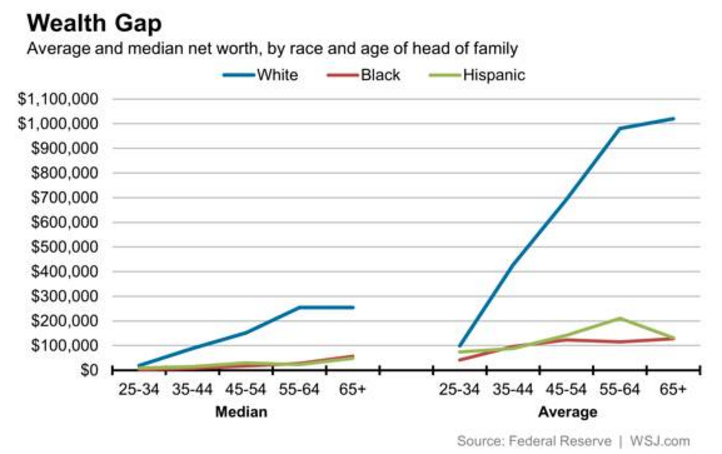
The Wall Street Journal’s Real Time Economics recently looked at wealth inequality.  The first chart taken from the post shows wealth differences by race and age of head of family.
wealth gap

Racial differences (white versus black and Hispanic) dominate whether looking at average or median net worth, and the gap grows as the head of the family ages.  Median figures are especially sobering, showing the limited wealth generation of representative black and Hispanic heads of families regardless of age.

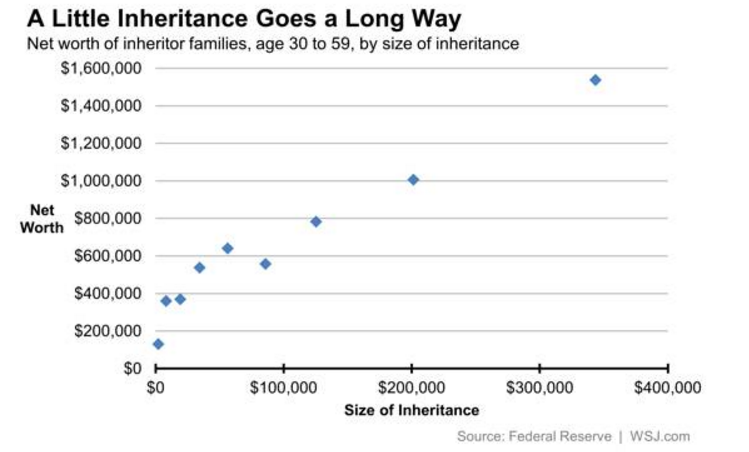
So, do these advantages and disadvantages transfer to the next generation? Yes, and not just laterally. This second chart looks at the relationship between inheritance and wealth generation.
Inheritance

Inheritance was divided into ten groups.  WARNING: THE TENTH GROUP, WHICH RECEIVED THE LARGEST INHERITANCE, IS NOT SHOWN.

As Josh Zumrun, the author of the blog, explains:

The bottom 10% of inheritors received an inheritance averaging only about $2,000. Families receiving this much inheritance aren’t that wealthy.

But among families that received a $35,000 inheritance, their net worth is over half a million. Families that received a $125,000 inheritance are worth $780,000 on average and those that receive a $200,000 inheritance are, on average, millionaires. (The top 10% of inheritors, not pictured in this chart, inherit $1.6 million on average and have a net worth of $4.2 million.)

The take-away is pretty simple: Wealth inequality is real, with strong racial determinants, and is also, to a significant degree, self-reinforcing.

Originally posted at Reports from the Economic Front.

———————————

Martin Hart-Landsberg is a professor of economics at Lewis and Clark College. You can follow him at Reports from the Economic Front.

Law professor and critical race scholar Kimberlé Crenshaw developed the term” intersectionality” to draw attention to the way that all of our socially salient identities work together to shape the stereotypes that apply to us. The experience of being black, for example, is shaped by gender, just as the experience of being a man is shaped by race.

Once a person has internalized an intersectional lens, the old model — epitomized by the famous phrase “all the women are white, all the blacks are men” — can be jarring. It has a way of making certain kinds of people and their experience invisible. In the above case, women of color.

At this weekend’s debate, Bernie Sanders made exactly one of these jarring statements in response to an inquiry about “racial blind spots.”

When you’re white, you don’t know what it’s like to be living in a ghetto. You don’t know what it’s like to be poor. You don’t know what it’s like to be hassled when you walk down the street or you get dragged out of a car.

I imagine poor white people, middle class blacks, and women everywhere sat up and were like “What!?”

Author Joy Ann Reid noted on twitter that Sanders was conflating race and class, making poor white and middle and upper class black people invisible. Most African Americans are not poor and most poor people are white. She noted, as well, that white immigrants have lived in what we call the “ghetto” for much of American history.

I’ll add that one doesn’t need to be black to get hassled when walking down the street, as most women of all races can attest. Or, for that matter, how about being a feminine-presenting or gender queer man? And being dragged out of a car is something that happens to black people who are being accosted by the police, but also those who are being victimized by violent boyfriends or husbands.

Ironically, Sanders was saying that his racial blind spot was not being able to fully understand the black experience, but he revealed a different blind spot: intersectionality.

The comment starts at about a minute, twenty seconds:

Lisa Wade, PhD is an Associate Professor at Tulane University. She is the author of American Hookup, a book about college sexual culture; a textbook about gender; and a forthcoming introductory text: Terrible Magnificent Sociology. You can follow her on Twitter and Instagram.

I recently moved to a neighborhood that people routinely describe as “bad.” It’s my first time living in such a place. I’ve lived in working class neighborhoods, but never poor ones. I’ve been lucky.

This neighborhood — one, to be clear, that I had the privilege to choose to live in — is genuinely dangerous. There have been 42 shootings within one mile of my house in the last year. Often in broad daylight. Once the murderers fled down my street, careening by my front door in an SUV. One week there were six rapes by strangers — in the street and after home invasions — in seven days. People are robbed, which makes sense to me because people have to eat, but with a level of violence that I find confusing. An 11-year-old was recently arrested for pulling a gun on someone. A man was beaten until he was a quadriplegic. One day 16 people were shot in a park nearby after a parade.

I’ve lived here for a short time and — being white, middle-aged, middle class, and female — I am on the margins of the violence in my streets, and yet I have never been so constantly and excruciatingly aware of my mortality. I feel less of a hold on life itself. It feels so much more fragile, like it could be taken away from me at any time. I am acutely aware that my skin is but paper, my bones brittle, my skull just a shell ripe for bashing. I imagine a bullet sheering through me like I am nothing. That robustness that life used to have, the feeling that it is resilient and that I can count on it to be there for me, that feeling is going away.

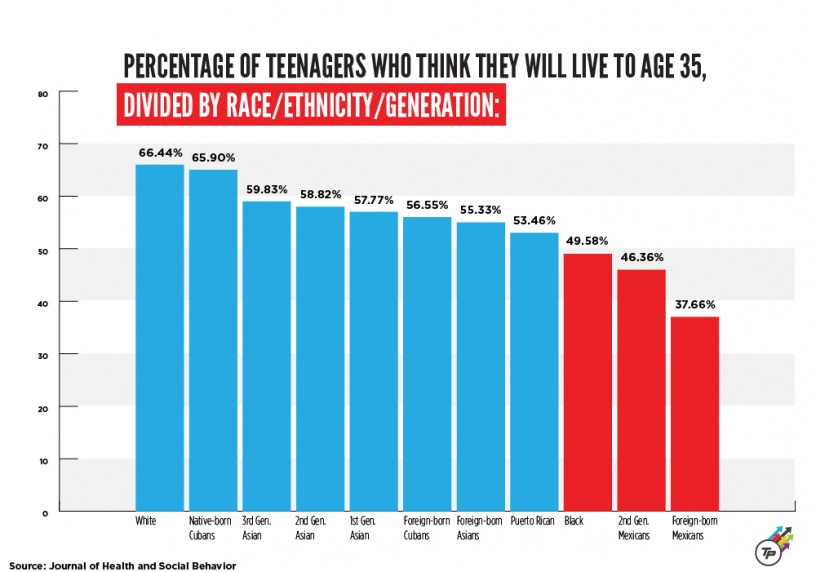
So, when I saw the results of a new study showing that only 50% of African American teenagers believe that they will reach 35 years of age, I understood better than I have understood before. Just a tiny — a teeny, teeny, tiny — bit better.

2

I have heard this idea before. A friend who grew up the child of Mexican immigrants in a sketchy urban neighborhood told me that he, as a teenager, didn’t believe he’d make it to 18. I nodded my head and thought “wow,”‘ but I did not understand even a little bit. He would be between the first and second column from the right: 54% of 2nd generation Mexican immigrants expect that they may very well die before 35. I understand him now a tiny — a teeny, teeny tiny — bit better.

Sociologists Tara Warner and Raymond Swisher, the authors of the study, make clear that the consequences of this fatalism are far reaching. If a child does not believe that they might live to see another day, what motivation can there possibly be for investing in the future, for caring for one’s body, for avoiding harmful habits or dangerous activities? Why study? Why bother to see a doctor? Why not do drugs? Why avoid breaking the law?

Why wouldn’t a person put their future at risk — indeed, their very life — if they do not believe in that future, that life, at all?

If we really want to improve the lives of the most vulnerable people in our country, we cannot allow them to live in neighborhoods where desperation is so high that people turn to violence. Dangerous environments breed fatalism, rationally so. And once our children have given up on their own futures, no teachers’ encouragement, no promise that things will get better if they are good, no “up by your bootstraps” rhetoric will make a difference. They think they’re going to be dead, literally.

We need to boost these families with generous economic help, real opportunities, and investment in neighborhood infrastructure and schools. I think we don’t because the people with the power to do so don’t understand — even a teeny, teeny tiny bit — what it feels like to grow up thinking you’ll never grow up. Until they do, and until we decide that this is a form of cruelty that we cannot tolerate, I am sad to say that I feel pretty fatalistic about these children’s futures, too.

Re-posted at Pacific Standard.

Lisa Wade, PhD is an Associate Professor at Tulane University. She is the author of American Hookup, a book about college sexual culture; a textbook about gender; and a forthcoming introductory text: Terrible Magnificent Sociology. You can follow her on Twitter and Instagram.

In the 6-minute video below, Stanford sociologist Aliya Saperstein discusses her research showing that the perception of other peoples’ race is shaped by what we know about them. She uses data collected through a series of in-person interviews in which interviewers sit down with respondents several times over many years, learn about what’s happened and, among other things, make a judgment call as to their race. You may be surprised how often racial designations. In one of her samples, 20% of respondents were inconsistently identified, meaning that they were given different racial classifications by different interviewers at least once.

Saperstein found that a person judged as white in an early interview was more likely to be marked as black in a later interview if they experienced a life event that is stereotypically associated with blackness, like imprisonment or unemployment.

She and some colleagues also did an experiment, asking subjects to indicate whether people with black, white, and ambiguous faces dressed in a suit or a blue work shirt were white or black. Tracing their mouse paths, it was clear that the same face in a suit was more easily categorized as white than the one in a work shirt.

5

Race is a social construction, not just in the sense that we made it up, but in that it’s flexible and dependent on status as well as phenotype.

She finishes with the observation that, while phenotype definitely impacts a person’s life chances, we also need to be aware that differences in education, income, and imprisonment reflect not only bias against phenotype, but the fact that success begets whiteness. And vice versa.

Watch the whole thing here:

[youtube]https://www.youtube.com/watch?v=jiwieME2tis[/youtube]

The Colbert Report also referenced Saperstein’s work:

Lisa Wade, PhD is an Associate Professor at Tulane University. She is the author of American Hookup, a book about college sexual culture; a textbook about gender; and a forthcoming introductory text: Terrible Magnificent Sociology. You can follow her on Twitter and Instagram.