intersectionality: race x class

Black history in Appalachia is largely hidden. Many people think that slavery was largely absent in central and southern Appalachia due to the poverty of the Scots-Irish who frequently settled in the area, and who were purportedly more “ruggedly independent” and pro-abolitionist in their sentiments. Others argue that the mountainous land was not appropriate for plantations, unlike other parts of the South, and so slavery in the area was improbable.

A Sample Slave Schedule
(Wikimedia Commons)

As historian John Inscoe and sociologist Wilma Dunaway show us, this is not the case. According to Inscoe, slavery existed in “every county in Appalachia in 1860.” Dunaway—who collected data from county tax lists, census manuscripts, records from slaveholders, and slave narratives from the area—estimates that 18% of Appalachian households owned slaves, which compares to approximately 29% of Southern families, in general.

While enslaved people in the Appalachian region were less likely to work on large plantations, their experiences were no less harsh. They often tended small farms and livestock, worked in manufacturing and commerce, served tourists, and labored in mining industries. Slave narratives, legal documents, and other records all show that slaves in Appalachia were treated harshly and punitively, despite claims that slavery was more “genteel” in the area than the deep South.

My own research, which focuses on the life experiences of Leslie [“Les”] Whittington, whose grandfather was enslaved, helps to document the presence of slavery in Appalachia and the consequences that exploitative system had for African Americans in the region. Les’s grandfather, John Myra, was owned by Joseph Stepp, who lived in Western North Carolina. Census records show that Joseph Stepp owned seven slaves in 1850, five women and two men, who together ranged from one to 32 years of age. Ten years later, in 1860, schedules show Stepp owned 21 slaves, making him one of the wealthiest property owners in Buncombe County, the county in which he and John Myra lived.

Joseph Stepp was not unique. According to Dunaway, slave owners in Appalachia “monopolized a much higher proportion of their communities’ land and wealth” compared to those outside the area, driving wealth inequality in the region. Part of the legacy of slavery, these inequities remained in place after the Civil War, reinforced by Jim Crow legislation that subjugated African Americans socially, culturally, and politically. Sociologist Karida Brown explains how Jim Crow Laws led approximately six million African Americans to migrate from the South to the North between 1910 and 1970.
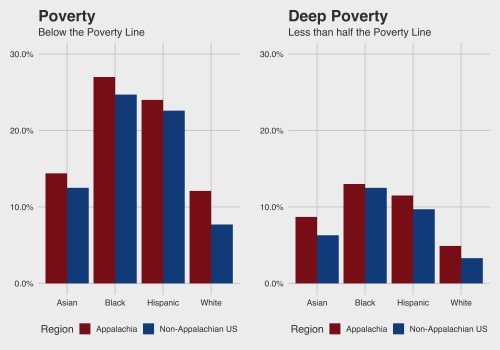
Poverty Rates in Appalachia by Race (U.S. Census Bureau, 2000).
Click to view report
Graphic by Evan Stewart

Those who stayed in Appalachia, such as John Myra and his descendants, faced continued restrictions, like living in racially segregated neighborhoods, having limited employment opportunities, and not being able to attend racially integrated schools. Such systematic forms of discrimination explain why racial disparities continue to exist today, even within a region where poverty among whites remains above the national average. To understand these existing inequities, we must document the past accurately.

Jacqueline Clark, PhD is a professor of sociology at Ripon College. Her teaching and research interests include social inequalities, the sociology of health and illness, and the sociology of jobs and work. 

In February of 1926, Carter G. Woodson helped establish “Negro History Week” to educate teachers, students, and community members about the accomplishments and experiences of Blacks in the United States. A native of Virginia, and the son of formerly enslaved parents, Woodson earned a PhD in history from Harvard University, and dedicated much of his life to writing and teaching about information largely omitted from textbooks and other historical accounts. Although Woodson died in 1950, his legacy continues, as “Negro History Week” eventually became “Black History Month” in 1976.

Nearly a century later, Black History is still at risk of erasure, especially in (once) geographically isolated areas, like Appalachia. The standard narrative that Scots-Irish “settled” Appalachia starting in the 18th century hides the fact that there were often violent interactions between European immigrants and indigenous people in the region. Even in the 1960s when authors like Michael Harrington and Harry Caudill reported on Appalachian mountain folk, the people were depicted as Scots-Irish descendants, known for being poor, lazy, and backward, representations that are reinforced in contemporary accounts of the region, such as J. D. Vance’s wildly popular memoir Hillbilly Elegy.

Source: Wikimedia Commons

Accounts like these offer stereotypical understandings of poor Appalachian whites, and at the same time, they ignore the presence and experiences of Blacks in the region. Work by social scientists William Turner and Edward Cabell, as well as “Affrilachia” poet Frank X. Walker, and historian Elizabeth Catte attempts to remedy this problem, but the dominant narrative of the region centers still on poor whites and their lives.

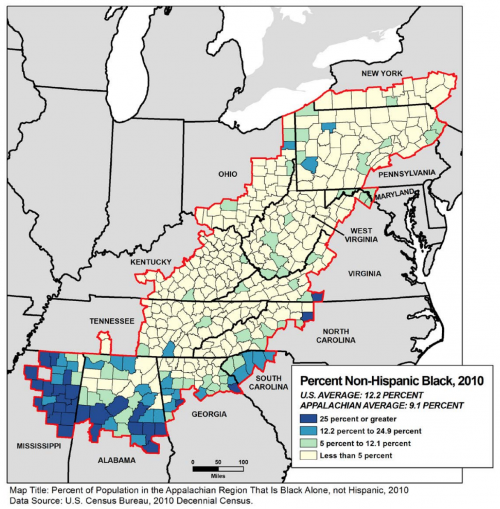
Work I have been doing documenting the life experiences of Leslie [“Les”] Whittington, a native of Western North Carolina and a descendent of a formerly enslaved people, has opened my eyes to a historical narrative I never fully knew. African Americans, for instance, accounted for approximately 10% of the Appalachian region’s population by 1860, and many were enslaved, including Les’ grandfather, John Myra Stepp. Yet, their stories are glaringly missing from the dominant narrative of the region.

Source: Appalachian Regional Commission Census Data Overview

So too are the stories of Blacks living in Appalachia today. Even though the number of African American residents has increased in some parts of  Appalachia, while the white population has decreased, little is formally documented about their lives. That absence has led scholar William Turner, to refer to Blacks in Appalachia as a “racial minority within a cultural minority.” Not only does erasing African Americans from the past and present of Appalachia provide an inaccurate view of the region, but it also minimizes the suffering of poor Blacks, who relative to their white counterparts, are and have been the poorest of an impoverished population.

Woodson established “Negro History Week” to document and share the history of Blacks in the United States, recognizing that, “If a race has no history, it has no worthwhile tradition, it becomes a negligible factor in the thought of the world, and it stands in danger of being exterminated.” The history of African Americans in the Appalachian region is largely absent from the area’s official record, and without making it part of the dominant narrative, we risk losing that history.

Jacqueline Clark, PhD is a professor of sociology at Ripon College. Her teaching and research interests include social inequalities, the sociology of health and illness, and the sociology of jobs and work. 

Where you grow up is consequential. It plays a critical role in shaping who you are likely to become. Where you live affects your future earnings, how much education you’re likely to receive, how long you live, and much more.

Sociologists who study this are interested in the concentrated accumulations of specific types and qualities of capital (economic, cultural, social) found in abundance in certain locations, less in more, and virtually absent in some. And, as inequalities intersect with one another, marginalization tends to pile up. For instance, those areas of the U.S. that are disproportionately Black and Latino are also areas struggling economically (see Dustin A. Cable’s racial dot map of the U.S.). Similarly, those areas of the country with the least upward mobility are also areas with some of the highest proportions of households of people of color. And, perhaps not shockingly (although it should be), schools in these areas receive fewer resources and have lower outcomes for students.

How much education you receive is, in part, a result of where you grow up. Think about it: you’re be more likely to end up with at least a bachelor’s degree if you grow up in an area where almost everyone is at least college educated. It’s not a requirement, but it’s more likely. And, if you do and go on to live in a similar community and have children, your kids will benefit from you carrying on that cycle as well. Of course, this system of advantages works in reverse for communities with lower levels of educational attainment.

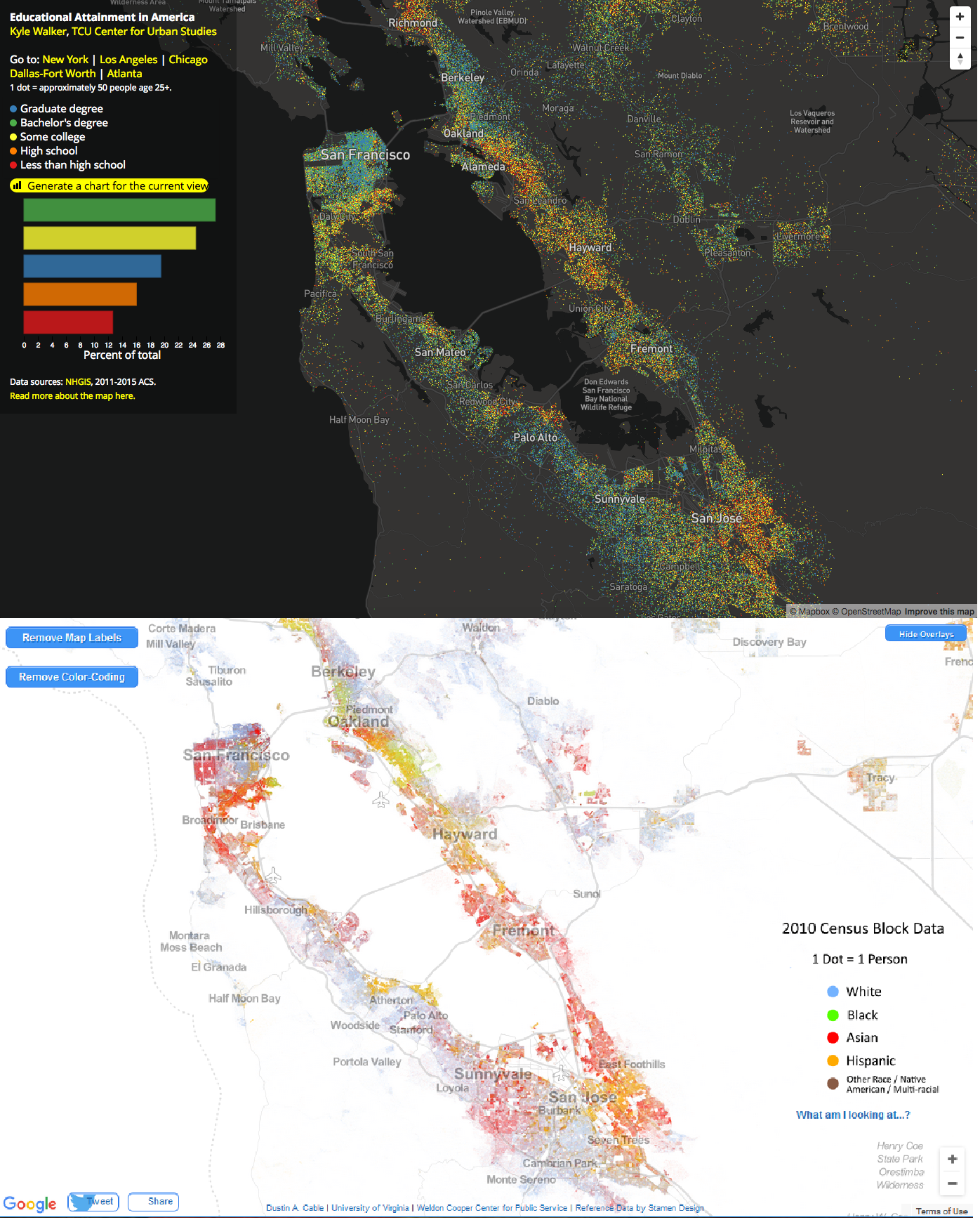
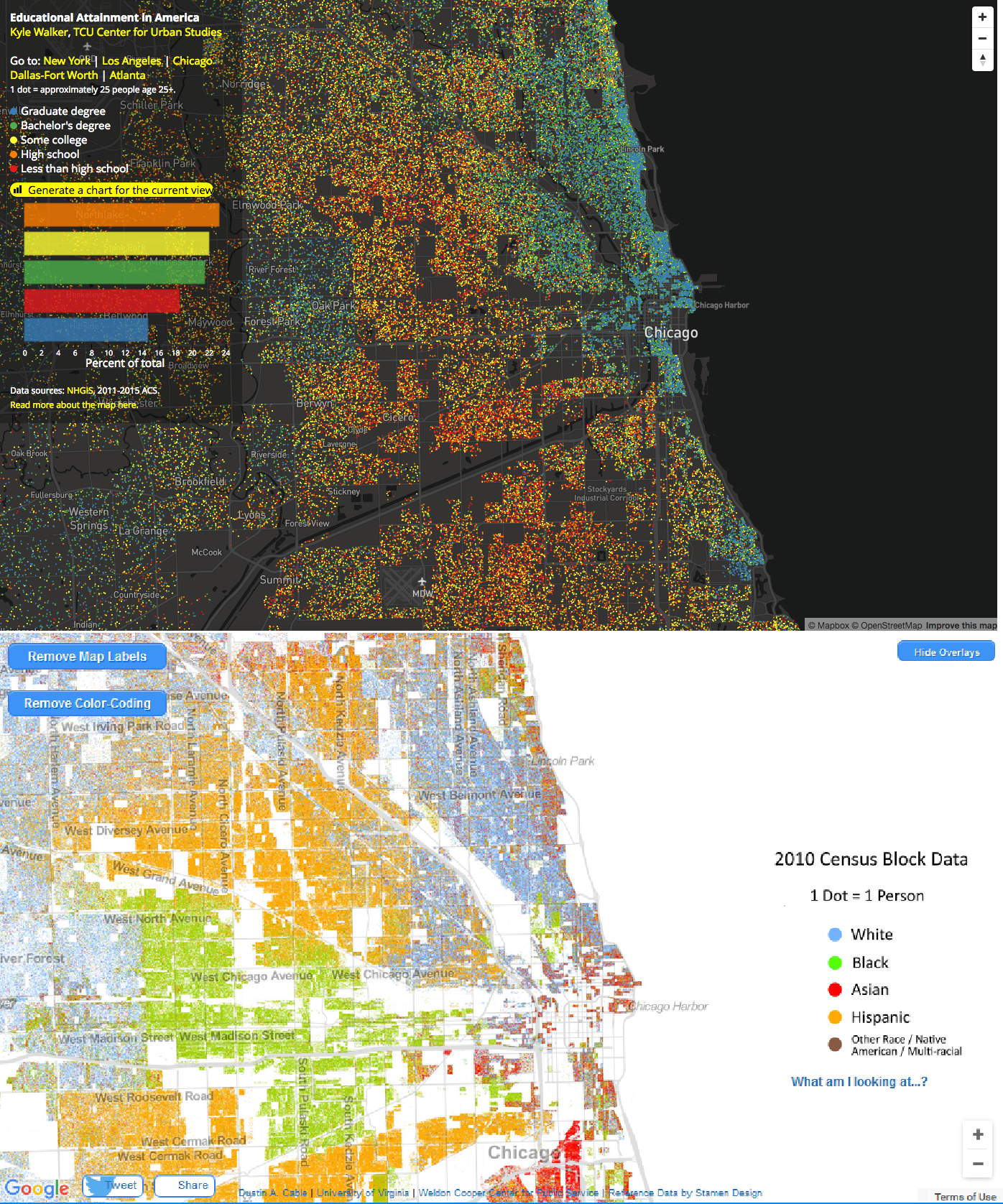
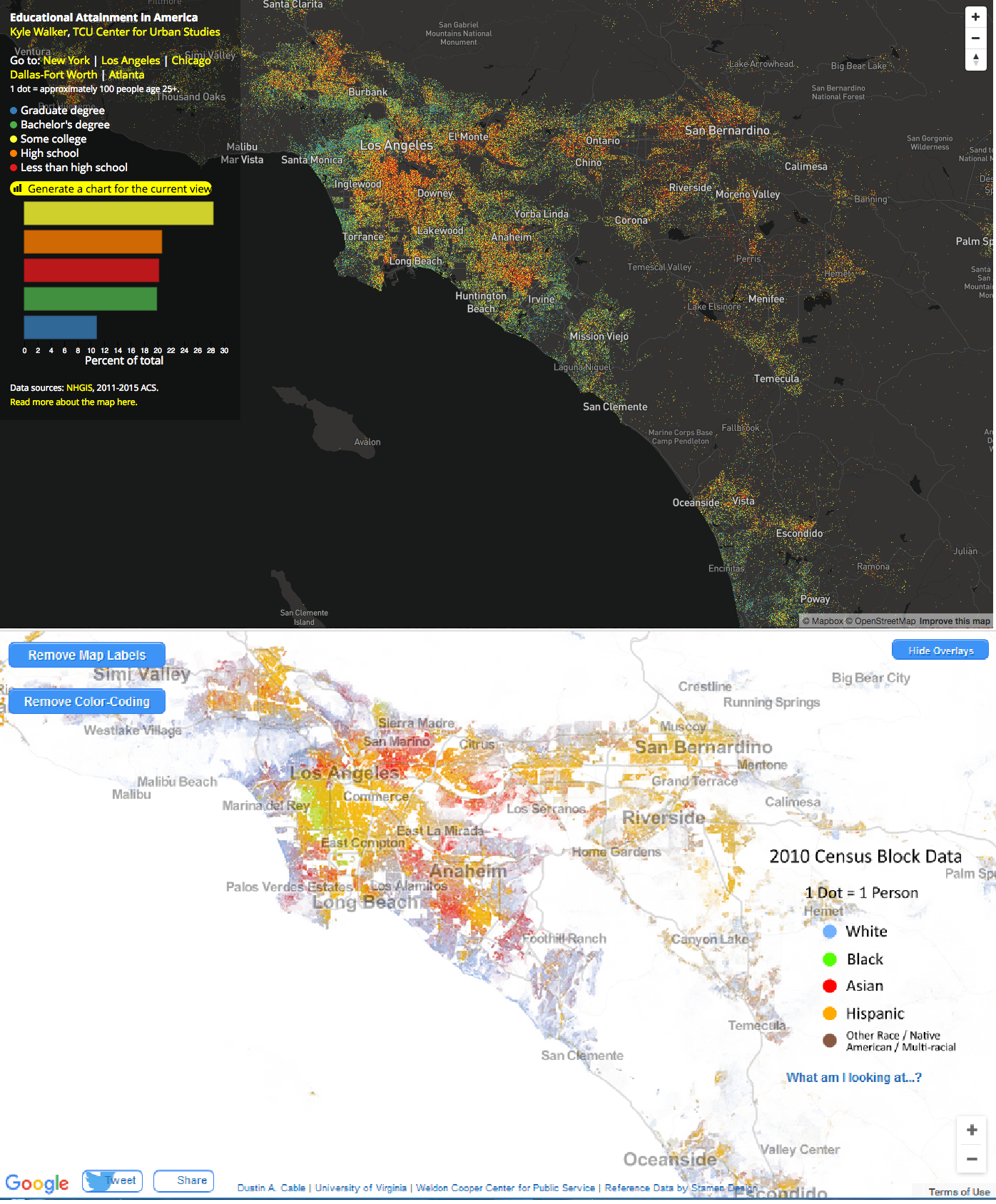
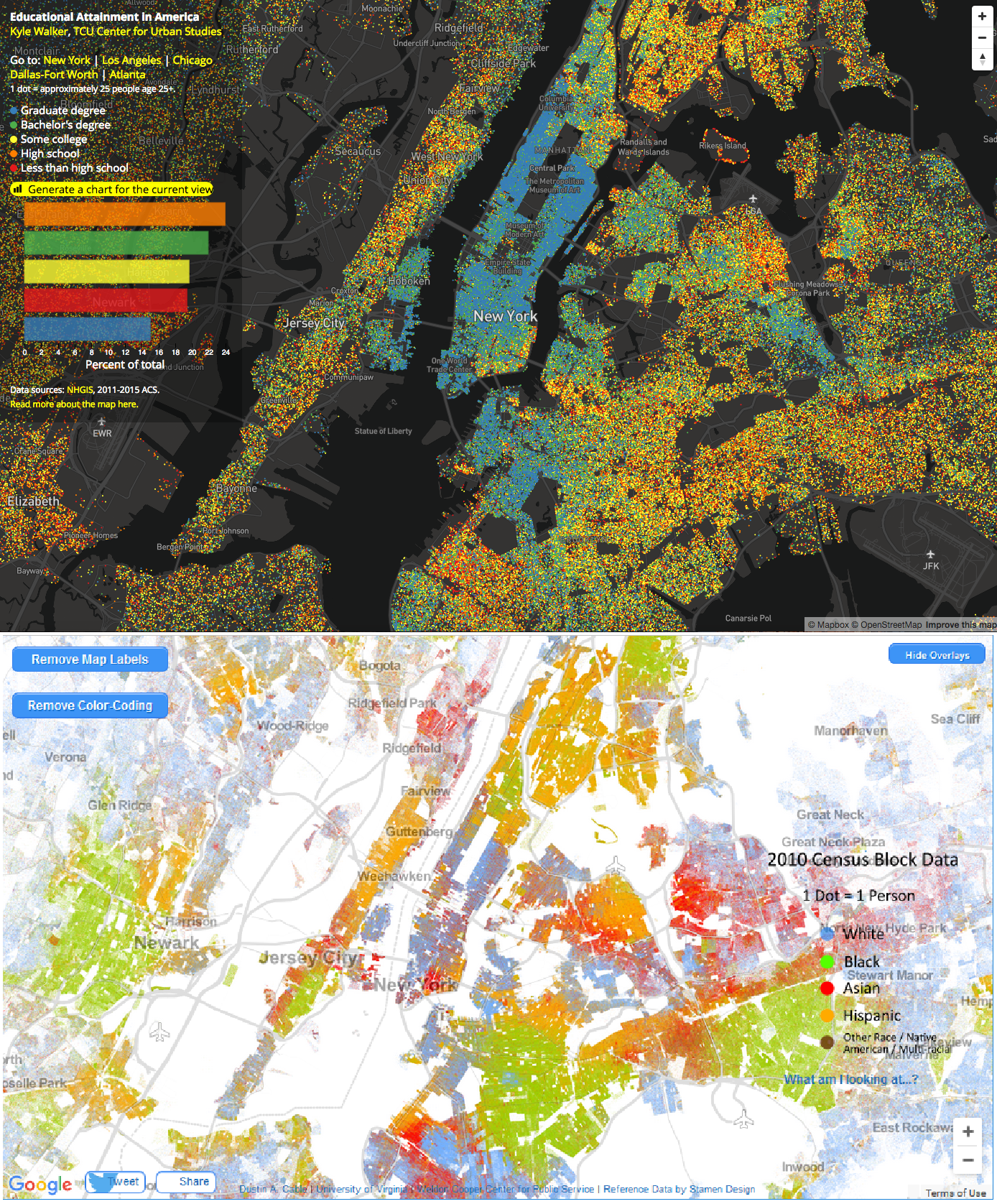
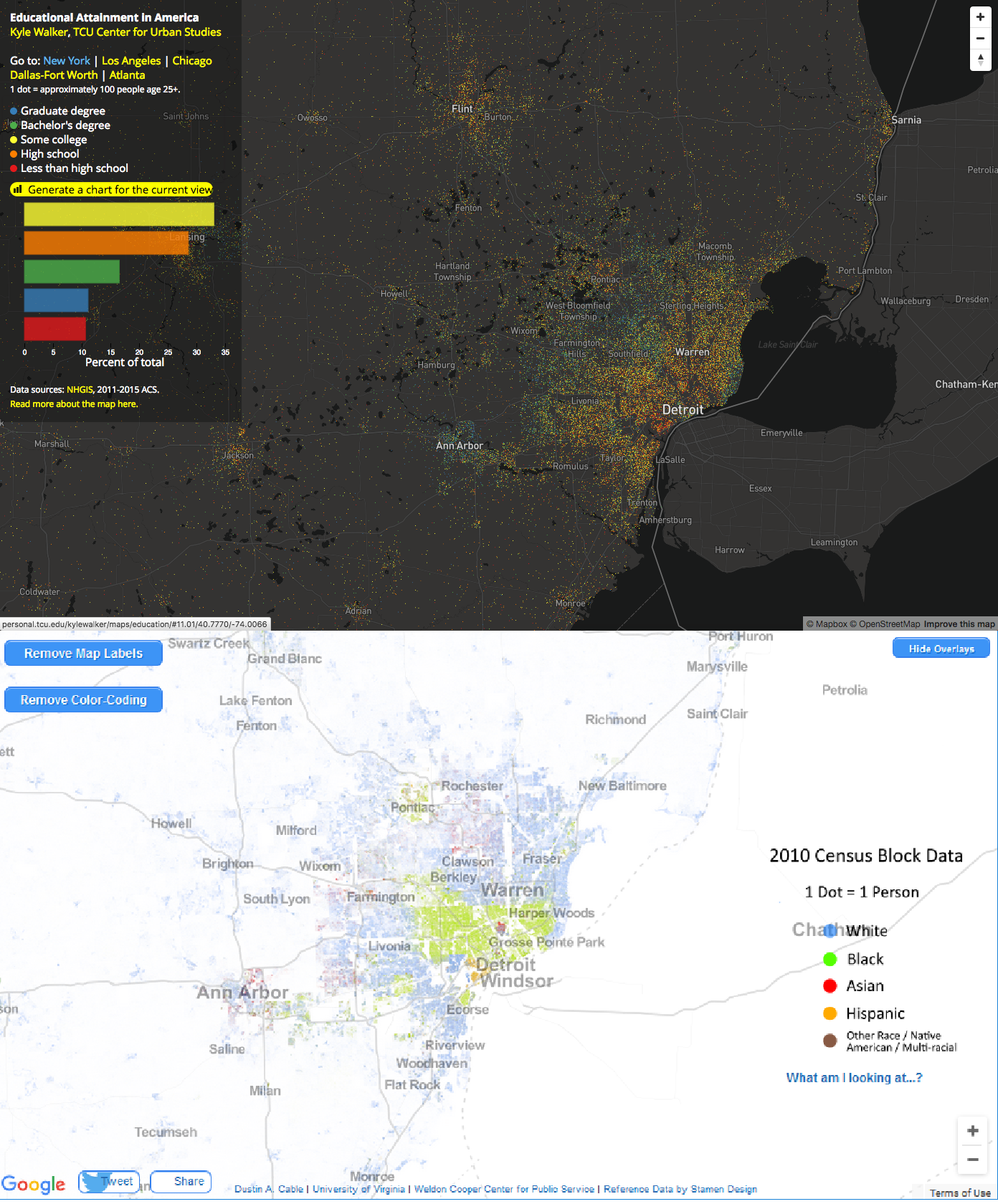
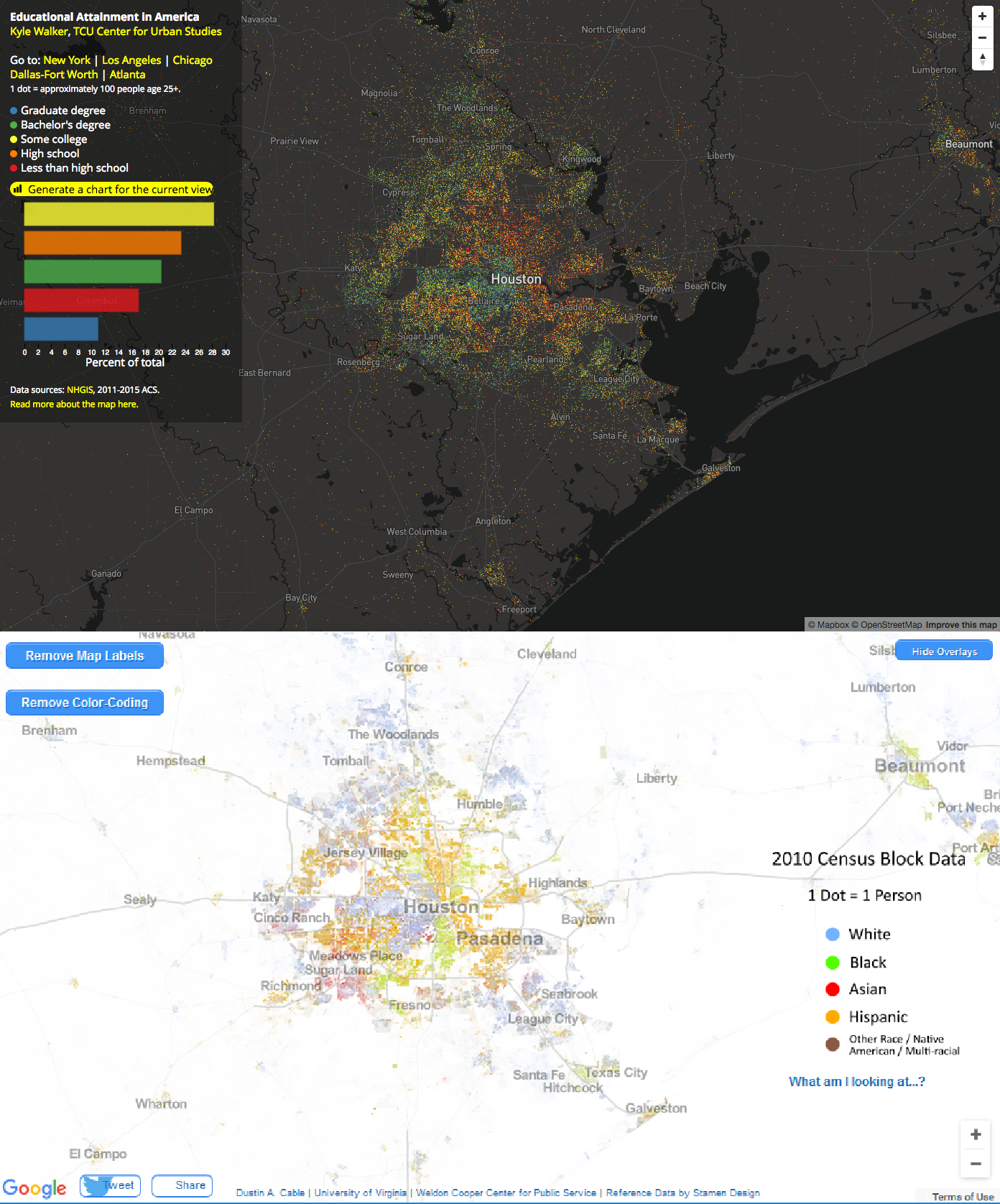
Recently, a geography professor, Kyle Walker, mapped educational attainment in the U.S. Inspired by Cable’s map of racial segregation, Walker visualizes educational inequality in the U.S. from a bird’s eye view. And when we compare Walker’s map of educational attainment to Cable’s map of racial segregation, you can see how inequalities tend to accumulate.

Below, I’ve displayed paired images of a selection of U.S. cities using both maps. In each image, the top map illustrates educational attainment and the bottom visualizes race.

  • On Walker’s map of educational attainment (top images in each pair), the colors indicate: less than high schoolhigh schoolsome collegebachelor’s degree, and graduate degree.
  • On Cable’s map of racial segregation (bottom images in each pair), the colors indicate: White, Black, Hispanic, Asian, and Other Race/Native American/Multi-Racial

So, one way of comparing the images below is to look at how the blue areas compare on each map of the same region.  

Below, you can see San Francisco, Berkeley, and San Jose, California in the same frame using Walker’s map of educational attainment (top) over Cable’s racial dot map (bottom).See how people are segregated by educational attainment (top image) and race (bottom image) in Chicago, Illinois:
Los Angeles, California:
New York City:
Detroit, Michigan:
Houston, Texas:
Compare regions of the U.S. examining Walker’s map with Cable’s racial dot map, you can see how racial and educational inequality intersect. While I only visualized cities above for comparison on both maps, if you examine Walker’s map of educational attainment, two broad trends with respect to segregation by educational attainment are easily visible:

  • Urban/rural divide–people with bachelors and graduate degrees tend to be clustered in cities and metropolitan areas.
  • Racial and economic inequalities–within metropolitan areas, you can see educational achievement segregation that both reflects and reinforces racial and economic segregation within the area (this is what you see above).

And, as research has shown, the levels of parents’ educational attainment within an area impacts the educational performances of the children living in that area as well. That’s how social reproduction happens. Sociologists are interested in how inequalities are passed on to subsequent generations. And it is sometimes hard to notice in your daily life because, as you can see above, we’re segregated from one another (by race, education, class, and more). And this segregation is one way interlocking inequalities persist.

Tristan Bridges, PhD is a professor at the University of California, Santa Barbara. He is the co-editor of Exploring Masculinities: Identity, Inequality, Inequality, and Change with C.J. Pascoe and studies gender and sexual identity and inequality. You can follow him on Twitter here. Tristan also blogs regularly at Inequality by (Interior) Design.

The Women’s March in Washington had three times more people in attendance than did President Trump’s inauguration. Many have argued about the reasons for these numbers (see here, here, and here), and used them both individually and together to make claims about activism and political support. But something is missing from these conversations. In order to fully understand the differences in attendance at these events in D.C., and to avoid taking these numbers to mean something they do not, we must account for class and race.

Gender, education and race may have been the biggest rifts in voters this past presidential election, but class is part of this political shift. At least part of why people didn’t show up for President Trump’s inauguration in droves but did show up to the Women’s Marches is a story of class privilege and the cultural capital that comes with it. Upper middle class white women and urban dwellers from all classes had easy access to Women’s Marches, both in D.C. and around the country. Many of Trump’s voters would have had to fly to D.C. Because research shows that only about 50% of the population in the US flies each year, and because that tracks with income and education, Women’s March supporters may have been more likely to fly than Trump voters were. If we look at data from just the five counties with the largest vote share for Trump, we see that, except for Buchanan, Virginia, these locations present great travel distance. Further, President Trump received 4.1% of the vote in Washington, D.C., and lost in surrounding states by large percentages. As CNN points out, a trip to inauguration would be a long one for a critical mass of Trump supporters.

White voters from rural areas and those without a college education represent the largest demographics to turn out for Trump. Many of Trump’s supporters reside in more rural areas that are struggling economically. Cost and familiarity with travel, ease and options in taking time off of work, and geographic proximity to D.C. may have affected participation in Inauguration events. Sociologists talk about cultural capital—or the non-financial goods that help with social mobility beyond economic means. Such capital can include knowledge, skills, and education—things that are both material and symbolic. When Emily lived in rural Arkansas, many people she met had never left the state or in some cases even the county. Indeed, when she told a friend there that she flew home for Christmas and it cost $70, he was surprised that a plane ticket cost less than it did to fill up his truck, because he’d never flown before. Emily’s knowledge of air travel is a form of cultural capital, and one that could put her at an advantage in planning a trip to fly to Washington, D.C. for the March. There is an intimidation that comes from not having done that or been there before—your cultural capital can determine how well versed you are in navigating AirBnB and the slew of cheap flight websites that exist.

Why was the Women’s March so highly attended? Many have analyzed the mass turn-out in D.C., nationally, and internationally. For the first time, the Women’s March brought out highly educated, more affluent white women who have the forms of capital to plan and attend a weekend in D.C. Of course, there were many—millions, in fact—who did not go to D.C., but who showed support in sister marches around the country and globe. For many, their lack of attendance in D.C. could be due to the same barriers that perhaps inhibited many from attending the Inauguration. For others, their participation was possible because demographics likely to participate in Women’s Marches – LGBTQA+ folks and people of color – are more likely to reside in urban communities. But to compare these attendance rates without talking about class, and without talking about the mobilization of white women, muddies the realities of who is ready and willing to act at more local levels.

While the Women’s March may have kicked off a movement that has the tools in place for success, we need to remember that Trump’s path to success was unpredicted. To take his inauguration attendance numbers to mean that his initial supporters have changed their minds or that Trump has lost political support would be a potentially grave mistake. To take what is now the largest protest in U.S. history as evidence of mass, continued mobilization, that may also be inaccurate. White women are just starting to show up—will they continue to do so? In talking about the intersections of class and race, we remember who is able to mobilize and show support when, and we must bring these intersections to the fore in future conversations about mobilization and activism.

Sarah Diefendorf is a PhD candidate in Sociology at the University of Washington. Her research centers on sexuality, gender, and evangelical religious groups. You can follow her on Twitter here.

Emily Kalah Gade is a PhD candidate in Political Science at the University of Washington. Her research centers on political violence, civil resistance and militancy.

1Will Davies, a politics professor and economic sociologist at Goldsmiths, University of London, summarized his thoughts on Brexit for the Political Economy and Research Centre, arguing that the split wasn’t one of left and right, young and old, racist or not racist, but center and the periphery. You can read it in full there, or scroll down for my summary.
——————————–

Many of the strongest advocates for Leave, many have noted, were actually among the beneficiaries of the UK’s relationship with the EU. Small towns and rural areas receive quite a bit of financial support. Those regions that voted for Leave in the greatest numbers, then, will also suffer some of the worst consequences of the Leave. What motivated to them to vote for a change that will in all likelihood make their lives worse?

Davies argues that the economic support they received from their relationship with the EU was paired with a culturally invisibility or active denigration by those in the center. Those in the periphery lived in a “shadow welfare state” alongside “a political culture which heaped scorn on dependency.”

Davies uses philosopher Nancy Fraser’s complementary ideas of recognition and redistribution: people need economic security (redistribution), but they need dignity, too (recognition). Malrecognition can be so psychically painful that even those who knew they would suffer economically may have been motivated to vote Leave. “Knowing that your business, farm, family or region is dependent on the beneficence of wealthy liberals,” writes Davies, “is unlikely to be a recipe for satisfaction.”

It was in this context that the political campaign for Leave penned the slogan: “Take back control.” In sociology we call this framing, a way of directing people to think about a situation not just as a problem, but a particular kind of problem. “Take back control” invokes the indignity of oppression. Davies explains:

It worked on every level between the macroeconomic and the psychoanalytic. Think of what it means on an individual level to rediscover control. To be a person without control (for instance to suffer incontinence or a facial tick) is to be the butt of cruel jokes, to be potentially embarrassed in public. It potentially reduces one’s independence. What was so clever about the language of the Leave campaign was that it spoke directly to this feeling of inadequacy and embarrassment, then promised to eradicate it. The promise had nothing to do with economics or policy, but everything to do with the psychological allure of autonomy and self-respect.

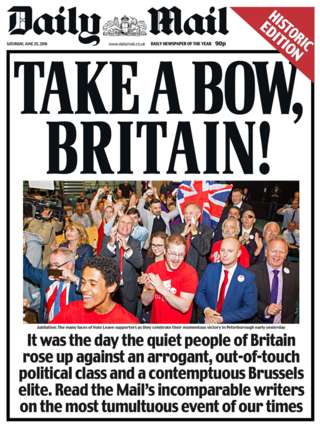
Consider the cover of the Daily Mail praising the decision and calling politicians “out-of-touch” and the EU “elite” and “contemptuous”:2

From this point of view, Davies thinks that the reward wasn’t the Leave, but the vote itself, a veritable middle finger to the UK center and the EU “eurocrats.” They know their lives won’t get better after a Brexit, but they don’t see their lives getting any better under any circumstances, so they’ll take the opportunity to pop a symbolic middle finger. That’s all they think they have.

And that’s where Davies thinks the victory  of the Leave vote parallels strongly with Donald Trump’s rise in the US:

Amongst people who have utterly given up on the future, political movements don’t need to promise any desirable and realistic change. If anything, they are more comforting and trustworthy if predicated on the notion that the future is beyond rescue, for that chimes more closely with people’s private experiences.

Some people believe that voting for Trump might in fact make things worse, but the pleasure of doing so — of popping a middle finger to the Republican party and political elites more generally — would be satisfaction enough. In this sense, they may be quite a lot like the Leavers. For the disenfranchised, a vote against pragmatism and solidarity may be the only satisfaction that this election, or others, is likely to get them.

Lisa Wade, PhD is an Associate Professor at Tulane University. She is the author of American Hookup, a book about college sexual culture; a textbook about gender; and a forthcoming introductory text: Terrible Magnificent Sociology. You can follow her on Twitter and Instagram.

Cross-posted at Cyborgology.

Fake news among the alt-right has been central in post-election public discourse, like with Donald Trump’s dubiously sourced tweet about the “millions of illegal voters” supposedly driving Clinton’s substantial lead in the popular vote. Less attention, however, has been paid to the way “real” news is, to use the sociologist Nathan Jurgenson’s term, based in “factiness,” described as “the feel and aesthetic of ‘facts,’ often at the expense of missing the truth.”  Mainstream news gets cast as objective in part because journalists, stack of papers and obligatory pen studiously in hand, point to statistics that back up their reports. Such reliance on “data” can mask the way that humans are involved in turning things into numbers and numbers into stories. So here I present a cautionary tale.

It is a common truism that white male voters without college degrees disproportionately supported Trump in the 2016 election. Indeed, the notion that men with high school as their highest level of education were more likely to vote for Trump is an empirically supported fact. This data point spread widely throughout the campaign season, and bore out in the post-election analyses. But also in the post-election analyses — over which researchers poured in response to the statistically surprising result — another data point emerged that could have, but didn’t, change the narrative around this demographic voting bloc.

The data point that emerged was that white American men without college degrees have remained economically depressed since the 2008 recession and subsequent recovery. Although the U.S. economy has been steadily improving, the economic reality for this particular segment of the population has not. This is what Michael Moore talked about experientially (but not statistically), claiming that he knows the people who live in the rust belt, and they are struggling. He was right, the data show that they are struggling. Highlighting the economic reality for people without college degrees in the U.S. tells a very different story than highlighting the fact that they don’t have college degrees. The former renders an image of a voting contingent who, in the face of personal economic hardship that contrasts with national economic gain, are frustrated and eager to try something — anything — new. The latter renders an image of ignorance.

Data about education levels of voters is transformed by its coupling with economic trajectories. What’s been strange, is that although this coupling was discovered, it never really penetrated the larger “what happened” narrative. This is particularly strange given the meticulous and sometimes frantic search for explanation and the media’s public introspective quests to understand how so many got it all so wrong.

The transformative effect of the economic data point and its failure to effectively transform the story underlines two related things: data are not self-evident and narrative currents are hard to change.

The data weren’t wrong — people without college degrees were more likely to vote for Trump — but they were incomplete and in their partialness, quite misleading. That’s not a data problem, it’s a people problem. Data are not silent, but they are inarticulate. Data make noise, but people have to weave that noise into a story. The weaving process begins with survey construction, and culminates in analyses and reports. Far from an objective process, turning data into narrative entails nuanced decisions about the relevance of, and relationship between, quantifiable items captured through human-created measures. The data story is thus always value-laden and teeming with explicit and implicit assumptions.

Framing a contingent of Trump supporters through the exclusive metric of education without examining the interaction, mediating, and moderating effects of economic gains, was an intellectual decision bore out through statistical analyses. That is, pollsters, strategists, and commentators treated “lack of education” as the variable with key explanatory power. Other characteristics or experiences of those with low levels of education could/should/would be irrelevant.

Such dismissal created a major problem with regard to Democratic strategy. To situate a voting bloc as “uneducated” is to dismiss that voting bloc. How does one campaign to those voting in ignorance? In contrast, to situate a voting bloc as connected through an economic plight not only validates their position, but also gives a clear policy platform on which to speak.

But okay, after the election, analysts briefly shed light on the way that economics and education operated together to predict candidate preference. Why has this gotten so little attention? Why is education — rather than economics or the economic-education combination — still the predominant story?

The predominance of education remains because narrative currents are strong. Even when tied to newly emergent data, established stories are resistant to change. Narratives are embedded with social frameworks, and changing the story entails changing the view of reality. A key tenet of sociology is that people tend towards stability. Once they understand and engage the world in a particular way, they do social and psychological gymnastics to continue understanding and engaging the world in that way. To reframe (some) Trump voters as part of an economic interest group that has been recently underserved, is an upheaval of previous logics. Moreover, disrupting existing logics in this way forces those who practice those logics to, perhaps, reframe themselves, and do so in a way that is not entirely flattering or identity affirming. To switch from a frame of ignorance to a frame of economics is to acknowledge not only that the first frame was distorted, but also, to acknowledge that getting it wrong necessarily entailed ignoring the economic inequality that progressives take pride in caring so much about. Switching from ignorance to economics entails both a change in logic and also, a threat to sense of self.

Data are rich material from which stories are formed, and they are not objective. Tracing data is a process of deconstructing the stories that make up our truths — how those stories take shape, evolve, and solidify into fact. The “truth” about Trump voters is of course complex and highly variable. The perpetually missed nuances tell as much of a story as those on which predominant narratives hang.

Jenny L. Davis, PhD, is in the department of sociology at James Madison University. She studies social psychology, experimental research methods, and new and social media. She is also a contributing author and editor at Cyborgology.  You can follow her at @Jenny_L_Davis.

Originally posted at the Huffington Post.

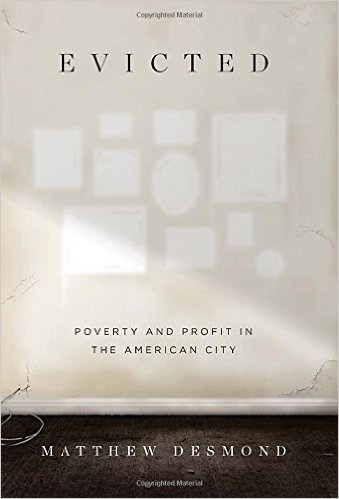
In the 21st century, it is perhaps time to rethink the American Dream of owning a house. The feasibility of this dream was in the back of my mind the entire time I read Matthew Desmond’s Evicted, the highly praised ethnography of landlords and renters in Milwaukee. Dr. Desmond flips the relationship between poverty and housing instability on its head: eviction is a cause, not a symptom, of poverty.

2 To make a long, well-put, and worth-reading argument short: eviction isn’t rare as many policymakers and sociologists might assume; it is actually a horrifyingly common phenomenon. Urban sociologists have missed the magnitude of the eviction phenomenon because they have traditionally used neighborhoods as the unit of analysis, studying issues such as segregation and gentrification. Because eviction is rarely studied, we don’t have good data on eviction. Establishing a dataset of eviction is not a simple data collecting task, given that there are many forms of informal eviction. The consequences of eviction are devastating and have a profound, negative, and life-long impact on subsequent trajectories: worse housing, more eviction, and homelessness, all disproportionately affecting women of color with children (“a female equivalent of mass incarceration,” Desmond argued at a talk at the University of Pennsylvania last week).

The solution is a universal housing voucher program that is funded using money that currently goes to the mortgage interest tax deduction, a $170 billion program for homeowners that benefits mostly the upper-middle class.

Let’s set the economics of a universal voucher program aside — Desmond and many economists on both sides of the political spectrum (including Harvard economist Edward Glaeser) have already addressed the effects on the market, the argument that such a program will be a disincentive to work, and the fear of the lag time that a program will create in the housing market increasing search times. At the heart of public policy are norms and values, and the existence of the mortgage interest tax deduction — the largest housing assistance program in the country — is not a reflection of an inherent American preference for the rich over the poor. Rather, it is a reflection of an inherent American preference for the homeowner over the renter.

To implement the universal voucher program that Desmond argues for, we need to rethink the way we conceive of homeownership in American culture. As I read Evicted, the work of Robert K. Merton came to mind. In 1938, Merton, one of the contenders for the title “founder of modern sociology,” published a paper titled “Social Structure and Anomie.” In the paper, Merton argues that every society has cultural goals, “a frame of aspirational references,” and institutionalized means, “permissible and required procedures for attaining these ends.”

In American society, the institutionalized means are study hard/work hard (and maybe go to church every so often), and the cultural goals are accumulate wealth and own a house. Obviously, the vast majority of Americans don’t achieve these goals and it is extremely hard to argue that the institutionalized means will actually lead them there. But that’s okay; it just makes for a nation of ritualists. Ritualism is devotion to the means without achieving the goals. These ritualists are everywhere in American society, or at least in the way we perceive our society. We romanticize a fictional poor person that takes pride that s/he never took welfare, for example, no matter how tough times were. Welfare is not one of the institutionalized means, and the ritualist prefers to stay farther away from the goal than to cross the line to non-institutionalized means.

According to City Lab, 41% of all US households are residing in a rental unit. Are these households inhabited by ritualists, trying to achieve the goal but without the means? Maybe, but Merton offers another option – they could be rebels. The rebel may or may not conform to the cultural goals and may or may not use the means. The condition for rebellion, according to Merton, is that “emancipation from the reigning standards, due to frustration or to marginalist perspectives, leads to the attempt to introduce ‘a new social order.’”

If one of the American cultural goals is homeownership, the mortgage interest tax deduction is a tool to maintain this social order. The goal’s support structure recognizes in a sense that, with only the purist version of the institutionalized means (hard work with no government assistance), the goal is out of reach. If that support system is taken away, if we shift funding from the mortgage interest tax credit to a universal housing voucher program, we must recognize that we are supporting a cultural rebellion.

It is time to call for a change in the norms and values that are at the heart of our public policy. That is not a simple task. When I think of the “American,” I think about Ron Swanson from the TV show Parks and Recreation. In one of the show’s episodes, Swanson explains America to a little girl, “Let’s get started. Life, liberty, and property. That’s John Locke. This is your lunch.” Matthew Desmond, by calling for a universal voucher program, challenges this status quo and attempts to put habitability, stability, and opportunity at the heart of our value system and not as byproducts of homeownership and hard work. He also challenges the institutionalized means by calling for an increase in the number of people achieving this new goal — a stable home — specifically through quality rental housing, with government assistance, rather than through hard work alone.

The United States is nation of renters that views itself as a nation of homeowners. The millions of rental households deserve to be a part of the group that achieves the American cultural goal. They deserve government support, they deserve stability, and they don’t deserve to have to break away from the American institutionalized means. We must not shy away from the size of this task. The country might not be ready to think of itself as the nation of renters that it is. The United States is undergoing a housing and eviction crisis, and as Matthew Desmond said in his talk at Penn this week, “This is not us, there is nothing American about this.” It is time for a new social order, for the rise of the renter class as more than ritualists and rebels.

Originally from Tel Aviv, Abraham Gutman is currently at the Center for Public Health Law Research at Temple University. He is an aspiring sociologist working on econometrics, race, policing, and housing. He blogs at the Huffington Post and you can follow him on Twitter.

As the 2016 presidential campaign enters the final stretch, Donald Trump has doubled down on his hard-line stance on immigration. In his August 31st immigration policy speech, Trump proposed implementing extreme vetting and employing a deportation force, and opposed amnesty for more than 11 million undocumented immigrants already in the U.S. Polling by Latino Decisions, a leader in Latino political opinion research, indicates Trump’s current poll numbers among Latinos have slipped to 19%. However, given Trump’s proposed policies and charged rhetoric against Latinos, it might seem perplexing that even that many Latinos still support Trump.

Recently on MSNBC’s All in With Chris Hayes, Joy Reid asked Latinos for Trump co-founder Marco Gutierrez whether Trump’s immigration policies would fundamentally drive Latinos away from the Republican party. Gutierrez replied that Trump’s message was “tough” but necessary; asked to clarify, he responded with the comment that immediately spawned a new internet meme:

My [Mexican] culture is a very dominant culture. And it’s imposing. And it’s causing problems. If you don’t do something about it, you’re gonna have taco trucks every corner.

Gutierrez defended his assessment, saying “you guys defend a Mexico that doesn’t exist anymore. There is a new Mexico that’s rising with crime and we need to stop that. And that stops right here [in America].”

His comments illustrate important concepts related to the psychology of ethnic identity. First, people differ in how strongly they affiliate with their Mexican or Latino identity; some feel more strongly identified and others less so. Second, Latinos in the U.S. navigate two cultural identities: their ethnic identity and their American identity. And these identity differences are linked to political ideology.

My co-authors and I asked 323 U.S.-born Mexican Americans about their political ideology and socioeconomic status, the strength of their identification with Mexican and American cultures, and their attitudes toward acculturating to American culture. Those who strongly identified with Mexican culture were more likely to support the integration of both their Mexican and American identities into one unified identity, such as maintaining their own cultural traditions while also adapting to Anglo-American customs. These leaned more liberal. In contrast, those who held weak Mexican identification were more likely to support full assimilation to American culture. These were more moderate or conservative in their ideologies.

Their socioeconomic status also influenced their political ideology. Those with higher socioeconomic status were significantly less liberal, but this was most true for those participants who both belonged to higher social classes and had the weakest identification with Mexican culture.

This may explain why some Latinos aren’t put off by Trump’s anti-immigrant rhetoric. Latinos who support Trump may feel less strongly identified with their ethnic culture and have a stronger desire to identify with American culture. They probably also believe that other Latinos should assimilate fully into American culture and minimize ties or connections to their heritage culture. These beliefs comport with Trump’s message that immigrants need to “successfully assimilate” in order to join our country.

Given that Mexican Americans with a strong ethnic identification were more likely to be liberal and support biculturalism over assimilation attitudes, it’s quite unlikely that Trump will be successful in winning over many Latino constituents who don’t already support him. In fact, being photographed eating taco salad and exclaiming “I love Hispanics!” could backfire with  conservative Latinos who do support him because that type of appeal makes salient a cultural identity that is unimportant to them, or worse, lumps them into a cultural group they have actively sought to minimize.

Laura P. Naumann, PhD is a personality psychologist who teaches in the Department of Social Sciences at Nevada State College. Her research interests include the expression and perception of personality as well as individual differences in racial/ethnic identity development. You can learn more about her here.