Archive: Jan 2013

SocImages News:

A huge “thank you” to all of the nearly 30,000 readers who liked and shared our post The Balancing Act of Being Female; Or, Why Women Wear So Many Clothes!  I’m thrilled that it stuck such a nerve!

In Twitter news, SocImages’ account reached 10,000 followers!

I’m also pleased to announce a new relationship with PolicyMic, a site dedicated to democratic media for the Millennial generation. I’ll be posting select stuff there.  (Special thanks to Sam Meier!)  I’ve re-started my blog on The Huffington Post as well.

Thanks, as well, to Jezebel, Racialicious, and Ms. Magazine for re-posting our bits about:

Tonight at 7pm I’m giving a public lecture about hook up culture on the campus of Occidental College in Los Angeles.  If you’re in town and would like to drop by, we can convene for drinks afterward!

Upcoming Lectures and Appearances:

I have six talks scheduled for Spring. If you’re in Kingston, Boston, or Akron, I’d love to schedule a meet up!

  • Jan. 31 — Occidental College — “‘The Night Overall Wasn’t Bad’: Oxy Students on Hooking Up”
  • Feb. 26 — Queen’s University of Kingston — Hook Up Culture Lecture and Workshop
  • Mar. 8-14 — Harvard University — “A Feminist Defense of Friendship”
  • Mar. 27 — Ponoma College — “‘The Night Overall Wasn’t Bad’: What College Students Really Think About Hooking Up”
  • Mar. 28-30 — Western Political Science Association (Hollywood, CA) — panels on “Public Intellectualism” and the “Twenty-First Century Sex Wars”
  • Apr. 19 — University of Akron — “Anatomy of an Outrage: Female Genital Cutting and the Politics of Acculturation”

Social Media ‘n’ Stuff:

Finally, this is your monthly reminder that SocImages is on TwitterFacebookGoogle+, and Pinterest.  Lisa is on Facebook and most of the team is on Twitter: @lisawade@gwensharpnv@familyunequal@carolineheldman, and @jaylivingston.

In Other News…

I was in Costa Rica this month and this — a wild sloth that came down from the trees to cross the path — was my favorite moment of the trip.  After he climbed into the forest on the other side, I actually burst into tears.

You would’ve too! Look at that face!!!

Lisa Wade, PhD is an Associate Professor at Tulane University. She is the author of American Hookup, a book about college sexual culture; a textbook about gender; and a forthcoming introductory text: Terrible Magnificent Sociology. You can follow her on Twitter and Instagram.

Cross-posted at Family Inequality.

previously complained about Tangled‘s 75%-male cast and extreme sex dimorphism — the habit of exaggerating average differences between men and women — in the romantic leads, as seen in this hand shot:

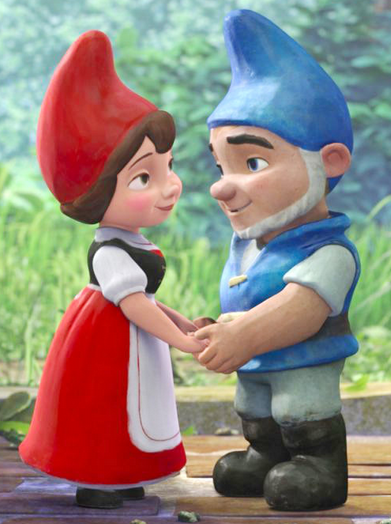
Keeping to my policy of two-year delays in movie reviews, let me add the same complaint about Gnomeo and Juliet, the charming adaptation from Disney’s Touchstone imprint. Here, a writing team of 8 men and 2 women (including Shakespeare) gives us a named cast of 14 men and 7 women, in a love story featuring these two adorable garden gnomes:

He’s only a little taller, and (judging by the gray beard) a little older. And in the movie she demonstrates bravery and feats of strength, as is now the norm. But look at those hands! Take a closer look:

What is it about hands that makes it so essential for men and women to have such differences?

In the “man hands” episode of Seinfeld we learned how distressing it can be for a man to find out the woman to whom he was attracted has large hands.

That scene required a hand double. In real life, men’s and women’s hands differ on average but with a lot of overlap in the distributions — lots of men have hands smaller than lots of women. But in animation the gloves are off — and Disney is free to pair up couples who are many standard deviations apart in hand size.

Philip N. Cohen is a professor of sociology at the University of Maryland, College Park, and writes the blog Family Inequality. You can follow him on Twitter or Facebook.

Cross-posted at Montclair Socioblog.

In the New York Times, Arthur Brooks argues that conservatives are happier than liberals.

Brooks starts with a reference to Barack Obama’s remark four years ago  about “bitter” blue-collar Whites who “cling to guns or religion.” Misleading, says Brooks.  So is a large body of research showing conservatives as “authoritarian, dogmatic, intolerant of ambiguity, fearful of threat and loss, low in self-esteem and uncomfortable with complex modes of thinking.”

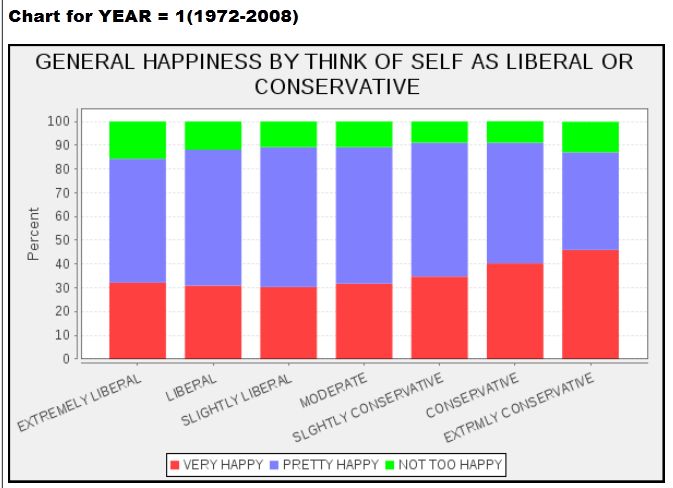
Despite that research, it’s conservatives, not liberals, who identify themselves as happy.  And, Brooks adds, the farther right you go on the political spectrum, the more happy campers you find.

Brooks cites a couple of surveys that support this view.  I was a bit skeptical, so I went to the GSS.

Sure enough, by about 10 percentage points, more conservatives identify themselves as “very happy” than do liberals.  The difference is even higher among the extreme conservatives.   As Brooks says, “none, it seems, are happier than the Tea Partiers, many of whom cling to guns and faith with great tenacity.”

Brooks cites two important factors linking political views and happiness: marriage (with children) and religion.

Religious participants are nearly twice as likely to say they are very happy about their lives as are secularists (43 percent to 23 percent). The differences don’t depend on education, race, sex or age; the happiness difference exists even when you account for income.*

I still found it hard to reconcile these sunny right-wingers with the image of bitter and angry Tea Partiers.  Then I remembered that the Tea Party is a very recent phenomenon.  To a great extent, it’s a reaction to the election of President Obama.    But Brooks is looking at pre-Obama studies of happiness.  The most recent one he cites is from 2006.  As the GSS graph above shows, Brooks is correct when he says, “This pattern has persisted for decades.”  But those decades don’t include the Tea Party.

Maybe conservatives were happy because until recently, they didn’t have much to be bitter about.  The US was their country, and they knew it.   Then Obama was elected, and ever since November 2008 conservatives have kept talking about “taking back our country.” (See my “Repo Men” post from 2 1/2 years ago.)

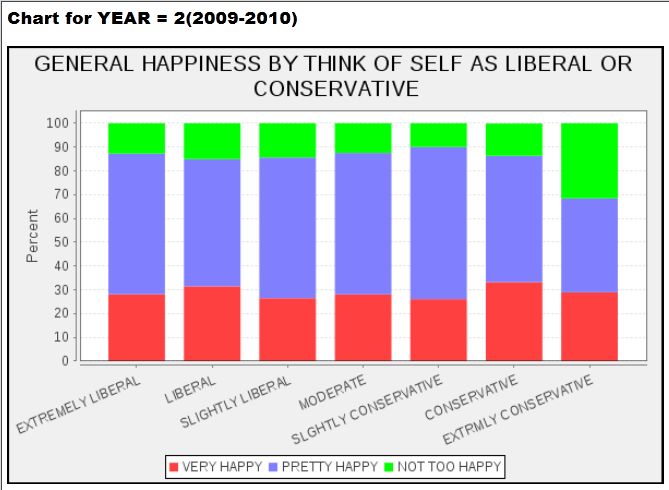
What if we look at the data from the Obama years?

Maybe that bitter Tea Party image isn’t such a distortion.  The GSS does not offer “bitter” or “Tea Party”  as choices, but those who identify themselves as “extreme conservative” are nearly three times as likely as others to be “not too happy.”  And overall, the happiness gap between conservatives and liberals is hard to find.

For all I know, Brooks’s general conclusion may be correct, but the recent data do at least raise some questions and suggest that the political context is itself a relevant variable.

Nearly eighty years ago, Harold Lasswell said that politics is about “who gets what, when, and how.”  Maybe the lesson here is that if you are going to study the connection between political views and happiness, you should take account of who is getting what, and when.

*That’s a bit misleading.  Happiness is in fact related to income, race, and education in exactly the ways you would expect, though for some reason Brooks does not include those variables in his analysis.  What Brooks means is that the religion effect holds even when you control for those variables. 

—————————

Jay Livingston is the chair of the Sociology Department at Montclair State University.  You can follow him at Montclair SocioBlog or on Twitter.

Cross-posted at PolicyMic.At the end of my sociology of gender class, I suggest that the fact that feminists are associated with negative stereotypes — ugly, bitter, man-haters, for example — is not a reflection of who feminists really are, but a sign that the anti-feminists have power over how we think about the movement.  The very idea of a feminist, in other words, is politicized… and the opposition might be winning.

A clip forwarded by Dmitriy T.C. is a great example.  In the 1.38 minute Fox News clip below, two pundits discuss a North Carolina teacher, Leah Gayle, who was accused of having sex with her 15-year-old student.  One of the show’s hosts suggests that feminism is to blame for Gayle’s actions. She says:

There’s something about feminism that lets them know, I can do everything a man does. I can even go after that young boy. I deserve it… It’s turning women into sexualized freaks.

This clip reveals a discursive act.  She is defining who feminists are and what they believe.  And this idea is being broadcast across the airwaves.

This happens all day every day.  Some of the messages are friendly to feminists, and some are not.  These messages compete in our collective imagination.  Most have little to do with what feminists (who are a diverse group anyway) actually believe and many are outrageous lies and distortions, like this one.

So, next time you hear someone describing a feminist, know that what you’re hearing is almost never a strict definition of the movement. Instead, it’s a battle cry, with one side competing with the other to shape what we think of people who care about women’s equality with men.

Lisa Wade, PhD is an Associate Professor at Tulane University. She is the author of American Hookup, a book about college sexual culture; a textbook about gender; and a forthcoming introductory text: Terrible Magnificent Sociology. You can follow her on Twitter and Instagram.
Cross-posted at PolicyMic and Racialicious.

In 1984 the U.S. began its ongoing experiment with private prisons. Between 1990 and 2009, the inmate population of private prisons grew by 1,664%  (source). Today approximately 130,000 people are incarcerated by for-profit companies.  In 2010, annual revenues for two largest companies — Corrections Corporation of America and the GEO Group — were nearly $3 billion.

Companies that house prisoners for profit have a perverse incentive to increase the prison population by passing more laws, policing more heavily, sentencing more harshly, and denying parole.  Likewise, there’s no motivation to rehabilitate prisoners; doing so is expensive, cuts into their profits, and decreases the likelihood that any individual will be back in the prison system.  Accordingly, state prisons are much more likely than private prisons to offer programs that help prisoners: psychological interventions, drug and alcohol counseling, coursework towards high school or college diplomas, job training, etc.

What is good for private prisons, in other words, is what is bad for individuals, their families, their communities, and our country.

This is a deeply unethical system and new research shows that, in addition to being disproportionately incarcerated, racial minorities and immigrants are disproportionately housed in private prisons.  Looking at three states with some of the largest prison populations — California, Texas, and Arizona — graduate student Christopher Petrella reports that racial minorities are over-represented in private prisons by an additional 12%; his colleague, Josh Begley, put together this infographic:

This means that, insofar as U.S. state governments are making an effort to rehabilitate the prison population, those efforts are disproportionately aimed at white inmates.  Petrella argues that this translates into a public disinvestment in the lives of minorities and their communities.

Lisa Wade, PhD is an Associate Professor at Tulane University. She is the author of American Hookup, a book about college sexual culture; a textbook about gender; and a forthcoming introductory text: Terrible Magnificent Sociology. You can follow her on Twitter and Instagram.

Cross-posted at Cyborgology.

Humans produce waste. A lot of waste—much of which comes from our very bodies. Indeed, the average American produces 7 pounds of organic waste per day, largely made up of feces and urine. Cities have to somehow manage this waste, manage these now expelled parts of human bodies, manage that which we produce, drop, leave, and conscientiously ignore. Such management is typically engaged by an underclass of workers, the sanitation department, waste management employees, septic cleaners. When all goes well, waste remains invisible. Unsmelled. Unseen. Silently moved through underground systems and channeled out in ambiguous ways. This is a process to which most producers of bodily waste remain blissfully ignorant.

Sometimes, however, this waste management becomes a problem, and when it does, our expelled and forgotten matter spills back up into human view, reconnecting humans with the ways in which their own bodies must be managed through external structures; reminding humans of the dirty reality of organic embodiment. Such is the case in the New York City sewer system. High water levels, coupled with high waste levels, can lead to sewer overflows, flushing raw human waste into the city’s waterways — including the East River and the Hudson. Nothing reminds humans of their own embodiment like literal consumption of expelled matter. Nothing reconnects humans to an otherwise hidden process than their own shit floating down the river.

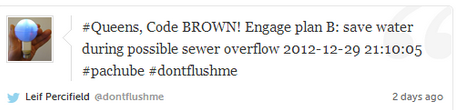
A recent solution to this problem of waste re-emergence comes from an unlikely place: social media. Leif Percifield recently introduced a social media tool called DontFlushMe, which allows New Yorkers to keep track of water levels and make waste management decisions accordingly — that is, decisions about whether or not to flush. The system works through sensors within the sewers, which notify users of high water levels via text message, Twitter, a call-in number, or by a website. When water levels get too high, users will ostensibly “let it mellow,” reducing the influx of waste into the sewer systems, and preserving the waterways.

The role of social media here is particularly interesting. Here we have a social tool, a communication medium necessarily removed from the body and physicality, working to reconnect the user to hir body, and reconnect the body to the architectures and structures in which it dwells. This form of mediated communication thins the mediating line between personal actions and public good, between expelling and consuming, between individuals and infrastructures. This tool makes invisible processes visible, and turns everyone into stewards of the shared land.

Such reconnection — between humans and their bodies; between individuals and infrastructures — is facilitated by a tool so often accused of causing disembodiment and disconnection. Social media republicizes and disseminates responsibility for that which was previously relegated out of sight, smell, and mind. This “new” technology, ironically, brings us back to an earlier time of chamber pots and smelly streets, in which bodily awareness was a communal necessity.

*Special thanks to James Chouinard for bringing this social media tool to my attention, and for sharing his vast knowledge on the Sociology of Dirt.

 ————————-

Jenny Davis is a postdoctoral researcher in the social psychology lab at Texas A&M University. Follow Jenny on twitter @Jup83.

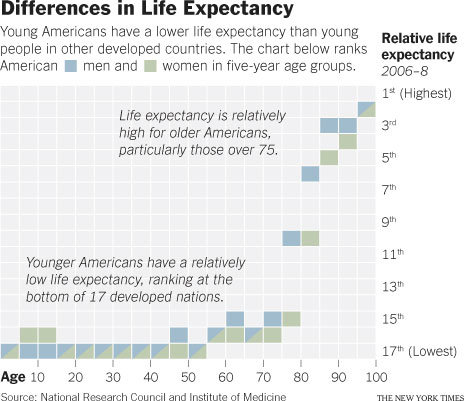
The Institute of Medicine and the National Research Council released some damaging numbers this month: Americans ranks startlingly low in life expectancy, compared to 16 other similarly developed countries.  This is especially true for younger Americans. Indeed, among people 55 and under, we rank dead last.  Among those 50-80 years old, our life expectancy is 3rd or 2nd to last.

Sabrina Tavernise at the New York Times reports that the “major contributors” to low life expectancy among younger Americans are high rates of death from guns, car accidents, and drug overdoses.  We also have the highest rate of diabetes and the second-highest death rate from lung and heart disease.

Americans had “the lowest probability over all of surviving to the age of 50.”  The numbers for American men were slightly worse than those for women. Overall, life expectancy for men was 17 out of 17; women came in 16th.  Education and poverty made a difference too, as did the more generous social services provided by the other countries in the study.

What isn’t making a difference?  Apparently our incredible rate of health care spending.

Via Citings and Sightings.

Lisa Wade, PhD is an Associate Professor at Tulane University. She is the author of American Hookup, a book about college sexual culture; a textbook about gender; and a forthcoming introductory text: Terrible Magnificent Sociology. You can follow her on Twitter and Instagram.

Cross-posted at Family Inequality.

It’s not that “working families” don’t exist, it’s just the way most people use this term it doesn’t mean anything.  Search Google images for “working families,” and you’ll find images like this:

And that’s pretty much the way the term is used: every family is a working family.

To hear the White House talk, you have to wonder whether there are people who aren’t in families. I’ve complained about this before, Obama’s tendency to say things like, “This reform is good for families; it’s good for businesses; it’s good for the entire economy.” As if “families” covers all people.

Specifically, if you Google search the White House website’s press office directory, which is where the speeches live, like this, you get 457 results, such as this transcript of remarks by Michelle Obama at a “Corporate Voices for Working Families” event. The equivalent search for “working people” yields a paltry 108 hits (many of them Obama speeches at campaign events, which include false-positives, like him making the ridiculous claim that Americans are the “hardest working people on Earth.”) If you search the entire Googleverse for “working families” you get about 318 million hits, versus just just 7 million for “working people” (less than the 10 million that turns up for “Kardashians,” whatever that means.)

You would never know that 33 million Americans live alone — comprising 27% of all households. And 50 million people, or one out of every 6 people, lives in what the Census Bureau defines as a “non-family household,” or a household in which the householder has no relatives (some of those people may be cohabitors, however). The rise of this phenomenon was ably described by Eric Klinenberg in Going Solo: The Extraordinary Rise and Surprising Appeal of Living Alone.

This is partly a complaint about cheap rhetoric, but it’s also about the assumption that families are primary social units when it comes to things like policy and economics, and about the false universality of “middle class” (which is made up of “working families”) in reference to anyone (in a family with anyone) with a job.

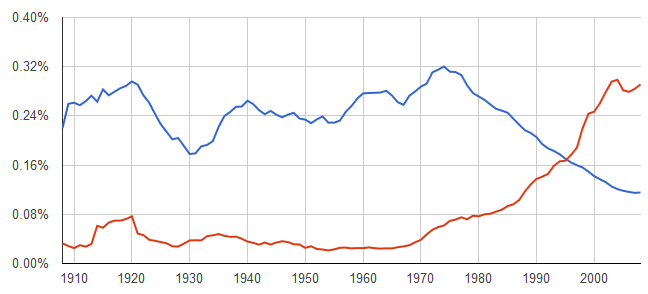
Here’s one visualization, from a Google ngrams search of millions of books. The blue line is use of the phrase “working people” as a fraction of references to “people,” while the red line is use of the phrase “working families” as a fraction of references to “families.” It shows, I think, that “working” is coming to define families, not people.

This isn’t all bad. Families matter, and part of the attention to “working families” (or Families That Work) is driven by important problems of work-family conflict, unequal care work burdens, and so on. But ultimately these are problems because they affect people (some of whom are in families). When we treat families as the primary unit of analysis, we mask the divisions within families — the conflicts of interest and exploitation, the violence and abuse, and the ephemeral nature of many family relationships and commitments — and we contribute to the marginalization of people who aren’t in, or don’t have, families.  And those members of the No Family community need our attention, too.

Philip N. Cohen is a professor of sociology at the University of Maryland, College Park, and writes the blog Family Inequality. You can follow him on Twitter or Facebook.