
sport

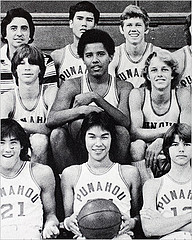
Obama BBall team
Obama's high school basketball team. Photo via senorglory, flickr.com.

In response to the sport and politics white paper Kyle Green and I recently wrote for this site, ThickCulture writer and loyal friend of TSP Andrew Linder emailed to suggest that although Barack Obama is obviously not the first “sports president,” he may be the first “ESPN President” or “SportsCenter President.” Andrew’s point (now up on ThickCulture as a more fleshed out post—jinx!) was that, although ESPN had become a cultural fixture under Bill Clinton and George W. Bush, Obama represented the core network demographic in its first two decades of its existence and it seems to have been formative for him. To the extent that ESPN has transformed sporting culture, then, Obama is the first President to be fully fashioned in and through that new culture.

This seemed plausible enough—and was definitely borne out in a recent interview the President gave to the star sportswriter/reporter Bill Simmons. At least two things about the interview should be pointed out. The first is why Obama chose this particular venue and reporter: “Simmons,” as one report put it, “is revered by the under-30 crowd” and “has more than 1 million—1,642, 522 to be exact—Twitter followers.” Indeed, his “B.S. Report” podcast, on which the Obama interview originally appeared, is said to be one of the most downloaded podcasts on the web.  The second point is how this interview and exchange reveals what a great fan of sports and sports talk our President actually is.

Not only is his obsession with ESPN’s SportsCenter evident, Obama shows himself to be an extremely knowledgeable sports fan, gifted in the arts of sports talk and debate. Talking with Simmons, the President riffs on Linsanity (claiming to have been on the bandwagon early) and the joys and challenges of coaching his daughters, argues about the best NBA teams and players of all time (MJ and the Bulls figure prominently), revisits his vision for a college football playoff, and waxes poetic about his philosophies on sportsmanship and scoring in golf. Obama even brags a bit about the “solid” crossover move he threw on NBA All-Star point guard Chris Paul in a summer scrimmage. All this is to say, Obama doesn’t just talk about sports, he’s really talking sports.

Entertaining (and impressive) as I found all of this, I was even more intrigued by a follow-up Washington Post post that explained why the President would take time out of his unbelievably busy schedule to do this interview (as well as other sports related activities such as his sit-down with Matt Lauer during the Superbowl pre-game show in February or his annual NCAA/march madness picks). “Sports,” according to the WSJ, “is a universal language that can bridge ideological, cultural, and socio-economic gaps …you are much more inclined to like people who share that fandom regardless of whether you have anything else in common with them. You feel some sort of connection to them. They speak your (sports) language.”

The piece goes on to speculate that sport may be particularly a particularly important medium (and media outlet) for Obama “whose background—biracial parents, childhood in Hawaii, Harvard Law School, etc.—is somewhat unfamiliar to many of the voters he needs to convince to back him if he wants to win a second term in November.” While talking with sportswriters “isn’t going to convince on-the-fence voters that Obama is one of them,” the writer says, we shouldn’t “forget the connective power that sports holds in the world of politics.” The article concludes: “Obama’s ability to speak the language of sports is a major political plus for him.”
Perhaps. I definitely agree with the points about sport having tremendous connective potential and potential political value. Indeed many of them accord with the piece Kyle and I wrote. However, there is one subtler nuance or contingency that continues to pester me. It goes back to our American cultural conviction of the separation of sports and politics—that these are two domains that, for different reasons depending upon who you are talking to or the context within which they are posed, are believed to be separate (and separate for good reason).
In my research and reading, the political power of sport works best—perhaps even only works at all—when this cultural line or prohibition isn’t violated or disturbed. When it is somehow compromised, the political power and import of sport can not only go out the window, it can backfire terribly, being seen to bring politics in where it doesn’t belong. Thus, the trick and challenge for Obama—or really any politician hoping to capitalize on connections to sport—is to be seen as both an authentic and informed sports fan, but not deliberately, strategically, or intentionally political in his engagement with sporting culture.
To be clear: I think Obama’s interest in sport is genuine, and he generally does a great job of keeping his sports talk separate from his political agenda. (Look back through the transcript of that Simmons if you’re not convinced). But it’s a fine line to walk, there are plenty of folks not inclined to be sympathetic, and the more clearly the political uses and implications of his sports obsessions are made, the less effective and more dangerous I think they become. Thus, the irony of a sporting president (not to mention of any scholarly analysis of the political power of sport).
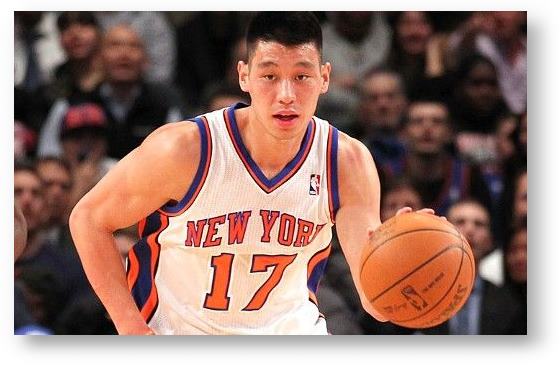
Jeremy Lin via asian-nation.org

In the past few days there is one story I’ve been asked about more than any other in the news or current events—it involves the (unexpected) hot hand of undrafted NBA rookie Jeremy Lin of the New York Knicks. “What do you think?,” everyone wants to know. “You must have an interesting angle or two given your interest in race and sport, right?”

Well, I am fascinated. Indeed, my son Ben and I were intrigued enough to buy tickets to our first Timberwolves game in at least five years to see Lin and his New York team take on our local favorites Saturday night (led by another heralded rookie point guard Spaniard Ricky Rubio). It was quite a spectacle: over 20,000 fans (the most in Minneapolis since 2004, they said), more Asian Americans than I can ever remember seeing at a pro sports event, and some interesting commentary up in the nosebleed seats where we were perched. There was also a puzzling (if racially revealing) reference in the local paper the next day about a budding “international” rivalry between the two rookie playmakers. (I mean, Lin is from Palo Alto, after all.)

Still, most of my interest so far has been at Lin’s amazing play. The number of points and assists he posted in his first five games in the league was better than any other first five-game stretch of any player in NBA history. He led the Knicks to a comeback win here in Minnesota even when he was clearly exhausted from having played the night before in New York. On Valentine’s Day, he nailed a last second three-pointer for the win. I just love seeing great basketball. Check out any of his highlight clips on YouTube and you’ll see what I mean.

Thankfully, one of our TSP bloggers, C.N. Le, writing on The Color Line, has been able to maintain professional decorum and provide some sociological meaning and context for the Lin-sanity.

Le reviews some of the ground he covered in 2010 when he wrote when Lin was still playing for Harvard—how the ballplayer provides a counter to certain model minority stereotypes and expectations and in doing so is expanding the definition of success for Asian Americans. (Le’s even earlier post mentioned some of the racial stereotypes and slurs Lin has dealt with along the way as well.) But what I like most about the post is at the end, where Le is talking not about Lin but about colorblindness:

But as Asian Americans becoming increasingly common in these areas of U.S. popular culture, are we headed for a day when it is no longer a “big deal” when we see Asian American faces in the media, just like it’s taken for granted when we see White faces or Black faces? Ultimately, yes, that is the goal—for us as a society to no longer consider it “strange” or “unusual” to see Asian Americans in the media or in other prominent positions in U.S. social institutions.

Le goes on to point out—and this is the part I really like—that what we are talking about here is the concept of colorblindness, a concept that many of us race scholars actually tend to be quite critical about. It is a provocative reminder of what is good, right, and valuable about colorblindness as an ideal. But appropriately, Le also insists on reminding us—as he does over and over in his writings—of two points: (1) that we are still not there yet, and (2) to get there we actually have to be aware of race and racial inequalities and racism and vigilant in trying to resist them.

I’m not sure how aware Jeremy Lin is about any of this (though I wouldn’t put it past him. He’s not only doing amazing things on the court, he is clearly a very smart guy. In fact, as a friend of mine speculated today, one of the stereotypes Lin is laying bare is the old dumb-jock trope. Even in his “nerdy handshake” with other smarty-pants baller Landry Fields—seen below—Lin is showing that Ivy Leaguers can definitely hoop.) But I very much appreciate C.N. Le’s ability to draw out this broader social significance and use the power of the popular in service of making these vitally important sociological points about race and the struggle to move past race in contemporary American society.