
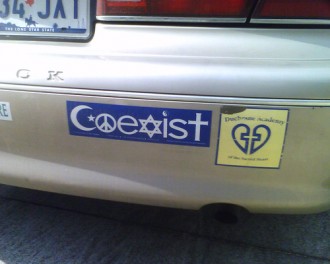
religion

Photo by Michael Glasgow via flickr

Sometimes, when we were editing Contexts, Chris and I would set out to try to arrange an issue around a given theme. More often, though, we simply found that, as the issue started to come together, it also started to coalesce around a topic or two and take on a life of its own. That would be how we found ourselves thinking of the issues as “Oh, you know, The Aging Issue,” or “The Problems Issue,” or, well, “The Sexy-times Issue.” As it turns out, that’s starting to happen on The Society Pages, too.

Right now, it’s religion that’s caught our eye. As I got ready to post an aside here on the incredibly interesting Huffington Post piece “If Tim Tebow Were Muslim, Would America Still Love Him?” by the clearly poetic environmental policy consultant Ibrahim Abdul-Matin, it dawned on me that, just this morning, our own wunderkind Alex Casey had just put up a Citings & Sightings post on an in-depth Salt Lake Tribune article about new research on the gender gap among Utah’s Mormons and why some other social scientists are arguing with the conclusions (though not the data). And of course, last week, I’d written about my own work and new Canadian research on Americans’ lack of trust in the Atheists among us. All of a sudden, religion was becoming a mini-theme here on The Society Pages.

And no wonder: religion’s hard to talk about, but often on our minds. For many, it’s the grounding of their every day, of the ways they try to move in society, and so understanding–or attempting to understand–others’ religions is both essential and tricky. Questioning their faith or the dogmas of their faith is, in many ways, questioning another’s place in the broader society. It seems to me that these sorts of “diversions” are what The Society Pages is all about.
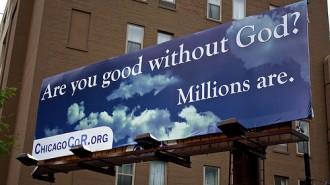
A few days ago the Vancouver Sun ran a story about new Canadian research on the topic of prejudice against atheists in North America. The article’s lead author, Will M. Gervais, told the Sun, “The only group the study’s participants distrusted as much as atheists was rapists.”

The newspaper story implies this is a new finding, but the paper, published in the Journal of Personality and Social Psychology, builds off an article I published with my colleagues Penny Edgell and Joe Gerteis a few years ago in the American Sociological Review. In that paper, part of our ongoing American Mosaic Project, we found that atheists were the least trusted on a long list of racial and religious minorities that we asked about in a representative national survey of Americans. It might not have been the first time this result was reported, but it seems to have been the first and fullest treatment of the anti-atheist phenomenon in the post 9/11 era. (It also resulted in what is perhaps the proudest citation of my scholarly career–and certainly the one my teenagers are most impressed with: p. 62 of Stephen Colbert’s I Am America (and So Can You)!. Colbert compares atheists with homosexuals, whom he says rate higher because at least we trust them with our hair. Okay, so we aren’t as funny as Colbert and weren’t mentioned by name, but the point is to get the work out there, right?)

Anyway, this new JPSP article, co-authored with Azim F. Shariff and Ara Norenzayan, not only confirms our initial findings about the level of anti-atheist sentiment, it takes the research further to explore the social psychological underpinnings of this bias. One important point they make is that anti-atheist bias is not just dislike or distaste, it is active distrust. And, using a series of survey questions designed specifically to probe these mechanisms, the authors are able to show that religious belief is one important factor that seems to be driving this phenomenon. North Americans, it would seem, believe that people behave better if those people think there is a god watching them.

None of this is to say that this is actually true, but, it does seem to be what regular folks think. My hope, as expressed in the original piece with Edgell and Gerteis, is that this work will stimulate better thinking and research not only on atheists, but on the role and significance of religious belief and practice–or lack thereof–in contemporary society.

*Photo by Eric Ingrum via flickr.com (click for original)